
Imagination is not just a talent for artists, writers, or people who seem naturally inventive. It is one of the ordinary ways the mind thinks beyond what is directly in front of it. You use imagination when you picture how a conversation might go, mentally test a new idea, remember a place, invent a metaphor, plan a future version of your life, or wonder what another person may be feeling.
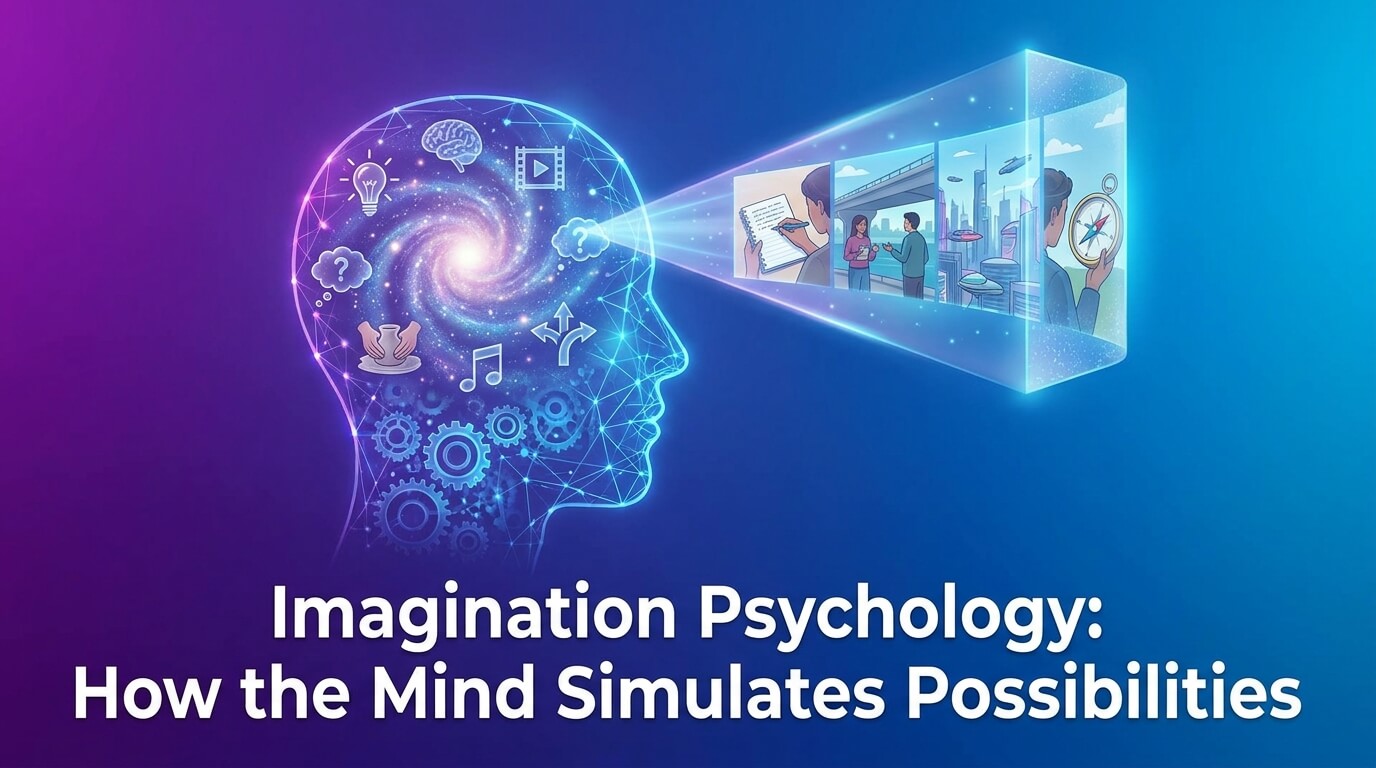
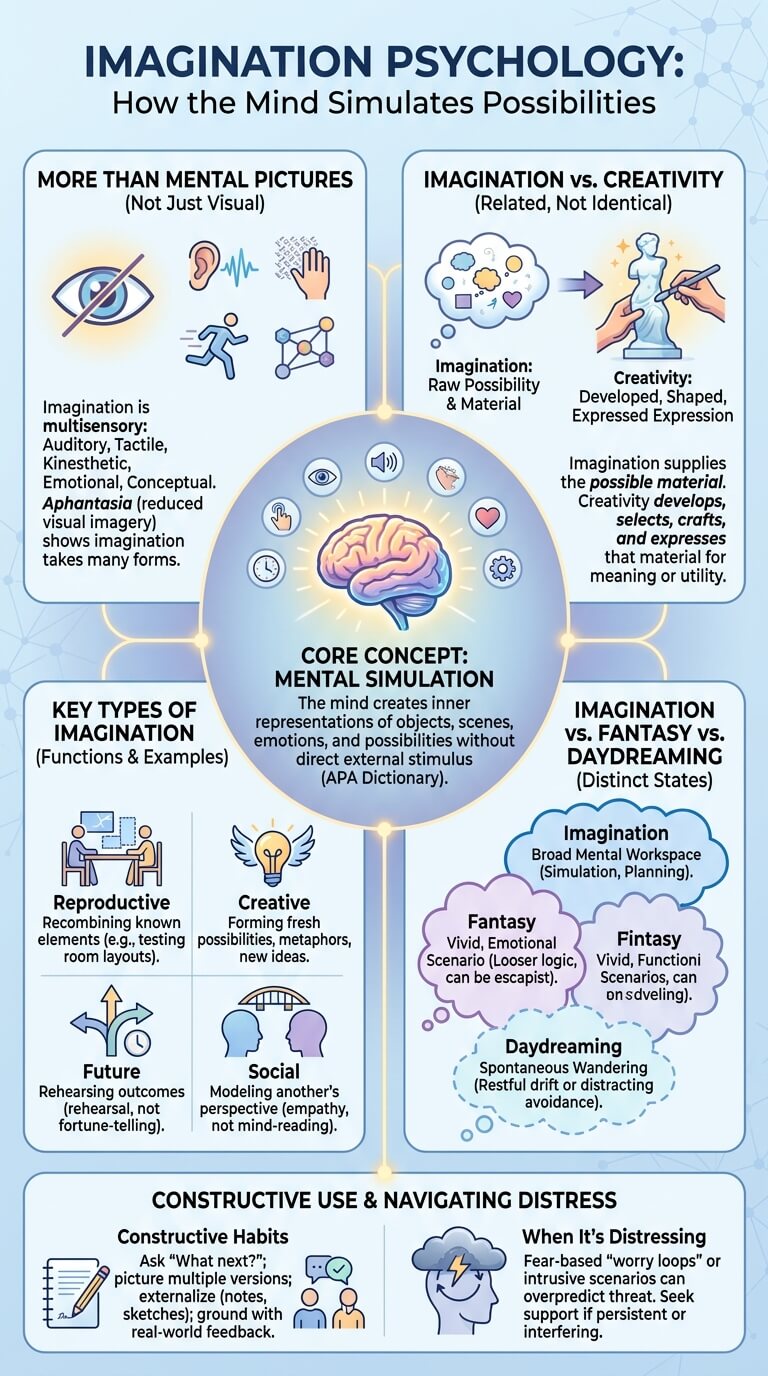
In imagination psychology, the key idea is mental simulation. The mind creates inner representations of objects, scenes, sounds, movements, emotions, social situations, and possible outcomes. These simulations may be vivid or faint, visual or nonvisual, realistic or playful. The APA Dictionary of Psychology describes imagery as sensory-like inner experience in the absence of the corresponding external stimulus, and it notes that imagery can involve visual, auditory, tactile, kinesthetic, emotional, and other forms of representation.
This matters for creativity because many creative acts begin before anything is made. A person imagines a scene before writing it, hears a rhythm before recording it, feels the shape of an argument before drafting it, or tests several possible endings before choosing one. Still, imagination is not the same as creativity. Imagination supplies possible material. Creativity develops, shapes, evaluates, and expresses that material in a way that has meaning, usefulness, or artistic force.
Quick Answer
Imagination as mental simulation
Imagination in psychology is the mind’s ability to simulate things that are not currently present. This includes mental images, sounds, movements, emotional scenes, future possibilities, and alternative versions of events. It helps people plan, remember, empathize, solve problems, and generate ideas before acting in the real world.
Why imagination is related to creativity but not identical
Imagination gives creativity raw possibility. Creativity adds selection, craft, feedback, context, and expression. You can imagine many things without making anything creative, and you can create something valuable without having unusually vivid visual images. The relationship is close, but not interchangeable.
What Imagination Means in Psychology
Mental images, scenarios, and possibilities
When people hear the word imagination, they often think of pictures in the mind. Visual imagery is one form, but imagination is broader than a private movie screen. Some people imagine in words, spatial relations, bodily feelings, sounds, moods, symbolic patterns, or a sense of how events may unfold.
A musician may imagine a chord progression without seeing anything. A designer may sense balance and proportion. A parent may imagine how a child will respond to a change in routine. A speaker may rehearse the emotional temperature of a room before entering it. In each case, the mind is working with something absent but mentally represented.
Remembering, predicting, and inventing
Imagination often uses memory as material. When you picture a beach you visited, imagine a future trip, or invent a fictional coastline, the mind may draw on stored sensory and emotional details. The difference is how those details are arranged. Remembering aims toward what happened. Predicting aims toward what may happen. Inventing rearranges pieces into something new.
This is why imagination can feel both familiar and novel. A scene you invent may contain rooms you have seen, voices you recognize, fears you understand, and hopes that belong to your life. The novelty comes from recombination, not from empty space.
Why imagination is not only visual
Some people have vivid mental pictures. Others have faint images, no voluntary visual imagery, or a stronger inner experience in words, concepts, feelings, sounds, or physical movement. That difference does not mean one person has imagination and another does not. It means imagination has different forms.
Research on aphantasia, a term often used for the inability or reduced ability to voluntarily form mental images, shows why visual imagery should not be treated as the whole story. A systematic review in PubMed Central on aphantasia describes individual differences in mental imagery and discusses how they may relate to memory, future imagination, and other cognitive functions. The practical lesson is simple: do not judge your imagination only by how clear your mental pictures are.
The Main Types of Imagination
Reproductive imagination: recombining what you know
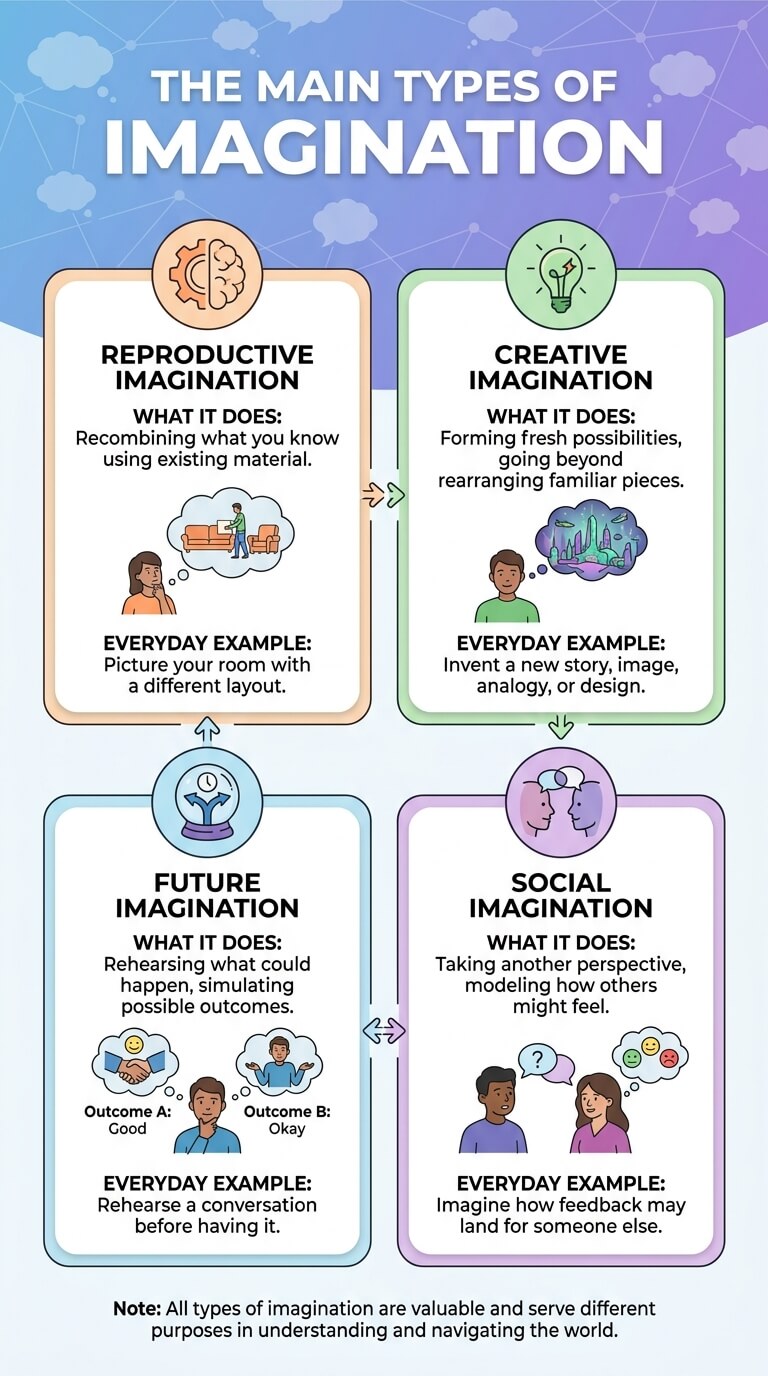
Reproductive imagination uses existing material and rearranges it. You may picture your living room with a different sofa, imagine a familiar person in a new role, or combine two ideas you already understand. This kind of imagination is not lesser because it uses known material. Most useful imagination starts with something you have lived, noticed, learned, or felt.
Recombination is also practical. It lets you test changes before making them. Before moving furniture, writing a message, changing a habit, or trying a new design, you can simulate several versions in your mind and notice which one feels clearer, kinder, simpler, or more useful.
Creative imagination: forming new possibilities
Creative imagination goes further than rearranging familiar pieces in an obvious way. It forms possibilities that feel fresh, surprising, expressive, or personally meaningful. A metaphor links two things that usually stay separate. A story gives form to a feeling. A product idea changes how people solve a problem. A personal insight turns vague discomfort into a clear question.
| Type of imagination | What it does | Everyday example |
|---|---|---|
| Reproductive imagination | Recombines known material | Picture your room with a new layout |
| Creative imagination | Forms fresh possibilities | Invent a story, image, analogy, or design |
| Future imagination | Simulates possible outcomes | Rehearse a conversation before having it |
| Social imagination | Models another perspective | Imagine how feedback may land for someone else |
Future imagination: rehearsing what could happen
Future imagination lets the mind try tomorrow before tomorrow arrives. You may imagine how a meeting will unfold, how it would feel to move cities, what might happen if you apologize, or what kind of life a certain decision may create. This is not fortune-telling. It is rehearsal under uncertainty.
A classic open-access paper on mental imagery as mental emulation argues that mental imagery helps people generate predictions based on past experience. In everyday terms, the mind may use inner simulation to prepare for action. It does not always predict accurately, but it helps you explore consequences before committing.
Social imagination: taking another perspective
Social imagination is the ability to mentally model another person’s perspective, not perfectly, but enough to pause before assuming your own view is the whole picture. You may imagine how your words could sound to a friend, how a child might experience a rule, or how a coworker may interpret silence after a difficult meeting.
This does not require mind-reading. In fact, responsible social imagination keeps uncertainty visible. It asks, “What might this be like from their side?” rather than “I know exactly what they think.” That difference matters because imagination can support empathy, but it can also become projection when you treat guesses as facts.
How Imagination Supports Creativity
Imagination is part of the larger creativity psychology map because it lets the mind test possibilities before they become actions, stories, designs, or decisions.
Trying ideas before making them
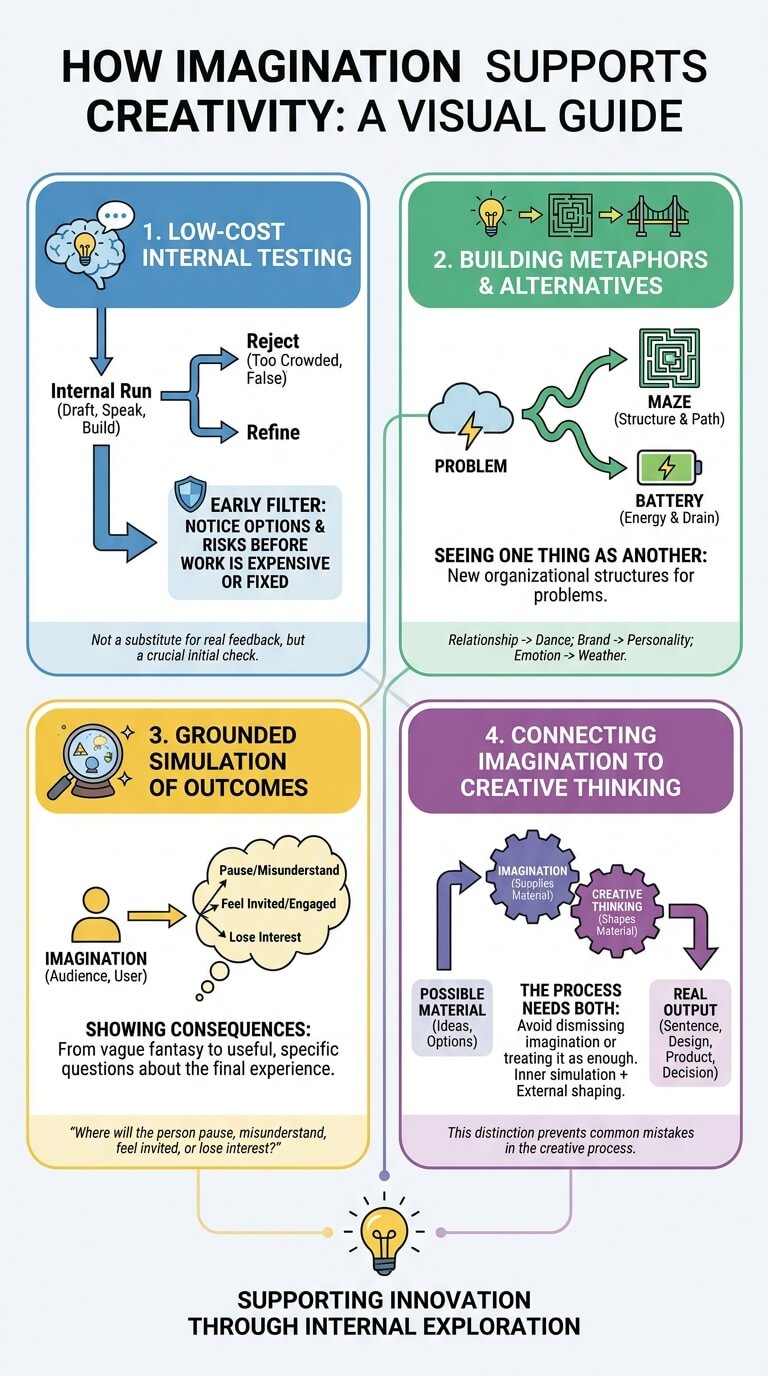
Imagination creates a low-cost testing space. Before you draw, speak, build, publish, or decide, you can run a rough version internally. You might hear a sentence and reject it before writing it down. You might picture a design and sense that it is too crowded. You might imagine a scene and realize the emotional turn is false.
Imagination may produce many possible ideas, but the next step is deciding which ideas are original, useful, and fitting for the situation.
This internal testing is not a substitute for real feedback. It is an early filter. It lets you notice options, risks, and directions before the work becomes expensive, public, or fixed.
Building scenes, metaphors, and alternatives
Creative work often depends on seeing one thing as another. A problem becomes a maze, a relationship becomes a dance, a brand becomes a personality, an emotion becomes weather, a life stage becomes a threshold. These links are imaginative before they are polished.
Metaphor is powerful because it carries structure. If you imagine burnout as a battery, you may notice energy, recharging, drain, and overload. If you imagine a conversation as a bridge, you may notice distance, weight, support, and crossing. The image gives the mind a new way to organize the problem.
Seeing possible outcomes
Imagination also supports creativity by showing consequences. A filmmaker imagines how an audience might feel in the final shot. A teacher imagines where a student may get confused. A writer imagines which detail will make a scene feel alive. A founder imagines how a customer will use a product on a tired Tuesday, not only during a perfect demo.
The more grounded the simulation, the more useful it becomes. A vague fantasy says, “This will be amazing.” A grounded imaginative test asks, “Where will the person pause, misunderstand, feel invited, or lose interest?”
Connecting imagination to creative thinking
Imagination supplies possible material. Creative thinking works with that material. It asks which idea fits the problem, what needs to be changed, which option is worth developing, and how the imagined possibility can become a real sentence, design, conversation, product, or decision.
This distinction prevents two common mistakes. One mistake is dismissing imagination because it is not finished work. The other is treating imagination as enough by itself. The creative process usually needs both inner simulation and external shaping.
Imagination vs Fantasy vs Daydreaming
Imagination as a mental capacity
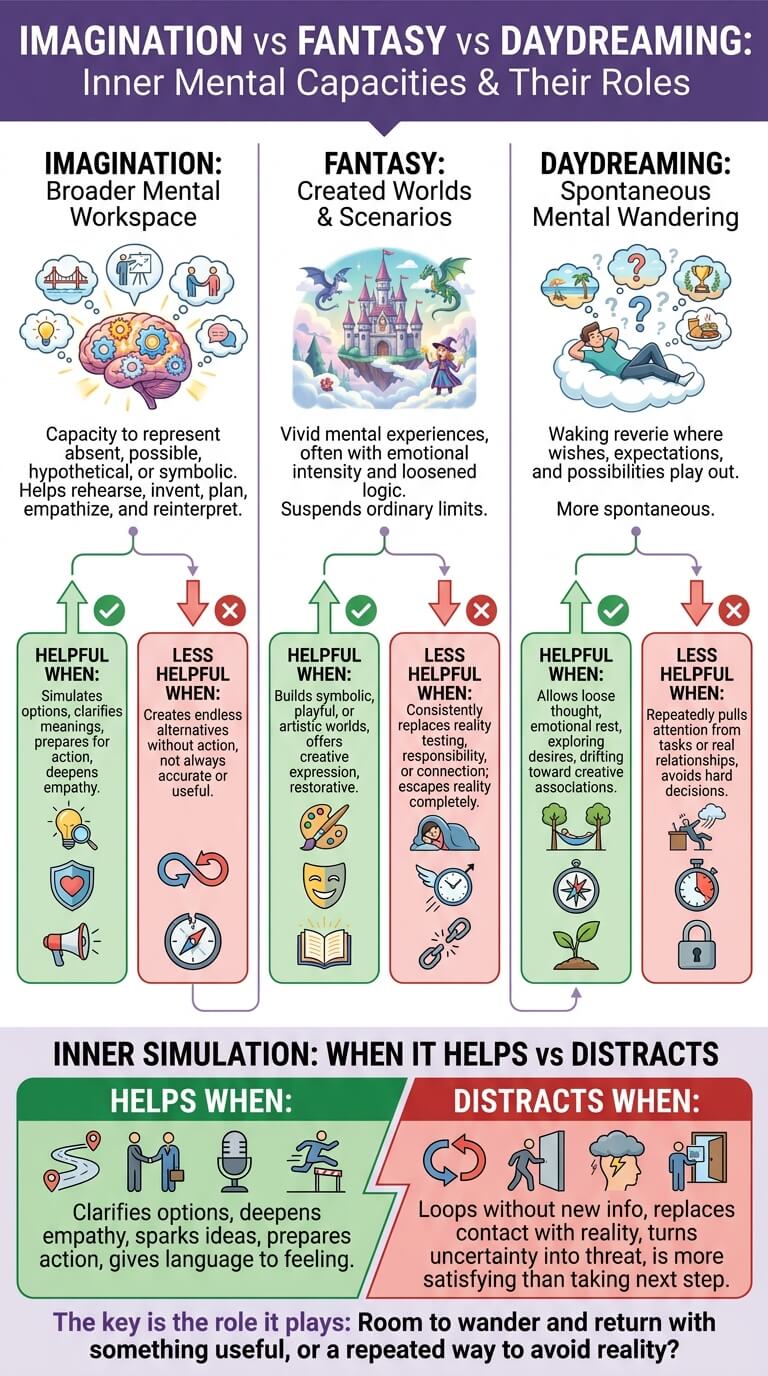
Imagination is the broader capacity to represent what is absent, possible, remembered, hypothetical, symbolic, or not yet real. It can be practical, artistic, emotional, social, playful, or strategic. It helps people rehearse, invent, plan, empathize, and reinterpret experience.
A helpful way to think about imagination is as a mental workspace. It is not always accurate, and it is not always useful, but it gives the mind room to try possibilities before reality forces a choice.
Fantasy as a created world or scenario
Fantasy is a more specific kind of imagined experience. The APA Dictionary of Psychology defines fantasy as mental experiences and processes often marked by vivid imagery, emotional intensity, and a loosening of ordinary logic. Fantasy can be normal, pleasurable, creative, and restorative. It can also become concerning when it consistently replaces reality testing, responsibility, or connection.
In creative life, fantasy can be useful because it suspends ordinary limits. In practical life, it needs grounding. You might use fantasy to invent a story world, then use creative thinking to decide what works, what confuses the audience, and what needs a clearer structure.
Daydreaming as spontaneous mental wandering
Daydreaming is usually more spontaneous. The APA Dictionary of Psychology describes daydreaming as a waking fantasy or reverie in which wishes, expectations, and possibilities play out in imagination. Daydreaming may help the mind rest, explore desires, or drift toward creative associations. It may also become distracting when it repeatedly pulls attention away from chosen tasks or real relationships.
The question is not whether daydreaming is good or bad. The better question is what role it is playing. Is it giving your mind room to wander and return with something useful, or is it helping you avoid a real decision, feeling, or responsibility?
When inner simulation helps and when it distracts
Inner simulation helps when it clarifies options, deepens empathy, sparks ideas, prepares action, or gives language to an unclear feeling. It distracts when it loops without new information, replaces contact with reality, turns every uncertainty into a threat, or becomes more satisfying than taking the next small step.
| Inner experience | Helpful version | Less helpful version |
|---|---|---|
| Imagination | Simulates options and possible meanings | Creates endless alternatives without action |
| Fantasy | Builds symbolic, playful, or artistic worlds | Escapes reality so completely that needs are ignored |
| Daydreaming | Allows loose thought and emotional rest | Becomes a repeated way to avoid hard tasks |
| Future rehearsal | Prepares for a real situation | Turns into repeated worst-case imagining |
Why Some People Feel More Imaginative Than Others
Memory material and lived experience
Imagination needs ingredients. A person who has read widely, observed closely, traveled, listened, practiced a craft, or lived through varied experiences may have more material to combine. This does not mean a narrow life cannot produce imagination. It means the mind often builds new scenes from old pieces.
You can expand imaginative material by noticing more, not only by doing more. Pay attention to textures, voices, rituals, conflicts, rooms, habits, gestures, and emotional details. The richer your noticing, the more material imagination has to work with.
Emotional salience
Emotion marks certain experiences as important. A scene that embarrassed you, moved you, scared you, delighted you, or made you curious may return more vividly than a neutral event. This is one reason imagination is often emotional. It does not only ask, “What could happen?” It asks, “What would this mean or feel like?”
Emotional salience can fuel art, storytelling, empathy, and problem solving. It can also bias imagination toward threat if fear is the strongest signal. When imagination keeps returning to danger, rejection, humiliation, or failure, grounding and support may matter more than forcing yourself to “think positive.”
Practice and attention to inner detail
Imagination often grows through use. People who write, sketch, improvise, design, play music, act, solve complex problems, or reflect regularly may become more fluent in noticing inner material. They learn to catch a half-formed image, phrase, or feeling before it disappears.
Practice does not have to be formal. You can strengthen imagination by describing a memory in five sensory details, imagining three possible endings to a scene, sketching a mood, or asking how an object would look from another person’s point of view. The skill is attention to inner movement, not forced vividness.
Comfort with uncertainty and play
Imagination often begins before you know whether an idea is good. That can feel uncomfortable for people who want certainty early. Play helps because it lowers the cost of being wrong. You are not declaring truth. You are trying a possibility.
People who seem highly imaginative may not have better ideas at every moment. They may be more willing to let strange, incomplete, or awkward possibilities exist long enough to see whether they contain something useful.
How to Use Imagination More Constructively
Ask what could happen next
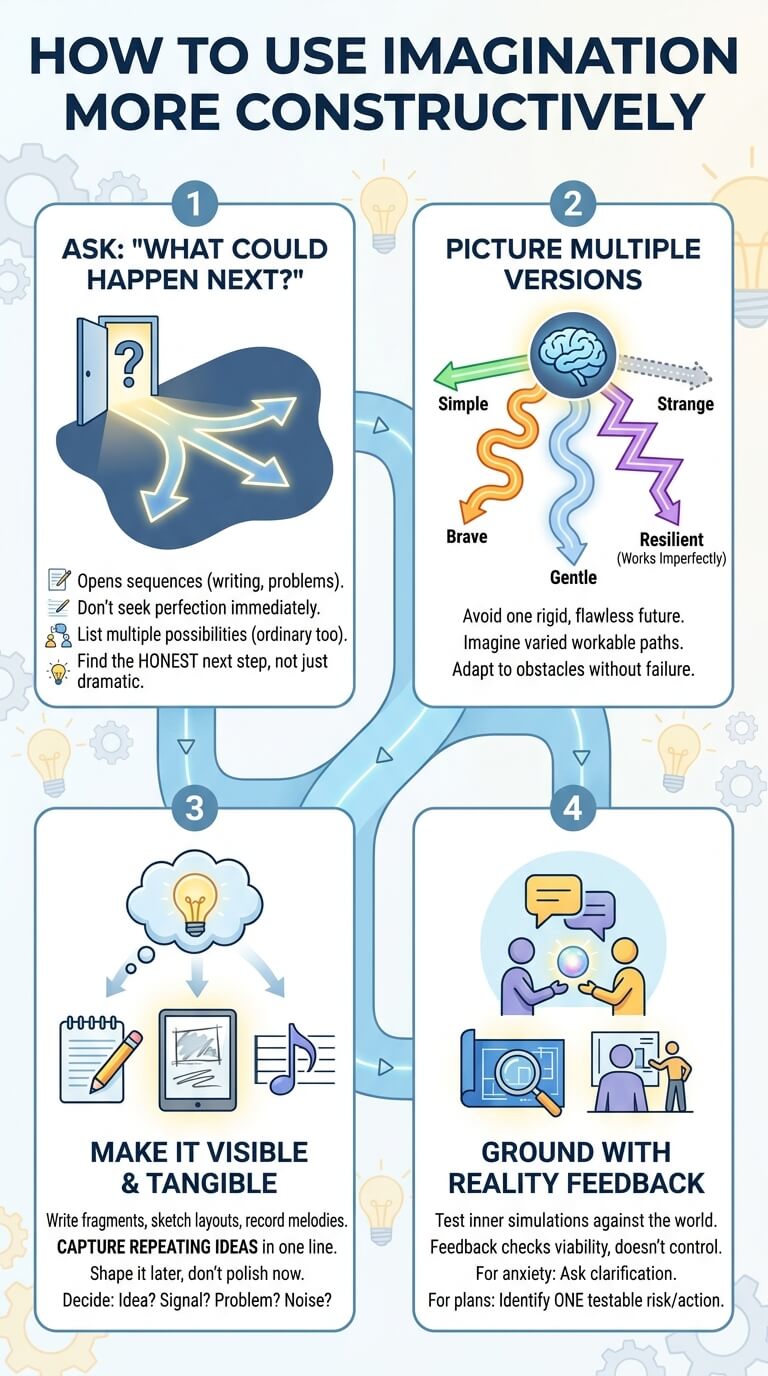
A simple way to use imagination is to ask, “What could happen next?” This question opens sequence. In writing, it may reveal the next scene. In problem solving, it may reveal the next consequence. In conversation, it may reveal how one response could escalate, soften, clarify, or confuse.
Keep the question open at first. Do not demand the best answer immediately. List several possible next moments, including ordinary ones. Often the useful idea is not the most dramatic possibility, but the most honest next step.
Picture multiple versions, not one perfect outcome
Imagination becomes rigid when it tries to build one flawless future. That kind of imagining often creates pressure because reality rarely matches the exact inner picture. A more constructive approach is to picture several versions: the simple version, the brave version, the gentle version, the strange version, and the version that would still work if conditions were imperfect.
This matters in creative work and life decisions. When you imagine only one ideal path, every obstacle feels like failure. When you imagine multiple workable paths, you can adapt without feeling that the whole future has collapsed.
Turn images into notes, sketches, or choices
Imagination gains power when it becomes visible enough to work with. Write the sentence fragment. Sketch the rough layout. Record the melody. Name the fear. List the possible outcomes. Describe the scene in plain language. Externalizing does not kill imagination. It gives you something to shape.
Try a small capture rule: when an image, phrase, or scenario repeats, save it in one clear line. Do not polish it immediately. Later, ask whether it is a real idea, an emotional signal, a problem to solve, or only mental noise.
Ground imagination with feedback
Imagination needs contact with reality. A story needs readers. A design needs users. A plan needs constraints. A social guess needs a question instead of certainty. Feedback does not mean letting other people control the imagination. It means checking whether the inner simulation survives contact with the world.
Grounding is especially useful for anxious imagination. If you imagine that someone is angry, ask for clarification when appropriate. If you imagine a project failing, identify one testable risk. If you imagine a new path, name the first action that would give you evidence.
Bridge Topics for Deeper Reading
Creative thinking when imagination becomes an idea
Creative thinking begins when imagination moves from possibility into development. The image, scene, or future scenario becomes a question: What is the actual idea here? Who is it for? What form should it take? What needs to be simplified, tested, or expressed?
Divergent thinking when imagination produces options
Divergent thinking uses imagination to produce multiple options rather than one immediate answer. If imagination says, “Here are possible worlds,” divergent thinking says, “Let’s generate several routes through them.” This is useful when the first idea is too obvious, too narrow, or too attached to a single assumption.
Originality when imagined ideas need context
Originality enters when imagined ideas are compared with context. An idea may feel new to you because it is new in your experience. Creative judgment asks a different question: how does this idea relate to what already exists, and what makes it distinct, useful, expressive, or worth developing?
When Imagination Feels Distressing
Intrusive scenarios vs chosen imagination
Chosen imagination has some sense of agency. You may decide to picture a possibility, build a scene, or rehearse a conversation. Intrusive scenarios feel more unwanted. They arrive suddenly, repeat despite your wishes, or pull your attention toward images and outcomes that feel frightening or upsetting.
Unwanted mental images do not automatically mean something is wrong with you. Many people experience odd, unpleasant, or fear-based thoughts at times. The concern rises when they become persistent, distressing, hard to disengage from, or linked to compulsive checking, avoidance, reassurance seeking, or major interference in daily life.
When fear-based imagination becomes overwhelming
Fear-based imagination often overestimates threat and underestimates coping. It may turn one uncertainty into a chain of imagined disasters: one message delay becomes rejection, one mistake becomes public shame, one body sensation becomes catastrophe, one awkward moment becomes proof that everything is ruined.
NIMH describes generalized anxiety disorder as involving excessive worry that can be hard to control and may interfere with daily life. Their guide to generalized anxiety disorder is a useful educational resource if worry feels persistent, intense, or difficult to manage. This article cannot tell you whether you have a disorder, but it can encourage you to take ongoing distress seriously.
When to get support for anxiety or intrusive thoughts
Consider support from a qualified mental health professional if imagined scenarios are frequent, distressing, difficult to interrupt, or causing avoidance, sleep disruption, panic, compulsive checking, or major problems at work, school, relationships, or daily life. Support may also help if imagination is tied to trauma memories, self-harm thoughts, or a sense that you cannot trust your own mind.
If your imagined scenarios involve fear of being harmed by someone else, threats, stalking, coercion, humiliation, or retaliation, prioritize safety and outside support. Do not rely only on better communication or private reframing when a situation may be unsafe.
FAQ About Imagination Psychology
Is imagination the same as creativity?
No. Imagination is the ability to mentally simulate possibilities, images, scenarios, and alternatives. Creativity involves producing or developing something original, useful, expressive, or meaningful. Imagination often feeds creativity, but creativity also needs selection, skill, evaluation, and expression.
Can imagination be improved?
Many parts of imagination can be practiced. You can improve your ability to notice inner details, generate alternatives, use metaphor, imagine future consequences, and turn vague images into notes or sketches. The aim is not always to make mental pictures more vivid. It is to use inner simulation more flexibly and constructively.
Why do I imagine worst-case scenarios?
Worst-case imagining may be the mind’s attempt to prepare for danger, rejection, loss, or uncertainty. Sometimes it helps you notice a real risk. Other times it becomes a worry loop that overpredicts threat and underpredicts your ability to cope. If it becomes persistent or distressing, grounding strategies and professional support may help.
Is daydreaming bad for creativity?
Daydreaming is not automatically bad for creativity. It may give the mind space to wander, combine ideas, and explore desires. It becomes less helpful when it repeatedly replaces action, avoids responsibility, or leaves you feeling more disconnected from real choices. A useful daydream often returns with a note, question, or small next step.
Do all people imagine visually?
No. Some people have vivid visual imagery, some have faint imagery, and some do not voluntarily picture images in the mind. Others imagine more strongly through words, sounds, movement, emotion, spatial awareness, or concepts. Visual imagery is one form of imagination, not the whole capacity.
Key Takeaways
- Imagination in psychology is best understood as mental simulation: the mind represents possibilities that are not currently present.
- Imagination may be visual, verbal, auditory, emotional, spatial, bodily, or conceptual, so vivid pictures are not the only valid form.
- Creativity uses imagination, but also requires development, selection, feedback, skill, and expression.
- Fantasy and daydreaming can support creativity, but they need grounding when they replace reality testing or action.
- Future imagination helps people prepare, but fear-based simulation can become distressing when it turns into persistent worry or intrusive scenarios.
- A constructive first step is to capture imagined material in notes, sketches, questions, or small choices that can be tested.
Final Thoughts
Your imagination is not only a place where impossible things happen. It is also where the mind rehearses, combines, remembers, predicts, empathizes, and experiments before reality gives feedback. The next time you notice an inner image, phrase, scene, or possible future, try not to judge it immediately. Ask what it is doing. It may be an idea, a warning, a hope, a question, or a piece of emotional material that needs grounding.
A useful next step is simple: choose one imagined possibility and make it concrete enough to test. Write one sentence, sketch one version, ask one clarifying question, or compare two possible outcomes. Imagination becomes more valuable when it moves gently between inner simulation and real-world contact.

Michael Reed is the Founder and Lead Writer at Psychology Exposed. He writes about human behavior, relationships, emotional patterns, self-awareness, and practical psychology topics using research-informed, easy-to-understand content.
Read More About Michael Reed: https://psychologyexposed.com/michael-reed/