
Many people assume creativity is something they either have or do not have. They wait to feel inspired, compare their first draft with someone else’s polished work, and then decide they are not creative enough. That belief can quietly shrink the number of ideas they are willing to try.
Creative flow is easier to reach when practice gives the work enough structure, feedback, and manageable challenge.
The incubation effect explains why some ideas become clearer after a break, especially when you return with a specific question.
From a psychology perspective, becoming more creative is less about forcing genius and more about changing the conditions that help ideas appear, develop, and improve. You need inputs to think with, mental flexibility to generate options, constraints that shape the work, a way to catch weak ideas, enough space for incubation, and repeated practice that builds creative confidence.
The APA Dictionary of Psychology defines creativity as the ability to produce or develop original work, theories, techniques, or thoughts. For everyday life, that means creativity is not limited to art. It can show up in problem solving, teaching, parenting, business, writing, design, humor, conversation, planning, and how you make meaning from experience. This guide focuses on practice, not personality labels, productivity hacks, or pressure to be brilliant all the time.

Quick Answer
Creativity grows through repeated creative processes
You become more creative by repeating the core processes behind creative work: noticing useful inputs, generating many possible ideas, changing categories, using constraints, stepping away when stuck, revising rough material, and learning from feedback. Creativity is not only a mood. It is a cycle you can practice.
The goal is more flexible output, not constant inspiration
The practical goal is not to feel inspired every day. It is to become more flexible when you face a blank page, an unclear problem, or an ordinary idea. A more creative person usually has more ways to begin, more tolerance for rough attempts, and more patience for shaping ideas over time.
Start With a Better Definition of Creativity
For the full map of how creativity works, including imagination, incubation, flow, originality, and creative blocks, start with the broader creativity psychology guide.

Creativity as novelty plus usefulness or meaning
A helpful definition of creativity includes two parts: something must be new enough to matter, and it must have usefulness, meaning, expression, or fit. A random idea may be unusual without being useful. A practical idea may be useful without being very new. Creativity often appears when novelty and value meet.
Value does not always mean commercial value. A creative idea may help someone understand a feeling, solve a small daily problem, tell a truth in a fresh way, make a lesson clearer, or connect two fields that rarely speak to each other. The question is not only, “Is this original?” It is also, “What does this idea do?”
Why you do not need to feel original all the time
One reason people stop creating is that they demand originality too early. They look at a rough idea and ask whether it has never existed before. That question is too heavy for the beginning stage. Early ideas are allowed to be borrowed, clumsy, familiar, incomplete, and influenced by what you have seen.
Originality often becomes clearer through transformation. You change the audience, combine two references, shift the format, simplify the message, add a personal observation, or solve a different problem with a familiar tool. If you wait until an idea feels completely original before you begin, you may never give the idea enough time to become your own.
Why creativity is built through cycles
Creativity usually moves in cycles: input, exploration, selection, shaping, testing, rest, and revision. The order is not always neat. You may gather examples, try five weak directions, notice a better question, take a walk, return with a clearer angle, and then revise again after feedback.
| Creative cycle | What it does | Everyday example |
|---|---|---|
| Input | Gives the mind material to work with | Collecting article openings, product ideas, or visual references |
| Exploration | Creates more options than the obvious one | Writing ten possible titles before choosing one |
| Constraint | Shapes vague possibility into a workable task | Explaining a hard idea using only a kitchen metaphor |
| Incubation | Lets fixation loosen after real effort | Stepping away from a stuck paragraph and returning later |
| Revision | Turns a rough idea into something useful or meaningful | Cutting the clever part that distracts from the main point |
Step 1: Feed the Mind With Better Inputs

Collect examples across domains
Your mind cannot combine material it has never encountered. To become more creative, build a wider library of examples. A writer can study comedy timing, product packaging, memoir, documentary voiceover, and classroom explanations. A business owner can study restaurant menus, game design, onboarding flows, and customer complaints. A student can look across science, history, art, and everyday conversations.
The point is not to copy the surface. It is to collect patterns. How does this person explain complexity? How does this design create trust? How does this story create tension? How does this teacher make an abstract idea concrete? Cross-domain input gives your brain more material to recombine.
Notice patterns, questions, and tensions
Better inputs are not only beautiful examples. They are also questions, friction points, contradictions, and moments of confusion. Creativity often begins when you notice that something does not quite fit. A tool is useful but ugly. A lesson is accurate but boring. A common belief sounds true but fails in real life. A topic is popular but missing nuance.
Keep a simple running list with three kinds of notes: what caught your attention, why it caught your attention, and what question it raises. This turns passive consumption into active observation. Instead of saving another example and forgetting it, you are training attention.
Use curiosity without overconsuming
Input helps until it becomes avoidance. If you keep researching because you are afraid to start, more examples may create comparison rather than creativity. A useful rule is input before output, then output before more input. Read three examples, make one rough version. Watch a tutorial, then try one small experiment. Study a style, then explain what you learned in your own format.
Curiosity should widen your thinking, not bury your voice. When overconsumption starts to make you feel smaller, switch from collecting to making. Even a rough attempt teaches you what kind of input you actually need next.
Step 2: Practice Divergent Thinking
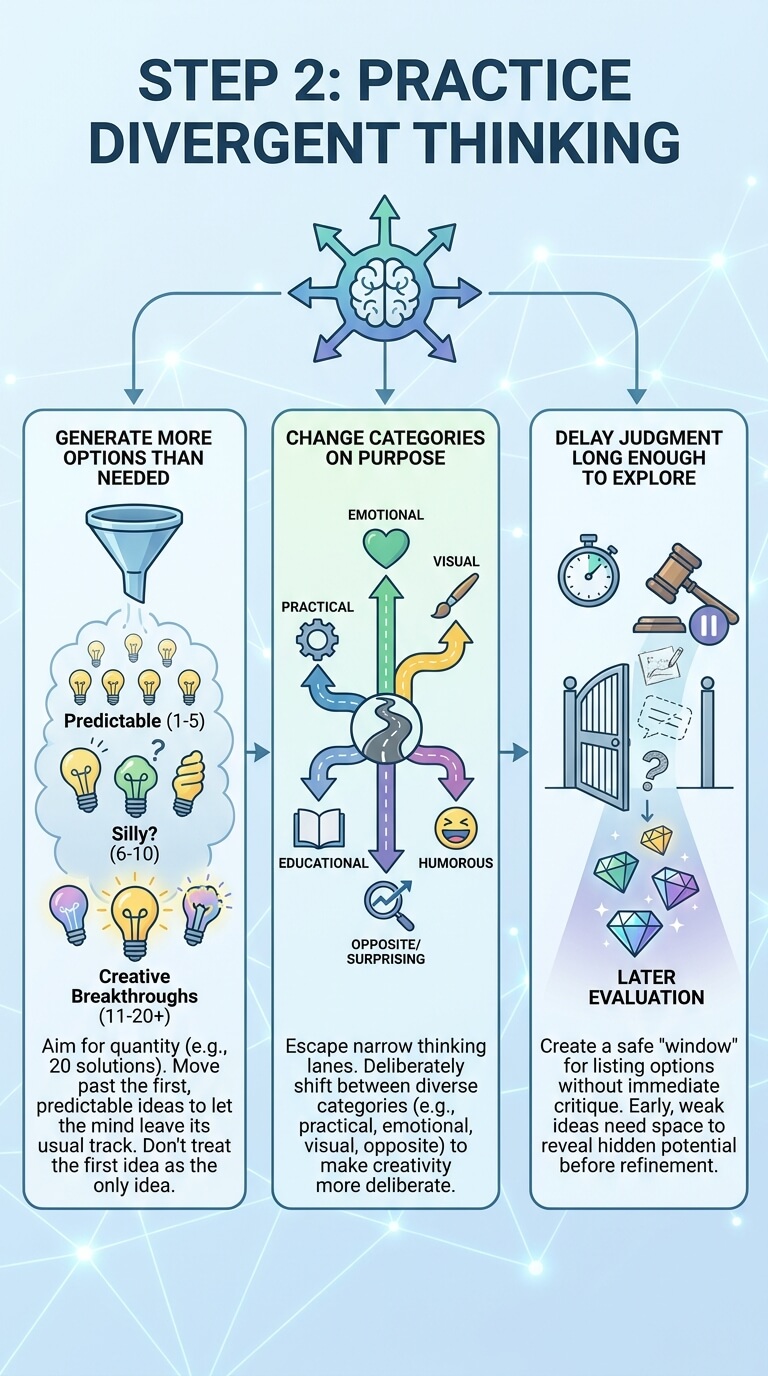
Generate more options than you need
Divergent thinking means producing multiple possible answers, uses, interpretations, or directions before choosing one. Creativity training often includes exercises that practice this kind of idea generation. For example, a PubMed Central article on creativity training discusses approaches that move beyond a single correct answer and train different routes for creative thought.
A simple exercise is to generate twenty possible solutions to a small problem. The first five will often be predictable. The next five may feel silly. Somewhere after that, the mind has to leave its usual track. You do not need all twenty ideas to be good. You need enough options to stop treating the first idea as the only idea.
Change categories on purpose
Many people generate ideas inside one category without realizing it. If you are naming a project, you may only think of clever wordplay. If you are planning content, you may only think of tutorials. If you are solving a work problem, you may only think of stricter rules. Category shifting helps you escape that narrow lane.
Try asking for one idea in each category: practical, emotional, visual, humorous, educational, opposite, tiny, extreme, beginner-friendly, and surprising. A creator might turn a psychology topic into a story, checklist, metaphor, myth correction, visual diagram, personal reflection, or question prompt. Changing categories makes creativity more deliberate.
Delay judgment long enough to explore
Judgment is useful, but timing matters. If you judge every idea the moment it appears, your mind learns that idea generation is unsafe. Give yourself a short window where the task is only to list options. You can evaluate later.
This does not mean every idea deserves equal respect forever. It means early ideas need enough space to reveal hidden potential. A weak idea may contain a strong image. A bad title may contain the right emotional angle. A strange example may point to a better audience. Delayed judgment gives you something to work with.
Step 3: Use Constraints to Shape Ideas
Why blank freedom can freeze creativity
Total freedom sounds creative, but it can be paralyzing. “Make anything” gives the mind too many doors. “Explain jealousy using a weather metaphor in 200 words” gives the mind a room to explore. A constraint reduces the number of decisions you must make before starting.
Creative people often use constraints on purpose. They limit length, audience, material, mood, tool, format, time, or point of view. The constraint creates pressure, and the pressure helps the mind choose.
Small rules that make ideas easier to start
Good constraints are small enough to begin with but strong enough to guide selection. For a writer, the rule might be “open with a real situation, not a definition.” For a designer, it might be “use only two shapes.” For a teacher, it might be “explain this concept without using the technical term until the second paragraph.” For a problem solver, it might be “solve this without adding a new tool.”
Constraints turn creativity into a task rather than a personality test. Instead of asking, “Am I creative?” you ask, “What can I make under this rule?” That question is much easier to answer.
Turning limitations into prompts
A limitation becomes a prompt when you use it to ask a better question. If you have little time, ask, “What is the smallest useful version?” If you have no budget, ask, “What can be done with attention, clarity, or timing?” If your topic feels overdone, ask, “What angle is missing for beginners?” If your tools are simple, ask, “What can simplicity make clearer?”
| Limitation | Prompt it creates | Creative direction |
|---|---|---|
| Too many existing ideas | What is misunderstood or oversimplified? | Clarify nuance |
| Too little time | What is the smallest honest version? | Prototype quickly |
| Too much complexity | What example makes this visible? | Use metaphor or story |
| Too much self-criticism | What version is allowed to be bad? | Draft without display |
Step 4: Build an Idea Capture System
Capture weak ideas before they vanish
Many ideas disappear because they arrive before you know what they are for. A phrase, image, question, or small irritation may seem useless in the moment. Later, it could become the opening of an article, the seed of a product, the example that makes a lesson work, or the problem a project solves.
Use a low-friction capture system. It can be a notes app, paper notebook, voice memo folder, sketchbook, or one document with date stamps. The system only needs to be easy enough that you actually use it. Do not make idea capture so organized that it becomes another way to avoid creating.
Keep notes, sketches, questions, and examples
A strong idea bank includes different kinds of material. Keep rough titles, metaphors, screenshots of structure, lines you almost said, questions from readers, surprising facts, mistakes you keep noticing, and examples from daily life. Creativity improves when you stop waiting for fully formed ideas and start saving fragments.
This is especially useful for people who say they are inconsistent. They may not lack ideas. They may lack a way to catch ideas when their mind is relaxed, walking, showering, talking, reading, or noticing something ordinary.
Review ideas without forcing them to be good
Review your idea bank lightly. Once or twice a week, scan the notes and mark anything that still feels alive. Do not demand that every note become a project. Some notes are compost. They enrich later thinking even if they never become visible work.
A useful review question is, “What is this really about?” A note about a messy desk may really be about decision fatigue. A note about boring tutorials may really be about pacing. A note about people avoiding feedback may really be about shame. Review helps fragments turn into themes.
Step 5: Use Incubation on Purpose
Work first, then step away
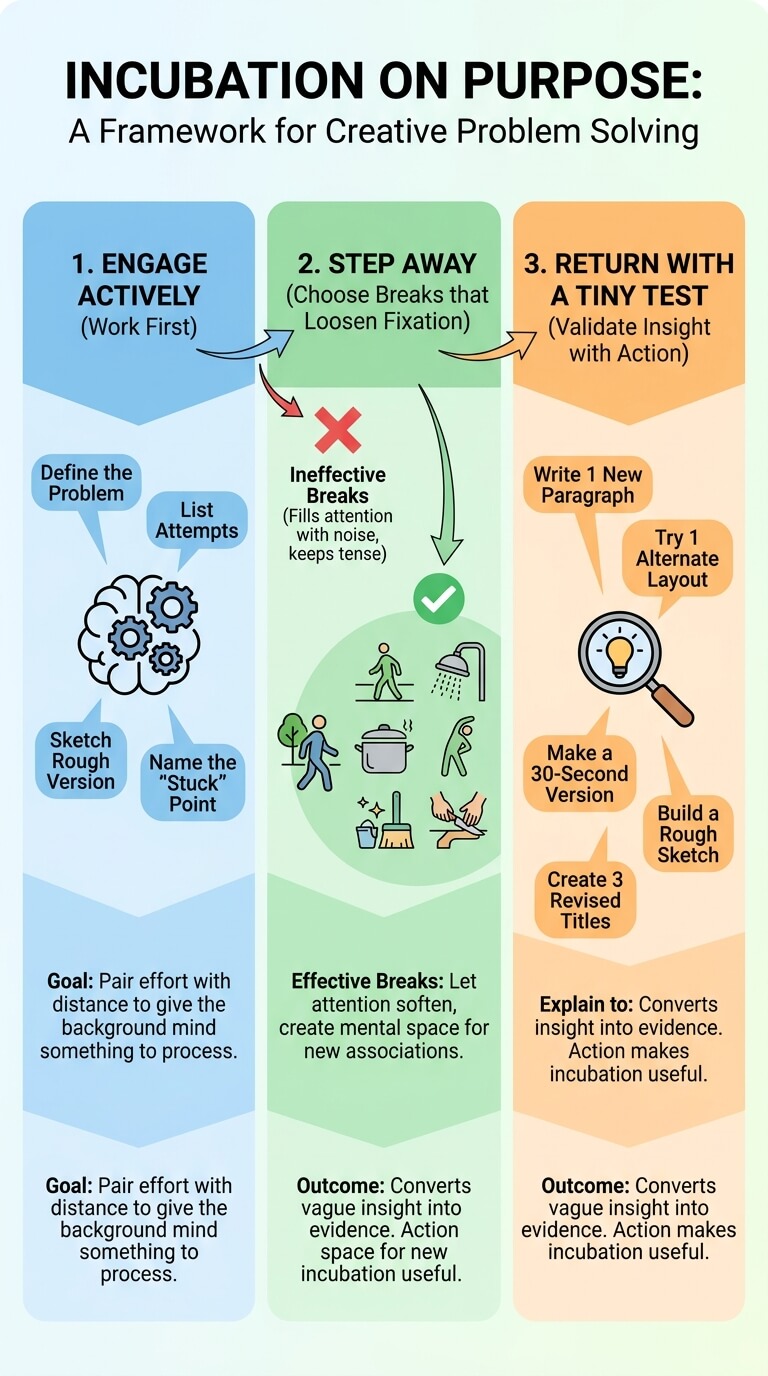
Incubation works best after genuine engagement. If you step away before your mind has touched the problem, the break may just be delay. First define the problem, list attempts, sketch a rough version, or name what is stuck. Then leave it alone for a while.
This gives the mind something to continue processing in the background. You are not outsourcing creativity to rest. You are pairing effort with distance. The distance helps you return less trapped by the first approach.
Choose breaks that loosen fixation
Not every break helps creativity. A break that fills your attention with noise may keep the mind tense. A break that lets attention soften may loosen fixation. Walking, showering, cooking, stretching, tidying, or doing a simple manual task can create enough mental space for new associations.
Research on creative association interventions also suggests that creativity can be influenced by how people practice connecting ideas. A PubMed Central article on association interventions and creative ability discusses interventions aimed at strengthening creative association. For everyday practice, this means you can train the mind to form links, not only wait for links to appear.
Return with a tiny test
When you return from a break, do not ask whether the whole project is solved. Ask for a tiny test. Write one new paragraph. Try one alternate layout. Make a thirty-second version. Explain the idea to one person. Build a rough sketch. Create three revised titles.
A tiny test converts vague insight into evidence. If the idea improves, continue. If it does not, you still learn what the next obstacle is. Incubation becomes more useful when followed by action.
Step 6: Reduce Creative Block and Self-Criticism
Separate drafting from judging
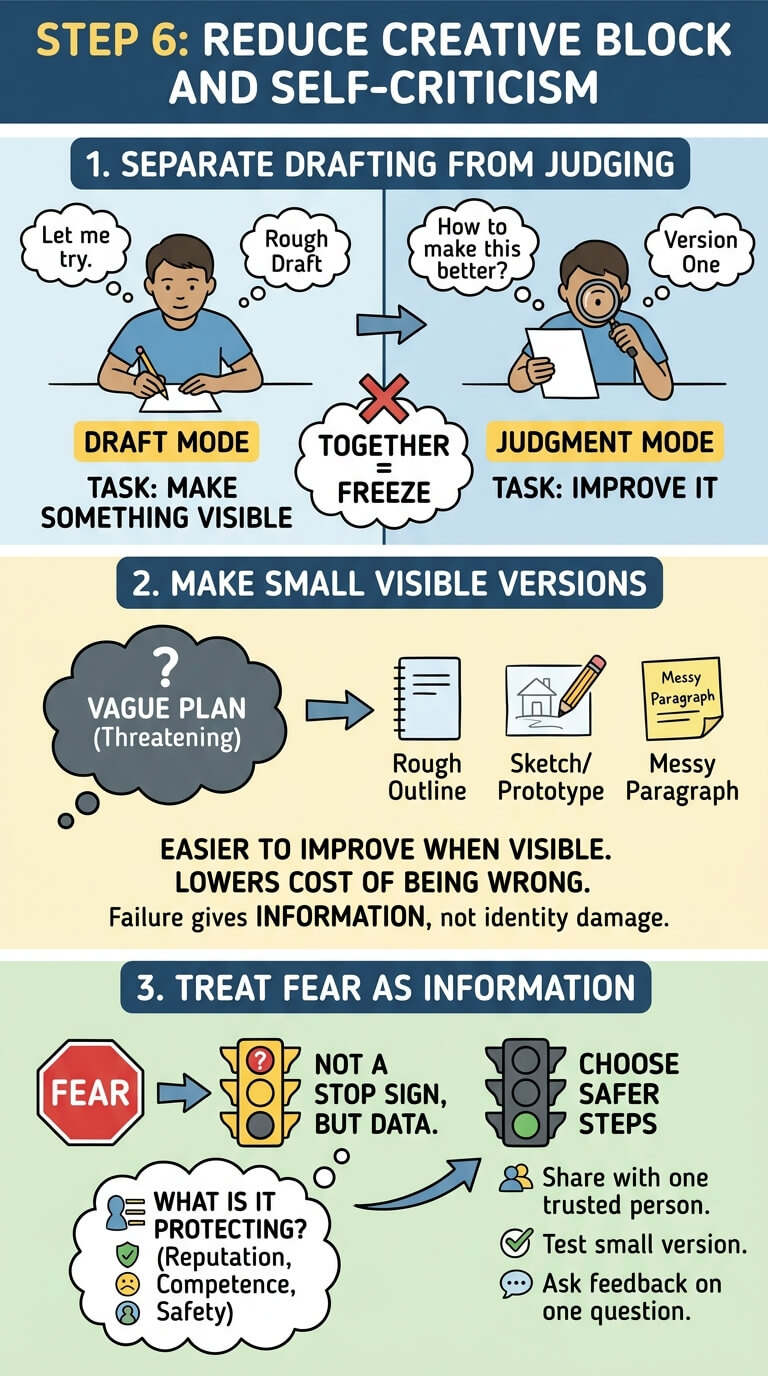
Creative block often grows when drafting and judging happen at the same time. The drafting part says, “Let me try.” The judging part says, “This is embarrassing.” Both are useful at different moments, but together they can freeze the work.
Try using two modes. In draft mode, the task is to make something visible. In judgment mode, the task is to improve it. You can even label the page: rough draft, private sketch, bad version, test version, or version one. The label reminds your nervous system that this is not the final display.
Make small visible versions
An idea becomes easier to improve when you can see it. A vague plan in your head may feel large and threatening. A rough outline, sketch, prototype, or messy paragraph gives you something specific to change.
Small visible versions also reduce perfectionism because they lower the cost of being wrong. If a rough draft takes ten minutes, failure gives information. If a perfect version must appear before you begin, failure feels like identity damage. Start smaller than your pride wants.
Treat fear as information, not a stop sign
Fear does not always mean the idea is wrong. It may mean you care, you are entering unfamiliar territory, or you are imagining judgment before there is enough evidence. Ask what the fear is protecting. Is it protecting your reputation, time, sense of competence, belonging, money, or emotional safety?
Once you know what fear is protecting, choose a safer next step. Share with one trusted person before posting publicly. Test a small version before changing your whole project. Ask for feedback on one question, not your entire identity as a creator. Fear can guide pacing without becoming the final decision maker.
Step 7: Develop Creative Confidence Through Repetition
Measure reps, not genius
Creative confidence grows when you collect evidence that you can return to the process. The APA Dictionary of Psychology definition of self-efficacy describes a person’s belief in their capability to perform in a setting or reach desired results. In creative work, self-efficacy often comes from repeated attempts, not from one perfect outcome.
Track repetitions that are under your control: ideas generated, drafts completed, experiments run, sketches made, feedback requests sent, revisions finished. This shifts attention from “Was I brilliant?” to “Did I practice the behavior that builds skill?”
Share safely and learn from feedback
Creativity develops faster when it meets reality, but not all feedback is equally useful. Choose feedback settings that match the stage of the work. A fragile early idea may need curiosity, not harsh critique. A nearly finished project may need precision. A skill you are learning may need a teacher, not a random audience.
Ask focused questions. Instead of “Is this good?” ask, “What part was clearest?” “Where did you lose interest?” “What felt fresh?” “What confused you?” “What would you want more of?” Specific feedback gives you material to revise without turning the whole experience into a referendum on your talent.
Refine instead of restarting endlessly
Some people confuse creativity with constantly starting over. New beginnings feel exciting because the idea still has potential. Refinement is harder because it exposes the gap between the imagined version and the real version. But refinement is where many ideas become valuable.
Before abandoning a project, try three focused revisions: make it clearer, make it more specific, and make the strongest part stronger. If it still feels dead after honest revision, move on with what you learned. If it improves, you have practiced one of the most important creative skills: staying with an idea long enough to shape it.
How to Choose Your Next Creativity Skill
If you lack ideas, build divergent thinking
If your main problem is “I cannot think of anything,” practice generating more options than you need. Use alternate uses, category shifts, what-if questions, opposite ideas, and forced combinations. Do not begin with evaluation. Begin with quantity, range, and movement.
If you feel stuck, address creative block
If you have ideas but cannot start or continue, the problem may not be imagination. It may be fear, perfectionism, unclear constraints, exhaustion, or judgment arriving too early. Focus on smaller drafts, lower-pressure experiments, and separating private practice from public performance.
If you need depth, use incubation
If your work is technically moving but feels shallow, use incubation. Give the problem attention, then step away. Return with a tiny test, not a demand for instant insight. Depth often requires time for hidden associations to surface.
If you worry about copying, study originality vs creativity
If you keep abandoning ideas because they resemble something else, learn to evaluate originality more carefully. Ask whether the idea is transformed, whether the context is different, whether it serves a new purpose, and whether you are being honest about influence. Creativity is not the absence of influence. It is what you do with influence.
| Your current obstacle | Skill to practice next | First small action |
|---|---|---|
| No ideas | Divergent thinking | List twenty directions before choosing |
| Too many ideas | Constraint setting | Pick one audience, one format, and one rule |
| Stuck midway | Incubation | Define the stuck point, then take a low-noise break |
| Fear of judgment | Creative confidence | Make a private version and share one small piece safely |
| Fear of copying | Originality evaluation | Name the influence and change the context or purpose |
Related Creativity Topics to Explore Next
Creativity Psychology for the full map
The broader creativity psychology map helps you understand how idea generation, imagination, originality, flow, incubation, and creative block fit together. Use it when you want the big picture rather than a step-by-step practice plan.
Creative Thinking Psychology for mental moves
Creative thinking focuses more narrowly on the mental moves behind creative output: combining, reframing, analogizing, questioning assumptions, and shifting perspective. It is useful when you want to understand what your mind is doing while it creates.
Imagination Psychology for inner simulation
Imagination is the mind’s ability to simulate possibilities. It helps you preview scenes, feelings, outcomes, metaphors, and alternatives before they exist in the outside world. Strengthening imagination can make idea generation richer and more emotionally detailed.
When to Get Support
If creative fear becomes severe anxiety or shame
Creative fear is common. It becomes more concerning when it turns into severe anxiety, intense shame, panic, constant avoidance, or a belief that your worth depends on performance. If fear stops you from functioning, sleeping, working, studying, or connecting with others, support may be more appropriate than another creativity exercise.
The National Institute of Mental Health guidance on caring for mental health notes that professional help may be worth seeking when severe or distressing symptoms last two weeks or more. Creativity practice can support self-understanding, but it is not a substitute for mental health care.
If burnout or depression makes creation feel impossible
Sometimes the problem is not a lack of creativity. It is depletion. Burnout, depression, grief, chronic stress, or major life pressure can make imagination feel unreachable. In that state, pushing harder may deepen avoidance. Rest, medical care, therapy, workload changes, or social support may matter more than another exercise.
Be gentle with the interpretation. A low-output season does not prove you are not creative. It may mean your system is overloaded. The next step may be recovery first, then practice.
FAQ About Becoming More Creative
Can adults become more creative?
Yes. Adults can practice many processes that support creativity, including divergent thinking, observation, idea capture, constraint use, revision, and feedback. You may not change every personality trait, preference, or life circumstance, but you can build habits that give creative thought more chances to appear and improve.
How long does it take to build creativity?
It depends on the skill and the amount of practice. Some changes happen quickly, such as learning to generate more options before judging. Deeper changes, such as creative confidence or a stronger personal style, usually build through repeated attempts over weeks, months, or years. Track practice quality rather than waiting for a single dramatic breakthrough.
What if I never feel inspired?
Begin without waiting for inspiration. Use a small constraint, a rough prompt, or a short timed draft. Inspiration often arrives after contact with the work, not before it. If you repeatedly feel numb, hopeless, exhausted, or unable to enjoy anything, consider whether stress or mental health support deserves attention.
Should I copy others to learn?
You can study others to learn structure, technique, pacing, framing, and craft. Private practice that imitates a style can teach you how something works. Public work should transform the influence, add your own purpose, and respect attribution, permission, and the norms of your field. Learning from influence is different from passing someone else’s work off as your own.
What is the best first exercise for creativity?
Choose one small object, topic, or problem and list twenty different uses, explanations, titles, or solutions. Then sort the list into categories: obvious, strange, useful, emotionally interesting, and worth testing. This simple exercise trains both idea generation and evaluation without requiring a big project.
Key Takeaways
- Becoming more creative means practicing creative processes, not waiting for a permanent creative mood.
- Useful inputs, cross-domain examples, and active curiosity give the mind more material to combine.
- Divergent thinking helps you move beyond the first obvious idea by generating options before judging them.
- Constraints make creativity easier to start because they reduce the blankness of total freedom.
- Incubation works best when you engage the problem first, step away, and return with a small test.
- Creative confidence grows through repetitions, safe feedback, and refinement, not through proving genius on every attempt.
Final Thoughts
Start with one small creative rep today. Collect three examples, generate ten options, set one constraint, capture one weak idea, or revise one rough piece instead of restarting. The aim is not to become a different person overnight. The aim is to give your mind more ways to explore, shape, and return to ideas until creativity becomes a process you trust.

Michael Reed is the Founder and Lead Writer at Psychology Exposed. He writes about human behavior, relationships, emotional patterns, self-awareness, and practical psychology topics using research-informed, easy-to-understand content.
Read More About Michael Reed: https://psychologyexposed.com/michael-reed/