
Creativity can feel mysterious because the best ideas often seem to arrive from nowhere. A sentence appears in your mind while walking. A solution comes after you stop forcing it. A visual image forms before you know how to explain it. But in psychology, creativity is not treated only as magic, talent, or artistic temperament. It is also a set of mental processes that help people combine information, notice possibilities, test ideas, and turn vague impressions into something useful.
This matters whether you make art, solve work problems, write content, design products, teach, parent, study, or simply try to handle daily life with more flexibility. Creativity psychology helps explain why some ideas need effort, why some need space, why judgment can shut down early thinking, and why imagination is not childish fantasy but a form of mental simulation.
This overview gives you the map. It will not go deeply into every technique, every creative block, or every flow strategy. Instead, it explains the main pieces of creativity so you can understand where your own creative process may be working, where it may be stuck, and which deeper topic is worth exploring next.
Quick Answer
Creativity as a process, not a magic trait
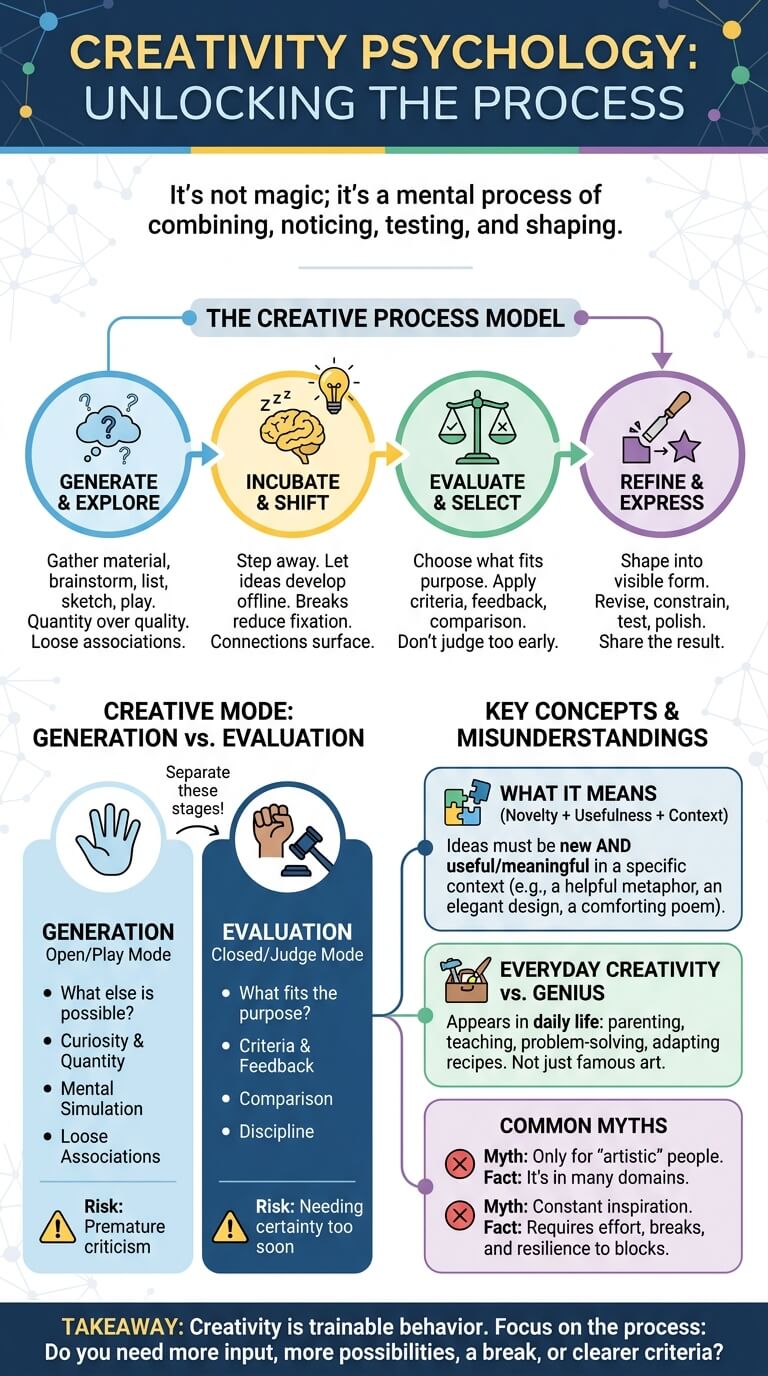
Creativity psychology studies how people produce ideas, images, solutions, and expressions that feel new, useful, meaningful, or fitting in a particular context. Creativity is partly supported by traits and experience, but it is not only a fixed gift. It usually involves a process: gathering material, generating possibilities, letting ideas shift, evaluating what works, and shaping the result into something visible.
The simple model: generate, explore, evaluate, refine
A practical way to understand creativity is to separate the messy early stage from the judgment stage. First, you generate and explore. Then you evaluate and refine. Many people struggle because they judge too early, or because they generate endlessly without choosing. Creative work usually needs both freedom and structure, but not at the same moment.
| Creative mode | Main question | What helps | What gets in the way |
|---|---|---|---|
| Generation | What else is possible? | Quantity, play, loose associations | Premature criticism |
| Exploration | Where could this idea lead? | Curiosity, examples, mental simulation | Needing certainty too soon |
| Evaluation | What fits the purpose? | Criteria, feedback, comparison | Confusing taste with fear |
| Refinement | How can this become clearer? | Revision, constraints, testing | Endless polishing or avoidance |
What Creativity Means in Psychology
Novelty, usefulness, and context
The APA Dictionary of Psychology describes creativity in terms of producing or developing original work, ideas, techniques, or thoughts. In everyday language, that sounds simple. In real life, two extra details matter: creative ideas are judged in context, and novelty alone is not enough.
A strange idea is not automatically creative. A useful idea is not automatically creative if it only repeats what everyone already knows. Most psychological definitions include some form of newness and usefulness, but usefulness does not always mean profitable or practical. A poem can be useful because it gives shape to grief. A joke can be useful because it changes the emotional tone of a room. A design can be useful because it solves a problem elegantly.
Everyday creativity vs artistic genius
Many people hear the word creativity and immediately think of famous painters, musicians, filmmakers, or inventors. That is one kind of creativity, but it is not the whole field. Everyday creativity shows up when someone adapts a recipe, explains a hard idea with a metaphor, finds a new route through a conflict, makes a room feel welcoming, or solves a small problem with the tools available.
This distinction matters because genius-based thinking can make creativity feel unreachable. If creativity only belongs to exceptional people, ordinary people stop noticing their own creative decisions. Psychology gives a more useful view: creative thinking can appear in small acts, repeated habits, social situations, problem solving, and private imagination.
Creative cognition vs creative personality
Creative cognition focuses on mental processes: memory, attention, imagination, association, evaluation, insight, and problem representation. Creative personality focuses more on tendencies, such as curiosity, openness, tolerance for ambiguity, or willingness to explore. Both can matter, but they are not the same thing.
This difference helps prevent confusion with personality topics. Openness to experience may make exploration more likely, but creativity psychology asks a different question: what is the mind doing when it creates? Someone can be open, curious, and expressive, yet still struggle to finish a project. Someone else may not see themselves as artistic, yet be highly creative in planning, teaching, business, caregiving, or repair work.
Why Creativity Matters in Human Behavior
Problem solving, meaning making, adaptation, and play
Creativity is not only about making beautiful things. It helps people adapt when familiar answers stop working. When a plan fails, creative thinking lets the mind look for alternatives. When an experience is painful or confusing, imagination can help people form meaning, tell a story, or picture a different future. When children play, they practice flexible thinking by turning objects, roles, and rules into something new.
The American Psychological Association frames creativity as something psychologists and neuroscientists study across people, processes, and environments. That broader view is helpful because creative behavior is influenced by mood, attention, culture, feedback, motivation, expertise, and the situation around the person.
Why people underestimate ordinary creativity
People often miss their own creativity because they compare their private process with someone else’s finished product. You see your messy notes, false starts, awkward drafts, and half-formed ideas. You see someone else’s polished painting, edited video, finished essay, or elegant solution. That comparison makes creativity look smoother than it is.
Another reason is that useful ideas often feel obvious after they appear. Once a solution fits, the mind may say, “Anyone could have thought of that.” But before the idea existed, the gap was real. Ordinary creativity often hides inside moments of adjustment, translation, reframing, and repair.
A Practical Mental Model of the Creative Process

Preparation: gathering material
Creativity rarely begins from nothing. The mind needs material to work with: experiences, examples, facts, emotions, images, conversations, mistakes, constraints, and memories. Preparation is the stage where you feed the system. Reading, observing, practicing, researching, living, asking questions, and studying the work of others all give the mind more pieces to combine later.
This is one reason people who seem naturally creative often have deep exposure to a field. A songwriter has heard thousands of songs. A designer has seen many layouts. A teacher has watched many students misunderstand the same idea in different ways. The creative moment may feel sudden, but it often rests on quiet accumulation.
Generation: producing possibilities
Generation is the stage where the mind produces options before it knows which one is best. This can look like brainstorming, freewriting, sketching, improvising, listing, asking unusual questions, or deliberately making bad versions so the mind loosens up. The point is not immediate quality. The point is range.
Divergent thinking is especially relevant here because it involves producing multiple possible responses rather than one correct answer. A deeper article on divergent thinking can explore fluency, flexibility, originality, and elaboration in more detail. For this overview, the key idea is simple: early creativity needs permission to make more than one path visible.
Incubation: letting ideas develop offline
Incubation happens when you step away from a problem and later return with a clearer idea, a new connection, or a different angle. This does not mean the mind has magically solved everything while you did nothing. It means some creative problems benefit from a shift in attention. Breaks can reduce fixation, loosen the grip of the first obvious answer, and allow other associations to surface.
Research on creative cognition often treats incubation with nuance. For example, a recent open-access study on mind wandering during incubation suggests that stepping away is not automatically helpful in every form. The type of task, the kind of break, and whether reflection is intentional can all change the effect. In plain English: a break helps most when it creates mental space, not when it becomes endless avoidance.
Evaluation: choosing and shaping ideas
Evaluation is where creative work becomes more disciplined. You ask what fits the audience, problem, medium, value, or constraint. You decide which ideas are worth developing and which ones are interesting but not right for this purpose. This stage is not the enemy of creativity. It protects creative work from staying vague forever.
The hard part is timing. Evaluate too early and you may crush ideas before they have a chance to grow. Evaluate too late and you may collect possibilities without turning any of them into something usable. A useful question is, “Am I judging this to improve it, or judging it to escape the discomfort of making it?”
Expression: making the idea visible
An idea becomes more creative in the world when it takes form. That form might be a sentence, diagram, recipe, lesson, prototype, melody, plan, conversation, or design. Expression reveals what the idea actually is. It also reveals what is missing.
This is why finished creative work often requires revision. The first visible version is not proof that the idea is good or bad. It is feedback. Once the idea is outside your head, you can compare intention with result. You can simplify, strengthen, reorganize, remove, or try again.
Main Topics in Creativity Psychology

Creative thinking psychology in daily life
Creative thinking psychology looks at how people form new connections, reframe problems, and move beyond automatic answers. In daily life, this might mean finding a gentler way to explain something, changing how you approach a stuck project, or noticing an assumption that limits your choices.
The deeper creative thinking article should be the next stop for readers who want practical mental habits. This hub only gives the overview: creative thinking is not random inspiration. It is flexible attention plus useful exploration.
Divergent thinking and multiple possibilities
Divergent thinking is the ability to generate several possible answers, uses, interpretations, or directions. It matters because creative work often begins with quantity before quality. You cannot choose a strong idea if only one idea is allowed to appear.
Still, divergent thinking is not the whole of creativity. A person can produce many ideas and still struggle to choose, test, or complete one. That is why divergent thinking belongs beside evaluation, not above it.
Creative blocks and psychological friction
A creative block is not always a lack of ideas. Sometimes it is fear of judgment, perfectionism, fatigue, unclear constraints, emotional overload, or too much pressure to be original. Sometimes the person has ideas but cannot tolerate the gap between the imagined result and the current skill level.
The creative block article should go deeper into troubleshooting. Here, the main point is that blocks are information. They may show where the process needs rest, clearer criteria, safer experimentation, smaller steps, or less harsh self-evaluation.
Flow state and absorbed creation
Flow state describes deep absorption in an activity where attention feels organized, time may feel altered, and the task is challenging enough to engage but not so hard that it overwhelms. Flow can appear in writing, sports, coding, music, design, teaching, games, or hands-on craft.
Flow is related to creativity, but it is not identical to creativity. Some creative work is slow, awkward, and uncertain. Some flow experiences are skilled but not especially original. A deeper flow state article should explain the conditions that make absorption more likely without turning creativity into a focus hack.
Incubation effect and why breaks help
The incubation effect explains why ideas sometimes improve after a pause. You stop staring at the problem directly, and later a connection becomes easier to see. This can happen during a walk, shower, commute, light chore, or quiet rest.
The key nuance is that incubation is not procrastination with a nicer name. A useful pause usually follows real contact with the problem. First you prepare and engage. Then you step back. Then you return and test what appeared.
Imagination as mental simulation
Imagination allows the mind to represent things that are not physically present: possible scenes, future outcomes, alternative selves, emotional situations, fictional worlds, and symbolic images. The APA Dictionary entry on imagery describes mental imagery as sensory-like experience in the mind without the matching external stimulus, and notes its role in creativity and problem solving.
In creativity, imagination is not only decoration. It lets people simulate before acting. A designer pictures how a user may move through a page. A writer hears a character’s voice. A parent imagines how a child might experience a rule. This mental rehearsal can make creative choices more emotionally and practically intelligent.
Originality vs creativity
Originality is about newness. Creativity is usually broader. An original idea may be strange, rare, or unexpected, but it may still need usefulness, meaning, skill, or context to become creative. A creative idea does not have to be completely disconnected from everything that came before. Most creative work recombines influences.
This distinction matters for people who reject their ideas because they are “not original enough.” In psychology, creativity is not pure invention from nothing. It often involves transforming existing material in a way that fits a new purpose.
Becoming more creative without forcing it
Becoming more creative does not mean trying to be brilliant on command. It usually means improving the conditions around the process: more input, more attempts, better questions, lower fear during early generation, clearer evaluation later, and enough rest for the mind to keep working.
A practical guide on becoming more creative can go deeper into habits and exercises. For this hub, the safer starting point is to treat creativity as trainable behavior, not as a personality label you either own or lack.
Which Creativity Topic Should You Read Next?

If you want better ideas, start with creative thinking
Choose the creative thinking psychology article if your main question is how ideas form in ordinary situations. This is the best next step if you want to understand reframing, association, curiosity, and mental flexibility without focusing only on art.
If you need more possibilities, read divergent thinking
Choose the divergent thinking article if you feel stuck on the first obvious answer. That topic should help you understand how the mind expands options, why quantity can matter before quality, and why flexible categories make ideation easier.
If you feel stuck, read creative block
Choose the creative block article if you have ideas but cannot start, continue, or finish. That article should focus less on inspiration and more on friction: fear, perfectionism, unclear goals, fatigue, pressure, and avoidance.
If you lose yourself in work, read flow state
Choose the flow state article if you want to understand absorbed attention. This is especially useful if you want to know why some tasks feel smooth and engaging while others feel scattered or forced.
If ideas arrive after stepping away, read incubation effect
Choose the incubation effect article if your best ideas often appear after a break. That topic should explain why pauses, distance, and lower-pressure attention can change the way a problem is represented.
If you live in mental images and possibilities, read imagination
Choose the imagination psychology article if your creative life is full of scenes, scenarios, inner dialogue, future pictures, or “what if” thinking. That topic should explain imagination as simulation, not just fantasy.
If you worry your ideas are not original, read originality vs creativity
Choose the originality vs creativity article if you often dismiss ideas because they resemble something else. That comparison can help you separate copying, influence, recombination, novelty, usefulness, and voice.
If you want a practice plan, read how to become more creative
Choose the practical creativity guide if you want habits. That article should move from understanding into action: prompts, constraints, routines, feedback, and ways to keep creating without forcing constant inspiration.
Common Misunderstandings About Creativity

Creativity is not the same as intelligence
Intelligence and creativity can overlap, but they are not identical. A person can be highly analytical and still struggle to generate unusual possibilities. Another person may not test as exceptional in traditional academic ways but may notice patterns, metaphors, designs, or solutions that others miss.
Creative work often needs both divergent and convergent thinking. It needs exploration and selection. Intelligence may help with learning, reasoning, and refinement, but creativity also depends on motivation, context, tolerance for uncertainty, emotional safety, and willingness to try imperfect versions.
Creativity is not only art
Art is one of the most visible forms of creativity, but creativity also appears in science, caregiving, engineering, education, entrepreneurship, humor, conflict repair, cooking, organizing, and everyday problem solving. A person who says “I am not creative” may actually mean “I do not make art.”
That distinction matters because people are more likely to practice creativity when they recognize the forms they already use. You may be creative in how you explain, arrange, adapt, negotiate, teach, plan, improvise, or comfort.
Creativity is not only openness to experience
Openness can support creativity because curiosity and interest in novelty may increase exploration. But openness is a trait, while creativity is also a process. If you only think of creativity as personality, you may ignore practical factors like preparation, feedback, timing, constraints, and emotional pressure.
This is why a person can feel creative in one season and blocked in another. The person’s trait profile did not completely change overnight. The process may have changed. Stress, lack of input, unclear expectations, isolation, criticism, or exhaustion may be affecting how ideas move.
Creativity is not constant inspiration
Inspiration is real, but it is not reliable enough to carry the whole process. Creative people often work before inspiration is present, then inspiration catches up during engagement. They also revise, discard, combine, and return.
Expecting constant inspiration can create unnecessary shame. A flat day does not prove you are not creative. It may mean the task needs a smaller entry point, more material, a clearer constraint, a break, or a less punishing standard for the first version.
When Creativity Becomes Stressful
Difference between normal frustration and distress
Creative frustration is common. It may feel like impatience, uncertainty, boredom, or disappointment when the current version does not match the imagined version. Normal frustration can still leave room for rest, perspective, and another attempt.
Distress is different. It may involve harsh self-criticism, sleep disruption, panic around performance, loss of pleasure, avoidance of everything related to the work, or a sense that your worth depends on producing something impressive. If creativity becomes tied to shame, fear, or constant pressure, the problem may no longer be only creative technique.
| Experience | More likely normal creative friction | May need more support |
|---|---|---|
| Feeling stuck | You can still take a small step later | You feel frozen for weeks and increasingly hopeless |
| Self-criticism | You notice flaws in the work | You attack your character or worth |
| Pressure | You care about the result | You feel unsafe, panicked, or unable to rest |
| Revision | You improve the work gradually | You cannot finish because nothing feels acceptable |
When to get support for anxiety, burnout, or severe self-criticism
If creative work is connected to ongoing anxiety, burnout, depression, severe perfectionism, or a harsh inner critic that affects daily life, it may help to speak with a qualified mental health professional. This is especially true if you feel unable to sleep, function, connect with others, or take care of yourself because of creative pressure.
The Cleveland Clinic’s overview of burnout describes burnout in terms of exhaustion, reduced motivation, lowered performance, and negative attitudes toward oneself or others. Creativity can suffer under those conditions, but more importantly, the person suffers. Support is not a sign that you failed at creativity. It may be the condition that helps you become human again before trying to produce more.
FAQ About Creativity Psychology
Is creativity learned or inherited?
Creativity is influenced by many factors, including temperament, personality, experience, environment, skill, motivation, and opportunity. Some people may be more naturally curious or comfortable with ambiguity, but that does not mean creativity is fixed. People can improve creative behavior by gathering richer input, practicing idea generation, learning a domain, using constraints, seeking feedback, and giving themselves room to revise.
Are creative people more emotional?
Some creative people are emotionally intense, but creativity does not require constant emotional drama. Emotion can provide material, meaning, and motivation, but creative work also needs attention, memory, evaluation, and craft. A calmer person can be deeply creative, and an emotional person may still need structure to turn feeling into expression.
Is imagination the same as creativity?
No. Imagination is the ability to mentally represent possibilities, scenes, images, futures, or alternatives. Creativity uses imagination, but it also involves selection, shaping, and expression. You can imagine many things without making something creative from them. Creativity begins to take form when imagination is organized toward a purpose, question, problem, or expression.
Why do ideas appear after a break?
Ideas may appear after a break because stepping away changes attention. You may stop repeating the same blocked approach, loosen the first assumption, and allow different associations to connect. Breaks work best after you have already engaged with the problem. Without preparation, a break may simply be a break. With preparation, it can become incubation.
Can adults become more creative?
Yes. Adults can become more creative, especially when they stop treating creativity as a rare identity and start treating it as a process. Useful changes include exploring more inputs, making more low-pressure attempts, separating idea generation from editing, learning from examples, using constraints, and building a healthier relationship with imperfect first versions.
Key Takeaways
- Creativity psychology explains creativity as a mental process involving generation, exploration, evaluation, refinement, and expression.
- Creative ideas usually need both novelty and usefulness, but usefulness depends on context, meaning, and purpose.
- Everyday creativity matters. It appears in problem solving, teaching, caregiving, humor, adaptation, planning, and communication, not only in art.
- Imagination, divergent thinking, incubation, and flow each support creativity in different ways, but none of them explains the whole process alone.
- Creative blocks often point to friction such as fear, perfectionism, fatigue, unclear constraints, or pressure, not simply a lack of talent.
- If creative pressure becomes tied to severe anxiety, burnout, or harsh self-criticism, support may matter more than another productivity technique.
The most useful first step is to notice which part of the creative process needs attention. Do you need more input, more possibilities, a break, clearer criteria, or a safer first draft? Once you know where the process is stuck, creativity becomes less like waiting for lightning and more like learning how your mind works.

Michael Reed is the Founder and Lead Writer at Psychology Exposed. He writes about human behavior, relationships, emotional patterns, self-awareness, and practical psychology topics using research-informed, easy-to-understand content.
Read More About Michael Reed: https://psychologyexposed.com/michael-reed/