
Many people use the words introvert and extravert as shortcuts for quiet and loud, private and social, shy and confident. That is easy to understand, but it is not accurate enough. In personality psychology, extraversion and introversion describe a broader pattern: how much stimulation a person tends to seek, how they often engage with the outer world, how quickly they move toward social contact, and how much recovery they may need after high-energy situations.
The APA Dictionary of Psychology describes introversion and extraversion as a continuum, not two separate boxes. That matters because most people are not pure introverts or pure extraverts. A person may love people but need quiet afterward. Another person may be talkative at work but private at home. Someone else may look confident in a group but still feel drained by constant stimulation.
This article explains extraversion vs introversion psychology in a practical way. You will learn what each side means, what it does not mean, how the spectrum works, why introversion is different from shyness or social anxiety, and how to work with your social energy without turning your personality into a problem to fix.
Quick Answer
Extraversion and introversion describe patterns of stimulation, social energy, assertiveness, and outward engagement, not whether someone is good or bad with people
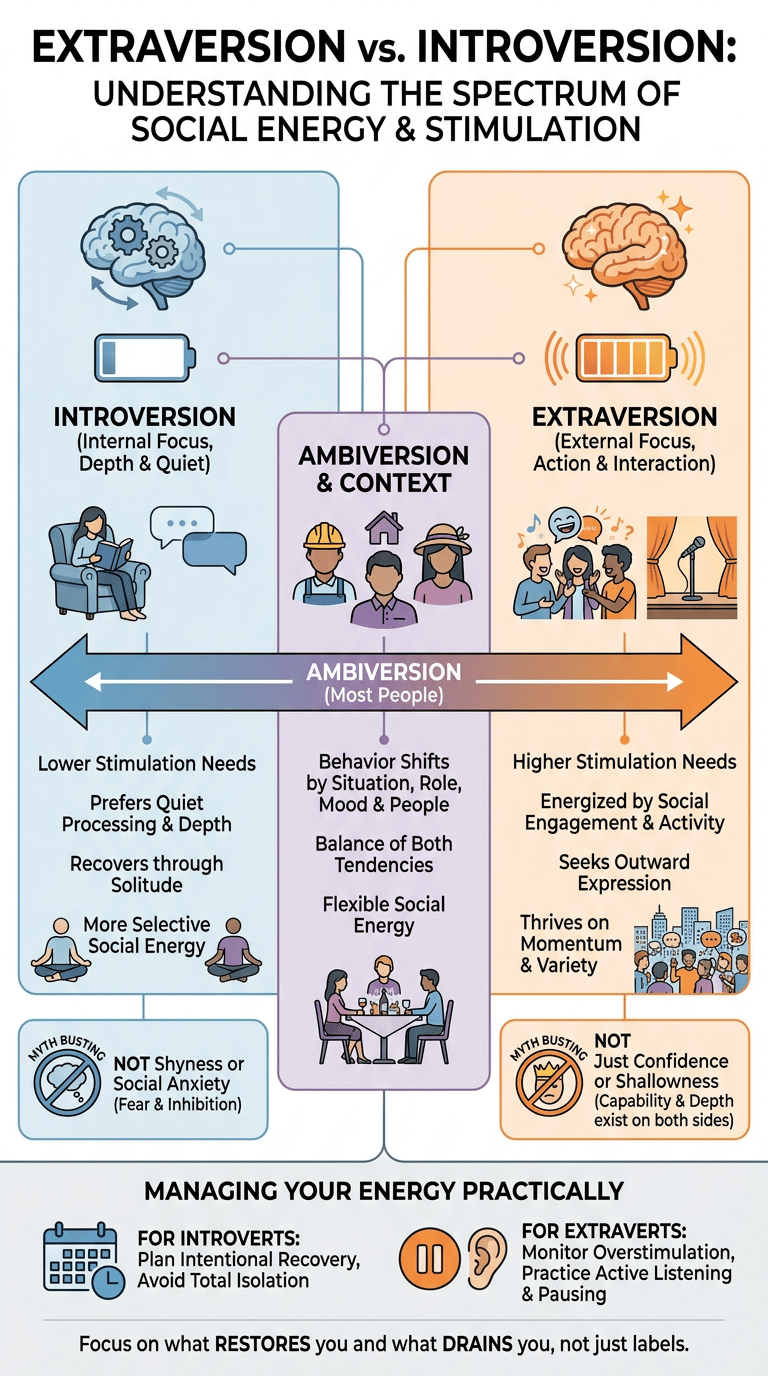
Extraversion usually means a person is more oriented toward social engagement, stimulation, activity, and outward expression. Introversion usually means a person needs less external stimulation, prefers more internal processing, and may recover through quiet or depth. Neither trait is better. Both describe tendencies, not fixed rules for every situation.
What Extraversion Means in Personality Psychology
Extraversion as a Big Five dimension
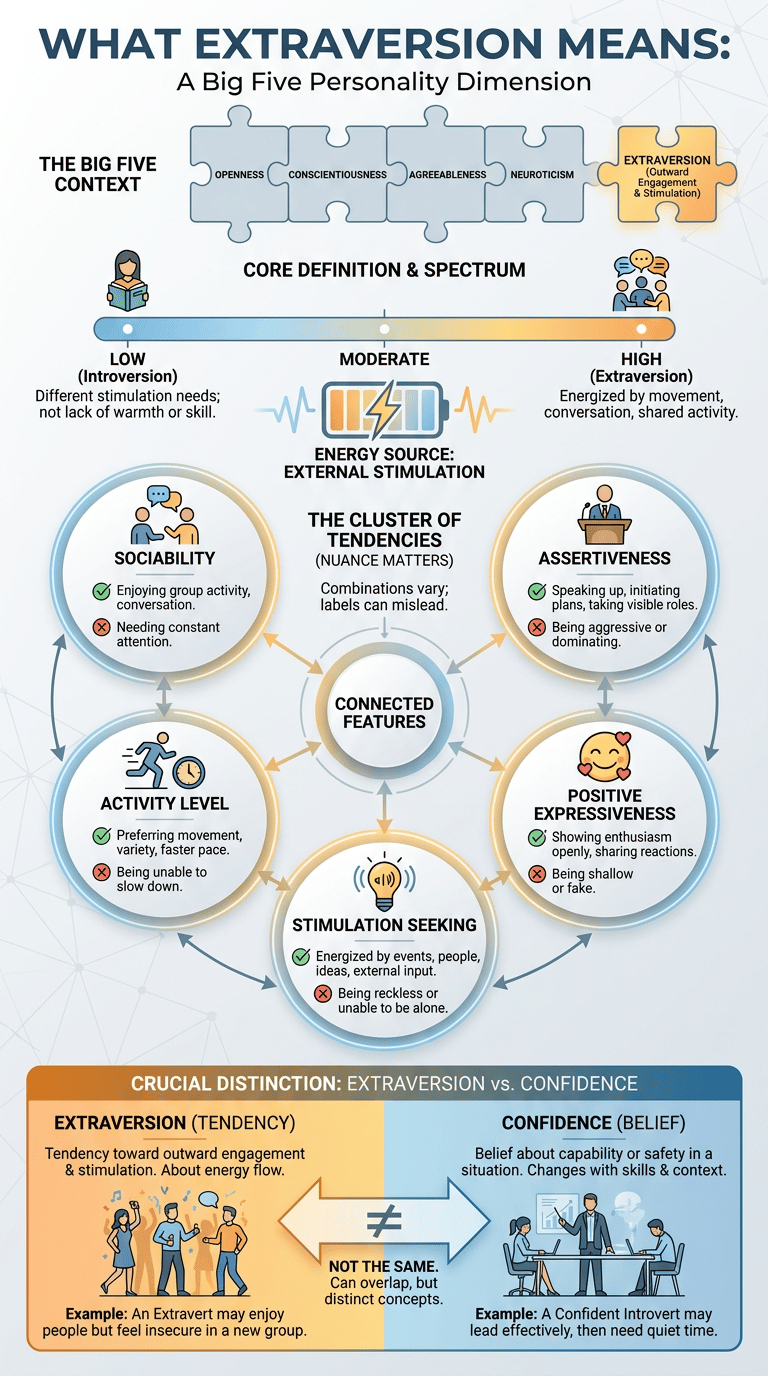
In the Big Five model, extraversion is one of the five broad personality dimensions, along with openness, conscientiousness, agreeableness, and neuroticism. The OpenStax Psychology 2e section on trait theorists presents the Big Five as broad trait dimensions that help describe consistent patterns in how people tend to think, feel, and behave.
Extraversion is not simply the number of friends someone has. It is closer to a cluster of tendencies that often includes sociability, energy, activity level, talkativeness, assertiveness, and positive emotional expression. A highly extraverted person may feel more alive when there is movement, conversation, novelty, or shared activity. They may think out loud, build momentum through interaction, and feel under-stimulated when life becomes too quiet for too long.
Still, extraversion is a dimension. A person can be high, moderate, or low. Low extraversion is often what people call introversion, but that does not mean a person has no social skill, no warmth, or no desire for connection. It means their natural stimulation needs and outward engagement may be different.
Sociability, assertiveness, activity level, and positive emotional expression
Extraversion often shows up through several connected features. Some people are high in all of them, but many are not. A person may be sociable but not assertive. Another person may be assertive at work but not interested in busy social events. This is one reason simple labels can mislead.
| Part of extraversion | What it can look like | What it does not automatically mean |
|---|---|---|
| Sociability | Enjoying group activity, conversation, and meeting people | Needing constant attention |
| Assertiveness | Speaking up, initiating plans, taking visible roles | Being aggressive or dominating |
| Activity level | Preferring movement, variety, and faster pace | Being unable to slow down |
| Positive expressiveness | Showing enthusiasm openly and sharing reactions quickly | Being shallow or fake |
| Stimulation seeking | Feeling energized by events, people, ideas, and external input | Being reckless or unable to be alone |
Thinking about these parts separately is more useful than asking, “Am I an extravert?” A better question is: which parts of outward engagement give me energy, and which parts drain me?
Why extraversion is not the same as confidence
Extraversion and confidence can overlap, but they are not the same. Confidence is a belief about capability or safety in a situation. Extraversion is a trait tendency toward outward engagement and stimulation. A confident introvert may speak clearly in a meeting, set boundaries, and lead a project, then still need quiet time afterward. An extravert may enjoy people and conversation but still feel insecure in a new group or during criticism.
This difference matters because many people judge themselves unfairly. If you are quieter, you may assume you lack confidence. If you are socially energetic, others may assume you never feel insecure. Both assumptions can be wrong. Personality describes tendencies. Confidence changes with skills, context, experience, safety, and feedback.
What Introversion Means in Personality Psychology
Introversion as lower extraversion on a spectrum
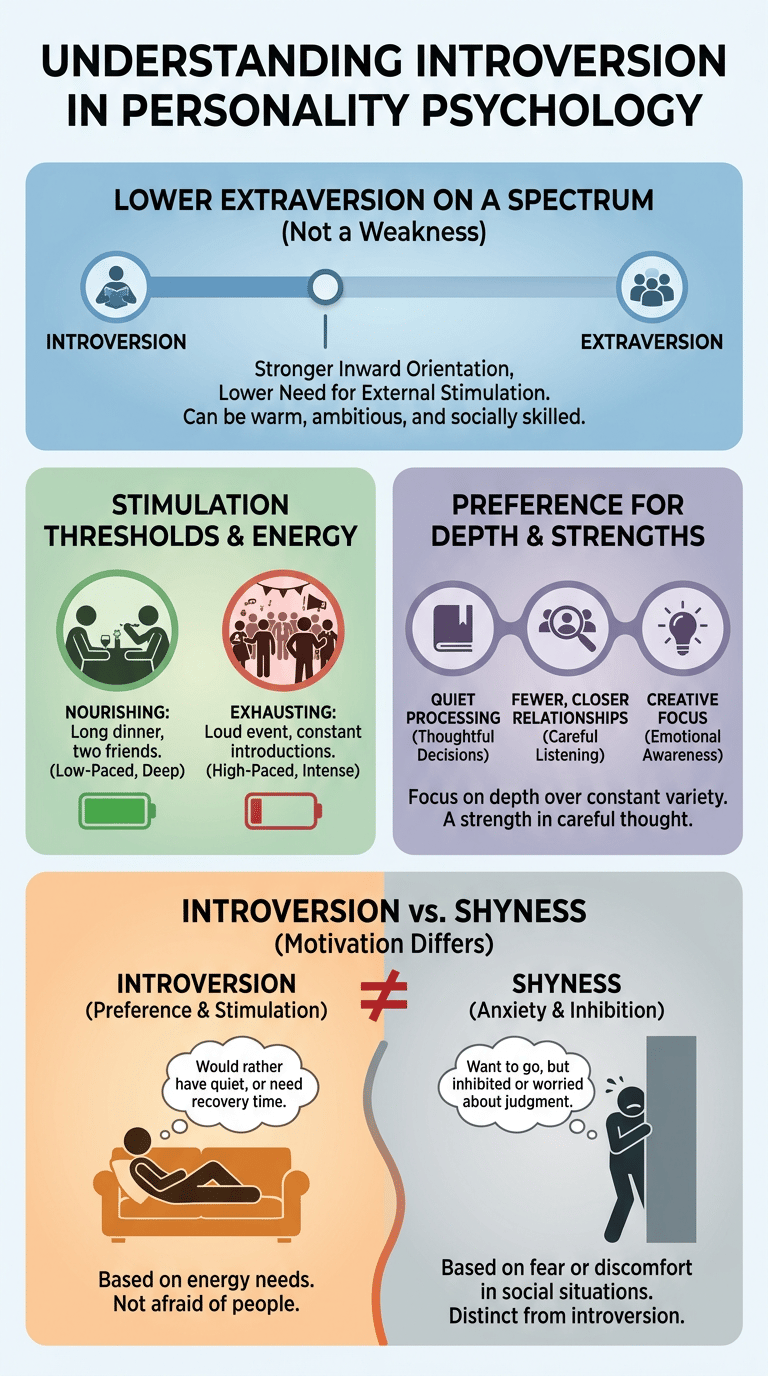
Introversion is often described as the lower end of extraversion, but that does not make it a weakness. It means a person may have a stronger inward orientation, lower need for external stimulation, or a preference for quieter forms of engagement. Introverts can be warm, funny, expressive, brave, ambitious, and socially skilled. They may simply have a different threshold for noise, speed, novelty, or group intensity.
For many introverted people, the issue is not people themselves. The issue is the amount, pace, and intensity of stimulation. A long dinner with two close friends may feel nourishing. A loud networking event with constant introductions may feel exhausting. Both are social, but they ask for very different kinds of energy.
Lower stimulation needs and preference for depth or quiet
Introversion often comes with a preference for depth over constant variety. That might mean one-on-one conversations instead of big group talk, reading before speaking, a few close relationships instead of many casual contacts, or a slower transition between work mode and social mode. It can also mean that the person notices subtle details because they are not trying to absorb every social cue at once.
This preference can be a strength. Quiet processing can support careful decisions, thoughtful listening, creative focus, and emotional self-awareness. It can also become costly if the person avoids all stimulation, says no to every opportunity, or assumes discomfort always means danger. The goal is not to force introverts to act extraverted all the time. The goal is to understand what kind of contact restores you, what kind drains you, and what kind is worth stretching for.
Why introversion is not the same as shyness
Shyness involves discomfort, inhibition, or anxiety in social situations. The APA Dictionary of Psychology definition of shyness describes it in terms of anxiety and inhibition during social situations. Introversion, by contrast, is more about preference and stimulation. A person can be introverted without feeling afraid of people. They may simply prefer fewer interactions, slower pacing, and more recovery time.
You can see the difference in motivation. An introverted person may skip a party because they would rather have quiet, or because they already spent the day in meetings and need to recover. A shy person may want to go but feel inhibited, exposed, or worried about being judged. The behavior may look similar from the outside, but the inner reason is different.
The Spectrum: Introvert, Extravert, and Ambivert
Why most people are not extreme on either end
Most people live somewhere near the middle. They may lean one way, but not in every setting. This is where the idea of ambiversion becomes useful. The APA Dictionary of Psychology definition of ambiversion describes a tendency to show introverted and extraverted characteristics in roughly equal degrees.
An ambivert may enjoy social time but not too much of it. They may lead a meeting and then want a quiet lunch. They may love deep conversation but dislike surface-level mingling. They may be energetic with close friends and reserved with strangers. This does not mean they are inconsistent. It means the situation changes which side of their personality becomes more visible.
How behavior can change by context
Your behavior may shift with role, mood, skill, familiarity, culture, stress, sleep, and the people around you. You might be talkative with siblings, quiet at work, confident online, cautious in a new city, and playful with people who feel safe. None of that cancels your personality. It shows that traits interact with context.
Think of personality as a usual range, not a prison. You may have a natural home base, but you can still move. An introverted teacher may become animated in class because the role is meaningful and structured. An extraverted writer may spend long hours alone because the project matters. A socially confident person may still become quiet around people who interrupt or judge.
Why labels can help but also limit self-understanding
Labels help when they give language to a real pattern. “I am introverted” can help someone stop shaming themselves for needing recovery. “I lean extraverted” can help someone understand why isolation feels unusually heavy. “I am more ambiverted” can help someone design a life with both connection and quiet.
Labels become limiting when they turn into rules. “I am an introvert, so I cannot speak up.” “I am an extravert, so I cannot enjoy solitude.” “I am an ambivert, so I have no real pattern.” A good personality label should increase flexibility, not reduce it. It should help you predict your needs without locking you into a smaller version of yourself.
Extraversion vs Introversion in Daily Life
Social gatherings and recovery time
At a social gathering, an extraverted person may warm up quickly. They may move between conversations, enjoy the energy of the room, and feel more awake as the event continues. An introverted person may prefer a smaller circle inside the gathering, one longer conversation, or a clear exit plan. They may enjoy the event and still need quiet afterward.
The misunderstanding happens when people judge the visible behavior without asking about the energy behind it. Leaving early does not always mean dislike. Talking a lot does not always mean attention-seeking. Wanting a full weekend with friends does not always mean neediness. Wanting a blank Sunday does not always mean avoidance.
Work style, meetings, and collaboration
In work settings, extraverted people may process ideas through discussion. They may offer thoughts before they are fully formed because speaking helps them think. Introverted people may prefer time to review, write, or think before responding. If a team values only fast verbal input, introverts can be underestimated. If a team values only quiet independent work, extraverts can be seen as disruptive even when they are trying to build momentum.
| Work situation | Extraverted tendency | Introverted tendency | Balanced approach |
|---|---|---|---|
| Brainstorming | Thinks through conversation | Thinks better with preparation time | Send prompts before the meeting, then discuss |
| Meetings | May speak early and often | May wait until their idea is clear | Invite both live input and written follow-up |
| Collaboration | May want frequent check-ins | May want longer focus blocks | Agree on rhythm instead of guessing |
| Feedback | May prefer direct conversation | May prefer time to reflect before reply | Give feedback clearly, then allow processing |
A good environment does not force everyone into one style. It creates more than one path for contribution.
Communication pace and processing style
Extraverted communication often looks faster, more outward, and more interactive. Introverted communication often looks more selective, reflective, and internally organized. Neither pace is automatically better. Fast talk can bring energy and creativity, but it can also miss details. Slow processing can bring thoughtfulness and precision, but it can also be mistaken for disengagement.
If you lean extraverted, you may help others by leaving space after asking a question. If you lean introverted, you may help others by naming your process: “I am thinking, not ignoring you. I need a few minutes.” Simple signals reduce misunderstanding without requiring either person to change their temperament.
Risk of misunderstanding between different energy patterns
Different energy patterns often create stories. The extravert may think, “They are bored with me.” The introvert may think, “They are overwhelming me.” The extravert may hear quiet as rejection. The introvert may hear enthusiasm as pressure. These interpretations are understandable, but they are not always true.
The repair begins with translation. “I need quiet after work” can mean recovery, not distance. “I want to invite people over” can mean connection, not disrespect for rest. “I am excited and talking fast” can mean energy, not control. “I am quiet in groups” can mean listening, not dislike.
Common Myths About Introverts and Extraverts
Myth: introverts dislike people
Many introverts care deeply about people. They may simply prefer smaller doses, familiar settings, or deeper contact. They might enjoy a long conversation with one person more than a room full of quick introductions. They may also be highly loyal friends because they invest carefully.
A more accurate statement is: introverts often have selective social energy. When they choose people, spaces, and timing wisely, they may be very engaged. When they are overloaded, they may look withdrawn even if they still care.
Myth: extraverts are shallow
Extraverts are sometimes judged as surface-level because they may enjoy broad social contact, visible enthusiasm, or fast conversation. But breadth does not mean lack of depth. Some extraverts process emotion through talking, learn through interaction, and build intimacy by sharing experiences. Their depth may be more outwardly expressed.
A more accurate statement is: extraverts often connect through engagement. They may still value serious conversation, privacy, loyalty, and reflection. They may simply reach those places through a more active route.
Myth: introversion means social anxiety
Introversion can exist without fear. Social anxiety involves fear, distress, and avoidance that can interfere with life. NIMH explains that social anxiety disorder is more than just shyness, and may include intense fear of being judged, embarrassed, or humiliated in social or performance situations.
This distinction protects both introverts and people with anxiety. Introverts should not be treated as if their preference is automatically a disorder. People with social anxiety should not be told they are “just introverted” if fear is limiting their life, relationships, work, or education.
Myth: one side is better for success
Some environments reward extraverted behavior: speaking up quickly, networking, presenting, persuading, leading from the front. Other environments reward introverted strengths: careful analysis, deep work, listening, patience, observation, and independent focus. Real success often requires a combination of social flexibility, self-awareness, skill, timing, and values.
Trying to rank introversion and extraversion usually misses the point. A better question is: which environments bring out your best contribution, and which skills are worth developing so your trait does not become a limitation?
Introversion vs Shyness vs Social Anxiety
Shyness is discomfort or inhibition, not simply low extraversion
Shyness often includes wanting to engage but feeling held back. A shy person may want to join the conversation but worry about saying something wrong. They may want to attend an event but feel physically tense. An introverted person may feel calm about attending and still choose not to because it does not match their energy needs.
Here is a useful distinction: introversion is often about preference, shyness is often about inhibition, and social anxiety is often about fear that becomes distressing or impairing. They can overlap, but they should not be treated as the same thing.
Social anxiety involves fear and distress that may need support
Social anxiety is not simply being quiet. It may involve intense fear of scrutiny, avoidance of important situations, physical symptoms, or worry that interferes with daily life. A person may avoid classes, meetings, dating, phone calls, meals in public, or normal activities because the fear feels too strong.
That does not mean you should diagnose yourself from one article. It means intensity, distress, and impairment matter. If social situations regularly create panic, humiliation, severe avoidance, or a sense that your life is shrinking, it may be worth speaking with a qualified mental health professional.
How to tell preference from fear
| Question | Preference may sound like | Fear may sound like |
|---|---|---|
| Why am I saying no? | “I would rather rest or spend time differently.” | “I want to go, but I am scared I will embarrass myself.” |
| How do I feel afterward? | Rested, clear, or simply neutral | Relieved at first, then ashamed or trapped |
| What happens if I must attend? | I can manage it, though I may need recovery | I feel intense dread or physical panic |
| Is my life getting smaller? | No, I choose fewer but meaningful contacts | Yes, fear blocks work, school, relationships, or normal tasks |
This table is not a diagnostic tool. It is a reflection guide. If fear is repeatedly driving the decision and limiting your life, support can help you understand what is happening.
How To Work With Your Social Energy
If you lean introverted, plan recovery instead of isolation
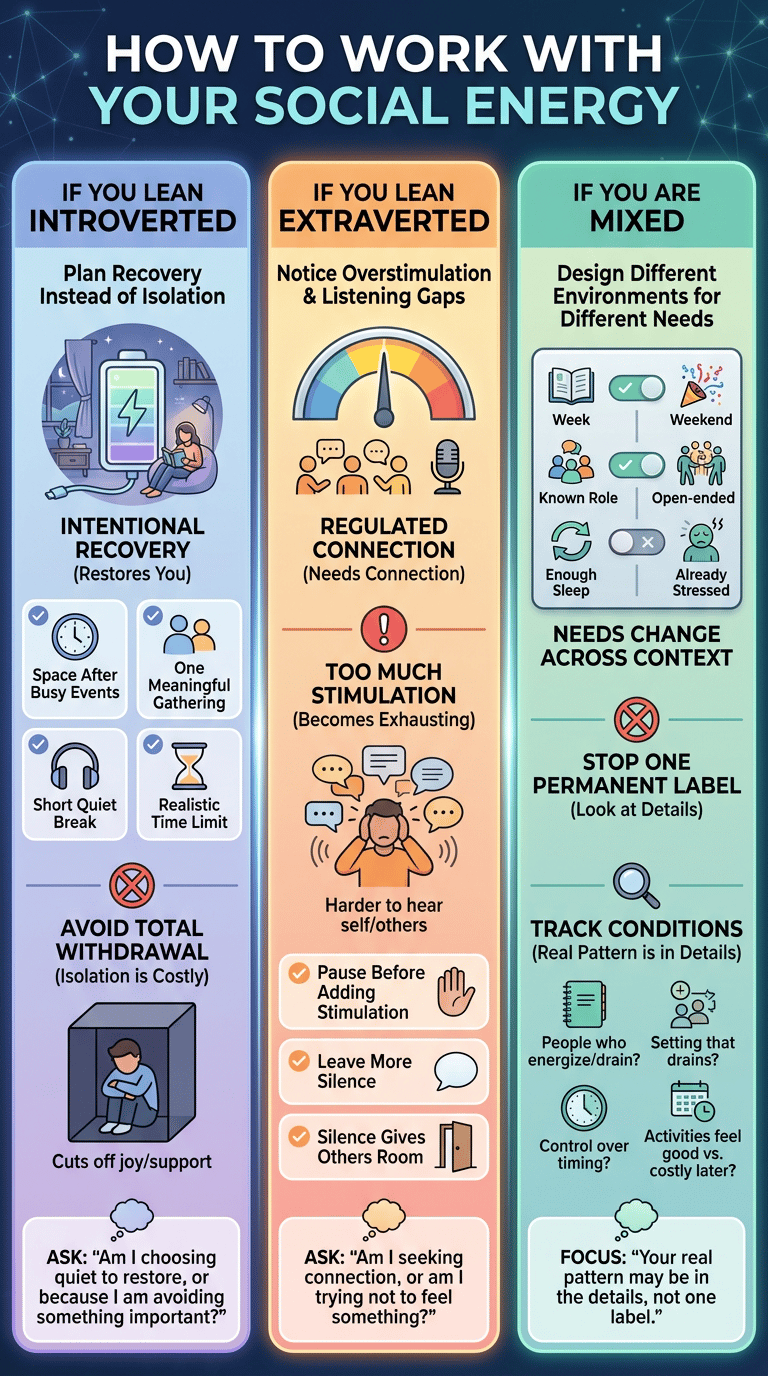
Introverted people often do better when they plan recovery intentionally. That might mean leaving space after a busy event, choosing one meaningful gathering instead of three, taking a short quiet break during a long workday, or setting a realistic time limit before agreeing to a plan.
The key is to avoid turning recovery into total withdrawal. Quiet time restores you when it gives your system a chance to settle. Isolation becomes costly when it cuts you off from people, growth, joy, or support you actually want. A practical rule is to ask: “Am I choosing quiet because it restores me, or because I am avoiding something important?”
If you lean extraverted, notice overstimulation and listening gaps
Extraverted people may need connection to feel regulated, but too much stimulation can still become exhausting. Constant plans, nonstop talking, and always needing input can make it harder to hear yourself. You may also miss cues from people who need more space or slower pacing.
A practical rule is to pause before adding more stimulation. Ask: “Am I seeking connection, or am I trying not to feel something?” In conversation, try leaving a little more silence than feels natural. Silence is not always awkward. Sometimes it gives the other person enough room to enter.
If you are mixed, design different environments for different needs
If you are closer to the middle, your needs may change across context. You may want quiet during the week and social energy on weekends. You may like groups when you know your role, but dislike open-ended mingling. You may enjoy meeting new people when you have enough sleep and avoid it when you are already stressed.
Mixed patterns are easier to manage when you stop asking for one permanent label. Instead, track conditions. What kind of people energize you? What kind of setting drains you? How much control over timing do you need? Which activities feel good during the event but costly afterward? Your real pattern may be in the details.
Bridge Topics for the Personality Cluster
How extraversion interacts with agreeableness
Extraversion describes outward engagement, while agreeableness describes warmth, cooperation, empathy, and concern for harmony. A person can be highly extraverted and low in agreeableness, which may look bold but blunt. Another person can be introverted and high in agreeableness, which may look quiet but deeply considerate.
This distinction prevents a common mistake: assuming social energy equals kindness. Someone can be friendly in a visible way but not very considerate. Someone else can be reserved but extremely caring. Looking at traits together gives a more accurate picture than judging one behavior alone.
How neuroticism can make social situations feel more threatening
Neuroticism involves a tendency toward stronger negative emotional reactivity, such as worry, self-doubt, or sensitivity to threat. When neuroticism is higher, a social situation may feel more risky even if the person is not especially introverted. They may replay conversations, expect criticism, or feel unsettled after minor awkwardness.
That is why “introvert” is not always the full explanation. A person may avoid social situations because they have low stimulation needs, because they feel anxious, because they have had painful experiences, or because their environment is genuinely unwelcoming. The same behavior can have different roots.
How personality change can involve flexible behavior without changing your core preference
Personality traits tend to be relatively stable, but behavior can become more flexible. An introverted person may learn to present, network, or initiate plans in ways that respect their recovery needs. An extraverted person may learn to enjoy solitude, listen longer, or slow their pace without losing their social warmth.
Research on personality and social attention suggests extraversion is connected with how people respond to social stimuli, but everyday life is more than one trait. One open-access study on extraversion and social stimuli found differences in how social cues captured attention, which is useful as one research window rather than a total explanation of anyone’s personality.
When To Get Support
Get support if social situations cause intense fear, avoidance, panic, humiliation, or daily-life impairment
Introversion itself does not need treatment. Extraversion itself does not need treatment. Support becomes important when fear, panic, avoidance, shame, or distress starts limiting your life. That might look like avoiding school, work, relationships, public places, calls, meetings, or normal responsibilities because social exposure feels unbearable.
It is also worth getting support if you feel trapped by a label. “I am just introverted” should not become a reason to ignore severe distress. “I am extraverted” should not become a reason to avoid being alone with your thoughts. A mental health professional can help you sort preference from fear, habit from anxiety, and personality from distress.
People may not completely switch from introvert to extravert, but it is still useful to ask whether introverts can become more social through practice, confidence, and changing comfort zones.
FAQ
Can an introvert enjoy parties?
Yes. Introverts can enjoy parties, especially when the setting feels comfortable, the people are familiar, or the event has meaningful conversation. The difference is often recovery. An introvert may enjoy the party and still need quiet afterward. Enjoyment and energy cost can both be true.
Can an extravert need alone time?
Yes. Extraverts are not machines that run on constant social contact. They may still need sleep, privacy, reflection, and emotional space. Extraversion means social engagement often gives energy, not that solitude is useless or unwanted.
Is ambivert a real personality category?
Ambivert is a useful everyday label for people who show both introverted and extraverted tendencies. In trait psychology, it often means someone is closer to the middle of the introversion-extraversion spectrum. It is helpful if it describes your pattern, but it should not become a rigid identity.
How is introversion different from social anxiety?
Introversion is usually about stimulation preference and recovery needs. Social anxiety involves fear, distress, and avoidance related to being judged, embarrassed, or scrutinized. A person can be introverted without social anxiety, socially anxious without being deeply introverted, or both.
Can introversion or extraversion change?
Your broad tendency may stay recognizable over time, but your behavior can become more flexible. You can build social confidence, learn to rest better, practice speaking up, choose better environments, and adjust habits. Change does not have to mean becoming the opposite of who you are.
Key Takeaways
- Extraversion and introversion are best understood as a spectrum of outward engagement, stimulation needs, and social energy.
- Introversion is not the same as shyness or social anxiety, although they can overlap in some people.
- Extraversion is not the same as confidence, popularity, or emotional shallowness.
- Most people show different levels of introverted or extraverted behavior depending on role, safety, stress, familiarity, and environment.
- Working with your trait means designing better rhythms for connection, quiet, recovery, stimulation, and contribution.
- Support may help when social fear, panic, humiliation, avoidance, or distress begins to limit daily life.
Final Thoughts
The most useful question is not “Am I an introvert or an extravert?” It is “What kind of energy do I need, and what kind of life helps me use that energy well?” When you understand your place on the spectrum, you can stop forcing yourself into stereotypes. You can choose social contact more wisely, protect recovery without disappearing, seek stimulation without overwhelming yourself, and respect people whose energy patterns look different from yours.
Start with one observation this week. Notice when you feel more alive, when you feel drained, and what kind of recovery actually helps. That small pattern may tell you more than any label used too quickly.

Michael Reed is the Founder and Lead Writer at Psychology Exposed. He writes about human behavior, relationships, emotional patterns, self-awareness, and practical psychology topics using research-informed, easy-to-understand content.
Read More About Michael Reed: https://psychologyexposed.com/michael-reed/