
Emotions can feel like they arrive before you have time to think. A small look from someone can feel like rejection. A mistake can turn into shame. A delayed reply can bring jealousy, loneliness, or a wave of old fear. When emotions feel this fast, it is easy to treat them as problems to remove, weaknesses to hide, or facts you must obey.
Emotion psychology offers a steadier way to understand them. Emotions are not random noise, and they are not perfect truth. They are whole-person responses that involve the body, attention, memory, meaning, impulse, and social context. They often tell you that something matters, but they still need interpretation.
This guide explains the big picture: what emotions are, why they matter, how they differ from feelings and moods, and how specific emotions like shame, guilt, jealousy, envy, embarrassment, loneliness, and emotional triggers fit into a larger map. It is not a guide to suppressing emotions or forcing yourself to calm down. The aim is understanding first, because people usually handle emotions better when they can name what is happening without judging themselves for having a human response.
Quick Answer
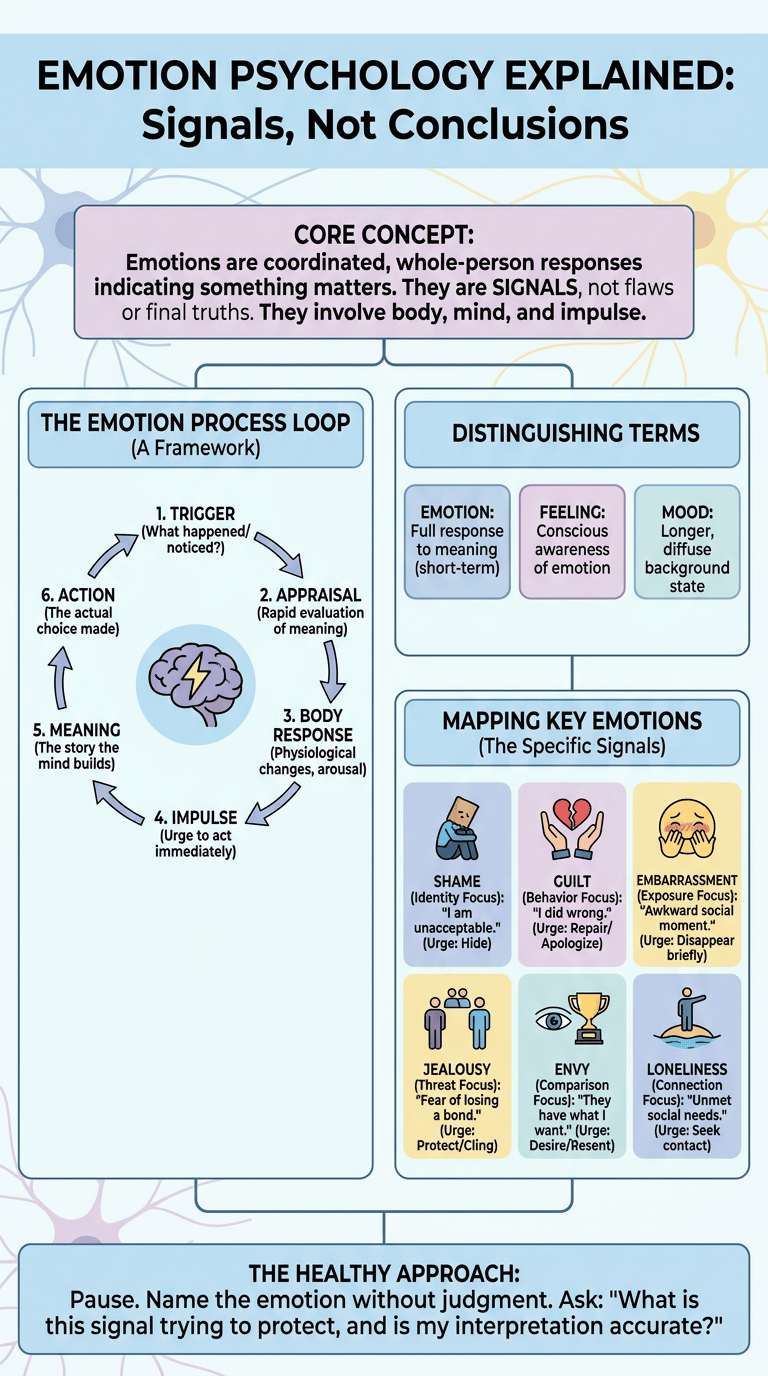
Emotion psychology studies how emotions begin, what they do, and how they shape thoughts, body sensations, behavior, and relationships. An emotion is more than a feeling. It usually includes a trigger, an interpretation of what the trigger means, body changes, an urge to act, and a conscious experience. Emotions can be useful signals, but they are not always complete or accurate conclusions.
What emotions are in psychology
In psychology, emotions are often understood as coordinated responses to something meaningful. The American Psychological Association describes emotions as involving more than private feeling, because emotion also includes some kind of engagement with the world. That engagement may be visible, like crying, smiling, freezing, withdrawing, or speaking sharply. It may also be internal, like replaying a memory or preparing to protect yourself.
A single emotion can involve several layers at once. Fear may include a tight chest, a scanning mind, a prediction of danger, and an urge to escape. Guilt may include heaviness, mental replay, concern about harm, and a pull toward repair. Envy may include comparison, desire, and the painful belief that someone else has something you lack.
Why emotions are not the same as moods or personality
An emotion is usually tied to something, even if the connection is not obvious at first. A mood is more diffuse and can last longer without a clear object. Personality is broader still. A person may be emotionally sensitive without being “dramatic,†and a person may feel anger in one situation without being an angry person.
This distinction matters because people often turn temporary emotional states into identity statements. Emotion psychology helps separate the feeling from the story the mind builds around it.
What Emotion Psychology Means
Emotion psychology looks at how emotional responses are created, expressed, interpreted, and used. It includes biological responses, learned associations, social rules, personal memory, culture, and the meanings people attach to events. It does not reduce emotions to one simple cause. To see how feeling, appraisal, body response, and action tendency fit together, start with what emotions mean in psychology.
Emotions as signals, not character flaws
A painful emotion does not automatically mean there is something wrong with you. It often means your mind and body have detected something important. That “something†may be a real situation, an old association, a possible threat, a broken value, a social risk, a need for connection, or a meaning your brain assigned very quickly.
For example, shame may signal that belonging feels at risk. Guilt may signal that a value or responsibility needs attention. Jealousy may signal fear of losing a bond, role, or priority. Loneliness may signal a need for more meaningful connection, even if people are physically nearby.
The difference between emotions, feelings, moods, and reactions
| Term | Plain-English meaning | Example |
|---|---|---|
| Emotion | A response to something meaningful that involves body, attention, meaning, and impulse | Feeling embarrassed after saying the wrong name in a meeting |
| Feeling | The conscious experience of the emotion | Noticing heat in your face and thinking, “I feel embarrassed†|
| Mood | A longer-lasting emotional background state | Feeling irritable all afternoon without one clear cause |
| Reaction | What you do or almost do because of the emotion | Apologizing quickly, leaving the room, checking your phone, or going silent |
These categories overlap in real life. Still, separating them helps you respond with more accuracy. You may not choose the first feeling, but you can become more thoughtful about the meaning and the next action.
Why Emotions Matter in Everyday Life
Emotions influence much more than private inner experience. They shape attention, memory, communication, decisions, and how people interpret other people’s behavior. Even when someone thinks they are being “purely logical,†emotion can still be shaping what feels important, urgent, fair, safe, or threatening.
How emotions guide attention, memory, choices, and behavior
Emotion acts like a spotlight. When you feel anxious, your mind may search for risk. When you feel ashamed, your mind may scan for signs of rejection. When you feel jealous, your attention may lock onto anything that looks like replacement. When you feel guilty, you may replay what happened until you find a way to repair it.
This spotlight can be useful. It helps people react quickly, protect relationships, notice unfairness, and move toward what matters. But it can also narrow the view. A jealous mind may miss evidence of trust. A shame-filled mind may ignore evidence of care. A lonely mind may interpret neutral silence as proof of being unwanted.
Why emotions can feel automatic before they feel logical
Emotions often begin as rapid appraisals, which means the mind evaluates what an event means before you have fully explained it to yourself. A tone of voice may be appraised as criticism. A facial expression may be appraised as rejection. A mistake may be appraised as social danger. Appraisal theory has been one major way researchers explain how situations become emotionally meaningful, and work available through PubMed Central on appraisal and emotion discusses how appraisals relate to emotional responses and later regulation choices.
This is why two people can experience the same event differently. One person sees a short reply as normal busyness. Another sees it as distance. One person hears feedback as information. Another hears it as proof they failed. The event matters, but the meaning given to the event matters too.
A Simple Framework for Understanding Emotions
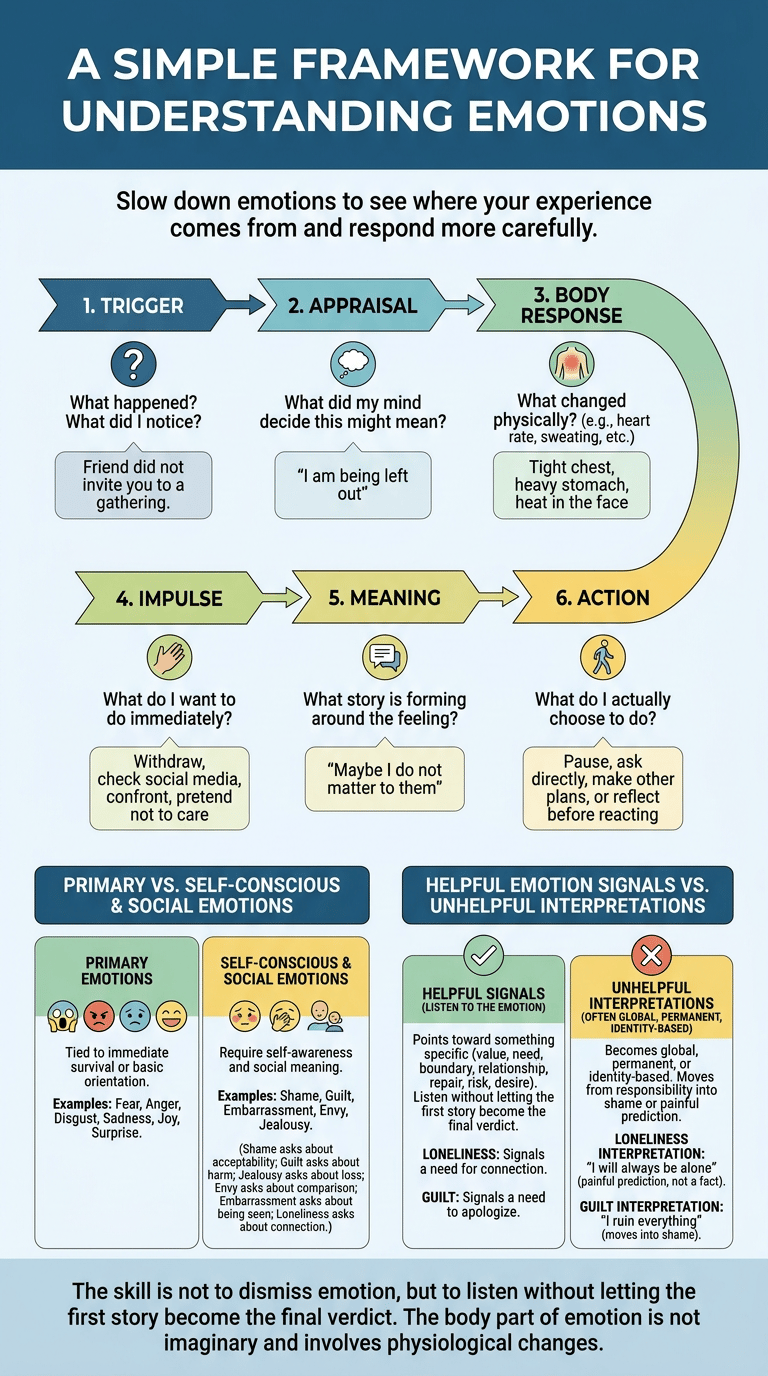
A useful way to understand emotion is to slow it down into parts. This does not make the emotion fake or less real. It helps you see where your experience may be coming from and where you have room to respond more carefully.
Trigger, appraisal, body response, impulse, meaning, action
| Part of emotion | Question to ask | Example |
|---|---|---|
| Trigger | What happened, or what did I notice? | A friend did not invite you to a gathering |
| Appraisal | What did my mind decide this might mean? | “I am being left out†|
| Body response | What changed physically? | Tight chest, heavy stomach, heat in the face |
| Impulse | What do I want to do immediately? | Withdraw, check social media, confront, pretend not to care |
| Meaning | What story is forming around the feeling? | “Maybe I do not matter to them†|
| Action | What do I actually choose to do? | Pause, ask directly, make other plans, or reflect before reacting |
The body part of emotion is not imaginary. The NCBI Bookshelf discussion of physiological changes associated with emotion describes how arousal can involve heart rate, blood flow, sweating, gastrointestinal activity, and other autonomic responses.
Primary emotions vs self-conscious and social emotions
Some emotions are tied to immediate survival or basic orientation, such as fear, anger, disgust, sadness, joy, and surprise. Others require self-awareness and social meaning, including shame, guilt, embarrassment, envy, and jealousy.
This cluster focuses on emotions that often confuse people because they carry social meaning. Shame asks about acceptability. Guilt asks about harm. Jealousy asks about loss. Envy asks about comparison. Embarrassment asks about being seen. Loneliness asks about connection.
Helpful emotion signals vs unhelpful emotion interpretations
An emotion can be useful without every interpretation being true. Feeling lonely may accurately signal a need for connection, but the thought “I will always be alone†may be a painful prediction, not a fact. Feeling guilty may accurately signal a need to apologize, but the thought “I ruin everything†moves from responsibility into shame.
A helpful emotion signal usually points toward something specific: a value, need, boundary, relationship, repair, risk, or desire. An unhelpful interpretation often becomes global, permanent, or identity-based. The skill is not to dismiss emotion. It is to listen without letting the first story become the final verdict.
The Main Emotion Topics in This Cluster
The emotions in this cluster are related, but they do not answer the same question. Seeing the difference helps prevent emotional confusion and helps each article stay focused.
Basic emotion understanding: What Are Emotions in Psychology
The foundational article on emotions explains what an emotional response is and how emotion differs from feeling, mood, personality, and behavior. It is the best next step if you want the mechanics before exploring one emotion deeply.
Self-evaluative emotions: shame, guilt, and embarrassment
Shame, guilt, and embarrassment all involve self-awareness, but they point in different directions. Shame is about identity and exposure. Guilt is about behavior, responsibility, and repair. Embarrassment is about awkward visibility or social missteps. Confusing them can make the wrong response feel necessary.
Comparison emotions: jealousy and envy
Jealousy and envy both involve other people, but they are not the same. Jealousy usually involves fear of losing something valued, such as a bond, role, attention, or priority. Envy involves wanting something another person has, such as status, ease, beauty, success, confidence, or belonging.
Social pain and disconnection: loneliness
Loneliness is not simply being alone. It is the painful sense that your need for connection is not being met in the way you need. A person can feel lonely while surrounded by people if the connection feels shallow, unsafe, unavailable, or unseen.
Emotional triggers: why certain situations hit harder
Emotional triggers are moments that activate a response stronger than the visible event seems to explain. The current event may be real, but it may also connect to memory, learned threat, old shame, repeated disappointment, or a familiar pattern. Triggered does not mean irrational. It means the present moment has emotional associations.
How to Know Which Emotion Article to Read Next
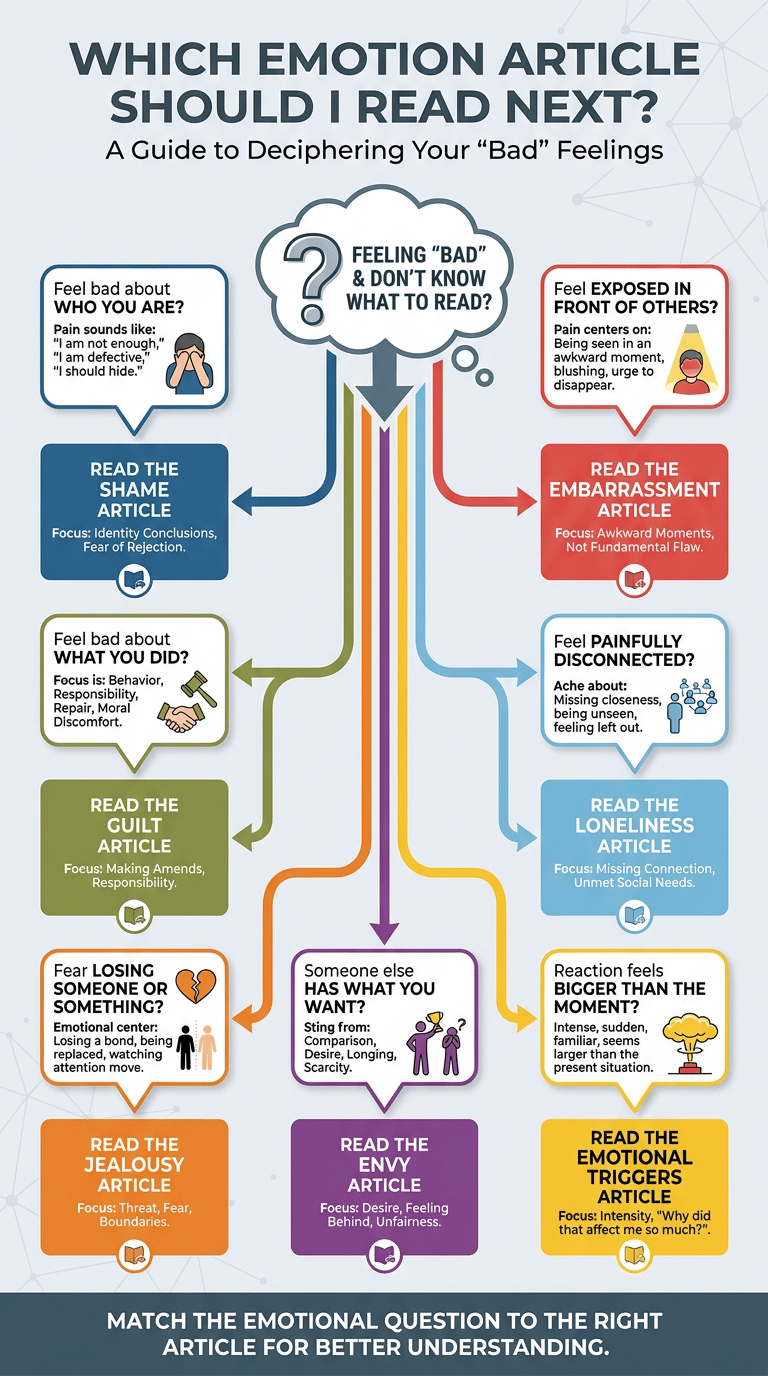
If you only know that you feel “bad,†it can help to ask what kind of bad it is. The next article you read should match the emotional question that keeps repeating.
If you feel bad about who you are, start with shame
Choose the shame article when the pain sounds like “I am not enough,†“I am defective,†“I should hide,†or “If people really knew me, they would reject me.†Shame is especially important to understand because it can turn ordinary mistakes into identity conclusions.
If you feel bad about what you did, start with guilt
Choose the guilt article when the focus is behavior, responsibility, repair, or moral discomfort. Guilt can be useful when it helps you make amends. It becomes more complicated when it is excessive, vague, or attached to responsibility that is not truly yours.
If you fear losing someone or something, start with jealousy
Choose jealousy when the emotional center is threat: losing a bond, losing priority, being replaced, or watching attention move elsewhere. Jealousy needs careful handling because it can reveal a fear or boundary, but it can also lead to checking, accusation, or control if acted out without reflection.
If someone else has what you want, start with envy
Choose envy when the emotional sting comes from comparison. You may not want to admit the envy, especially if you care about the person. But envy often points to desire, longing, scarcity, unfairness, or a part of life where you feel behind.
If you feel exposed in front of others, start with embarrassment
Choose embarrassment when the pain centers on being seen in an awkward moment. Embarrassment often brings blushing, replaying, nervous laughter, or the urge to disappear. It differs from shame because the event may be awkward without meaning you are fundamentally flawed.
If you feel painfully disconnected, start with loneliness
Choose loneliness when the ache is about missing closeness, being unseen, feeling left out, or lacking meaningful connection. Loneliness is not proof that you are unwanted. It may be a signal that your social needs and your current connections are mismatched.
If your reaction feels bigger than the moment, start with emotional triggers
Choose emotional triggers when your reaction feels intense, sudden, or familiar in a way that seems larger than the present situation. This is especially useful when you keep asking, “Why did that affect me so much?â€
Shame Psychology Summary
Shame is one of the most identity-focused emotions. It does not simply say, “I made a mistake.†It says, “Something about me is unacceptable.†That is why shame often brings hiding, silence, defensiveness, people-pleasing, or self-attack. Because shame turns an event into a judgment about the self, shame psychology looks closely at hiding, self-attack, and the shame spiral.
What shame usually signals
Shame often signals a perceived threat to belonging, dignity, or acceptance. It may appear after rejection, criticism, social comparison, vulnerability, humiliation, or failure. The danger is that shame can treat one moment as evidence of your whole worth.
How shame differs from guilt and embarrassment
Guilt can ask for repair. Embarrassment can ask for social recovery. Shame often asks you to disappear. That is why understanding shame matters. A mistake may need accountability, but it does not need an identity sentence.
Guilt Psychology Summary
Guilt is usually connected to behavior, responsibility, and values. It can be uncomfortable because it points toward something that may need attention. Unlike shame, guilt does not have to define the whole self. When the concern is responsibility for a specific action rather than a defective identity, guilt psychology offers the more useful frame.
Why guilt can support repair
Guilt can help people apologize, change behavior, restore trust, or realign with their values. In this sense, guilt is not automatically unhealthy. It can be a social and moral signal that connection or responsibility matters.
When guilt becomes excessive or misplaced
Guilt becomes less helpful when it is vague, endless, or attached to things outside your control. Some people feel guilty for having needs, setting boundaries, disappointing someone, or not preventing another person’s feelings. That kind of guilt often needs a responsibility check.
Jealousy Psychology Summary
Jealousy is often misunderstood because people associate it only with romance or control. In psychology, jealousy can appear anywhere a valued bond, role, or position feels threatened. It can happen in friendships, families, workplaces, creative circles, and social groups. Fear of losing a valued bond or role is explored more fully in the psychology of jealousy.
Why jealousy involves threat and attachment to what matters
Jealousy tends to rise when something important feels at risk. The emotion may be saying, “I do not want to lose this.†That does not mean the threat is always real, but it does mean the bond, status, or role carries meaning.
How jealousy differs from envy and insecurity
Jealousy asks, “Am I losing what matters to me?†Envy asks, “Why do they have what I want?†Insecurity asks, “Am I enough?†These can overlap, but separating them helps you avoid reacting to the wrong emotional question.
Envy Psychology Summary
Envy is the pain of comparison. It happens when another person seems to have something you want, such as success, confidence, attractiveness, ease, money, love, freedom, recognition, or belonging. People often hide envy because it feels morally uncomfortable. When comparison reveals something you want or feel deprived of, envy psychology helps separate desire from resentment and self-judgment.
Why envy is about comparison and desire
Envy can reveal a desire that has not been fully admitted. It may point toward a value, a longing, an unmet need, or a belief that life is unfair. Envy becomes more painful when the other person’s gain feels like proof of your lack.
Benign envy vs hostile envy
Some envy can become information: “I want to move toward something like that.†Hostile envy wants the other person lowered so the comparison hurts less. The difference matters because envy can either clarify desire or turn into resentment.
Embarrassment Psychology Summary
Embarrassment appears when you feel awkwardly exposed. It may happen after a visible mistake, a social misread, unexpected attention, a public correction, or a bodily reaction like blushing. It can feel huge in the moment even when others forget it quickly. For awkward exposure that feels painful without defining the whole self, the psychology of embarrassment explains why the moment can keep replaying.
Why embarrassment protects social belonging
Embarrassment often shows that you understand social norms and care about how your behavior affects the group. In mild forms, it can help smooth awkward moments because it communicates, “I know that did not go quite right.â€
How embarrassment differs from shame
Embarrassment is usually about a moment. Shame is more likely to become a statement about the self. “That was awkward†is embarrassment. “I am humiliating and everyone sees it†is moving closer to shame.
Loneliness Psychology Summary
Loneliness is social pain. It is not only the absence of people. It is the feeling that the connection you need is missing, thin, unsafe, or unavailable. The NCBI Bookshelf overview of emotions describes emotions as part of normal human experience, and loneliness is one way the emotional system can signal a need for connection. The distinction between solitude and unwanted disconnection becomes clearer in the psychology of loneliness.
Why loneliness is social pain, not just being alone
Solitude can feel peaceful when it is chosen and emotionally nourishing. Loneliness feels painful because it involves an unmet need for contact, understanding, belonging, intimacy, or being known. A person can be alone without being lonely, and lonely without being alone.
Emotional loneliness vs social loneliness
Emotional loneliness is the absence of close, meaningful connection. Social loneliness is the absence of a broader network, group, or community. Someone may have coworkers and casual friends but still miss one trusted person who truly knows them.
Emotional Triggers Psychology Summary
An emotional trigger is a situation, tone, cue, memory, or interaction that activates a strong emotional response. The trigger may be obvious, like criticism. It may also be subtle, like being ignored, interrupted, watched, compared, or spoken to in a familiar tone. When a reaction feels larger than the visible event, emotional triggers psychology explains how present cues can carry older meaning.
Why some moments activate strong reactions
Triggers often become powerful because the present moment connects to stored emotional learning. If a certain tone once meant danger, humiliation, rejection, or abandonment, the body may react quickly when a similar tone appears again. That reaction may not be the whole truth of the present, but it is not random.
Triggers as learned emotional associations, not proof of weakness
Being triggered does not mean you are weak. It means your system has linked a cue with emotional meaning. The useful question is not “Why am I like this?†but “What did my mind and body learn this cue might mean?â€
Common Misunderstandings About Emotions
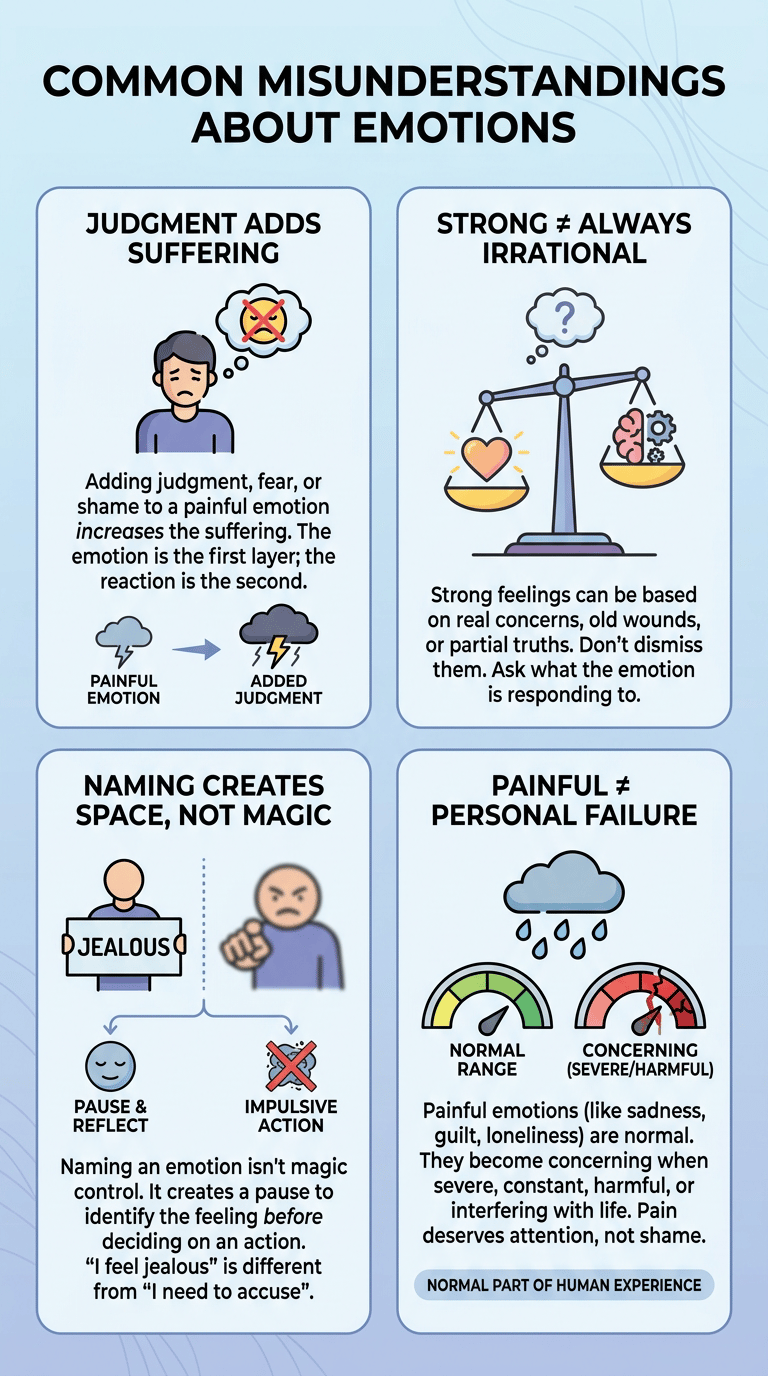
People often suffer more when they misunderstand what emotions are supposed to do. The emotion may already be painful, and then the person adds judgment, fear, or shame about having it.
Strong emotions are not always irrational
A strong emotion can be based on a real concern, a partial truth, an old wound, or a misread cue. Calling it irrational too quickly can make people feel dismissed. A better first step is to ask what the emotion is responding to, then separate facts from interpretations.
Naming an emotion is not the same as controlling it
Naming an emotion is not magic, but it can create a little space. “I feel jealous†is different from “I need to accuse someone.†“I feel ashamed†is different from “I should hide forever.†The name helps you identify the emotional question before deciding what action fits.
Not every painful emotion means something is wrong with you
Sadness, envy, shame, guilt, jealousy, and loneliness can be painful without being abnormal. They become more concerning when they are severe, constant, harmful, connected to unsafe situations, or interfering with daily life. Pain deserves attention, but it does not automatically equal personal failure.
When to Get Support
Understanding emotions can be helpful, but it is not a substitute for professional care, crisis support, or safety planning. Some emotional patterns are too heavy to carry alone, especially when they involve trauma reminders, panic, self-harm thoughts, abuse, coercion, threats, stalking, humiliation, or fear of retaliation.
Severe distress, panic, trauma reminders, self-harm thoughts, or unsafe situations
If emotions feel unmanageable, if you feel at risk of harming yourself, or if someone else’s behavior makes you afraid for your safety, prioritize immediate support from local emergency services, a crisis line, a trusted professional, or a safe person near you. If a relationship includes fear, threats, monitoring, coercion, stalking, or retaliation, communication tips are not the priority. Safety is.
How professional support can help with patterns that feel unmanageable
Therapy can give people a place to understand emotional patterns with more support and skill. Cleveland Clinic™s guidance on when people may consider therapy includes reasons such as feeling overwhelmed by stress, adjusting to major life changes, feeling stuck, coping with loss, or being ruled by fear. You do not need to wait until you are in crisis to ask for help.
FAQ About Emotion Psychology
What is the purpose of emotions in psychology?
Emotions help people notice what matters, prepare for action, communicate with others, and respond to changes in the environment. They can point toward needs, values, risks, losses, boundaries, desires, or social connection. They are useful signals, but they still need interpretation because the first emotional story may be incomplete.
Are emotions always accurate?
Emotions are real experiences, but the conclusions attached to them are not always accurate. Feeling rejected does not prove rejection happened. Feeling guilty does not always prove you did something wrong. Feeling jealous does not always prove there is a real threat. The emotion deserves attention, while the interpretation deserves careful checking.
What is the difference between emotions and feelings?
An emotion is the broader response, including body changes, attention, meaning, impulse, and expression. A feeling is the conscious experience of that emotion. For example, your body may tense, your face may heat, and your mind may replay a social mistake before you clearly label the feeling as embarrassment.
Why do some emotions feel stronger than others?
Some emotions feel stronger because they connect to survival, belonging, identity, past experiences, or important relationships. Intensity can also rise when stress is high, sleep is poor, the situation is uncertain, or the emotion touches an old wound. A strong emotion is a reason to slow down, not a reason to assume the strongest interpretation is correct.
Can two emotions happen at the same time?
Yes. Mixed emotions are common. A person can feel happy and sad about a change, guilty and relieved after setting a boundary, jealous and ashamed of feeling jealous, or lonely and afraid to reach out. Mixed emotion does not mean you are confused in a flawed way. It often means the situation carries more than one meaning.
Key Takeaways
- Emotion psychology explains emotions as whole-person responses involving body, meaning, attention, impulse, and conscious feeling.
- Emotions are signals, not final verdicts. They can be meaningful without every interpretation being accurate.
- Feelings, moods, reactions, and personality are related, but they are not the same thing.
- Shame, guilt, embarrassment, jealousy, envy, loneliness, and emotional triggers each answer different emotional questions.
- The most useful first step is often to name the emotion, identify what it seems to protect, and check whether the story around it is specific or global.
- Support is worth seeking when emotions feel severe, unsafe, constant, or connected to trauma, self-harm thoughts, coercion, threats, or fear.
Final Thoughts
Emotions become easier to understand when you stop treating them as enemies or instructions. A feeling can be intense and still need interpretation. A reaction can be understandable and still need a thoughtful next step. A painful emotion can point toward something important without defining who you are.
If you want one practical next step, ask: “What is this emotion trying to protect, and what story is it asking me to believe?†That question turns confusion into curiosity and helps you choose the next emotion-specific article.

Michael Reed is the Founder and Lead Writer at Psychology Exposed. He writes about human behavior, relationships, emotional patterns, self-awareness, and practical psychology topics using research-informed, easy-to-understand content.
Read More About Michael Reed: https://psychologyexposed.com/michael-reed/