
Jealousy is one of those emotions people often judge before they understand. Someone feels it, then immediately worries they are being insecure, dramatic, immature, or controlling. But jealousy is not automatically proof of a bad character. In psychology, jealousy is usually tied to perceived threat: the possibility that something important to you could be lost, replaced, weakened, or taken away.

That “something” is often a romantic relationship, but jealousy does not belong only to dating or marriage. A person may feel jealous when a friend grows close to someone else, when a sibling receives more attention, when a coworker gets praise, or when a social group seems to shift without them. The emotional question underneath is often simple: “Am I still safe, valued, chosen, or included?”
This article explains jealousy as an emotion, not as a relationship conflict manual. It will help you separate jealousy from envy, insecurity, possessiveness, and real warning signs. It will also give you a grounded self-check so jealousy does not have to become accusation, monitoring, or self-attack.
Quick Answer
Jealousy is a threat-based emotion that often appears when you fear losing a valued bond, role, attention, status, or sense of security. It can include anxiety, anger, suspicion, comparison, sadness, and an urge to protect what matters. Jealousy is different from envy because envy is about wanting what someone else has, while jealousy is about fearing the loss or weakening of something you already value.
What jealousy means in psychology
In everyday language, jealousy often gets used for many different emotions. Someone might say they are jealous of a friend’s vacation when they really mean they feel envy. In psychology, jealousy is more closely connected to a perceived rival or threat to something valued. The APA Dictionary describes suspicious jealousy as fear of losing a valued relationship to a rival even when a partner has not misbehaved.
Why jealousy usually involves fear of loss or replacement
Many jealous reactions have a hidden sentence underneath them: “What if I am being replaced?” The person may not say this out loud, and they may not even realize it at first. Instead, they may notice tension in the body, a sudden need for reassurance, a sharp comparison, or a strong urge to check what is happening.
What Jealousy Feels Like
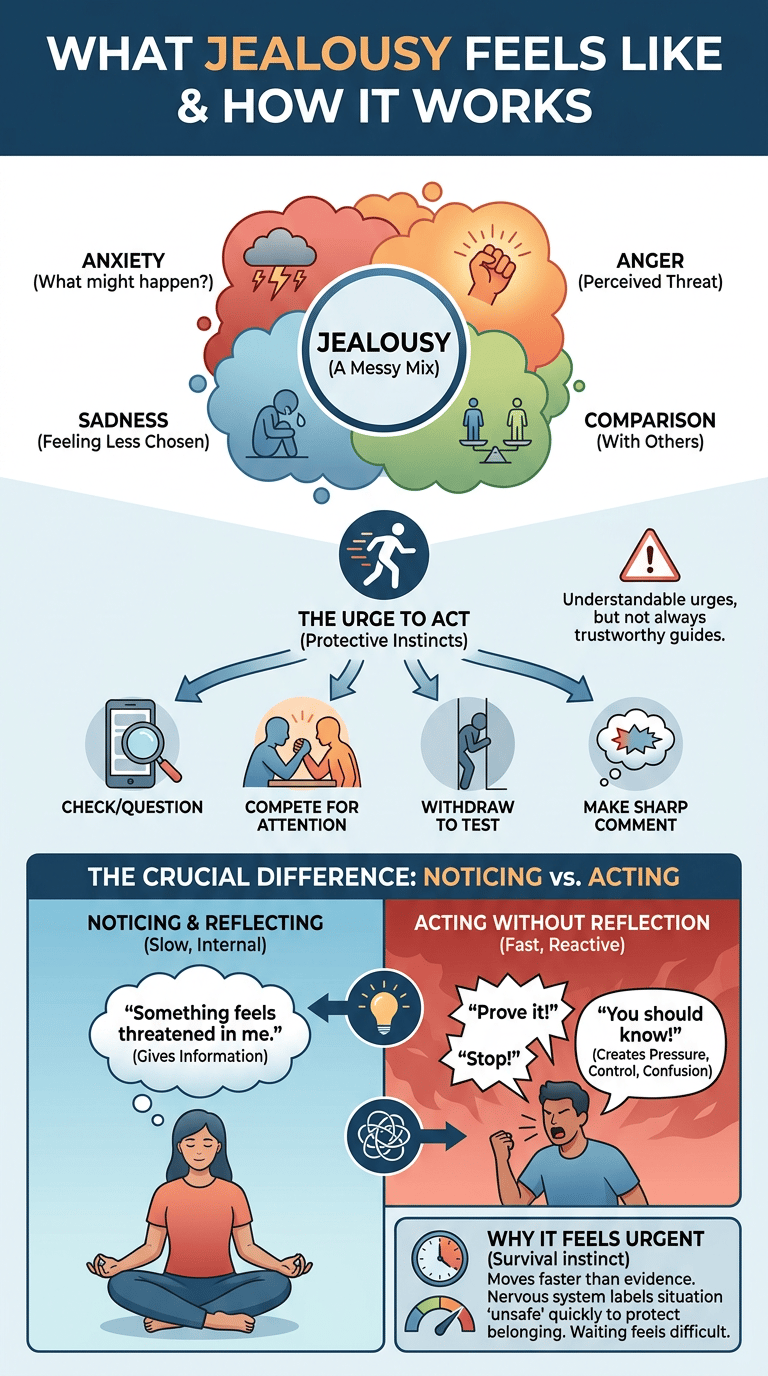
Anxiety, vigilance, comparison, anger, or sadness
Jealousy rarely arrives as one clean emotion. It often feels like a mix. There may be anxiety about what might happen, anger at a perceived threat, sadness about feeling less chosen, and comparison with the person who seems to have attention or access. The result can feel messy because jealousy pulls several emotional systems at once.
The urge to check, question, compete, or protect
Because jealousy is linked to threat, it often creates action urges. A person may want to ask repeated questions, check a phone, compare themselves, compete for attention, withdraw to test whether someone notices, or make a sharp comment before they feel ignored. These urges are understandable, but they are not always trustworthy guides.
There is a difference between noticing jealousy and acting from jealousy. Noticing jealousy means, “Something feels threatened in me.” Acting from jealousy without reflection may sound like, “Prove you did nothing,” “Stop talking to them,” or “If you cared about me, you would already know why I am upset.” The first response gives information. The second response may create pressure, control, or confusion.
Why jealousy can feel urgent even before facts are clear
Jealousy often moves faster than evidence. The mind is built to respond quickly to possible social loss because belonging has always mattered to human survival. Waiting calmly for complete information may feel difficult when the nervous system has already labeled the situation as unsafe.
Why Jealousy Happens
Jealousy as a response to perceived threat
Jealousy begins with perceived threat, not always with actual betrayal. That distinction is important. A person can feel jealous in a situation where nothing harmful is happening, and a person can also feel jealous because something truly is uncertain, disrespectful, or unsafe. The emotion alone does not settle the facts. That protective response is one example of the meaning-and-action system described in emotion psychology.
Experimental research on relational threat and jealousy also helps explain why jealousy can become stronger when someone sees a specific rival, not just a vague possibility. A named person, visible comparison, or concrete interaction gives the mind an object to track.
Why valued bonds, roles, attention, and status can trigger jealousy
People often think jealousy is only about romance, but the same emotional logic can appear in many social settings. A child may feel jealous when a parent praises a sibling. A friend may feel jealous when a best friend starts sharing secrets with someone else. A coworker may feel jealous when another person becomes the trusted favorite. A creator may feel jealous when another creator gets attention from the audience they hoped to reach.
How uncertainty intensifies jealousy
Uncertainty gives jealousy room to grow. When facts are clear, a person has something to respond to. When facts are unclear, imagination may fill the gaps. This is especially true when there has been secrecy, inconsistent behavior, broken trust, or a history of being blindsided.
Jealousy vs Envy vs Insecurity
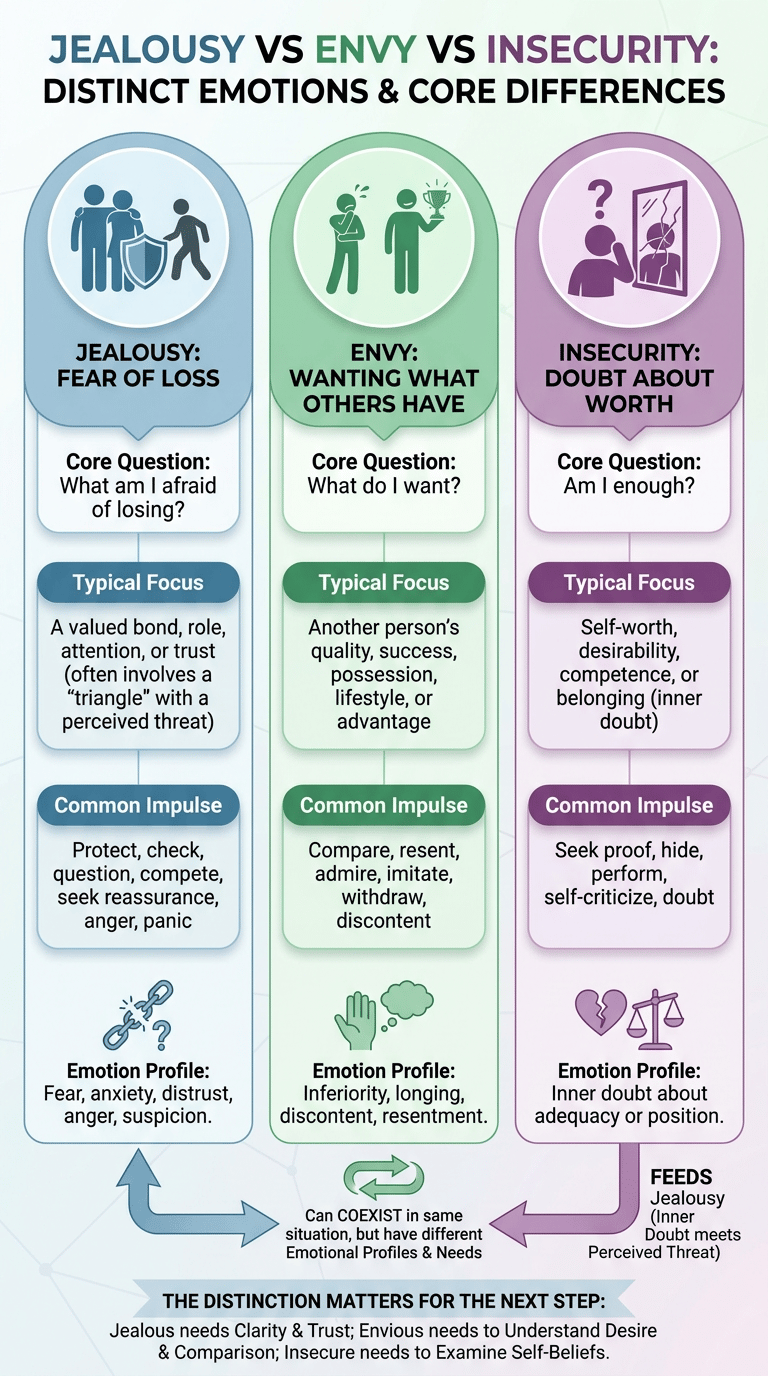
Jealousy, envy, and insecurity often overlap, but they are not the same emotional experience. Mixing them up can lead to the wrong next step. If the feeling is envy, the useful question may be, “What do I want?” If it is jealousy, the useful question may be, “What am I afraid of losing?” If it is insecurity, the useful question may be, “What doubt about myself has been activated?” If the central issue is wanting what another person has rather than fearing a loss, envy psychology provides the clearer distinction.
| Emotion | Core question | Typical focus | Common impulse |
|---|---|---|---|
| Jealousy | What if I lose my place? | A valued bond, role, attention, or trust | Protect, check, question, compete, or seek reassurance |
| Envy | Why do they have what I want? | Another person’s quality, success, possession, lifestyle, or advantage | Compare, resent, admire, imitate, or withdraw |
| Insecurity | Am I enough? | Self-worth, desirability, competence, or belonging | Seek proof, hide, perform, or self-criticize |
Jealousy: fear of losing something valued
Jealousy usually involves a triangle, even when the triangle is emotional rather than literal. There is you, something or someone you value, and a perceived rival or threat. The rival may be another person, a job, a friend group, a hobby, a screen, an ex-partner, or even a new identity that seems to pull someone away.
The jealous feeling says, “Something important may be taken from me or reduced.” This is why jealousy can show up as protectiveness, suspicion, anger, or panic. Under the surface, the emotion is trying to guard a valued connection or position.
Envy: wanting what someone else has
Envy has a different center. The APA Dictionary defines envy as a negative emotion involving discontent or resentment connected to another person’s possessions, qualities, attributes, or achievements. Envy does not require a threatened relationship. It can happen simply because someone else has something you want.
Insecurity: doubt about your worth or position
Insecurity often feeds jealousy, but it is not identical to jealousy. Insecurity is the inner doubt. Jealousy is the emotional response when that doubt meets a perceived threat. A person may think, “I am not attractive enough,” then feel jealous when their partner talks to someone they see as more attractive. The jealousy is about possible loss. The insecurity is about perceived inadequacy.
Why these emotions often overlap but are not the same
Research distinguishing envy and jealousy found different emotional profiles: envy was more tied to inferiority and longing, while jealousy was more tied to fear of loss, distrust, anxiety, and anger. That difference helps explain why the same situation may contain both emotions at once.
The distinction is not just wordplay. Research distinguishing envy and jealousy shows why these emotional states should not be treated as interchangeable. A person who is jealous may need clarity and trust. A person who is envious may need to understand desire and comparison. A person who is insecure may need to examine the belief that they are not enough.
Common Jealousy Triggers
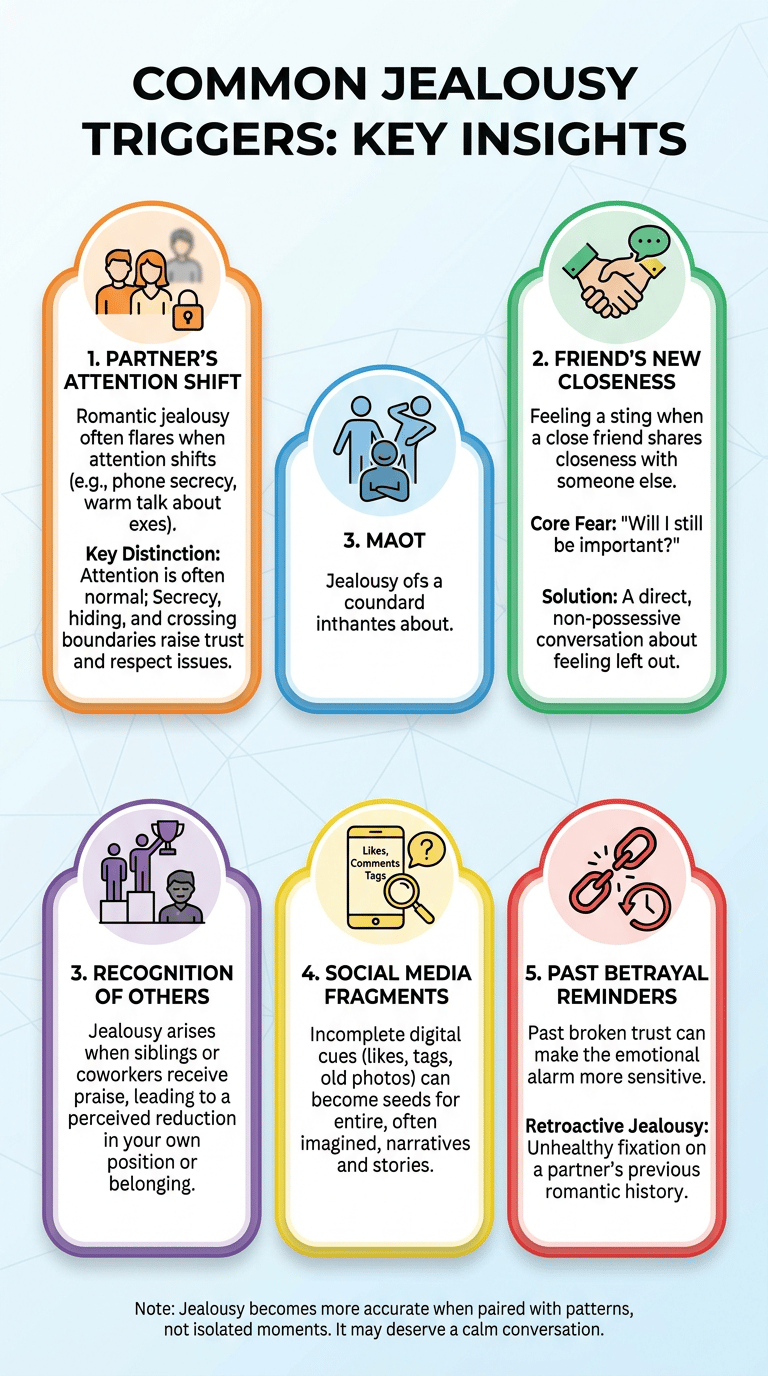
A partner’s attention going elsewhere
Romantic jealousy often appears when attention shifts. A partner laughs with someone, protects their phone, talks warmly about an ex, or seems emotionally energized by another person. Sometimes the situation is harmless. Sometimes it deserves a calm conversation. Jealousy becomes more accurate when it is paired with patterns, not just isolated moments. When a delayed reply or shift in attention carries emotional weight from earlier experiences, emotional triggers psychology can explain the speed of the reaction.
One useful distinction is between attention and secrecy. Attention can be normal. People connect with coworkers, friends, and strangers without betrayal. Secrecy is different. If someone hides, lies, mocks your concern, or repeatedly crosses agreed boundaries, the issue is no longer only jealousy. It becomes trust and respect.
A friend becoming close to someone new
Friendship jealousy is real, even if people rarely talk about it. A person may feel a sting when their closest friend begins sharing inside jokes, plans, or emotional closeness with someone else. The feeling may be embarrassing because friendship is “supposed” to feel freer than romance, but belonging still matters.
The core fear may be, “Will I still be important?” That does not mean the friend has done anything wrong. It means the bond has meaning, and the change has activated uncertainty. A direct but non-possessive conversation may sound like, “I know you are allowed to have other close friends. I also noticed I have been feeling a little left out lately. Could we plan time together this week?”
A sibling or coworker receiving praise
Jealousy can appear around recognition. A sibling receives more approval. A coworker gets the role you wanted. Someone else becomes the “favorite.” This may look like envy at first, but jealousy enters when the praise seems to reduce your own position or belonging.
Social media cues and imagined stories
Social media gives jealousy endless fragments without full context. A like, comment, tag, story view, follow, or old photo can become the seed for an entire imagined story. The mind sees a small cue, then builds a narrative around it.
Past betrayal or broken trust reminders
This does not mean every jealous fear is accurate. It means the emotional alarm may be more sensitive. A person may need both present-day clarity and compassion for why the alarm is loud. If the jealousy centers on a partner’s past relationships and becomes repetitive or obsessive, Cleveland Clinic describes retroactive jealousy as an unhealthy fixation on a partner’s previous romantic history.
What Jealousy Tries to Protect
Belonging and attachment
At its most basic, jealousy often tries to protect belonging. Humans are social. Being chosen, included, trusted, and valued matters. When a bond feels threatened, jealousy may act like an alarm that says, “Pay attention. This connection matters.” The fear of replacement may also expose a belief that you are not good enough, which is where shame psychology becomes relevant to self-worth rather than relationship evidence.
Exclusivity, trust, or priority
Jealousy often becomes stronger when there is an expectation of exclusivity. In romance, exclusivity might involve sexual boundaries, emotional boundaries, privacy agreements, or shared expectations about flirting. In friendship, it may involve loyalty, time, or emotional priority. At work, it may involve trust, access, or recognition. If that fear leads to withdrawal or feeling shut out, it can overlap with the unwanted disconnection described in loneliness psychology.
Status, fairness, or recognition
Jealousy can also protect status. A person may feel jealous when someone else becomes the center of attention, receives praise, gains influence, or seems to have easier access to people in power. This form of jealousy can feel less relational, but it still involves perceived loss.
Personal meaning attached to the bond
Jealousy becomes intense when the bond carries deep meaning. If a relationship represents safety, identity, future plans, healing, belonging, or proof of worth, a possible threat will feel bigger. The jealousy is not only about the other person. It is about what the relationship represents internally.
For example, if someone believes, “Being chosen by this person proves I am lovable,” any perceived rival may feel like a threat to their entire self-image. That is where jealousy can connect to shame and insecurity. The threat is not only, “I may lose them.” It becomes, “If I lose them, what does that say about me?”
Helpful Jealousy vs Harmful Jealousy
When jealousy points to a real boundary or value
Jealousy is not always useless. Sometimes it points to a value that needs attention. You may value honesty, emotional priority, mutual respect, transparency, or shared agreements. If a situation violates those values, jealousy may be one of the first emotions to alert you.
When jealousy becomes suspicion without evidence
Jealousy becomes less helpful when it treats fear as fact. Suspicion without evidence can lead to repeated interrogation, scanning, testing, or imagining. The jealous person may feel temporarily relieved after checking, but the relief rarely lasts. Soon the mind wants another check.
When jealousy turns into control, monitoring, or accusation
Jealousy does not excuse control. Feeling threatened is different from deciding that another person must surrender privacy, friendships, movement, clothing choices, work opportunities, or social contact to calm your fear. A relationship may need boundaries, but boundaries are not the same as ownership.
If jealousy includes threats, intimidation, stalking, humiliation, forced isolation, constant monitoring, retaliation, or fear of what someone will do if you say no, safety matters more than better communication. The National Domestic Violence Hotline explains that emotional abuse can include nonphysical patterns that control, frighten, isolate, or degrade someone.
A Self-Check Before Reacting to Jealousy
Jealousy moves quickly, so a self-check should be simple enough to use while the emotion is still active. The point is not to talk yourself out of every jealous feeling. The point is to slow the jump from alarm to action.
What am I afraid of losing?
Start with the loss. Are you afraid of losing a person, a role, attention, trust, status, certainty, or your image of yourself? A jealous reaction becomes clearer when you name the specific thing that feels threatened.
What evidence do I actually have?
Separate facts from interpretation. Facts are what happened. Interpretations are the meaning your mind added. “They laughed together for ten minutes” is a fact. “They are replacing me” is an interpretation. “They hid messages after we agreed to openness” is a fact. “Everyone always leaves me” is a larger story.
Is this about the present moment or an old wound?
Ask whether the current situation is carrying old emotional weight. Does this remind you of being cheated on, excluded, compared, laughed at, replaced, or ignored? If yes, the feeling may be partly present and partly historical.
What respectful conversation or boundary would fit the facts?
A respectful response is specific, proportionate, and focused on behavior. It does not demand mind-reading. It does not punish the other person for having a life outside you. It also does not force you to pretend everything is fine when a real boundary has been crossed.
Helpful language might sound like this:
| Situation | Instead of saying | Try saying |
|---|---|---|
| You feel left out by a friend | You clearly replaced me. | I know you can have other close friends. I have been missing our time together and would like to plan something. |
| You feel uneasy about secrecy | You are definitely hiding something. | I noticed the secrecy around this, and it is making trust harder for me. Can we talk about what privacy and transparency should look like? |
| You feel jealous at work | They only like you because you flatter them. | I realized I have been feeling insecure about where I stand. I want to ask for clearer feedback on my own role. |
| You feel triggered by an ex | You are not allowed to mention them. | I know your past exists. I also notice this topic brings up fear for me, so I want to talk about what helps both of us feel respected. |
How This Connects to Other Emotion Situations
Read envy when the emotion is about wanting someone else’s life, success, or quality
If the main feeling is “I wish I had what they have,” envy may be the better word. Envy points toward desire, comparison, and perceived gaps. It may show you what you value, what you feel deprived of, or where you are measuring yourself against someone else.
Read emotional triggers when jealousy feels larger than the current situation
If jealousy feels much stronger than the current facts explain, an emotional trigger may be involved. A tone, delay, person, place, or small cue may activate an older memory of loss, betrayal, exclusion, or humiliation. The reaction is then not only about now.
Understanding triggers can help you avoid two extremes: dismissing yourself as irrational or treating every intense feeling as proof of danger. The stronger the emotional charge, the more useful it becomes to ask what the current event is touching.
Read loneliness when jealousy is tied to feeling left out or replaced
Sometimes jealousy is connected to loneliness. A person may not only fear losing one relationship. They may feel a broader ache of being outside the circle, forgotten, unwanted, or not chosen. In that case, the jealous moment is one expression of a deeper need for connection.
When to Get Support
Jealousy with panic, obsession, threats, coercion, stalking, or fear
Jealousy deserves extra care when it becomes obsessive, frightening, or unsafe. If you feel unable to stop checking, questioning, imagining, or monitoring, support may help you understand the emotional loop before it harms you or the relationship. If another person’s jealousy makes you feel afraid, trapped, watched, punished, or isolated, prioritize safety rather than trying to find the perfect explanation.
Support may come from a therapist, counselor, domestic violence advocate, trusted doctor, or local support service, depending on the situation. If there is fear of retaliation, stalking, threats, coercion, or physical danger, do not rely on couples communication as the first step. A private safety plan and outside support may be safer.
When past betrayal or trauma makes jealousy feel unmanageable
Past betrayal can leave the nervous system alert to signs of repetition. A person may want to trust but still feel their body react as if danger is near. That experience is not a personal failure. It is also not something a partner can always fix through reassurance alone.
FAQ About Jealousy Psychology
Is jealousy always about insecurity?
No. Insecurity can intensify jealousy, but jealousy is not always caused by low self-worth. Sometimes jealousy points to a real uncertainty, broken agreement, lack of transparency, or fear of losing something important. The key is to separate the emotional alarm from the evidence. Ask what actually happened, what you are afraid it means, and whether your response fits the facts.
Can jealousy happen outside romantic relationships?
Yes. Jealousy can appear in friendships, families, workplaces, creative communities, social groups, and even between siblings. Any place where belonging, attention, loyalty, recognition, or status matters can create jealousy. Romantic jealousy is common, but it is only one form of a wider social emotion.
What is the difference between jealousy and possessiveness?
Jealousy is an emotion. Possessiveness is a way of treating another person as if they are something to own, control, or restrict. A jealous person may feel afraid of losing a bond. A possessive response may demand access, control social contact, punish independence, or use fear to maintain power. The feeling may be understandable, but controlling behavior still needs a firm boundary.
Why does jealousy make me want to check or monitor?
Checking gives short-term relief because it seems to reduce uncertainty. The problem is that reassurance from checking often fades quickly, especially when the deeper fear has not been addressed. The mind then asks for another check. A more useful step is to identify the fear, look at the evidence, and choose a direct conversation or boundary that fits the situation.
Can jealousy ever be useful?
Jealousy can be useful when it reveals a value, a boundary, or a need for clarity. It may show that trust, priority, transparency, or belonging matters to you. It becomes harmful when fear turns into accusation, control, monitoring, humiliation, or constant suspicion without evidence. The useful part of jealousy is the information, not every impulse that comes with it.
Key Takeaways
- Jealousy usually involves fear of losing a valued bond, role, attention, status, or sense of security.
- Jealousy is different from envy: envy is about wanting what someone else has, while jealousy is about perceived threat to something you value.
- Jealousy can include anxiety, anger, sadness, comparison, suspicion, and an urge to check or protect.
- The emotion may point to a real boundary, but it can also be intensified by uncertainty, insecurity, past betrayal, or old wounds.
- Healthy responses to jealousy separate facts from interpretation before making accusations or demands.
- If jealousy involves threats, stalking, coercion, control, humiliation, or fear, safety support matters more than communication tips.
Jealousy becomes easier to understand when you stop treating it as proof that something is wrong with you. It is an emotional alarm around possible loss. The next step is not to obey the alarm blindly or shame yourself for having it. The next step is to ask what feels threatened, what evidence exists, and what response protects dignity, safety, and truth at the same time.

Michael Reed is the Founder and Lead Writer at Psychology Exposed. He writes about human behavior, relationships, emotional patterns, self-awareness, and practical psychology topics using research-informed, easy-to-understand content.
Read More About Michael Reed: https://psychologyexposed.com/michael-reed/