
Some people seem to create order almost automatically. They remember deadlines, prepare early, keep promises, and feel uncomfortable when tasks are left unfinished. Other people may have good intentions but struggle to turn those intentions into consistent action. They may start quickly, improvise well, or resist rigid systems, yet still feel frustrated when follow-through falls apart.
The conscientiousness personality trait helps explain these differences without turning them into moral labels. It is not a simple measure of who is “good,” “lazy,” “successful,” or “undisciplined.” In personality psychology, conscientiousness describes a broad tendency toward organization, responsibility, persistence, planning, and self-control. The APA Dictionary of Psychology defines conscientiousness as a tendency to be organized, responsible, and hardworking within the Big Five personality model.
This article explains what conscientiousness looks like in everyday life, how high and lower conscientiousness can both have strengths and costs, and how to separate conscientiousness from discipline, perfectionism, anxiety-driven control, and people-pleasing. The goal is not to judge your personality. The goal is to understand your natural pattern, then choose one practical adjustment that makes life work better.
Quick Answer
Conscientiousness describes a tendency toward organization, responsibility, planning, persistence, and reliable follow-through
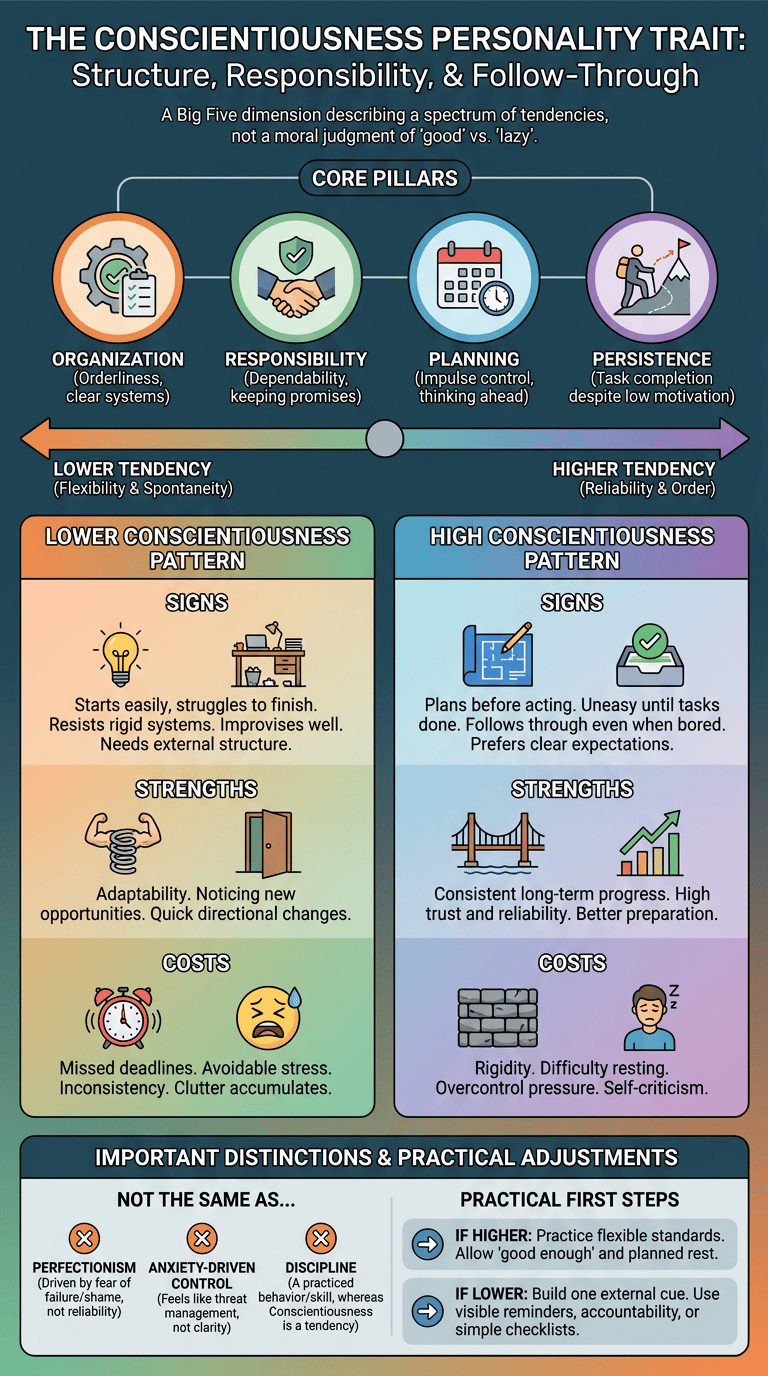
Conscientiousness is a Big Five personality trait linked with structure, dependability, impulse control, and task completion. High conscientiousness often shows up as reliability and careful planning. Lower conscientiousness may show up as spontaneity, flexibility, or difficulty staying consistent. Neither end of the trait is a diagnosis or a moral verdict. It is a pattern that can help or cost you depending on the situation.
What Conscientiousness Means in Personality Psychology
Conscientiousness as a Big Five dimension
The Big Five model describes personality through five broad dimensions: openness, conscientiousness, extraversion, agreeableness, and neuroticism. In this model, conscientiousness sits on a spectrum. People do not simply “have it” or “lack it.” Most people show a mix of conscientious and less conscientious behavior across different settings.
OpenStax Psychology explains the Big Five factors as broad traits that occur along a continuum rather than as fixed categories, which matters because a person can be high, low, or somewhere in the middle on each trait. You can see this continuum framing in the OpenStax Psychology 2e section on trait theorists.
Why it is about tendencies, not moral worth
It is easy to turn conscientiousness into a character judgment. High conscientiousness can be praised as maturity, responsibility, or discipline. Lower conscientiousness can be criticized as laziness, carelessness, or lack of ambition. That framing is too harsh and too simple.
A trait is a tendency, not a full identity. A lower-conscientious person may be deeply caring, creative, intelligent, and capable, but may need stronger external systems to finish tasks. A highly conscientious person may be dependable and productive, but may also struggle to rest, delegate, or tolerate uncertainty. Personality traits describe patterns. They do not measure human value.
How context changes whether conscientiousness is visible
Conscientiousness often becomes more visible when structure is required. School, work, caregiving, finances, health routines, and shared living arrangements can all reveal how someone handles responsibility and follow-through.
Context also matters. A person may be highly conscientious at work but less structured at home because work provides deadlines, expectations, feedback, and consequences. Someone else may seem disorganized in school but become reliable in a job they care about. Instead of asking, “Am I conscientious or not?” it may be more useful to ask, “Where does structure naturally appear for me, and where does it disappear?”
Core Parts of Conscientiousness
Organization and orderliness
Organization is the part of conscientiousness most people notice first. It can look like a clean workspace, a calendar system, a clear plan, or a preference for knowing what comes next. Orderliness helps reduce mental clutter because the person does not have to constantly remember everything from scratch.
Responsibility and dependability
Responsibility is the part of conscientiousness that shows up in promises. Conscientious people often care about being trusted. They may remember what they said they would do and feel uncomfortable if they let someone down.
Planning and impulse control
Planning gives future consequences a stronger voice in the present. A conscientious person may pause before spending money, sending a message, leaving work unfinished, or agreeing to something they cannot realistically do. This pause can prevent avoidable stress.
Persistence and task completion
Persistence is the follow-through part of conscientiousness. It shows up when motivation drops but the person keeps going because the task still matters. This does not mean highly conscientious people always enjoy their work. It means they are often better at continuing when the emotional reward is low.
| Core part | Helpful expression | Possible cost |
|---|---|---|
| Organization | Clear systems, fewer forgotten tasks, less chaos | Stress when plans change or spaces feel messy |
| Responsibility | Trust, reliability, stronger follow-through | Overcommitting, guilt, difficulty saying no |
| Planning | Better preparation and fewer preventable problems | Overthinking, delayed action, fear of uncertainty |
| Persistence | Long-term progress even when motivation drops | Working past limits, difficulty resting, self-criticism |
Signs of High Conscientiousness
You plan before acting
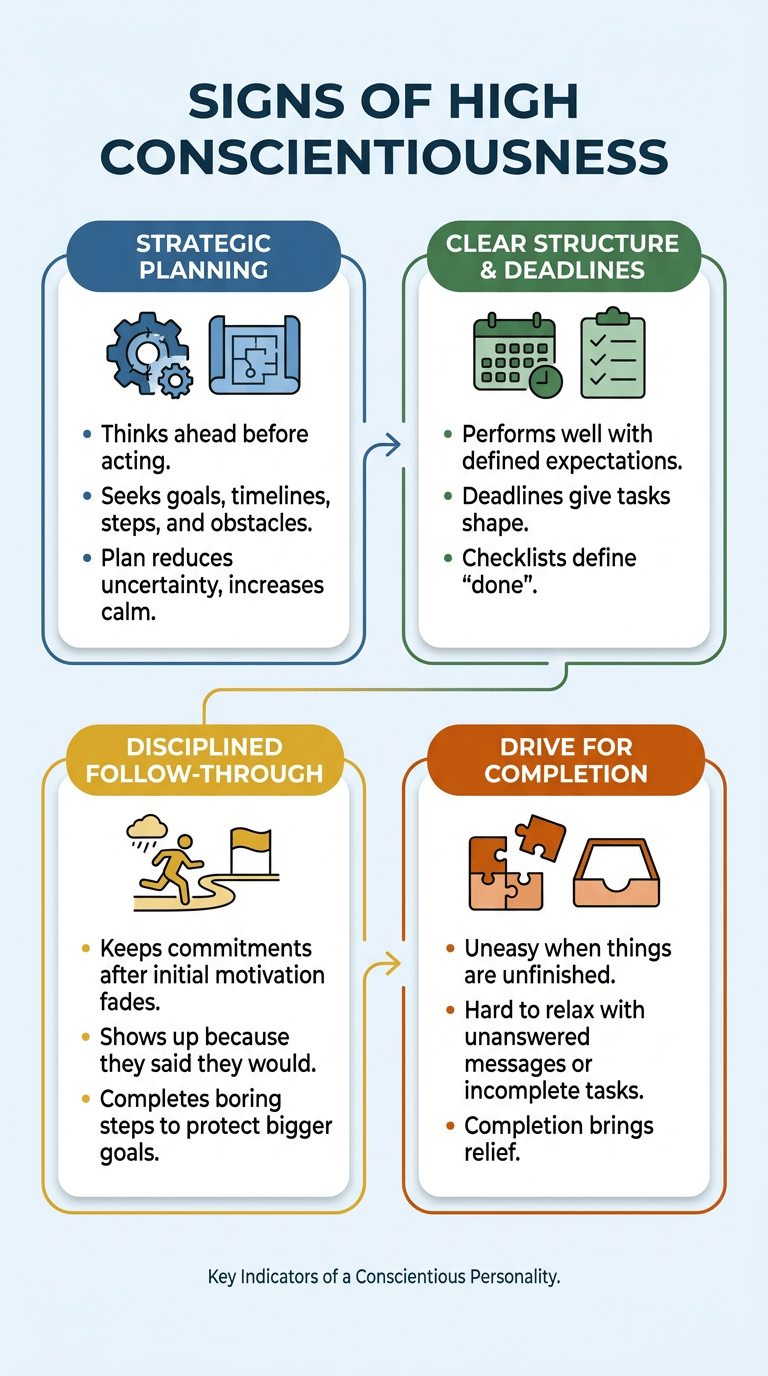
If you are high in conscientiousness, you may naturally think ahead. Before starting a project, you may want to know the goal, timeline, steps, and likely obstacles. You may feel calmer once there is a plan because the plan reduces uncertainty.
You prefer clear expectations and deadlines
Highly conscientious people often perform well when expectations are clear. A deadline gives the task shape. A defined role reduces confusion. A checklist or standard lets the person know what “done” means.
You follow through even when motivation drops
A strong sign of conscientiousness is the ability to keep commitments after the initial mood fades. You may not feel excited about the task, but you still show up because you said you would. You may finish a boring step because you know it protects a bigger goal.
You may feel uneasy when things are unfinished
Unfinished tasks can stay active in your mind. You may find it hard to relax if messages are unanswered, dishes are in the sink, forms are incomplete, or a project is halfway done. Completion gives relief.
Signs of Lower Conscientiousness
You may act more spontaneously
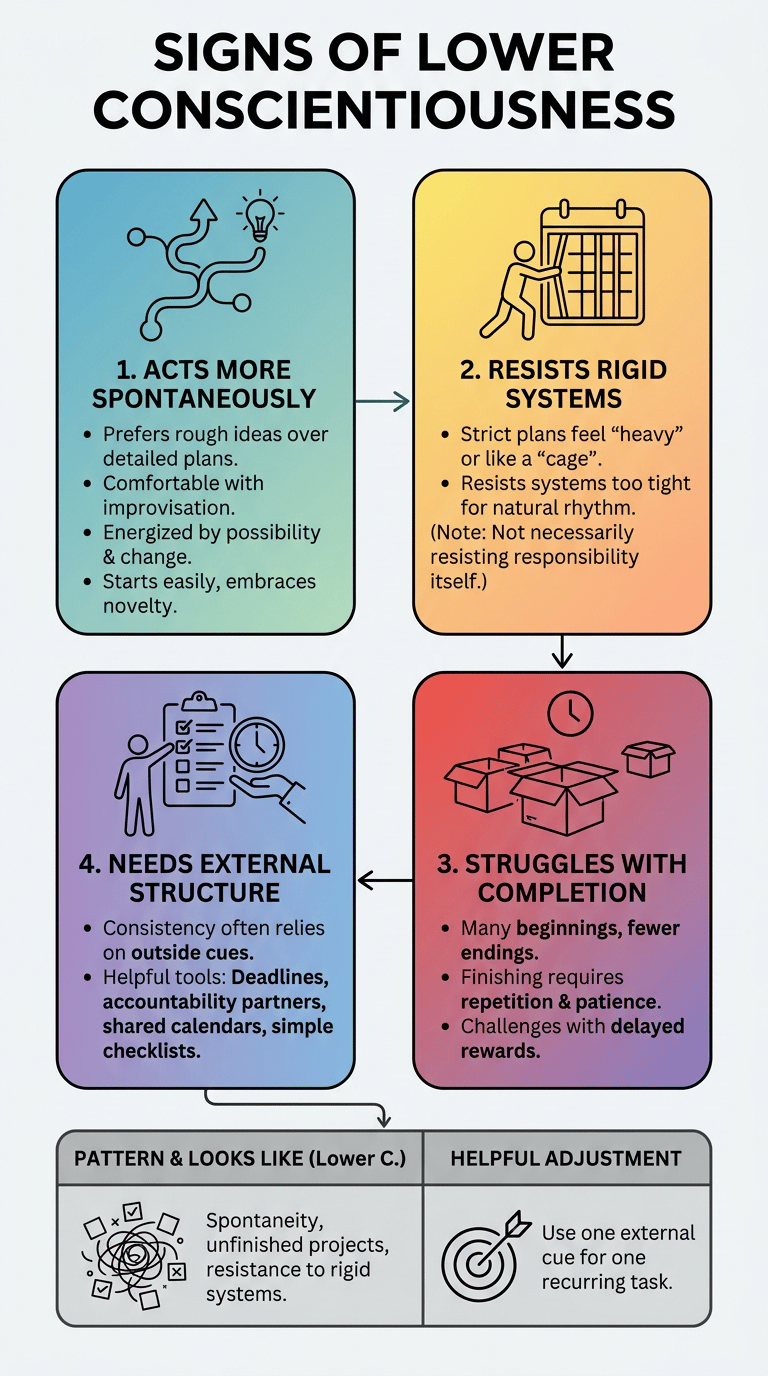
Lower conscientiousness often comes with more comfort around improvisation. You may prefer to start with a rough idea rather than a detailed plan. You may feel energized by possibility, change, and movement.
You may resist rigid systems or detailed plans
If you are lower in conscientiousness, strict systems may feel heavy. A long routine, detailed spreadsheet, or strict weekly plan may work for a few days, then begin to feel like a cage. You may not resist responsibility itself. You may resist systems that feel too tight for your natural rhythm.
You may start easily but struggle with completion
Starting can be exciting because it carries novelty and possibility. Finishing often requires repetition, detail, patience, and delayed reward. Lower conscientiousness may show up as many beginnings with fewer endings.
You may need external structure to stay consistent
Some people do not maintain structure well internally, but they do well when structure is outside them. A deadline, class, coworking session, reminder, shared calendar, accountability partner, or simple checklist can make follow-through easier.
| Pattern | What it may look like | Helpful adjustment |
|---|---|---|
| High conscientiousness | Strong planning, high standards, discomfort with unfinished tasks | Practice flexible standards and planned rest |
| Middle conscientiousness | Reliable in some areas, loose in others | Identify where structure matters most |
| Lower conscientiousness | Spontaneity, unfinished projects, resistance to rigid systems | Use one external cue for one recurring task |
Strengths and Costs of High Conscientiousness
Strength: reliability, trust, and long-term progress
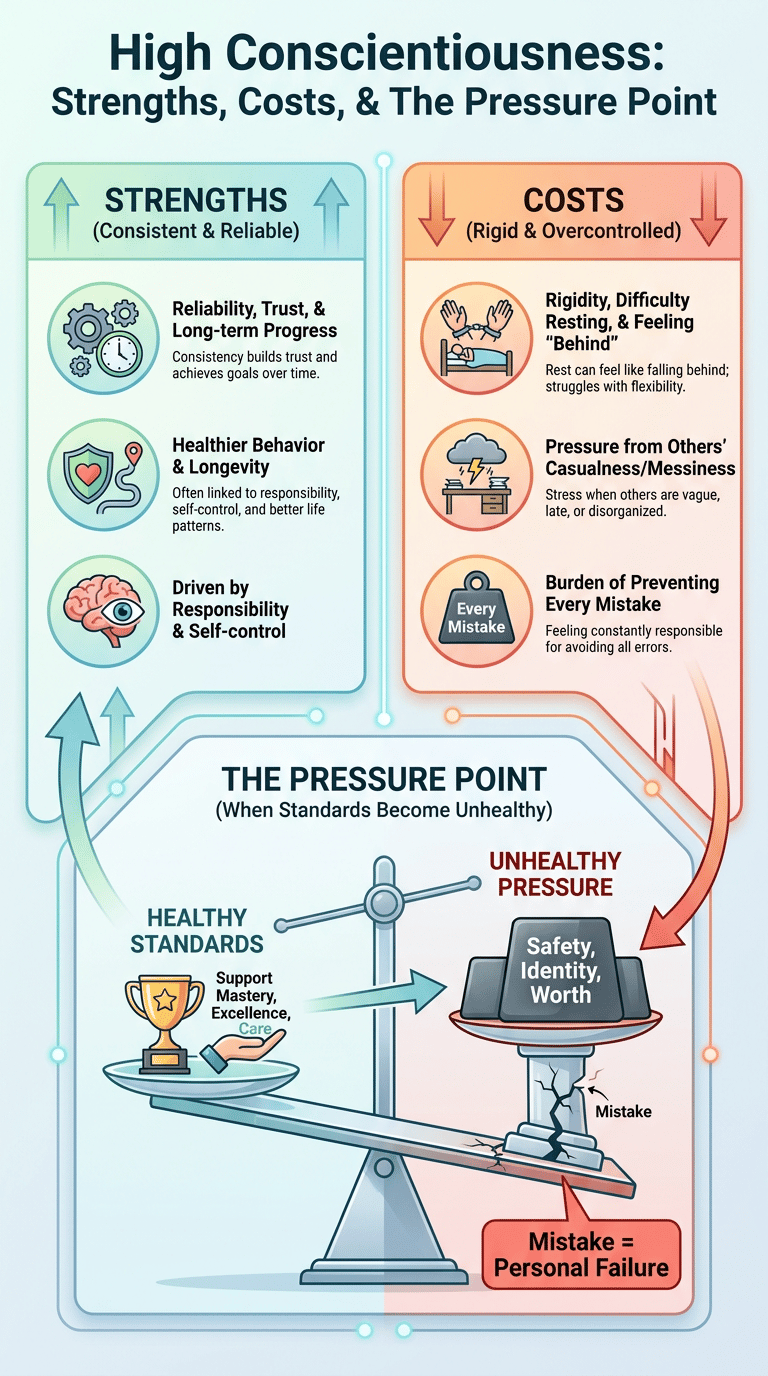
High conscientiousness is often linked with outcomes that require consistency over time. Research on personality and health has connected conscientiousness with long-term patterns such as healthier behavior and longevity, although the pathways are complex and not automatic. One open-access review on conscientiousness and longevity discusses how responsibility, self-control, and behavior patterns may be part of the connection.
Cost: rigidity, overcontrol, and difficulty resting
The same trait can create pressure. A highly conscientious person may struggle when others are casual, late, messy, or vague. They may feel responsible for preventing every mistake. They may find it hard to rest because rest feels like falling behind.
When high standards become pressure
High standards are not automatically unhealthy. They can support mastery, excellence, and care. The problem begins when standards become tied to safety, identity, or worth. Then a normal mistake may feel like a personal failure.
Strengths and Costs of Lower Conscientiousness
Strength: flexibility, adaptability, and improvisation
Lower conscientiousness is often discussed only as a problem, but it can come with real strengths. Less rigid planning can make it easier to change direction. A spontaneous person may notice opportunities that a highly structured person overlooks. An improviser may respond well when there is no clear map.
Cost: missed deadlines, avoidable stress, and inconsistency
The cost of lower conscientiousness often appears later. A missed bill becomes a fee. A late reply becomes tension. A half-finished project becomes clutter. A vague plan becomes a rushed emergency. These consequences can create shame, and shame can make the person avoid the task even more.
How to add structure without changing your whole identity
You do not need a complicated productivity system to support lower conscientiousness. In fact, complicated systems often fail because they require the very consistency they are supposed to create. Start with one external cue that reduces thinking.
Conscientiousness vs Nearby Concepts
Conscientiousness vs discipline
Conscientiousness and discipline overlap, but they are not identical. Conscientiousness is a personality tendency. Discipline is more often a practiced behavior, routine, or choice. A highly conscientious person may find discipline easier because structure feels natural. A lower-conscientious person may still build disciplined behavior by using external supports.
Conscientiousness vs perfectionism
Perfectionism is not the same as conscientiousness. A conscientious person wants to do things carefully and reliably. A perfectionistic person may feel unable to tolerate mistakes, uncertainty, or imperfect outcomes. The difference is often emotional intensity.
Conscientiousness vs anxiety-driven control
Anxiety-driven control can look like conscientiousness from the outside. The person may plan, check, prepare, and organize. But the inner experience is different. Conscientious structure often feels like clarity. Anxiety-driven control often feels like threat management.
If you organize because it helps life run smoothly, that may be conscientiousness. If you organize because uncertainty feels unbearable, because a small mistake feels dangerous, or because you cannot stop checking, anxiety may be part of the picture. NIMH describes anxiety disorders as involving fear or anxiety that does not go away and can interfere with daily activities, and its overview of anxiety disorders can be a useful starting point if distress is significant.
Conscientiousness vs agreeableness and people-pleasing
People-pleasing adds another layer. Someone may seem responsible because they always say yes, but the engine may be fear of disappointing others rather than genuine capacity. If your reliability depends on ignoring your limits, the issue may not be “too much conscientiousness.” It may be a boundary problem wearing responsible clothing.
| Concept | Main focus | Key difference |
|---|---|---|
| Conscientiousness | Structure, responsibility, follow-through | A broad personality tendency, not a moral score |
| Discipline | Consistent action despite resistance | A behavior or skill that can be supported by systems |
| Perfectionism | Avoiding mistakes or imperfection | Often driven by fear, shame, or all-or-nothing standards |
| Anxiety-driven control | Reducing threat and uncertainty | May feel urgent, repetitive, or hard to stop |
| People-pleasing | Preventing disappointment or conflict | May ignore personal limits to keep others happy |
Self-Check Questions for Conscientiousness
Where do you naturally create structure?
Think about the areas where you already use structure without much effort. It may be work, money, fitness, parenting, school, cooking, cleaning, creative projects, or social plans. These areas show where conscientiousness is already supported by interest, identity, skill, or consequence.
Where do you avoid structure?
Now look at the areas where structure disappears. You may avoid planning because the task feels boring, emotionally heavy, too vague, too big, or connected to fear of failure. Avoiding structure does not always mean you do not care. Sometimes it means the task has too much friction.
What kind of accountability actually helps you?
Accountability is not one thing. For some people, a public deadline helps. For others, public pressure creates anxiety and avoidance. Some people need reminders. Some need body doubling. Some need a smaller task. Some need to remove choices.
A useful self-check is this: “When I followed through in the past, what made it easier?” Maybe the task was visible. Maybe someone expected it. Maybe the first step was tiny. Maybe the environment was prepared. Your past success often gives better clues than another person’s perfect system.
First Steps Based on Your Trait Pattern
If you are highly conscientious, practice flexible standards
If you are highly conscientious, your growth edge may not be more discipline. It may be flexibility. Try choosing one area where “good enough” is allowed on purpose. This could mean sending a clear but imperfect email, leaving a small task for tomorrow, asking for help before you are overloaded, or taking a break without earning it first.
If you are lower in conscientiousness, build one external cue
If you are lower in conscientiousness, do not begin by redesigning your entire life. Pick one recurring problem and add one cue. The cue should be visible, simple, and close to the behavior.
For example, if you forget appointments, use one calendar and set two reminders. If laundry piles up, put the basket where clothes actually land. If you avoid a task, write only the next physical action, not the whole plan. If you miss deadlines, create a fake deadline two days earlier and tell one person. Small external cues often work better than big identity promises.
If anxiety drives your structure, separate safety from control
If structure feels urgent, tense, or impossible to stop, pause before adding more systems. Ask: “What am I afraid will happen if this is not controlled?” The answer may reveal whether the behavior is about responsibility or fear.
Then separate a real safety need from a control loop. A real safety need might be locking the door, checking a medical instruction, or confirming an important appointment. A control loop might be checking the same thing repeatedly even when you already have enough information. If the loop causes significant distress or interferes with daily life, professional support may help.
Bridge Topics for the Personality Cluster
How conscientiousness interacts with openness
Conscientiousness and openness can pull in different directions, but they can also work well together. Openness brings curiosity, imagination, and comfort with novelty. Conscientiousness brings structure, completion, and responsibility. A person high in both may be creative and productive because they generate ideas and finish them.
How conscientiousness and neuroticism can create perfectionistic pressure
Conscientiousness can become more intense when it combines with high neuroticism, which involves emotional sensitivity and stress reactivity. The person may care deeply about doing well and also feel highly distressed when things are uncertain or imperfect.
How personality change often begins with behavior systems
Personality traits are relatively stable, but that does not mean behavior is frozen. A person may not become a completely different person overnight, but they can build systems that make certain behaviors more likely. A lower-conscientious person can become more reliable in specific areas. A highly conscientious person can learn to rest and tolerate flexibility.
Change often starts smaller than identity. You choose one repeated situation, one cue, one standard, or one boundary. Over time, repeated behavior can change how you experience yourself. The focus is not “become a new personality.” The focus is “make the next behavior easier to repeat.”
When To Get Support
Seek support if control, perfectionism, avoidance, or shame creates severe distress or interferes with daily functioning
Conscientiousness itself is not a mental health problem. Lower conscientiousness is not a diagnosis, and high conscientiousness is not automatically anxiety. Still, support may be useful if your relationship with structure creates serious distress.
Consider speaking with a qualified professional if you feel trapped in checking or control, if mistakes create intense shame, if avoidance is harming your work or relationships, or if anxiety makes daily tasks feel unmanageable. Seek urgent help right away if distress includes thoughts of self-harm or not wanting to be alive. Educational personality content can help with reflection, but it is not a substitute for mental health care.
Being conscientious can look like strong character from the outside, but responsibility is not the same as character by itself.
With repeated routines and responsibilities, conscientiousness can change gradually over time.
FAQ
Is conscientiousness the same as discipline?
No. Conscientiousness is a personality trait, while discipline is usually a behavior or skill. A highly conscientious person may find disciplined routines more natural, but a lower-conscientious person can still act responsibly with the right structure. This distinction helps reduce shame because follow-through is not only about willpower.
Is low conscientiousness laziness?
Not automatically. Lower conscientiousness may involve spontaneity, lower interest in rigid systems, difficulty finishing tasks, or a stronger response to novelty than routine. Laziness is a judgment, not a precise psychological explanation. If low follow-through is costing you, it is more useful to ask what kind of cue, deadline, environment, or support would make the next step easier.
Can a highly conscientious person still procrastinate?
Yes. Highly conscientious people can procrastinate, especially when perfectionism, fear of failure, unclear expectations, or overload are involved. In that case, the person may care a lot about doing well, but the pressure around doing well makes starting difficult. Procrastination does not always mean a lack of responsibility.
Can conscientiousness change with habits or age?
Personality traits tend to show some stability, but people can change behavior patterns over time. Habits, roles, maturity, work demands, relationships, and repeated practice may all influence how conscientious behavior shows up. The most realistic goal is often not to change your whole personality, but to build reliable systems in areas that matter.
Key Takeaways
- Conscientiousness is a Big Five trait connected with organization, responsibility, planning, persistence, and reliable follow-through.
- High conscientiousness can support trust and long-term progress, but it can also become rigid or pressure-filled if standards are never flexible.
- Lower conscientiousness is not laziness by default. It may include spontaneity, adaptability, and a greater need for external structure.
- Conscientiousness is different from discipline, perfectionism, anxiety-driven control, and people-pleasing, even though they can overlap in daily behavior.
- A practical first step is to match your system to your trait pattern: flexible standards for high conscientiousness, simple external cues for lower conscientiousness, and support when control or shame becomes overwhelming.
Final Thoughts
The conscientiousness personality trait is easiest to understand when you stop treating it as a scorecard. It is not proof that one person is better than another. It is a pattern in how people handle structure, responsibility, time, impulses, and unfinished work.
If you are highly conscientious, your next step may be to keep your reliability while letting your standards breathe. If you are lower in conscientiousness, your next step may be to stop attacking yourself and add one simple cue that protects what matters. Either way, the most useful question is not “What is wrong with my personality?” It is “What kind of structure helps me live with more clarity, less shame, and better follow-through?”

Michael Reed is the Founder and Lead Writer at Psychology Exposed. He writes about human behavior, relationships, emotional patterns, self-awareness, and practical psychology topics using research-informed, easy-to-understand content.
Read More About Michael Reed: https://psychologyexposed.com/michael-reed/