
Some people feel most alive when they are learning something unfamiliar, trying a new route, playing with ideas, or imagining a different way to live. Other people feel calmer when life has proven routines, clear expectations, and practical reasons for change. The openness personality trait helps explain that difference without turning either side into a compliment or an insult.
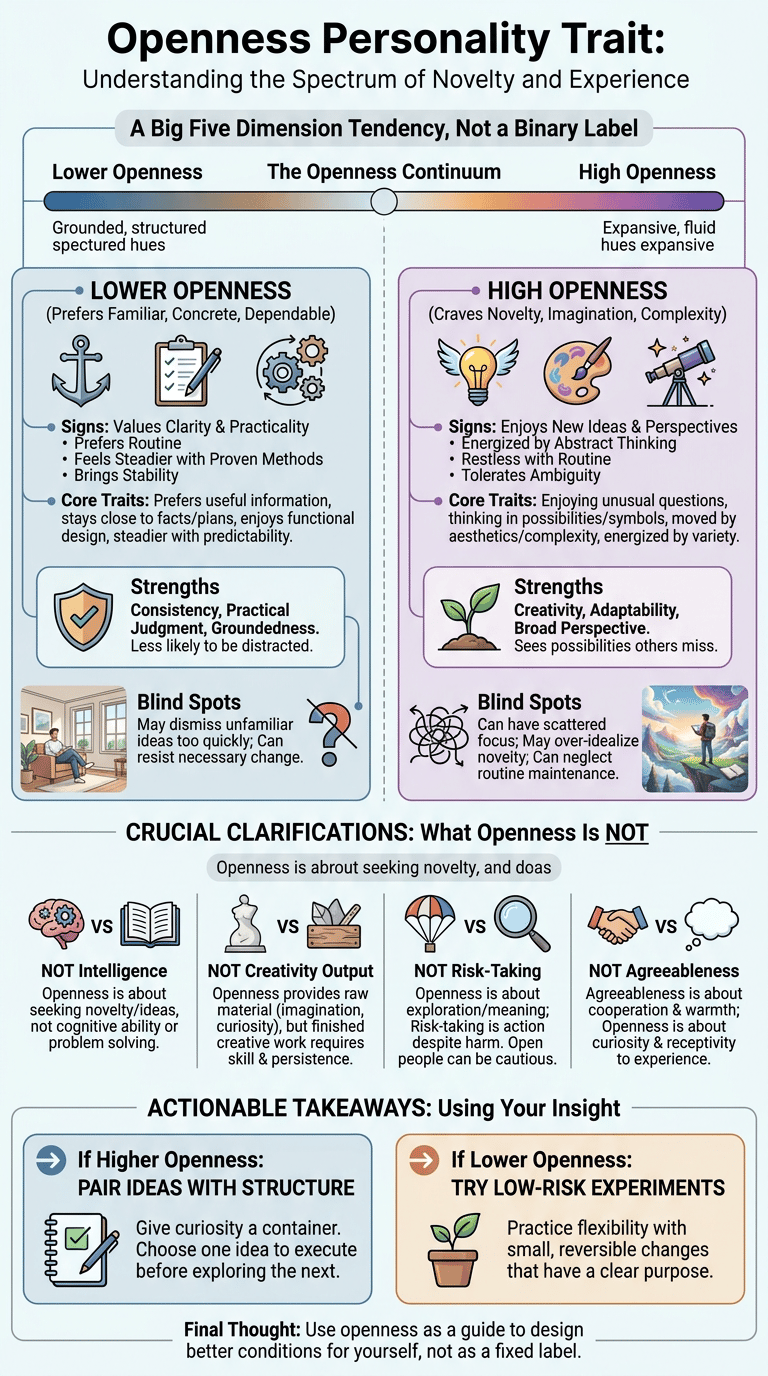
Openness is not the same as being smart, creative, rebellious, artistic, or willing to say yes to everything. It is a broad personality dimension that describes how strongly a person is drawn toward novelty, imagination, ideas, complexity, variety, and inner experience. A highly open person may crave mental room to explore. A lower openness person may prefer what is familiar, concrete, and dependable.
This matters because many people judge this trait too quickly. High openness can look inspiring, but it can also become scattered. Lower openness can look cautious, but it can also bring stability and practical judgment. Understanding your level of openness can help you make better choices about work, learning, relationships, routines, and change without forcing yourself into a personality label.
Quick Answer
Openness describes how strongly someone tends to seek novelty, ideas, imagination, variety, and complex experiences
The openness personality trait describes a person’s tendency to be curious, imaginative, flexible, and receptive to new experiences. The APA Dictionary of Psychology defines openness to experience as a Big Five dimension involving openness to new aesthetic, cultural, or intellectual experiences. High openness often shows up as curiosity and creative exploration. Lower openness often shows up as preference for clarity, familiarity, and proven methods.
What the Openness Personality Trait Means
Openness as a Big Five dimension
Openness is one of the five broad traits in the Big Five model of personality, along with conscientiousness, extraversion, agreeableness, and neuroticism. The APA Dictionary entry on the Big Five personality model describes these as primary dimensions of individual differences. In plain English, they are broad patterns that help describe how people tend to think, feel, and behave across situations.
Openness sits on a continuum. A person can be very high, very low, or somewhere in the middle. Most people are not one extreme all the time. You might love new ideas but dislike sudden schedule changes. You might enjoy art and music but prefer predictable meals, familiar friends, and clear work instructions. A trait score is a tendency, not a complete biography.
Openness to experience versus being open-minded in every situation
Everyday language can make this trait confusing. People often use “open-minded” to mean fair, tolerant, or willing to listen. Openness to experience is related, but it is not identical. Someone can score high in openness and still be stubborn about certain beliefs. Someone can score lower in openness and still listen respectfully when another person explains a different view.
Why low openness does not mean closed-minded or unintelligent
Lower openness is often misunderstood. It does not mean a person is unintelligent, boring, narrow, or unable to learn. It may mean they prefer learning that has a clear purpose, change that has a practical reason, and ideas that can be tested against real life. A lower openness person may ask, “How will this work?” before asking, “What could this become?”
Core Parts of Openness
Curiosity and intellectual exploration
One major part of openness is curiosity. Highly open people often enjoy asking unusual questions, exploring different subjects, and connecting ideas that seem unrelated. They may enjoy documentaries, long conversations, philosophy, psychology, science, travel, history, design, or creative problem solving. The topic matters less than the experience of discovery.
OpenStax Psychology 2e describes openness in the Five Factor Model with words such as imagination, feelings, actions, and ideas, while the high end includes curiosity and a wide range of interests in its trait theorists chapter. That is why openness can show up in many places: the books someone reads, the questions they ask, the hobbies they try, and the way they respond to unfamiliar perspectives.
Imagination and inner experience
Openness also includes the inner world. Some people naturally think in images, metaphors, stories, possibilities, and “what if” scenarios. They may replay experiences in their mind, imagine alternate paths, or feel emotionally moved by symbols, stories, music, and art. Their attention does not stay only on what is immediately visible.
Aesthetic sensitivity and appreciation of complexity
Many descriptions of openness include aesthetic sensitivity, which means noticing and responding to beauty, pattern, tone, atmosphere, and complexity. A highly open person may be deeply affected by a song, a film, a building, a line of poetry, or the mood of a place. They may notice small details others pass over.
Comfort with novelty, change, and uncertainty
Openness also shapes how a person reacts when life becomes unfamiliar. High openness can make novelty feel interesting rather than automatically threatening. A highly open person may be more willing to try a new method, move to a new place, question an old assumption, or experiment with a different routine.
| Part of openness | Higher openness may look like | Lower openness may look like |
|---|---|---|
| Curiosity | Enjoying new ideas, questions, and subjects | Preferring useful information and clear answers |
| Imagination | Thinking in possibilities, symbols, and scenarios | Staying close to concrete facts and proven plans |
| Aesthetics | Being moved by art, atmosphere, beauty, or complexity | Enjoying simple, familiar, or functional design |
| Novelty | Feeling energized by variety and change | Feeling steadier with routine and predictability |
Signs of High Openness
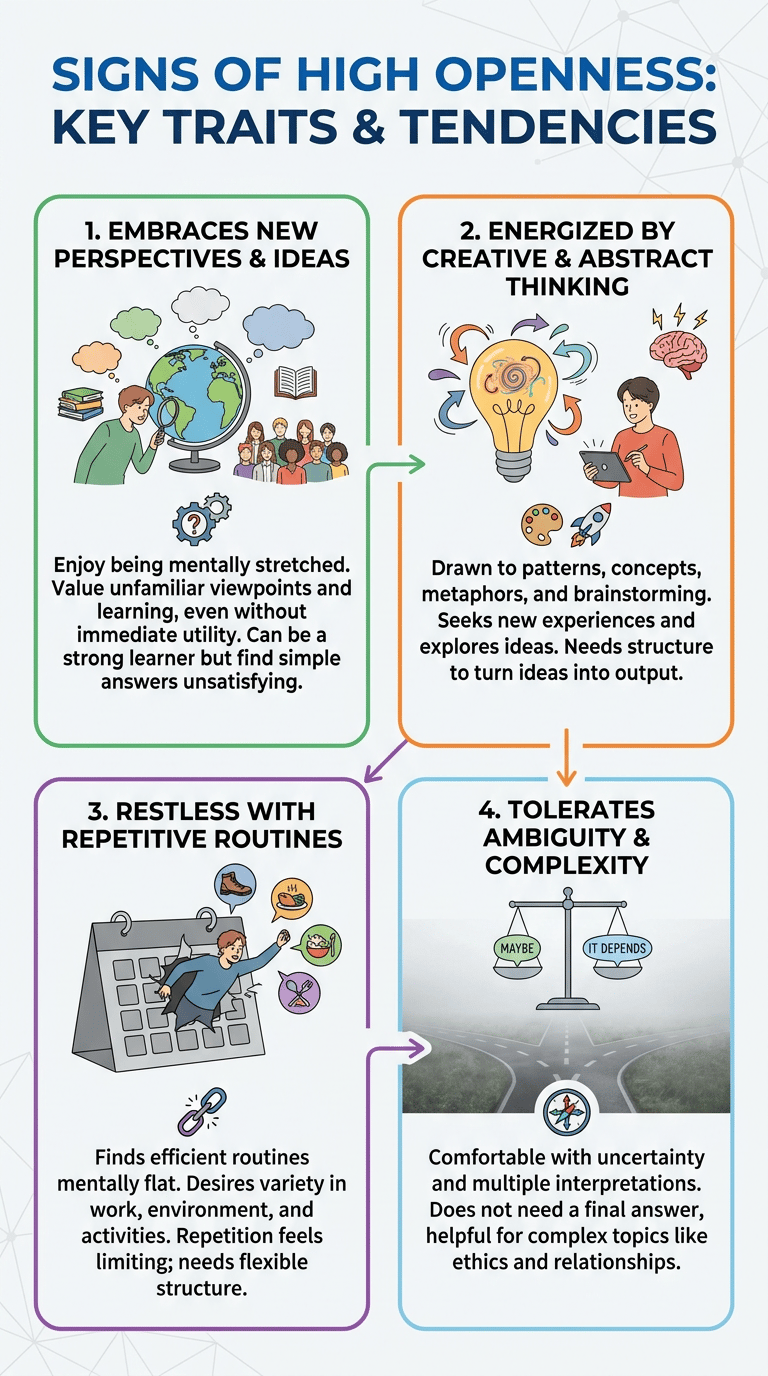
You enjoy new ideas and unfamiliar perspectives
A high openness person often likes being mentally stretched. You may enjoy hearing how people from different backgrounds think, reading about unfamiliar cultures, or considering a viewpoint before deciding whether you agree. You may not need every idea to be immediately useful. Sometimes the usefulness is the expansion itself.
This can make you a strong learner. It can also make simple answers feel unsatisfying. You may keep asking, “What else could be true?” even when other people want to make a decision and move on.
You get energy from creative or abstract thinking
High openness often appears when someone enjoys patterns, concepts, metaphors, and creative combinations. You may like brainstorming, designing, writing, exploring human behavior, or building something original. A 2023 open-access review in PubMed Central notes that openness is linked with seeking new experiences and exploring ideas, values, emotions, and sensations in its discussion of the neurobiology of openness as a personality trait.
Still, openness is not the same as creative output. You can have many ideas and not turn them into finished work. You can enjoy abstract thinking and still need structure, practice, and feedback to make something useful from it.
You may feel restless with repetitive routines
If you are high in openness, a routine that feels efficient to someone else may feel mentally flat to you. You might want variety in your work, environment, conversations, meals, hobbies, or learning. Repetition can start to feel like being boxed in, even when the routine is objectively working.
The challenge is that daily life needs some repetition. Bills, health habits, work systems, and relationships all require follow-through. High openness works best when it has enough structure to protect your energy without removing all room for experimentation.
You can tolerate ambiguity better than rigid answers
Highly open people may be more comfortable sitting with “maybe,” “it depends,” or “there are several ways to see this.” They may not need every conversation to end with one final answer. This can be helpful in complex topics such as identity, culture, creativity, ethics, and relationships.
Signs of Lower Openness
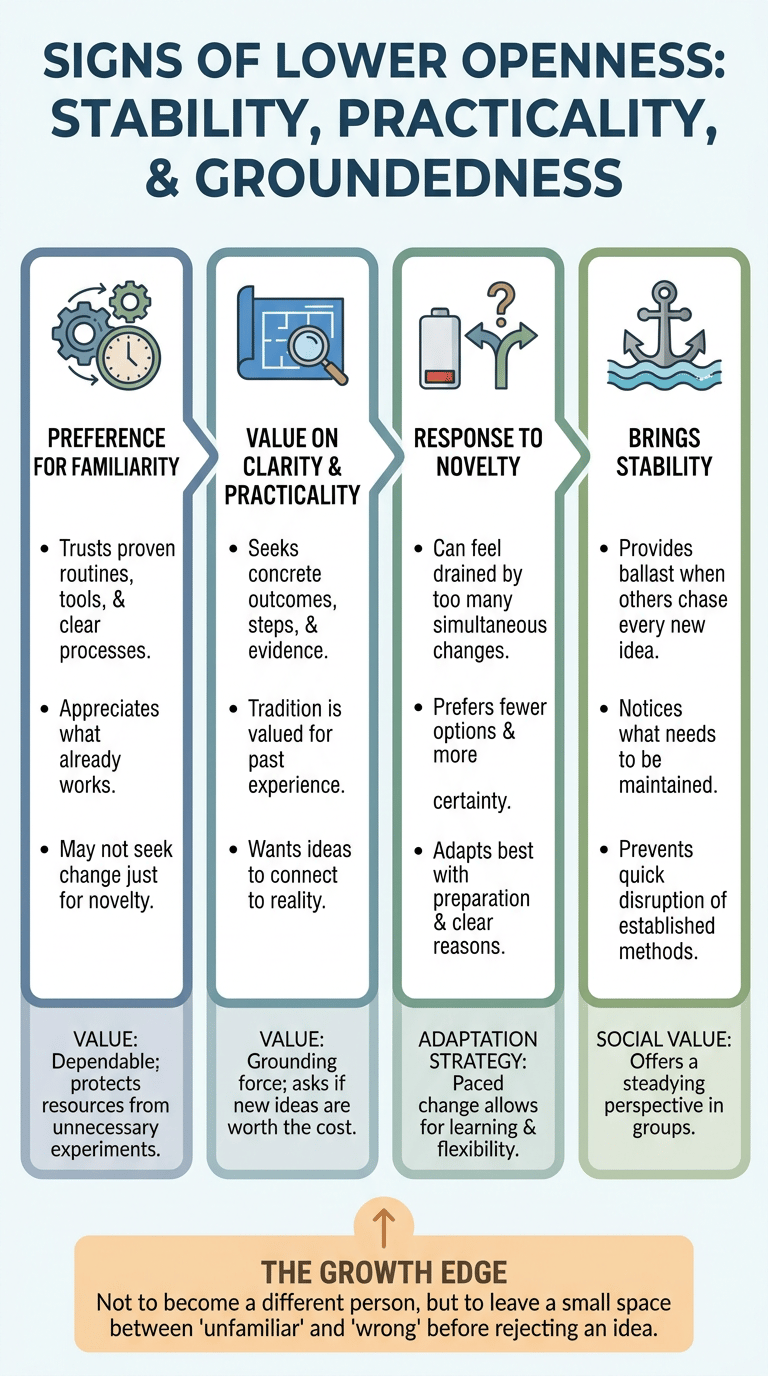
You prefer familiar routines and proven methods
Lower openness often shows up as appreciation for what already works. You may prefer restaurants you trust, tools you understand, clear processes, familiar music, or practical advice. You may not feel a strong need to change something simply because it is new.
This can make you dependable. You may protect time, money, and attention from unnecessary experiments. In a team, you may be the person who asks whether a new idea is worth the cost before everyone rushes into it.
You may value clarity, tradition, and practical usefulness
A lower openness person often wants ideas to connect to reality. You may ask for examples, steps, evidence, and concrete outcomes. Tradition may matter to you because it carries experience from the past, not because you reject every future possibility.
This can be grounding. It can also become limiting if every unfamiliar idea is rejected before it is understood. The growth edge is not to become a completely different person. It is to leave a small space between “unfamiliar” and “wrong.”
You may feel overloaded by too much novelty
Novelty takes energy. New places, new people, new systems, and new ideas all require the brain to orient itself. If you are lower in openness, you may feel drained when too many things change at once. You may want fewer options and more certainty before acting.
That does not mean you cannot adapt. It may mean you adapt better with preparation, clear reasons, and one change at a time. When change is paced well, lower openness can still include learning, flexibility, and growth.
You can bring stability when others chase every new idea
Lower openness has social value. A family, business, or friendship group can suffer when every exciting idea becomes a new direction. Someone who values stability may notice what needs to be maintained, what has already been tried, and what should not be disrupted too quickly.
Strengths and Blind Spots of High Openness
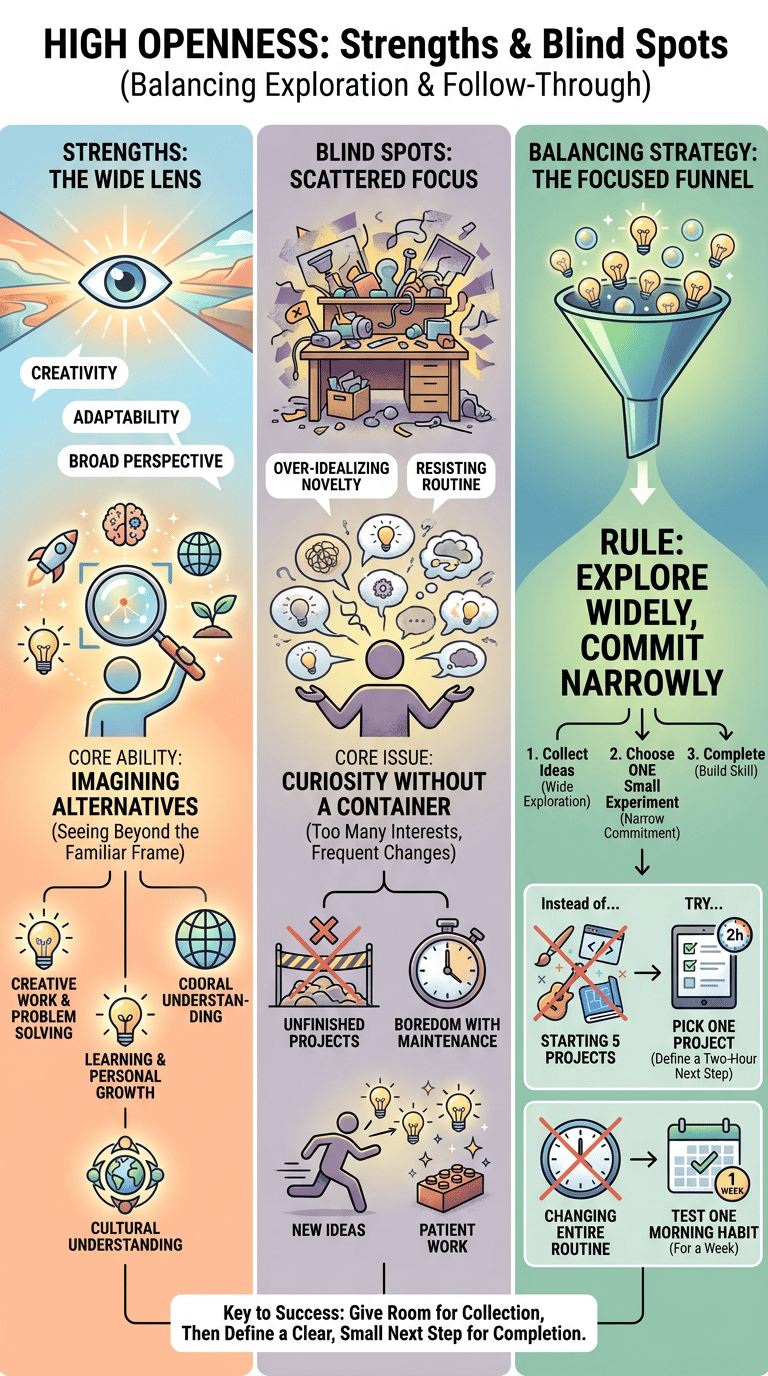
Strength: creativity, adaptability, and broad perspective
High openness can help a person imagine alternatives. This is useful in creative work, problem solving, learning, cultural understanding, and personal growth. A highly open person may see possibilities that others miss because they are willing to look beyond the familiar frame.
Blind spot: scattered focus, over-idealizing novelty, or resisting routine
The same trait can create trouble when curiosity has no container. High openness may lead to too many interests, unfinished projects, frequent changes of direction, or boredom with necessary maintenance. New ideas may feel more exciting than the patient work of building skill.
How to balance exploration with follow-through
A useful high-openness rule is: explore widely, commit narrowly. Give yourself room to collect ideas, then choose one small experiment to complete. For example, instead of starting five creative projects, pick one project and define a two-hour next step. Instead of changing your entire routine, test one morning habit for a week.
Strengths and Blind Spots of Lower Openness
Strength: consistency, practicality, and grounded judgment
Lower openness can protect a person from unnecessary distraction. You may be good at maintaining routines, respecting proven methods, and noticing practical problems before they become expensive. These strengths matter in parenting, finances, teamwork, health habits, and long-term responsibilities.
Blind spot: dismissing unfamiliar ideas too quickly
The blind spot of lower openness is premature rejection. Something may feel wrong simply because it is unfamiliar, abstract, inefficient, or different from how things have always been done. When that happens, the person may miss useful information because they stop listening too early.
How to experiment safely without abandoning what works
Lower openness does not need dramatic reinvention. Small experiments are usually better. Try a new route once, read one article from a different perspective, change one part of a routine, or ask one curious question before giving advice. The experiment should be small enough that it does not feel like your whole life is being overturned.
Openness vs Nearby Ideas People Confuse
Openness vs intelligence
Openness and intelligence are not the same thing. Intelligence often refers to cognitive abilities such as reasoning, learning, and problem solving. Openness refers more to the tendency to seek and appreciate novelty, complexity, imagination, and ideas. A person can be highly intelligent and prefer familiar routines. Another person can be highly open and not always think carefully.
Openness vs creativity
Openness often supports creativity, but it is not identical to creativity. Creativity usually involves producing something original and useful in a context, such as a story, solution, design, strategy, or performance. Openness may provide raw material: curiosity, imagination, unusual associations, and tolerance for ambiguity.
Research has connected openness with cognitive and creative tendencies. For example, an open-access neuropsychological study notes links between trait openness, intelligence, and divergent thinking in its discussion of trait openness in adults. Still, a finished creative result usually needs practice, skill, feedback, and persistence. Openness may open the door, but it does not complete the work by itself.
Openness vs risk-taking
Openness can look like risk-taking because both may involve trying something new. But the motive is different. Openness is often about exploration, meaning, curiosity, or complexity. Risk-taking is about willingness to act despite possible harm, loss, or uncertainty.
A person can be highly open but cautious. They may love new ideas, art, travel, and deep conversations while still avoiding dangerous behavior. Another person may take risks for excitement, status, or impulsive relief without being especially reflective or imaginative. Novelty is not the same as danger.
Openness vs agreeableness
Agreeableness is more about cooperation, trust, warmth, and concern for others. Openness is more about curiosity, imagination, and receptivity to new experiences. These traits can combine in different ways. A highly open and agreeable person may enjoy understanding many perspectives. A highly open but lower agreeable person may enjoy challenging ideas without focusing much on harmony.
| Confused idea | How it differs from openness | Simple example |
|---|---|---|
| Intelligence | Ability to reason or solve problems | Solving a complex math problem |
| Creativity | Producing something original and useful | Writing a song or designing a new process |
| Risk-taking | Willingness to act despite possible harm | Making a high-stakes decision with uncertain outcome |
| Agreeableness | Warmth, cooperation, and concern for others | Trying to keep a conversation respectful |
Self-Check Questions for Openness
What kinds of novelty attract you?
Not all novelty is the same. Some people love intellectual novelty, such as new theories, books, or ideas. Some prefer sensory novelty, such as food, music, places, or design. Others prefer social novelty, such as meeting unfamiliar people or hearing different life stories. Your openness may be strongest in one area and weaker in another.
What kinds of change drain you?
Even highly open people have limits. You may enjoy creative change but hate logistical chaos. You may like new ideas but dislike sudden social plans. You may love travel but need familiar routines at home. These distinctions help you understand your trait more accurately.
Where does your openness help or hurt your daily life?
Trait insight becomes useful when it connects to behavior. High openness may help you learn, create, adapt, and empathize with unfamiliar viewpoints. It may hurt when you avoid structure, start too many things, or treat routine as a threat to identity.
Lower openness may help you stay consistent, protect resources, and make grounded decisions. It may hurt when you dismiss unfamiliar ideas, avoid growth, or expect other people to value routine in the same way you do. The question is not whether your trait is good or bad. The question is where it helps and where it needs support.
What To Do Next With This Insight
If you are highly open, pair ideas with one small structure
If your mind produces many possibilities, do not try to shut it down. Instead, give it a container. Keep an idea list, then choose one idea for action. Use a weekly review to decide what is worth continuing. Set a small completion rule, such as “finish the first draft before starting the next concept.”
If you are lower in openness, try low-risk experiments
If novelty drains you, do not force huge change as proof of growth. Choose experiments that are small, reversible, and connected to a reason you care about. Try one new recipe, one new learning source, one new conversation question, or one small adjustment to a routine.
The point is not to become someone else. The point is to practice flexibility without abandoning stability. Over time, small experiments can teach your nervous system and your habits that unfamiliar does not always mean unsafe or useless.
Use openness as a guide, not a label
A personality trait should help you notice patterns, not trap you inside them. Saying “I am high in openness” should not become an excuse to avoid commitments. Saying “I am low in openness” should not become an excuse to reject every new idea. The trait is information.
Use it to design better conditions. If you are high in openness, you may need novelty built into stable routines. If you are lower in openness, you may need preparation before change. If you are in the middle, you may need different levels of openness in different life areas.
Bridge Topics for the Personality Cluster
How openness interacts with conscientiousness
Openness and conscientiousness often create an interesting tension. Openness asks, “What is possible?” Conscientiousness asks, “What is the plan?” A person high in openness and low in conscientiousness may have many ideas but struggle to finish them. A person lower in openness and high in conscientiousness may be reliable but less interested in experimentation.
The most useful combination is not always high on both. It depends on the context. Creative work may need more openness during exploration and more conscientiousness during execution. A stable household may need enough openness to adapt and enough conscientiousness to maintain responsibilities.
Why openness matters in personality change
Openness can influence how a person responds to self-reflection and change. A highly open person may be more willing to explore new interpretations of themselves. A lower openness person may prefer change that is practical, measured, and clearly useful. Both approaches can work.
How Big Five profiles combine openness with other traits
No trait exists by itself. High openness with high agreeableness may look like warm curiosity. High openness with lower agreeableness may look like bold debate. High openness with high neuroticism may create a rich inner life that sometimes becomes emotionally intense. Lower openness with high conscientiousness may create strong routines and practical consistency.
This is why the Big Five is more useful as a profile than as five separate labels. Openness gives one part of the picture. The rest of the picture comes from how it combines with other traits, life experiences, values, skills, and current circumstances.
When To Get Support
Seek support if novelty seeking becomes unsafe, distressing, impulsive, or tied to severe anxiety or self-harm thoughts
Most differences in openness are normal personality variation. Wanting variety does not mean something is wrong, and preferring routine does not mean you are stuck. Support may be worth considering if the way you seek novelty becomes unsafe, compulsive, financially damaging, relationship-damaging, or tied to intense distress.
Also seek immediate support if thoughts of self-harm, wanting to die, or feeling unable to stay safe appear. The National Institute of Mental Health lists warning signs and crisis options, including calling or texting 988 in the United States. If you are outside the United States, contact local emergency services or a local crisis line. Personality insight is not a substitute for urgent care when safety is involved.
Openness makes more sense when it is viewed as one part of the wider psychology of personality.
Openness is not completely fixed; repeated experience can shape whether openness can change over time.
FAQ
Is openness the same as creativity?
No. Openness can support creativity because it often involves curiosity, imagination, and comfort with unusual ideas. Creativity usually requires producing something original and useful, which also depends on skill, practice, feedback, and persistence. A highly open person may have many ideas without finishing creative work, while a less open person may create excellent work within a familiar style or practical tradition.
Is low openness bad?
Low openness is not bad. It can bring consistency, caution, practical judgment, respect for proven methods, and comfort with routines. It becomes limiting only when it turns into automatic rejection of anything unfamiliar. A lower openness person can still learn and grow, especially when change has a clear reason and arrives at a manageable pace.
Can openness increase over time?
Some people become more open in specific areas through repeated exposure, education, travel, relationships, creative practice, or life transitions. It is usually more helpful to think in terms of flexible behaviors than forcing a new identity. You might not become a completely novelty-seeking person, but you can practice curiosity in small, realistic ways.
Can you be open to ideas but not open to new social situations?
Yes. A person can be intellectually open but socially cautious. You might love books, theories, art, and complex conversations while still needing quiet, predictability, or familiar people. That difference may involve other traits, such as extraversion or neuroticism, and it shows why one trait never explains the whole person.
Key Takeaways
- Openness describes a person’s tendency toward curiosity, imagination, novelty, complexity, and flexible thinking.
- High openness can support creativity, adaptability, and broad perspective, but it may need structure to avoid scattered focus.
- Lower openness can support consistency, practicality, and grounded judgment, but it may need small experiments to avoid rigid rejection of new ideas.
- Openness is not the same as intelligence, creativity, agreeableness, or risk-taking, even though these ideas can overlap in daily life.
- Your level of openness is best used as a guide for self-understanding, not a fixed label or a reason to judge yourself.
- Support may be needed if novelty seeking becomes unsafe, distressing, impulsive, or connected to self-harm thoughts.
Final Thoughts
The openness personality trait is easiest to use when you stop treating it as a ranking. High openness is not superior to low openness. Lower openness is not a defect. They are different ways of relating to novelty, complexity, imagination, and change.
Your next step is to notice where your current level of openness helps your life and where it creates friction. If you are highly open, choose one idea worth giving structure. If you are lower in openness, choose one small experiment that feels safe enough to try. Self-understanding becomes useful when it changes one real choice, not when it becomes another label to carry around.

Michael Reed is the Founder and Lead Writer at Psychology Exposed. He writes about human behavior, relationships, emotional patterns, self-awareness, and practical psychology topics using research-informed, easy-to-understand content.
Read More About Michael Reed: https://psychologyexposed.com/michael-reed/