
If you have ever wondered why you react strongly to some situations but stay calm in others, why one person loves variety while another prefers routine, or why people can be different without one of them being “wrong,” personality psychology gives you a useful language for that.
Personality Psychology Explained is a broad, non-clinical starting point for understanding how personality works. It does not reduce you to a label, and it does not treat a personality test as a final identity. It looks at patterns: how people tend to think, feel, behave, make decisions, handle stress, relate to others, and adapt across situations.
Many people use personality language in an all-or-nothing way. They say, “I am just like this,” or “They are an introvert, so that explains everything.” Real personality psychology is more careful. It helps you notice tendencies without pretending those tendencies control every choice. It also helps you know which deeper topic to explore next, such as the Big Five, a specific trait, the difference between personality and character, or whether personality can change over time.
Quick Answer
Personality psychology studies patterns in how people tend to think, feel, behave, and respond across situations
Personality psychology studies the relatively stable patterns that make one person psychologically different from another. It looks at traits, motives, emotions, habits, values, self-concept, and behavior, but it does not mean every action is fixed. A trait is better understood as a tendency that becomes more visible across repeated situations.
What Personality Psychology Means
Personality as patterns of thinking, feeling, and behavior
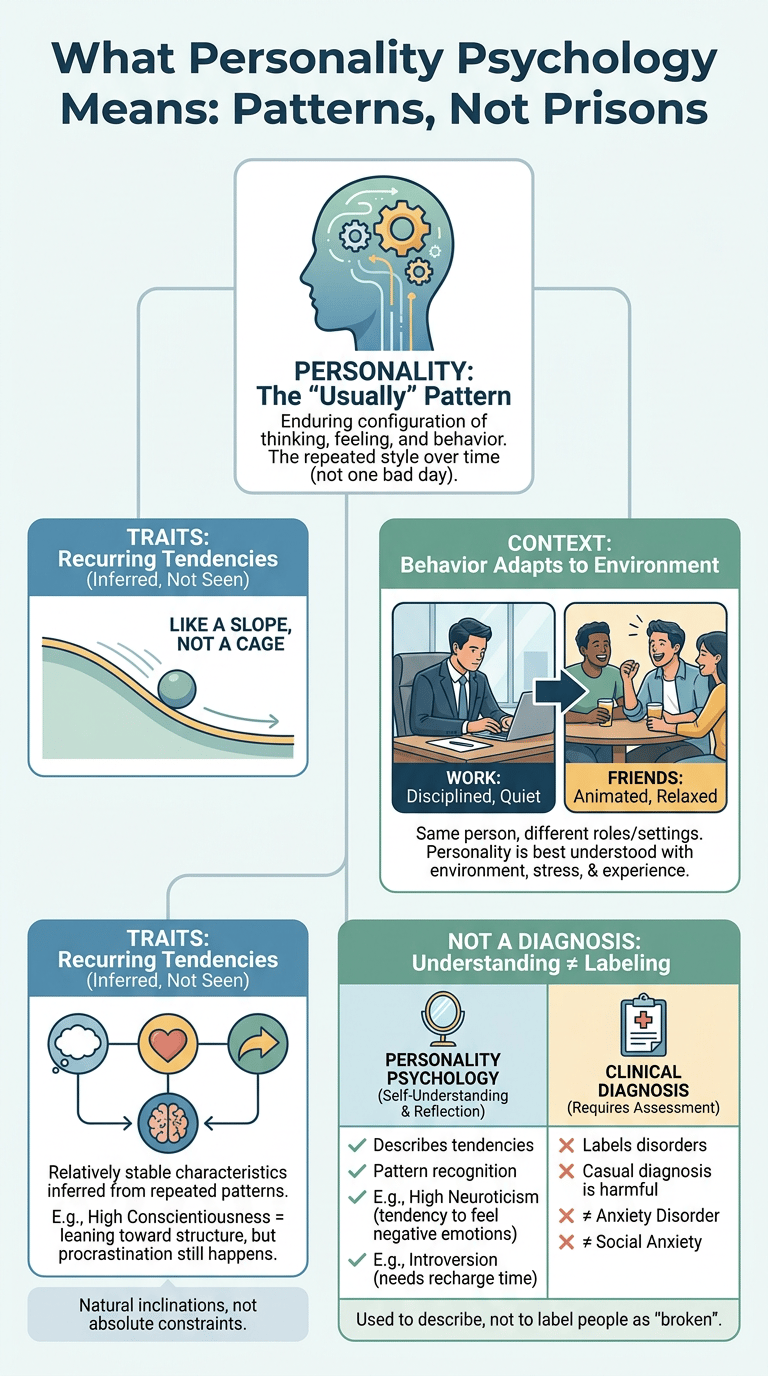
The APA Dictionary of Psychology defines personality as an enduring configuration of characteristics and behavior that includes traits, interests, drives, values, self-concept, abilities, and emotional patterns. In simple terms, personality is the larger pattern of how a person usually operates in life.
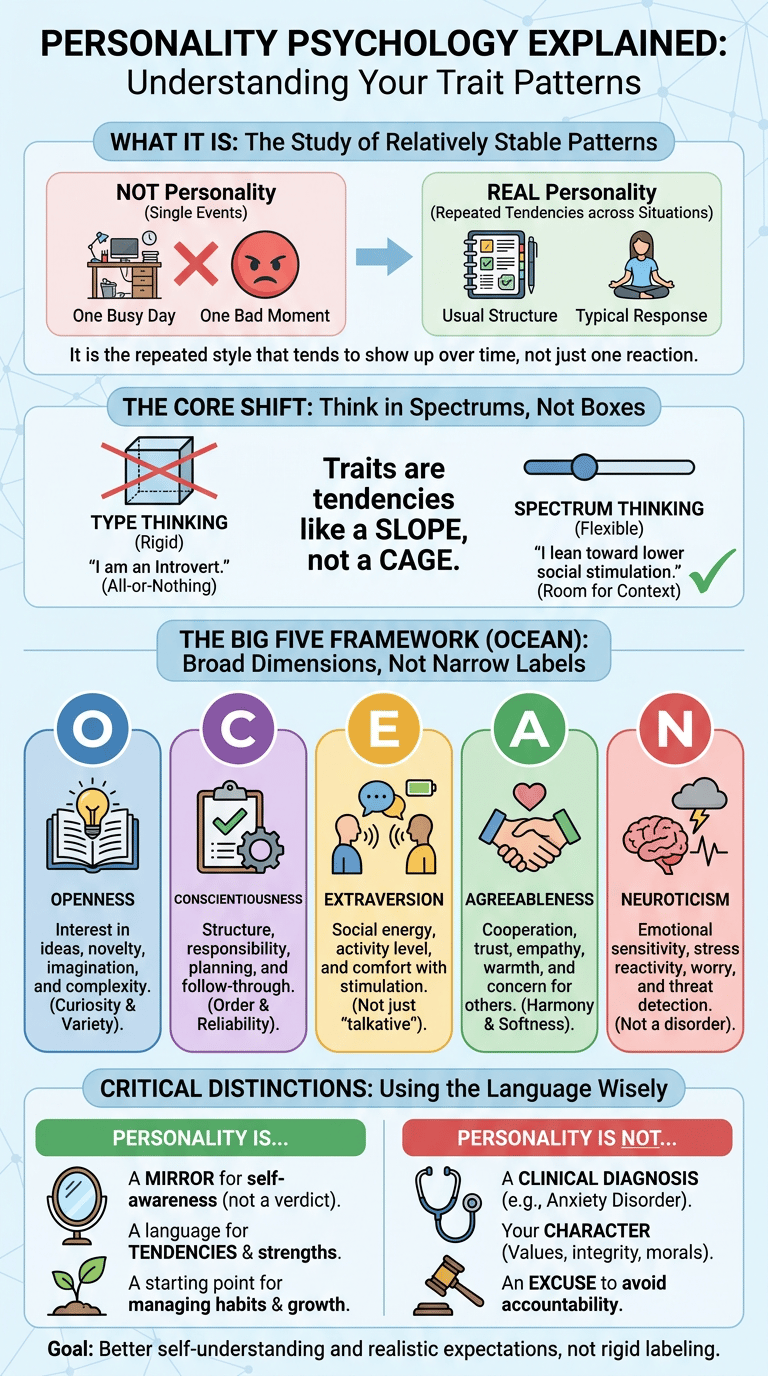
That word “usually” is important. Personality is not one reaction on a bad day. It is not one awkward conversation, one messy desk, one brave choice, or one moment of anger. It is the repeated style that tends to show up when enough situations are observed over time.
Traits, tendencies, and context
A personality trait is a recurring tendency. The APA Dictionary of Psychology describes a personality trait as a relatively stable internal characteristic inferred from patterns of behavior, attitudes, feelings, and habits. That means traits are not directly seen like eye color. They are inferred from repeated behavior.
Think of a trait like a slope, not a cage. If you are high in conscientiousness, you may naturally lean toward planning, order, and follow-through. That does not mean you never procrastinate. It means that, across many situations, structure may feel more natural to you than chaos.
Context still matters. A person who seems quiet at work may become animated with close friends. A person who seems disorganized at home may be highly disciplined in a job that gives clear deadlines. Personality becomes most useful when it is read together with environment, stress level, role, culture, and life experience.
Why personality is not the same as a diagnosis
Personality language can become harmful when it turns into casual diagnosis. Saying “I am high in neuroticism” is not the same as saying “I have an anxiety disorder.” Saying someone is lower in agreeableness is not the same as calling them cruel. Saying someone is introverted is not the same as saying they have social anxiety.
Diagnosis requires clinical assessment. Personality psychology, especially in a general reader context, is better used for self-understanding, reflection, and pattern recognition. It can help you describe tendencies, but it should not be used to label people as broken, disordered, or impossible to change.
Why Personality Psychology Matters for Self-Understanding
Better self-awareness without rigid labels
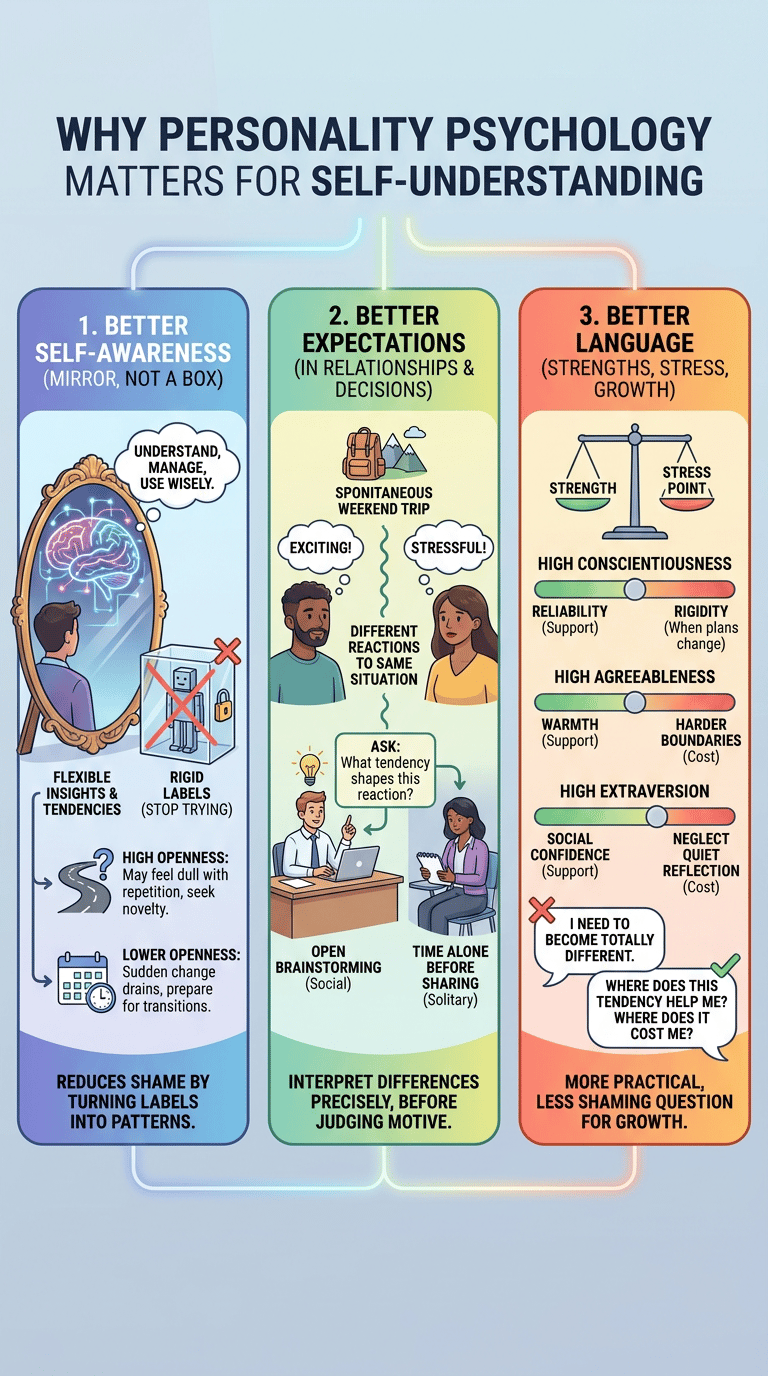
Good personality psychology gives you a mirror, not a box. A rigid label says, “This is who you are, so stop trying.” A useful personality insight says, “This is a tendency you may want to understand, manage, or use more wisely.”
For example, a person who scores high in openness may realize that they feel dull and restless when life becomes too repetitive. A person lower in openness may realize that sudden change drains them, so they can prepare for transitions more deliberately. Both insights reduce shame because they turn a harsh label into a more specific pattern.
Better expectations in work, friendship, family, and decision-making
Personality differences often create confusion because people assume others experience the same situation the same way. One friend may see a spontaneous weekend trip as exciting. Another may see it as stressful. One coworker may like open brainstorming. Another may need time alone before sharing ideas.
Personality psychology helps you ask a better question: “What tendency might be shaping this reaction?” That does not mean every behavior is acceptable. It means you can interpret differences with more precision before judging motive.
Better language for strengths, stress points, and growth
A trait is rarely only good or only bad. High conscientiousness can support reliability, but may become rigid when plans change. High agreeableness can support warmth, but may make boundaries harder. High extraversion can support social confidence, but may make quiet reflection easier to neglect.
Instead of saying, “I need to become a totally different person,” you can ask, “Where does this tendency help me, and where does it cost me?” That question is more practical and less shaming.
The Core Mental Model: Traits Are Tendencies, Not Fixed Boxes
Spectrum thinking instead of type thinking
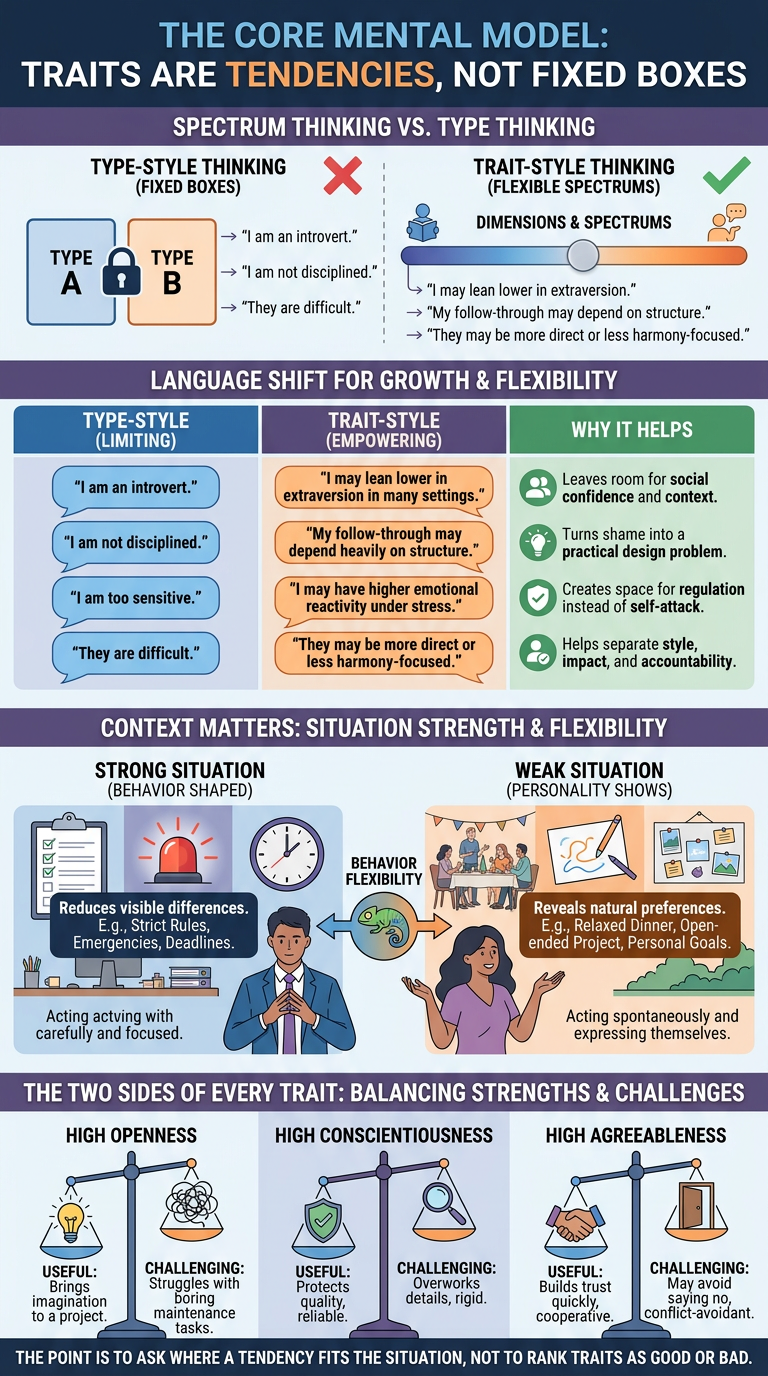
Many popular personality systems talk in types: you are this kind of person or that kind of person. Trait psychology usually works differently. It looks at dimensions. Instead of asking whether you are an introvert or an extrovert as a fixed category, it asks where you tend to fall on a spectrum of extraversion.
Spectrum thinking allows for middle ground, mixed patterns, and context. You can be socially confident but still need quiet recovery. You can be creative but not enjoy constant novelty. You can be kind but not conflict-avoidant. You can be emotionally sensitive but still function well under pressure when the situation is meaningful.
| Type-style thinking | Trait-style thinking | Why it helps |
|---|---|---|
| “I am an introvert.” | “I may lean lower in extraversion in many settings.” | Leaves room for social confidence and context. |
| “I am not disciplined.” | “My follow-through may depend heavily on structure.” | Turns shame into a practical design problem. |
| “I am too sensitive.” | “I may have higher emotional reactivity under stress.” | Creates space for regulation instead of self-attack. |
| “They are difficult.” | “They may be more direct or less harmony-focused.” | Helps separate style, impact, and accountability. |
Situation strength and behavior flexibility
Some situations leave a lot of room for personality to show. A relaxed dinner, an open-ended project, a new social event, or a personal goal may reveal natural preferences. Other situations are strong enough to shape most people’s behavior in similar ways. A strict workplace rule, a serious emergency, or a clear deadline can reduce visible differences.
This is why personality should not be used to predict every single action. A highly spontaneous person may become careful when the stakes are high. A usually reserved person may become assertive when someone they love needs help.
Why a trait can help in one context and hurt in another
Every trait has a useful side and a challenging side. A high-openness person may bring imagination to a project, but may struggle with boring maintenance tasks. A highly conscientious person may protect quality, but may overwork details that do not matter. A highly agreeable person may build trust quickly, but may avoid saying no.
The point is not to rank traits as good or bad. The point is to ask where a tendency fits the situation. A trait becomes wiser when you know when to lean on it and when to balance it.
The Big Five Framework at a Glance
One of the most widely used trait frameworks is the Big Five, also called the Five-Factor Model. OpenStax Psychology 2e explains trait theorists and the Big Five factors as a way to describe broad personality dimensions rather than narrow personality boxes.
| Big Five trait | Simple meaning | Everyday example | Common misunderstanding |
|---|---|---|---|
| Openness | Interest in ideas, novelty, imagination, and complexity. | You enjoy learning unusual topics or trying new approaches. | Low openness does not mean unintelligent. |
| Conscientiousness | Structure, responsibility, planning, and follow-through. | You feel better when tasks and deadlines are clear. | High conscientiousness does not automatically mean emotional maturity. |
| Extraversion | Social energy, assertiveness, activity level, and stimulation. | You may feel energized by lively group interaction. | Introversion does not mean poor social skill. |
| Agreeableness | Cooperation, trust, warmth, empathy, and concern for others. | You notice relational tension quickly and may try to keep peace. | Low agreeableness does not automatically mean cruelty. |
| Neuroticism | Emotional sensitivity, stress reactivity, worry, and threat detection. | You may notice risks or emotional shifts before others do. | High neuroticism is not the same as having a disorder. |
Openness as curiosity and comfort with novelty
Openness describes how drawn a person is to new ideas, imagination, variety, aesthetics, and complex experiences. Higher openness may show up as love of exploration or flexible thinking. Lower openness may show up as appreciation for clarity, tradition, routine, and practical usefulness.
Conscientiousness as structure and follow-through
Conscientiousness is about order, planning, reliability, persistence, and self-control around goals. It is easy to moralize, but it should not be reduced to “good person” versus “lazy person.” Follow-through is shaped by motivation, stress, environment, health, attention, and consequences.
Extraversion and introversion as stimulation and social energy patterns
Extraversion is often misunderstood as “talks a lot” and introversion as “does not like people.” In personality psychology, extraversion includes sociability, assertiveness, activity level, positive emotional expression, and comfort with stimulation.
Agreeableness as cooperation and interpersonal warmth
Agreeableness describes tendencies around trust, empathy, cooperation, softness, and concern for others. The challenge is balance. High agreeableness can become self-abandonment if the person cannot say no. Low agreeableness can become harshness if the person ignores impact.
Neuroticism as emotional sensitivity and stress reactivity
Neuroticism describes a tendency toward stronger negative emotion, worry, self-doubt, irritability, or stress sensitivity. The term can sound insulting, so it needs careful handling. High neuroticism is not a character flaw, and it is not the same as a clinical diagnosis.
How the Cluster Fits Together
Start with Big Five Personality Traits for the framework
If you want the main model in one place, the Big Five article is the next best step. It explains the OCEAN model in more depth, shows what high and low tendencies can look like, and helps you avoid turning the model into five personality types.
Read individual trait articles for deeper self-checks
Individual trait guides are better when your question is specific. If you keep wondering why novelty matters so much to you, openness is the right place to go deeper. If your frustration is about planning, procrastination, or follow-through, conscientiousness is more relevant. If your question is social energy, extraversion and introversion deserve their own attention.
Read comparison articles when two ideas are easy to confuse
Some personality questions are not about a single trait. They are about a confusion. Personality versus character is one of those questions. A trait can influence how you behave, but character is more about values, integrity, responsibility, and repeated choices. Research on the Five-Factor Model recognizes both structure and complexity; one PubMed Central review of the Five-Factor Model discusses the broad domains of personality structure and how the model organizes trait differences.
Short Guide to Big Five Personality Traits
What the model explains and what it does not
The Big Five helps explain broad differences in tendencies. It can help you compare people in a flexible way, especially around curiosity, organization, sociability, cooperation, and emotional reactivity.
What it does not do is explain every detail of a person’s life. It does not tell you their values, history, culture, maturity, relationship skills, or private motives. It should not be used as a shortcut for judging someone’s worth.
Short Guide to Openness Personality Trait
Curiosity, imagination, and tolerance for novelty
Openness is most helpful when you are trying to understand your relationship with ideas, creativity, variety, and change. Higher openness may show up as love of exploration, abstract thinking, or comfort with unusual experiences. Lower openness may show up as appreciation for clear routines, tradition, and proven methods.
Short Guide to Conscientiousness Personality Trait
Organization, responsibility, and reliable follow-through
Conscientiousness affects planning, preparation, persistence, neatness, punctuality, and how seriously someone treats commitments. The deeper conscientiousness guide should help readers understand planning style, procrastination, perfectionism, follow-through, and how to build systems that fit their real behavior instead of relying on shame.
Short Guide to Extraversion vs Introversion Psychology
Social energy, stimulation, and common myths
Extraversion and introversion are useful only when handled carefully. The real issue is not whether someone likes people. The difference often involves stimulation, pace, social recovery, assertiveness, and how a person processes experience.
Short Guide to Agreeableness Personality Trait
Cooperation, boundaries, and conflict style
Agreeableness affects how people approach trust, empathy, conflict, cooperation, and the needs of others. The deeper agreeableness guide should avoid making “nice” the goal. A better goal is balanced consideration: enough care to respect others, enough self-respect to avoid resentment, and enough honesty to make cooperation real.
Short Guide to Neuroticism Personality Trait
Emotional sensitivity, stress response, and mental health boundaries
Neuroticism is about emotional reactivity, not emotional worth. A person higher in this trait may notice threats, rejection, uncertainty, or possible failure more quickly. That can feel exhausting, but it can also make them alert to details that others ignore.
Short Guide to Personality vs Character
Traits, values, choices, and moral behavior
Personality and character overlap in daily life, but they are not the same thing. Personality describes tendencies. Character has more to do with values, integrity, accountability, fairness, courage, and repeated choices. This distinction helps readers avoid two mistakes: excusing harm as personality, and moralizing harmless differences as character flaws.
Short Guide to Can Your Personality Change?
Stability, maturity, habits, and life experience
Personality traits are relatively stable, but not frozen. A person may become more responsible through work demands, more emotionally steady through support and practice, more open through exposure to new experiences, or more assertive through repeated boundary-setting.
Change is usually easier to understand as a shift in patterns, habits, roles, and coping skills than as becoming an entirely different person. The deeper change article should explore realistic personality change, maturity, trait stability, and the difference between changing one behavior and shifting a broader tendency.
Common Misunderstandings About Personality
Personality is not destiny
Personality can influence what feels natural, but it does not write your future in advance. If you lean introverted, you can still build social confidence. If you lean spontaneous, you can still learn planning systems. If you are emotionally reactive, you can still develop steadier recovery habits.
Traits are not excuses
Trait language should not be used to avoid accountability. “I am just direct” does not erase the impact of contempt. “I am just anxious” does not justify controlling another person. “I am just low in conscientiousness” does not remove the need to repair broken commitments.
A better use of trait language is responsibility with self-knowledge: “This is harder for me, so I need a plan.” That sentence keeps compassion and accountability in the same room.
Personality tests are starting points, not identity labels
Personality tests can be interesting and sometimes useful, but they are not final truth. Results depend on the quality of the test, the honesty of responses, the person’s current stress level, and how questions are interpreted. Use test results as questions, not conclusions.
What To Read Next Based on Your Question
If you want the framework, read Big Five Personality Traits
Choose the Big Five guide if your main question is, “What are the five traits and how do they work together?” It is the best next step for understanding the OCEAN model without turning it into a personality type system.
If you want a trait self-check, read the specific trait article
Choose an individual trait article if your question is personal and specific. Openness is best for curiosity and novelty. Conscientiousness is best for structure and follow-through. Extraversion versus introversion is best for social energy and stimulation. Agreeableness is best for cooperation and boundaries. Neuroticism is best for stress sensitivity and emotional reactivity.
If you confuse traits with values, read Personality vs Character
Choose the personality versus character article if you are trying to understand responsibility, integrity, and moral choice. That comparison is especially useful when you catch yourself excusing behavior too quickly or judging a normal difference too harshly.
If you want growth, read Can Your Personality Change?
Choose the personality change article if your question is about what can realistically shift. It is the better place to explore habits, maturity, life roles, therapy support when appropriate, repeated practice, and the difference between trait change and short-term behavior change.
| Your question | Best next topic | Why it fits |
|---|---|---|
| “I want the main model.” | Big Five Personality Traits | It explains the OCEAN framework directly. |
| “I need to understand my creativity or need for novelty.” | Openness Personality Trait | It focuses on curiosity, imagination, and comfort with change. |
| “I struggle with follow-through or planning.” | Conscientiousness Personality Trait | It focuses on structure, responsibility, and practical systems. |
| “I am confused about social energy.” | Extraversion vs Introversion Psychology | It separates stimulation from social skill myths. |
| “I want to understand sensitivity or worry.” | Neuroticism Personality Trait | It focuses on stress reactivity without diagnosing. |
When To Get Support
Seek professional help if personality-related distress involves severe anxiety, self-harm thoughts, fear, coercion, or unsafe relationship dynamics
Personality psychology can help with reflection, but it is not a substitute for professional care. If your distress feels intense, persistent, or hard to manage, support can help you sort out what is personality, what is stress, and what may need more direct attention. NIMH guidance on caring for your mental health explains that mental health includes emotional, psychological, and social well-being.
Get urgent help if you are thinking about harming yourself or feel unable to stay safe. If you are in the United States, call or text 988 for the Suicide and Crisis Lifeline. Outside the United States, contact local emergency services or a crisis line in your country. If fear, threats, coercion, stalking, humiliation, or retaliation are present in a relationship, prioritize safety planning and trusted support over trying to communicate perfectly.
The best next step for the full trait framework is the Big Five model.
If you are wondering whether personality can change, the growth guide is the natural next step.
FAQ
Is personality psychology the same as a personality test?
No. Personality psychology is a field of study. A personality test is one possible tool within that broader field. Some tests are research-based, some are informal, and some are mainly used for entertainment. A test result may give you language for reflection, but it should not replace careful self-observation or professional assessment when distress is serious.
Are personality traits permanent?
Personality traits are relatively stable, which means they often show consistency over time. Stable does not mean unchangeable. People can develop skills, habits, coping strategies, and different ways of responding. Some broader trait patterns may also shift across life experience, maturity, role changes, and intentional practice.
Can a trait be good in one situation and difficult in another?
Yes. High conscientiousness may help with deadlines but create tension when flexibility is needed. High openness may help with creativity but make routine feel dull. High agreeableness may support warmth but make boundaries harder. A trait is best understood by asking where it fits, where it creates friction, and what balancing skill may help.
Is the Big Five better than personality types?
The Big Five is often more flexible for serious self-understanding because it describes dimensions rather than fixed categories. Personality types can feel memorable and easy to discuss, but they may oversimplify people. A trait model gives more room for middle ground, mixed tendencies, and context.
Key Takeaways
- Personality psychology studies repeated patterns in thinking, feeling, behavior, motivation, and emotional response.
- Traits are tendencies, not fixed boxes, and they become most useful when viewed across repeated situations.
- The Big Five gives a broad map of openness, conscientiousness, extraversion, agreeableness, and neuroticism.
- No trait is purely good or bad; the same tendency can help in one context and create friction in another.
- Personality is different from diagnosis, character, and temporary stress reactions.
- If personality-related distress involves safety risks, severe anxiety, self-harm thoughts, fear, or coercion, support should come before self-analysis.
Final Thoughts
Use personality psychology as a map, not a verdict. The next useful step is to pick one tendency that affects your daily life and observe it in three places: where it helps you, where it creates friction, and what small skill would make it easier to handle. That keeps self-understanding practical, flexible, and humane.

Michael Reed is the Founder and Lead Writer at Psychology Exposed. He writes about human behavior, relationships, emotional patterns, self-awareness, and practical psychology topics using research-informed, easy-to-understand content.
Read More About Michael Reed: https://psychologyexposed.com/michael-reed/