
If you react strongly to stress, replay conversations, worry about what might go wrong, or feel criticism more deeply than other people seem to, you may have wondered whether something is wrong with you. The neuroticism personality trait offers a more useful starting point. It describes a normal personality dimension related to emotional sensitivity, stress reactivity, worry, and how quickly your mind detects possible threat.
That does not mean every strong feeling is a disorder. It also does not mean you are “too dramatic,” weak, or impossible to be around. Neuroticism is one part of the Big Five model of personality, a framework used to describe broad patterns in how people tend to think, feel, and respond. The APA Dictionary of Psychology describes neuroticism as one of the Big Five dimensions and connects it with emotional instability and proneness to psychological distress.
This article explains neuroticism in plain language, including what high and low neuroticism can look like, how it differs from anxiety disorders, and what first steps can help you work with emotional sensitivity without shaming yourself. It is educational, not a diagnosis or a substitute for mental health care.
Quick Answer
Neuroticism describes a tendency toward stronger negative emotion, stress sensitivity, worry, threat detection, and emotional reactivity
Neuroticism is a personality trait that reflects how easily someone experiences emotional distress and how strongly they respond to stress, uncertainty, criticism, or perceived threat. Higher neuroticism often means emotions rise faster and take longer to settle. Lower neuroticism often means a steadier baseline. Neither side makes someone better or worse. The useful question is how the trait affects daily choices, relationships, and self-care.
What Neuroticism Means in Personality Psychology
Neuroticism as a Big Five dimension
In personality psychology, neuroticism is usually discussed as one of the Big Five traits: openness, conscientiousness, extraversion, agreeableness, and neuroticism. The Big Five does not sort people into fixed types. It describes broad dimensions, which means most people fall somewhere along a range rather than fitting neatly into a category.
The OpenStax Psychology 2e chapter on trait theorists explains the Big Five as a trait framework for describing consistent individual differences. Neuroticism is the dimension most closely related to emotional stability versus emotional reactivity. A person high in neuroticism may notice danger, tension, uncertainty, and possible rejection quickly. A person low in neuroticism may return to calm more easily or may not experience the same situation as emotionally loaded.
Thinking of neuroticism as a dimension matters because it reduces shame. You are not either “normal” or “neurotic.” You may simply have a nervous system and thinking style that responds strongly to possible problems. The work is not to erase sensitivity. It is to understand when sensitivity is useful, when it becomes exhausting, and how to respond before the emotion takes over the whole day.
Emotional reactivity versus emotional weakness
Emotional reactivity means your feelings may activate quickly and intensely. A small mistake can feel urgent. A vague text message can feel like rejection. A work comment can feel like proof that you failed. This is not the same as weakness. It is a response pattern.
Weakness is a judgment. Reactivity is a process. When you separate the two, you can start noticing what happens inside you: a body signal, a thought, a fear, an urge to fix, and then a behavior. That sequence is easier to work with than a global label like “I am too sensitive.”
Why high neuroticism is not the same as an anxiety disorder
High neuroticism may include worry, tension, reassurance-seeking, and sensitivity to uncertainty, so it can overlap with anxiety-like experiences. But a personality trait is not the same thing as a mental health diagnosis. A trait describes a tendency. A disorder involves a fuller clinical picture, including intensity, duration, impairment, distress, and context.
The National Institute of Mental Health explains that anxiety disorders involve persistent fear or worry that can interfere with daily life and may include physical symptoms, avoidance, and distress. If worry, panic, avoidance, sleep disruption, or distress is interfering with work, school, relationships, or basic functioning, it is worth speaking with a qualified professional. Neuroticism can help you understand a tendency, but it should not be used to diagnose yourself.
Core Parts of Neuroticism
Stress sensitivity
Stress sensitivity means your system may respond strongly to pressure, deadlines, conflict, uncertainty, or possible mistakes. Two people can face the same situation and experience it differently. One person may think, “This is annoying, but manageable.” Another may feel a surge of urgency, dread, muscle tension, and mental replay.
High neuroticism often makes stress feel personal. A delayed reply may not feel like a delayed reply. It may feel like proof that someone is upset. A small error may not feel like a small error. It may feel like the beginning of a bigger failure. The stress trigger is real, but the meaning your mind attaches to it may be larger than the situation itself.
Worry and threat scanning
Threat scanning is the habit of looking for what could go wrong. In some situations, this can be useful. It helps you prepare, notice risk, and avoid careless decisions. The cost appears when your mind scans constantly, even when there is no clear problem to solve.
Worry often pretends to be preparation. It says, “If I think about this enough, I will prevent the bad thing.” Sometimes thinking helps. Other times, it turns into a loop where each answer creates a new question. Neuroticism can make that loop feel urgent because the body is already acting as if danger is near.
Mood shifts and emotional intensity
People higher in neuroticism may notice stronger changes in mood after everyday events. A tense meeting, awkward silence, disappointing message, or unexpected plan change can affect the rest of the day. This does not mean the person is choosing to overreact. It means the emotional system may stay activated longer.
The practical issue is not whether the feeling is “valid enough.” Feelings do not need a courtroom. The practical issue is what the feeling is asking you to do. If sadness asks for reflection, that may help. If anxiety asks for ten reassurance messages, that may create more stress. If anger asks for a harsh reply, that may damage a situation you still care about.
Sensitivity to criticism, uncertainty, or rejection
Neuroticism often shows up around social threat. Criticism may land as humiliation. Uncertainty may feel like danger. Neutral feedback may sound like disapproval. A person may not only hear the words someone said, but also imagine the rejection behind them.
This is where self-understanding helps. If you know criticism activates you quickly, you can build a pause between feedback and conclusion. The pause does not mean pretending the comment did not hurt. It means giving yourself time to ask, “What was actually said, what am I adding, and what do I need to clarify?”
Signs of Higher Neuroticism

You react strongly to uncertainty or possible mistakes
Uncertainty can feel uncomfortable for anyone, but higher neuroticism may make uncertainty feel unsafe. You may want immediate answers, clear reassurance, or a plan for every possible outcome. A small unresolved detail can take up more mental space than you want it to.
For example, if your manager says, “Let us talk tomorrow,” your mind may jump to criticism, job insecurity, or embarrassment. The actual information is limited. The emotional reaction fills in the blanks. The first step is not to mock yourself for caring. It is to notice that your mind is treating unknown information as negative information.
You replay stressful conversations
Replay is a common sign of emotional sensitivity. You may review what you said, how someone looked, what you should have answered, or whether your tone sounded wrong. The replay may begin as problem-solving, but it often becomes self-punishment.
| Replay question | Helpful version | Unhelpful loop |
|---|---|---|
| What happened? | Identify the specific moment that bothered you. | Review the whole conversation repeatedly without a clear purpose. |
| What can I learn? | Choose one adjustment for next time. | List every possible way you may have failed. |
| Do I need to repair? | Send one grounded clarification if needed. | Seek repeated reassurance because the feeling has not settled yet. |
Your body may stay tense after a problem ends
Neuroticism is not only a thinking pattern. It can have a body component. Your shoulders may stay tight, your stomach may feel unsettled, your sleep may become lighter, or your breathing may stay shallow after a stressful event is technically over.
This matters because a tense body can keep the mind searching for reasons to be tense. You may believe, “I still feel anxious, so there must still be danger.” Sometimes the body is simply taking longer to return to baseline. A grounding step can help before you interpret the feeling as evidence.
You may need more reassurance during stress
Reassurance is not bad. People need support. But high neuroticism can make reassurance feel short-lived. Someone tells you things are okay, and you feel calmer for ten minutes. Then the doubt returns, and your mind wants another round of certainty.
The question is not, “Am I allowed to need reassurance?” You are. The better question is, “What kind of reassurance actually helps me become steadier?” Sometimes the answer is a direct answer from another person. Sometimes it is learning to tolerate a small amount of uncertainty without chasing immediate relief.
Signs of Lower Neuroticism or Higher Emotional Stability
You return to baseline more easily
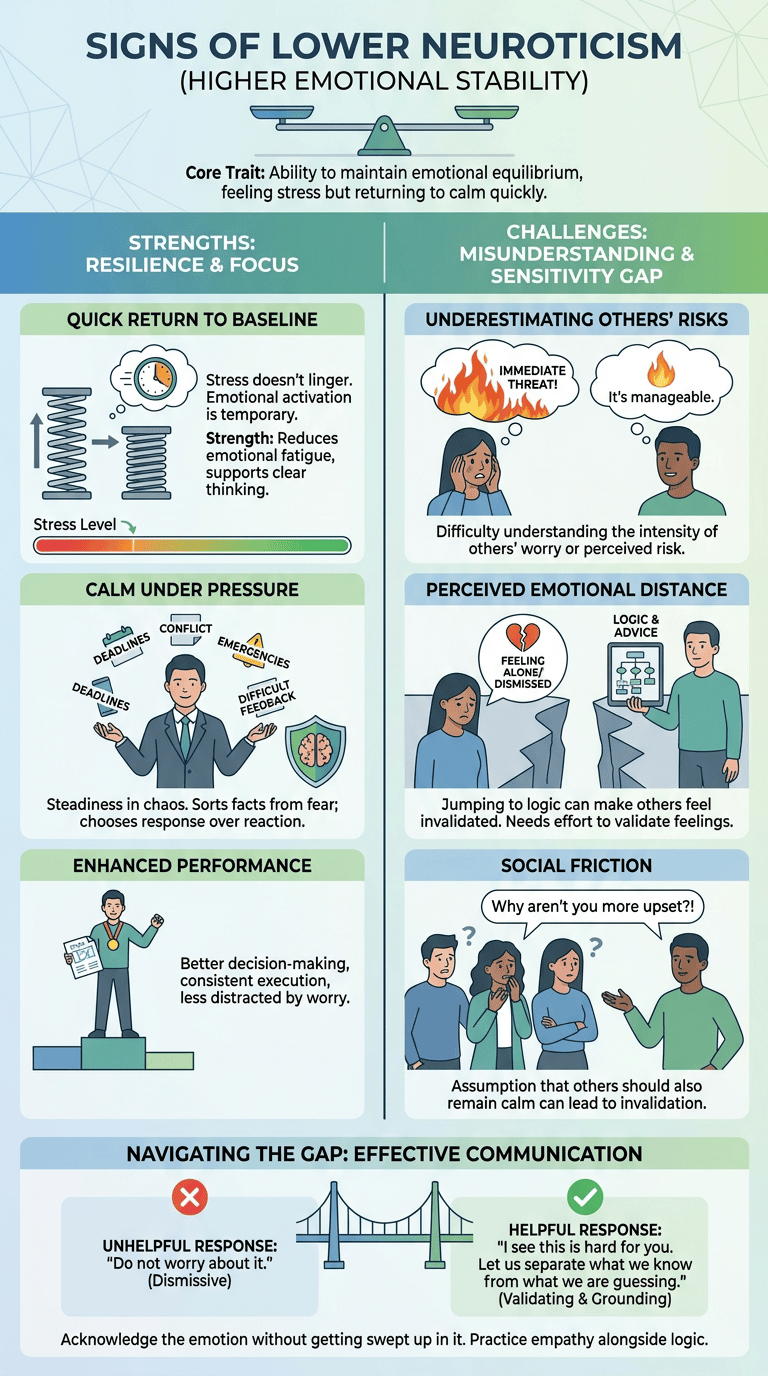
Lower neuroticism is often described as higher emotional stability. People lower on this trait may feel stress, sadness, irritation, or worry, but they may not stay activated as long. A tense conversation may bother them, but it does not always take over the rest of the day.
This can be a strength. It supports clear thinking under pressure and reduces emotional fatigue. But it can also create misunderstanding. Someone who returns to calm quickly may assume others should do the same. That assumption can make emotionally sensitive people feel dismissed.
You may stay calm under pressure
Lower neuroticism can help in situations that require steadiness: emergencies, deadlines, difficult feedback, or conflict. Calmness allows a person to sort facts from fear and choose a response instead of reacting immediately.
You may underestimate emotional risks others feel
If you are low in neuroticism, you may not understand why another person worries so much. Their concern may look excessive from the outside. But from the inside, their body may be responding as if the risk is immediate.
A useful response is not, “Do not worry about it.” A more helpful response is, “I can see this is hitting you hard. Let us separate what we know from what we are guessing.” That keeps the conversation grounded without shaming the emotion.
You may need to practice sensitivity when others are distressed
Emotional stability can sometimes look like emotional distance. If another person is upset and you move straight into logic, advice, or minimization, they may feel alone. This is not because you lack care. It may be because your system does not experience the same level of threat.
Strengths and Costs of High Neuroticism
Strength: early risk detection and emotional depth
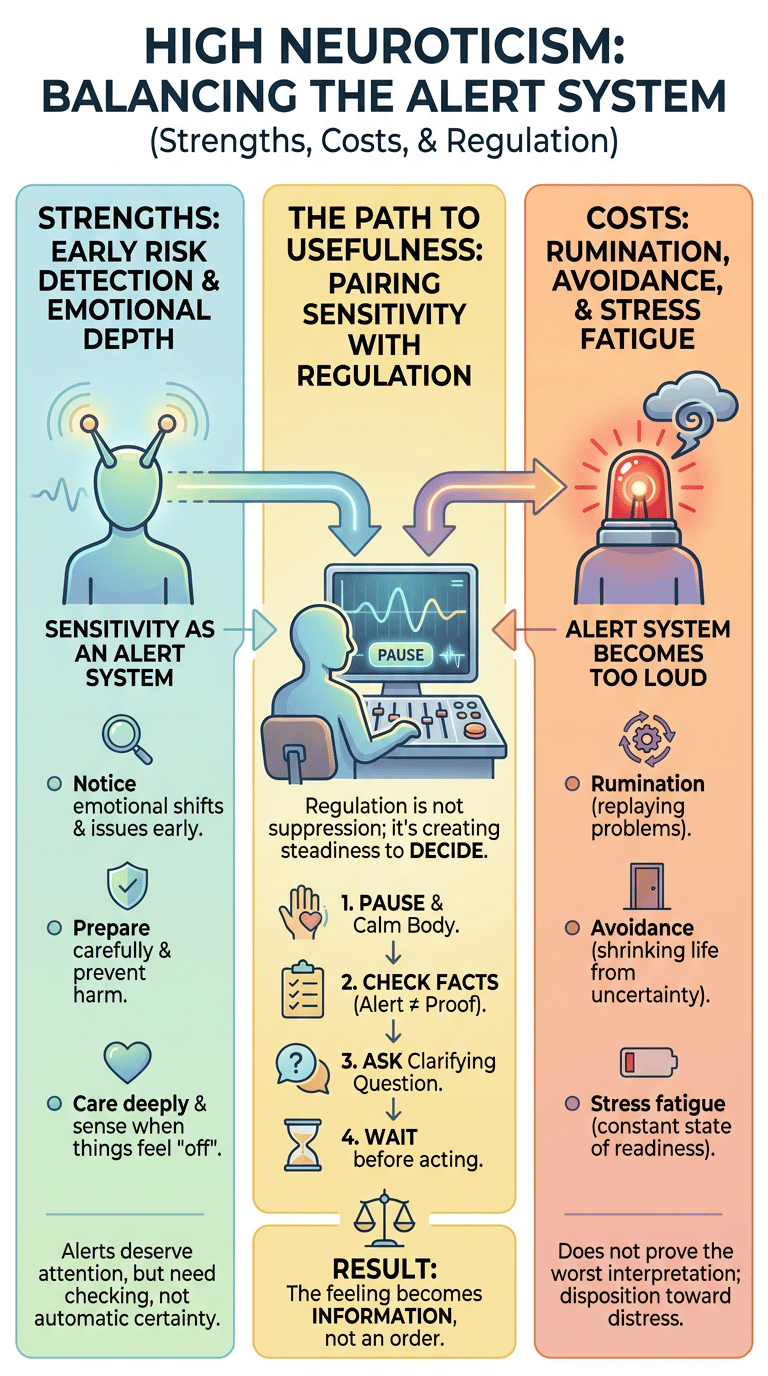
High neuroticism is often discussed only as a problem, but sensitivity can carry strengths. You may notice emotional shifts early. You may prepare carefully. You may sense when something feels off. You may care deeply about preventing harm, disappointing others, or repeating mistakes.
The key is to separate sensitivity from certainty. Your sensitivity may notice a possible issue, but it does not automatically prove the worst interpretation. Think of it as an alert system. An alert deserves attention, but it still needs checking.
Cost: rumination, avoidance, and stress fatigue
The cost of high neuroticism is that the alert system can become too loud. Rumination may keep replaying problems. Avoidance may shrink your life because uncertainty feels unbearable. Stress fatigue may build when your body spends too much time in a state of readiness.
Research on neuroticism often connects the trait with negative affect and distress. One open-access review in World Psychiatry describes neuroticism as a broad disposition toward negative emotions such as anxiety, irritability, anger, self-consciousness, and emotional instability. That does not mean a person is doomed by the trait. It means the trait can shape what needs more care and regulation.
How sensitivity becomes useful when paired with regulation
Sensitivity becomes more useful when you add regulation. Regulation does not mean suppressing your reaction or pretending you are fine. It means creating enough steadiness to decide what the feeling is telling you and whether the situation needs action.
A regulated sensitive person may still notice danger early, but they do not treat every alarm as proof. They pause, check facts, calm the body, ask a clarifying question, or wait before sending the message. The feeling becomes information, not an order.
Neuroticism vs Nearby Ideas
Neuroticism vs anxiety disorder
Neuroticism is a personality dimension. An anxiety disorder is a clinical condition that may involve persistent, excessive fear or worry, physical symptoms, avoidance, and significant distress or impairment. The two can be related, but they are not the same.
You can have high neuroticism without having an anxiety disorder. You can also have an anxiety disorder for reasons that cannot be reduced to personality. If anxiety feels unmanageable, interferes with daily life, or includes panic, avoidance, sleep problems, or intense physical symptoms, professional support can be important.
Neuroticism vs trauma response
A trauma response is not simply a personality trait. It can develop after overwhelming or unsafe experiences and may include hypervigilance, emotional numbing, intrusive memories, avoidance, or intense body reactions. High neuroticism may involve threat sensitivity, but it should not be used to explain away trauma symptoms.
If reactions feel connected to past harm, fear, flashbacks, panic, or feeling unsafe in your body, the next step is not self-labeling. The next step may be trauma-informed support from a qualified professional. Personality language can help with self-understanding, but it should never replace care when safety or trauma symptoms are involved.
Neuroticism vs conscientious overcontrol
Conscientiousness is about order, responsibility, planning, and follow-through. Neuroticism is about emotional reactivity and sensitivity to threat. They can combine in a way that looks like perfectionistic pressure: “I must do this right, or something bad will happen.”
The difference matters. If the main issue is conscientiousness, you may need more flexible standards and rest. If the main issue is neuroticism, you may need threat-checking, grounding, and reassurance that does not feed rumination. If both are involved, you may need to simplify expectations and calm the body before planning.
Neuroticism vs introversion
Introversion is about social energy, stimulation, and preference for quieter environments. Neuroticism is about emotional sensitivity and negative affect. An introverted person may be emotionally steady. An extraverted person may be highly reactive. The traits can combine, but one does not prove the other.
This is especially important when people confuse introversion with social anxiety or emotional fragility. Wanting quiet time is not the same as fear. Feeling anxious in social situations is not the same as needing solitude. Trait language is most useful when it helps you describe the right pattern.
How Neuroticism Shows Up in Daily Decisions
Uncertainty feels like danger
When uncertainty feels like danger, you may rush to remove it. You may over-research, ask for reassurance, check messages repeatedly, or imagine worst-case scenarios. The emotional goal is safety. The problem is that certainty is not always available.
A practical question is: “What decision is actually needed right now?” If no decision is needed yet, the task may be regulation rather than analysis. You might take a short walk, breathe slowly, write down what you know, or set a time to revisit the issue instead of thinking about it all evening.
Feedback may feel like rejection
Feedback can become painful when your mind translates it into identity. “This draft needs changes” becomes “I am not good enough.” “You seemed distracted” becomes “They are disappointed in me.” This translation can happen quickly, especially if criticism has felt unsafe in the past.
Try separating three layers: the words spoken, the meaning you added, and the action needed. The words may contain useful information. The meaning may contain fear. The action may be smaller than your nervous system believes.
| Event | Fast interpretation | Grounded reframe |
|---|---|---|
| A friend replies briefly. | They are upset with me. | I do not have enough information yet. |
| A manager asks for changes. | I failed. | The work needs revision, not my identity. |
| A partner needs space. | They are pulling away forever. | Space may mean regulation, and I can ask for a return time. |
| A plan changes suddenly. | Something will go wrong. | This is inconvenient, and I can adjust one step at a time. |
Small problems can feel urgent when your nervous system is activated
When your nervous system is activated, urgency can spread. A minor issue feels like it must be solved immediately. A slightly awkward moment feels like a relationship threat. A normal delay feels like rejection.
This is why timing matters. The first interpretation you make while activated may not be the most accurate one. Waiting twenty minutes before acting can change the quality of your response. You may still care about the issue, but you may not feel controlled by the spike of emotion.
First Steps for Working With High Neuroticism
Name the pattern without attacking yourself
Start with language that is accurate and kind. Instead of “I am ridiculous,” try “My threat system is loud right now.” Instead of “I always ruin things,” try “I am having a strong reaction to uncertainty.” This kind of language lowers shame and gives you something specific to work with.
Self-attack usually increases activation. If you shame yourself for feeling anxious, now you have the original stress plus shame about the stress. Naming the pattern gives you a small amount of distance from it.
Separate signal from story
A signal is the raw experience: tension, fear, sadness, irritation, a need for clarity. A story is the explanation your mind builds around the signal: “They hate me,” “I will fail,” “This will never get better,” or “I cannot handle this.”
Try writing two lines:
- Signal: My chest is tight and I feel worried after that message.
- Story: I am telling myself they are upset and I did something wrong.
This does not prove the story is false. It simply prevents the story from becoming the only possible truth.
Use one grounding step before problem-solving
Problem-solving while activated can turn into overthinking. Before you analyze, try one grounding step. You might place both feet on the floor, lengthen your exhale, unclench your jaw, drink water, or name five things you can see. The point is not to make the feeling disappear. The point is to give your body a cue that this moment is survivable.
Research on emotion regulation suggests that how people regulate negative emotion matters. A study available through PubMed Central discusses links between neuroticism, negative emotions, and cognitive reappraisal, which is the ability to change how a situation is interpreted. In everyday terms, regulation gives you more room between the first alarm and the final conclusion.
Reduce unnecessary threat inputs
If you are high in neuroticism, your environment matters. Constant alerts, conflict-heavy social media, late-night checking, vague conversations, and sleep loss can all make your emotional system louder. You may not be able to remove every stressor, but you can reduce avoidable threat inputs.
Consider one small experiment for a week: stop checking stressful messages right before bed, limit repeated reassurance-seeking to one clear question, write worries down instead of carrying them mentally, or delay major interpretations until after sleep. These are not cures. They are ways to stop feeding the alarm system.
When to Get Support
Strong emotions deserve care when they start shrinking your life
High neuroticism can be part of normal personality variation. Still, support may be helpful if worry, panic, distress, avoidance, sleep disruption, irritability, or body tension is affecting your daily life. Support may also be important if you feel stuck in rumination, unable to make decisions, or constantly afraid of rejection or failure.
If you have thoughts of self-harm, feel unsafe, experience panic that feels unmanageable, or notice trauma-related symptoms such as flashbacks, intense fear, or feeling detached from your body, reach out to a qualified mental health professional or local crisis support. If you are in immediate danger, contact emergency services in your area. Personality language can support insight, but urgent safety and mental health needs deserve direct care.

Emotional patterns are not frozen, so many readers naturally wonder whether neuroticism can change with support, skills, and healthier responses to stress.
FAQ
Is neuroticism a bad personality trait?
No. Neuroticism is not a moral flaw. It is a personality dimension related to emotional sensitivity, stress reactivity, and negative emotion. Higher neuroticism can make life more emotionally tiring, but it may also come with carefulness, depth, and early risk detection. The goal is not to hate the trait. The goal is to regulate it so it does not run every decision.
Can high neuroticism make me more anxious?
It can make worry, uncertainty, and threat detection more common, which may feel anxiety-like. But high neuroticism is not the same as an anxiety disorder. If anxiety is persistent, overwhelming, physically intense, or interfering with daily life, it is worth seeking professional support instead of relying only on personality labels.
What does low neuroticism look like?
Low neuroticism often looks like emotional steadiness, faster recovery after stress, and less tendency to assume the worst. It can help people stay calm under pressure. The possible downside is that someone low in neuroticism may underestimate how intense stress feels for others, so empathy still matters.
Can neuroticism change over time?
Personality traits tend to be relatively stable, but that does not mean your responses are fixed forever. People can learn regulation skills, change habits, reduce avoidable stress inputs, and relate to emotions differently. A trait may describe your starting tendency, but it does not have to decide every behavior.
How do I know whether I am sensitive or overreacting?
A better question is, “What is the signal, what is the story, and what action is needed?” Sensitivity may be noticing something real. Overreaction usually happens when the action becomes bigger than the available evidence. Pausing, checking facts, and choosing one grounded next step can help you respond without dismissing yourself.
Key Takeaways
- Neuroticism is a Big Five personality trait related to emotional reactivity, stress sensitivity, worry, and threat detection.
- High neuroticism is not the same as an anxiety disorder, trauma response, weakness, or being “dramatic.”
- Sensitivity can be useful when it helps you notice risk, but it becomes costly when it turns into rumination, avoidance, or constant reassurance-seeking.
- Lower neuroticism often brings steadiness, but emotionally stable people may still need to practice empathy for people who feel stress more intensely.
- Useful first steps include naming the pattern kindly, separating signal from story, grounding before problem-solving, and reducing avoidable threat inputs.
- Professional support may help when distress, panic, avoidance, sleep disruption, trauma symptoms, or self-harm thoughts are present.
Final Thoughts
Understanding neuroticism can give you language for emotional sensitivity without turning that sensitivity into an insult. You may notice danger quickly, feel criticism deeply, or need more time to return to calm. Those reactions deserve honesty, but they also deserve care.
For today, choose one small next step: write down the signal and the story, pause before asking for reassurance again, or use one grounding cue before solving a stressful problem. The point is not to become a different person overnight. The point is to build enough steadiness that your emotions can inform you without controlling you.

Michael Reed is the Founder and Lead Writer at Psychology Exposed. He writes about human behavior, relationships, emotional patterns, self-awareness, and practical psychology topics using research-informed, easy-to-understand content.
Read More About Michael Reed: https://psychologyexposed.com/michael-reed/