
Many people ask this question after they notice a pattern they do not like. Maybe you avoid new experiences, procrastinate even when you care, shut down in busy social settings, react strongly to criticism, or say yes too quickly because conflict feels uncomfortable. It can start to feel as if your personality has already decided what your life will look like.
Personality does matter. It shapes repeated patterns in how you think, feel, relate, plan, react, and recover. The APA Dictionary of Psychology describes personality as an enduring configuration of traits, emotional patterns, values, self-concept, and behavior. That word “enduring” is important, but it does not mean permanent in the strictest sense.
The more realistic answer is this: you may not become a completely different person on command, but you can often change how your traits show up in daily life. Personality change usually looks less like replacing yourself and more like practicing new responses until they become easier to access. That is still meaningful change.
Quick Answer
Personality is relatively stable, but it is not frozen; traits can shift through time, roles, habits, relationships, therapy, and repeated behavior
Yes, personality can change, but not usually through one decision, one personality test, or one motivational push. Traits tend to be relatively stable patterns, yet research on adult personality development shows that they can shift across adulthood and through sustained experience. A realistic goal is not to erase your temperament, but to widen your range of behavior.
| Common question | Realistic answer |
|---|---|
| Can I change my whole personality? | You may be able to change parts of how your personality is expressed, but becoming a totally different person is not a useful goal. |
| Can traits change after adulthood? | Yes, traits can keep changing in adulthood, especially through roles, relationships, interventions, and repeated behavior. |
| Is change fast? | Usually no. Trait change tends to be gradual because traits are repeated patterns, not single habits. |
| Does change mean I was wrong before? | No. Change can mean your environment, needs, coping skills, or self-understanding have developed. |
What It Means for Personality To Change
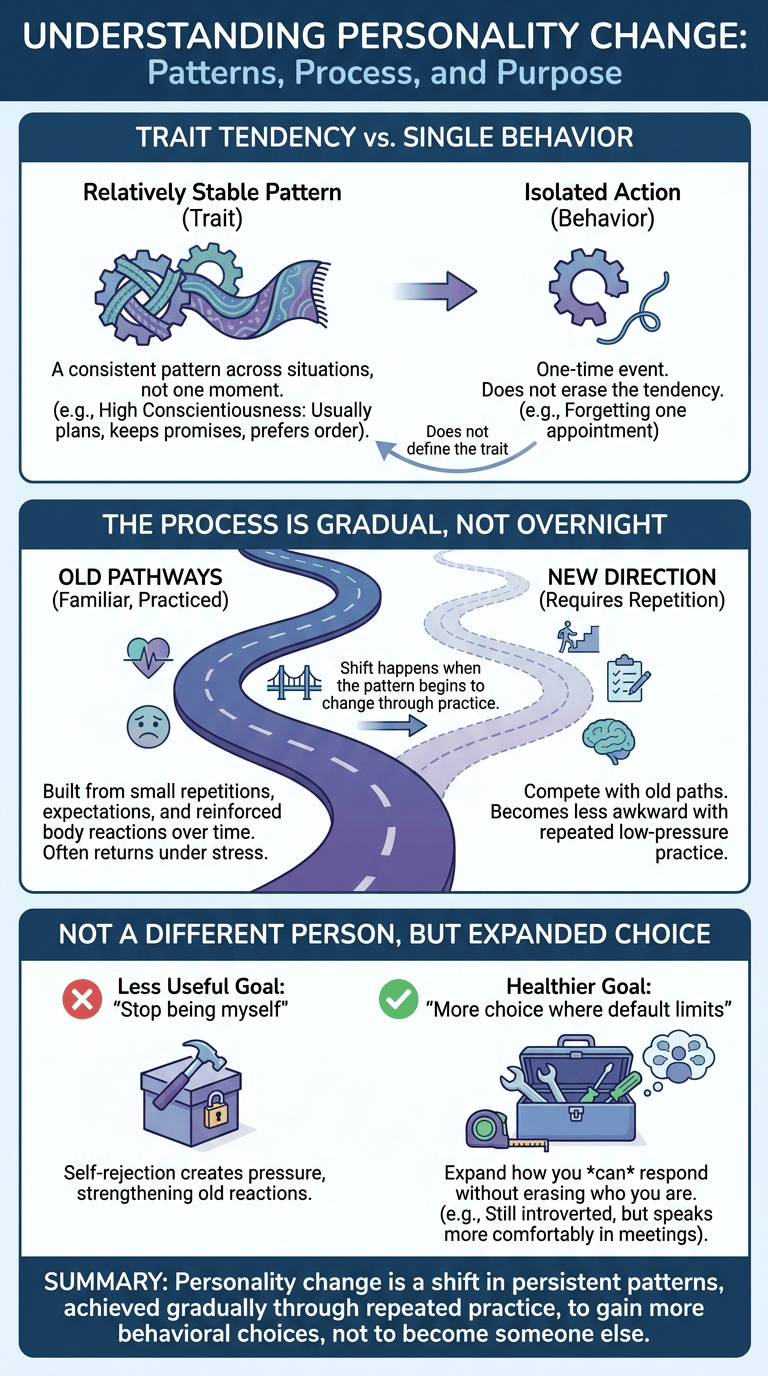
Changing a trait tendency versus changing one behavior
A trait is not the same as one behavior. The APA Dictionary defines a trait as a relatively stable characteristic or quality that helps describe a person. That means a trait is a pattern across situations, not one moment.
For example, a person high in conscientiousness may usually plan ahead, keep promises, and prefer order. Forgetting one appointment does not erase that tendency. A person lower in extraversion may need more quiet recovery time. Enjoying one party does not suddenly make them an extravert.
Personality change becomes more meaningful when the repeated pattern begins to shift. If you normally avoid hard tasks until the last minute, but over time you learn to break tasks into smaller steps, prepare earlier, and recover from mistakes without quitting, your conscientiousness may begin to show differently. If you usually react to stress by assuming the worst, but you build regulation skills and check evidence before responding, the expression of neuroticism may soften.
Why change usually happens gradually, not overnight
Personality is built from many small repetitions: what you expect from situations, what you notice first, how your body reacts, what feels rewarding, what feels threatening, and which behaviors your environment reinforces. Because of that, a new personality direction has to compete with older pathways that already feel familiar.
This is why a person can sincerely want to be more open, calm, direct, organized, or socially flexible and still return to old behavior under stress. The old response may not be ideal, but it is practiced. Change often requires repeated low-pressure moments where a new response becomes less awkward.
Why personality change is not the same as becoming a different person
A healthier goal is not “I want to stop being myself.” A more useful goal is “I want more choice in situations where my default reaction limits me.” That difference matters because self-rejection often creates pressure, and pressure can make old reactions stronger.
You might still be introverted and learn to speak more comfortably in meetings. You might still be sensitive and learn not to answer every feeling as if it were a fact. You might still prefer routine and become more willing to try something unfamiliar. These changes do not erase who you are. They expand how you can respond.
Personality Stability vs Personality Flexibility
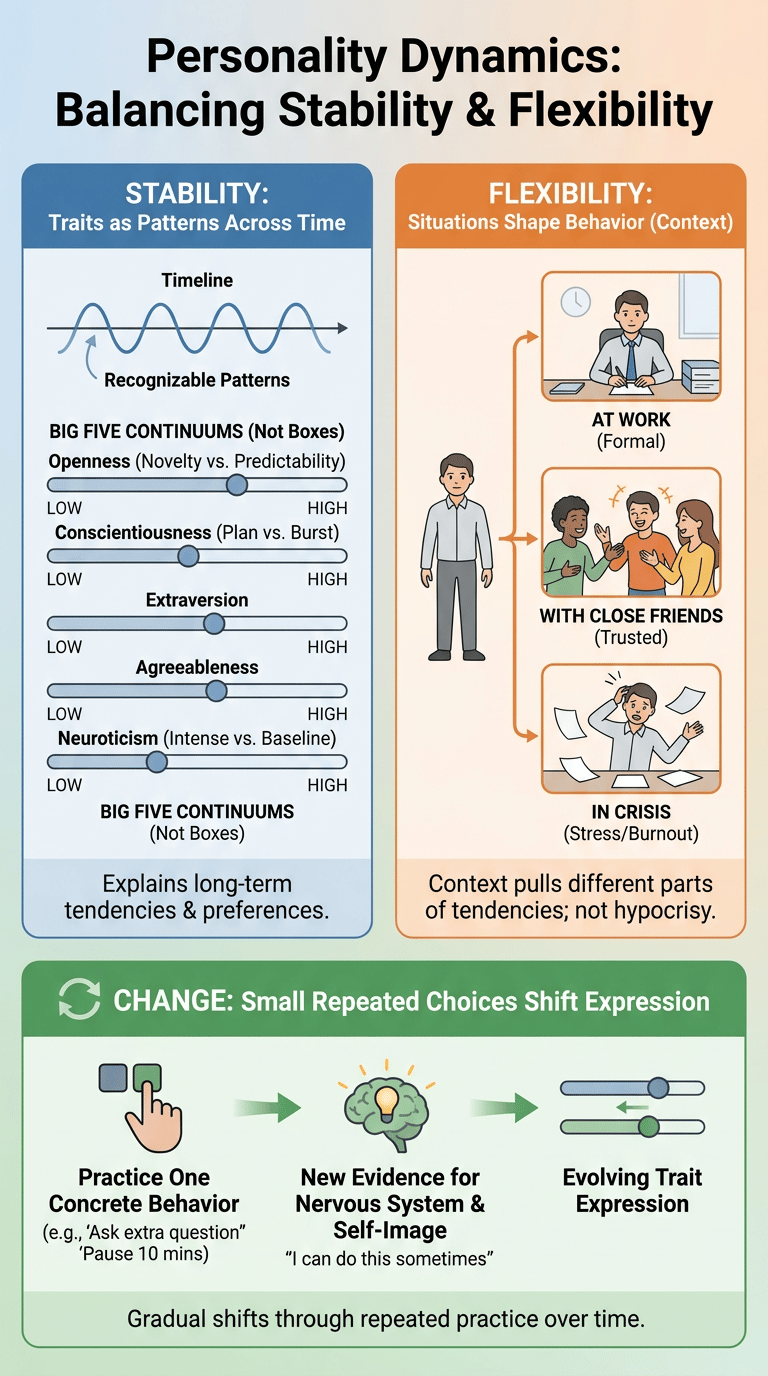
Traits create patterns across time
Trait psychology is useful because people do show recognizable patterns. The OpenStax overview of trait theory explains the Big Five as broad dimensions used to describe personality differences. These dimensions are not boxes. They are continuums.
A person may be higher, lower, or somewhere in the middle on openness, conscientiousness, extraversion, agreeableness, and neuroticism. Those tendencies can help explain why one person seeks novelty while another prefers predictability, why one person plans early while another works in bursts, or why one person processes emotions intensely while another returns to baseline quickly.
Situations can pull different behaviors from the same person
Even stable traits do not control every action. A quiet person may become animated around people they trust. A highly agreeable person may become firm when a boundary is crossed. A usually organized person may become scattered during grief, burnout, or major life transition.
This is not hypocrisy. It is context. Personality describes tendencies across time, while situations shape which parts of those tendencies become visible. A person’s behavior at work, with close friends, during conflict, in a crisis, and when exhausted may not look exactly the same.
Small repeated choices can slowly change trait expression
Trait expression is the part most people can work with first. You may not be able to decide, “Starting tomorrow, I will be a completely different personality type.” But you can decide to practice one concrete behavior in one repeatable situation.
That might mean asking one extra question in a social setting, preparing your calendar the night before, delaying a reactive reply for ten minutes, saying “I need to think before I answer,” or choosing one unfamiliar activity each month. Over time, repeated behavior gives your nervous system and self-image new evidence: “I can do this sometimes.” That evidence is often the beginning of change.
What Can Influence Personality Change
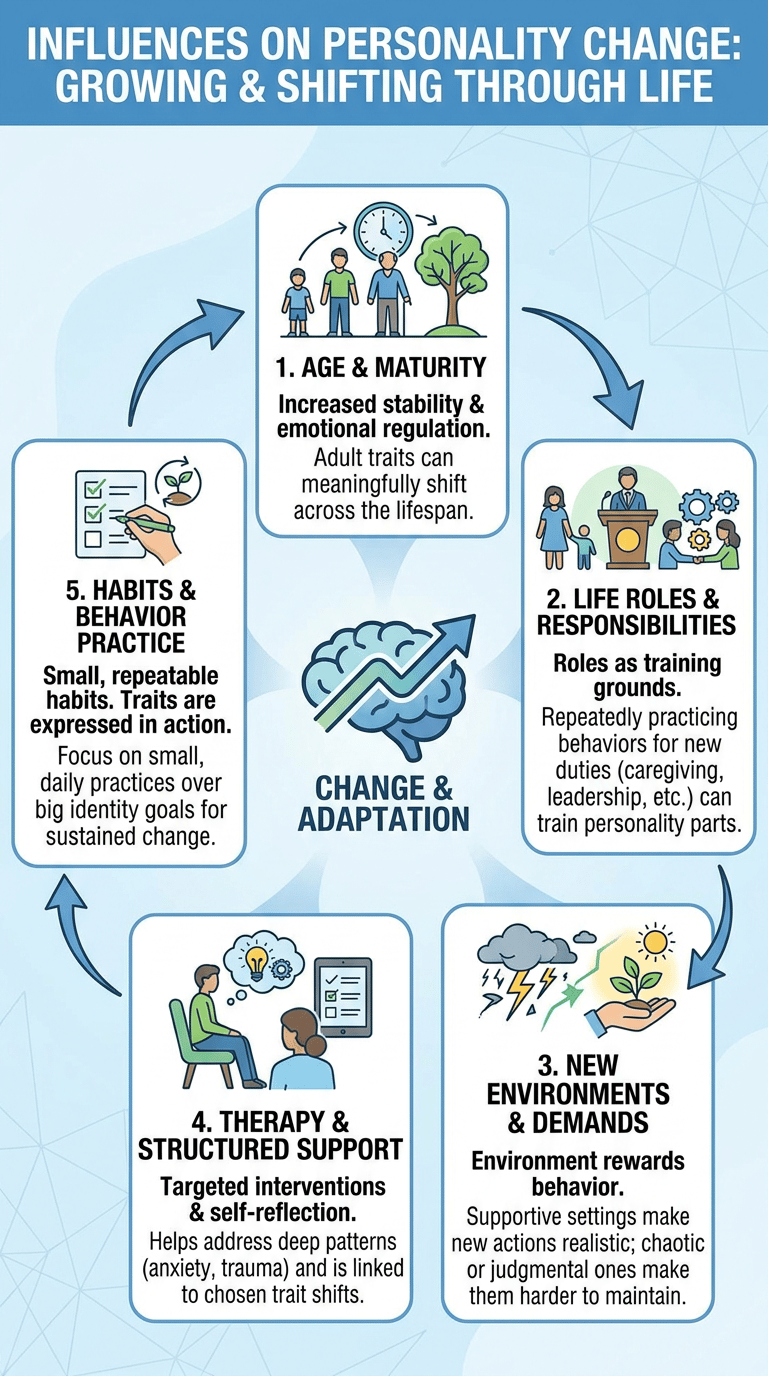
Age and maturity
People often become more stable, responsible, emotionally regulated, or socially skilled with age, although not everyone changes in the same way. A review on personality trait change in adulthood notes that adult traits can continue to change and that these shifts can be meaningful across the life span.
Life roles and responsibilities
Roles can train parts of personality. Parenting, leadership, caregiving, teamwork, long-term partnership, creative work, or running a household can all ask a person to repeat behaviors that once felt unnatural.
For example, a person who never saw themselves as organized may become more conscientious when their job requires reliable systems. Someone who avoided disagreement may become more direct after learning that silence creates bigger problems. The role does not automatically change the trait, but it can create repeated practice.
New environments and repeated demands
Environment matters because it rewards certain behaviors and makes other behaviors harder to keep. A chaotic environment may make conscientiousness difficult to express. A judgmental environment may make openness feel risky. A highly competitive environment may make agreeableness feel unsafe. A supportive environment can make new behavior more realistic.
Therapy, coaching, or structured self-reflection
Structured support can help when a pattern is tied to anxiety, depression, trauma, grief, chronic stress, or relationship safety concerns. Personality change research also suggests that interventions can coincide with trait shifts. For example, a randomized trial of a digital personality change intervention found that targeted support and repeated practice were associated with changes in chosen traits over several months.
Habits and behavior practice
Habits matter because traits are expressed through behavior. If you want to become more conscientious, the practical target may be planning your next day before bed. If you want to become more open, the target may be one low-risk novelty habit. If you want to become less reactive, the target may be naming your body signal before answering.
The habit should be small enough to repeat when you are tired. Big identity goals are inspiring for one afternoon. Small behaviors are what personality change can actually use.
How Each Big Five Trait Might Change in Real Life
Openness may expand through safe novelty and learning
Openness involves curiosity, imagination, flexibility, and interest in new ideas or experiences. A realistic change goal is not “be adventurous all the time.” It may be “practice curiosity before rejection.”
Examples include reading outside your usual topic, trying a new route, asking “what else could be true,” learning a creative skill, or spending time with people who think differently without forcing yourself to agree. Openness grows best when novelty feels safe enough to explore, not when you shame yourself for liking familiarity.
Conscientiousness may grow through structure and accountability
Conscientiousness often shows up as planning, reliability, follow-through, and care with responsibilities. If you want to become more conscientious, avoid turning the goal into “I must become perfectly disciplined.” That is too broad and too harsh.
Useful change may look like choosing one planning ritual, making tasks visible, using reminders, asking for accountability, or designing your environment so the next right step is obvious. The aim is dependable follow-through, not a personality built from pressure and self-criticism.
Extraversion may become more flexible through social practice and energy planning
Extraversion is not simply “talking more.” It involves energy, stimulation, social engagement, assertiveness, and positive emotional expression. A low-extraversion person may not want constant social intensity, but they can still become more socially flexible.
That might mean initiating one conversation, speaking earlier in a meeting, planning recovery time after events, or choosing social settings that fit their energy. The goal is not to deny introversion. It is to build more choice around when to engage, when to rest, and how to communicate needs clearly.
Agreeableness may shift through boundaries, empathy, and direct communication
Agreeableness includes cooperation, trust, warmth, and concern for others. A person who wants to become more agreeable may practice listening before defending, assuming less hostility, or responding with more patience. A person who is very agreeable may need a different kind of change: becoming kinder without abandoning their own limits.
Real change might mean saying no more clearly, disagreeing without contempt, or naming a need before resentment builds. Agreeableness is most useful when it includes respect for others and respect for yourself.
Neuroticism may ease through regulation skills and support
Neuroticism relates to emotional sensitivity and stress reactivity. If you are high in this trait, change may not mean “stop feeling deeply.” It may mean learning how to slow the chain between feeling, interpretation, and reaction.
Helpful practices may include sleep support, grounding, naming emotions, checking facts, reducing avoidable stressors, and getting help when anxiety, depression, trauma, or self-harm thoughts are present. Emotional depth is not the problem. The change target is often the speed and intensity of the spiral.
What Personality Change Is Not
It is not forcing yourself to copy someone else’s temperament
Trying to copy another person’s personality usually creates frustration. You may admire someone’s calm, confidence, warmth, creativity, or discipline, but you do not need to become their temperament to learn from their behavior.
A better question is: “What part of this behavior would help my life if I practiced it in my own style?” An introverted person can practice assertiveness quietly. A sensitive person can practice emotional regulation without pretending not to care. A structured person can practice openness through planned experimentation.
It is not using shame as motivation
Shame often creates short bursts of effort followed by avoidance. If your change goal begins with “I hate this part of myself,” the process may become a fight against your own nervous system.
Self-awareness works better when it is honest without being cruel. You can say, “This reaction is costing me something,” without saying, “I am bad.” You can say, “I want to respond differently,” without pretending the old response came from nowhere.
It is not ignoring mental health, trauma, or unsafe environments
Some patterns are not only personality. Anxiety, depression, trauma responses, chronic stress, sleep deprivation, substance use, grief, coercion, or unsafe relationships can all affect behavior. In those cases, trying to “fix your personality” may miss the real issue.
If you feel afraid, controlled, threatened, humiliated, isolated, or at risk of retaliation, prioritize safety and support before communication practice or personality goals. If you are struggling emotionally or have concerns about your mental health, NIMH offers guidance on finding help. If there is immediate danger or self-harm risk, contact local emergency services or a crisis support line in your country.
A Realistic Personality Change Framework
Choose one trait expression to work with
Start with one expression, not your entire personality. “I want to be a better person” is too large. “I want to answer criticism without instantly counterarguing” is workable. “I want to be more disciplined” is vague. “I want to plan tomorrow’s first task before I end work today” is specific.
A trait expression is the visible part of the trait. You are not trying to rewrite your whole identity. You are choosing one repeated place where a different response would help.
Identify one repeated situation where it appears
Personality patterns become clearer when you connect them to situations. Ask yourself: When does this trait expression show up most strongly? Is it during uncertainty, conflict, boredom, social pressure, deadlines, criticism, or transitions?
For example, you may not be “unmotivated” in general. You may lose follow-through when a task has no clear first step. You may not be “too emotional” in general. You may become reactive when feedback feels sudden, public, or unfair.
Pick one behavior that is small enough to repeat
The behavior should be so small that it can survive a normal week. If the plan only works when you are calm, rested, and inspired, it is not ready for real life.
| Trait direction | Small repeatable behavior | Why it helps |
|---|---|---|
| More openness | Ask one curiosity question before rejecting a new idea. | It trains flexibility without forcing dramatic change. |
| More conscientiousness | Write the next physical step for one task. | It turns intention into a visible action. |
| More social flexibility | Initiate one low-pressure interaction each week. | It builds social practice without overwhelming your energy. |
| More balanced agreeableness | Say “I need to think before I answer” before agreeing. | It creates space between kindness and automatic compliance. |
| Lower reactivity | Name the feeling and wait ten minutes before replying. | It slows the path from emotion to reaction. |
Track friction, not perfection
Perfection tracking asks, “Did I do it right every time?” Friction tracking asks, “Where did the new behavior become hard?” That second question is more useful.
If you failed to follow through, was the step too big? Did the environment make it difficult? Did you need a reminder? Did the old behavior protect you from embarrassment, conflict, or uncertainty? Friction is information. It shows you where the plan needs to fit your real life better.
Adjust the environment before blaming yourself
Many personality goals fail because the person tries to change behavior while leaving every cue for the old behavior untouched. If you want to be less reactive, do not keep having hard conversations when you are exhausted and hungry. If you want to be more organized, do not rely only on memory. If you want to be more open, do not choose the most intimidating new experience first.
Environment design is not cheating. It is how you reduce the gap between intention and action.
Examples of Realistic Trait Change
Becoming more conscientious without becoming rigid
Jenna often misses deadlines because she waits until she feels ready. Her change goal is not to become a flawless planner. She begins by writing one “first step” for tomorrow before closing her laptop. After a few weeks, she adds a 15-minute start block for tasks she usually avoids.
She is not suddenly a different person. She is training earlier engagement. Her personality expression changes because her behavior becomes more reliable in a specific repeated situation.
Becoming more socially flexible without denying introversion
The change is not “introvert becomes extravert.” The change is “introvert learns to engage intentionally and recover respectfully.”
Becoming less reactive without losing emotional depth
Alina feels emotions intensely and often sends long messages when upset. Her first change target is not to stop feeling. It is to pause between the first emotional surge and the first response.
She writes the message in a note, waits ten minutes, and then chooses one sentence that names the issue without accusing. Over time, her sensitivity stays, but the reaction becomes less damaging.
Becoming more open without abandoning stability
He tests new foods, new work methods, and new weekend plans in low-risk ways. Openness grows because novelty becomes linked with experimentation instead of threat.
Why Personality Change Often Fails
The goal is too vague
“I want to change my personality” gives the mind nothing to practice. Vague goals create vague effort. A useful goal names the behavior, situation, and repeatable action.
Instead of “be more confident,” try “speak once in the first ten minutes of the meeting.” Instead of “be less anxious,” try “write down the fact, the feeling, and the story before I respond.” Instead of “be nicer,” try “ask one clarifying question before assuming bad intent.”
The plan fights your natural energy pattern
A change plan should stretch you, not ignore your nervous system. An introverted person may fail at a plan that requires constant social exposure. A highly sensitive person may fail at a plan that demands instant calm during intense conflict. A low-structure person may fail at a system with twenty daily rules.
The plan works better when it respects your starting point. Growth usually needs a bridge, not a personality transplant.
The environment rewards the old behavior
If procrastination helps you avoid discomfort until the last possible moment, it is being rewarded with temporary relief. If people only respect your boundaries when you become angry, anger becomes reinforced. If saying yes prevents conflict in the short term, automatic agreement may feel safer than honesty.
Shame replaces self-awareness
Shame sounds like insight, but it usually closes learning. “I am lazy,” “I am too much,” “I am cold,” or “I am weak” may feel like honesty, but these labels do not show you the next useful step.
Self-awareness is more specific: “I avoid tasks when I do not know the first step.” “I react strongly when I feel dismissed.” “I agree too fast when I fear disappointment.” Specific awareness creates a path. Shame creates a wall.
Bridge Topics for the Personality Cluster
Start with Big Five Personality Traits if you need the framework
If the language of traits feels confusing, begin with the Big Five framework. It gives you a map for understanding openness, conscientiousness, extraversion, agreeableness, and neuroticism without turning them into rigid labels.
Read a specific trait article if one pattern keeps repeating
If one trait keeps showing up in your life, it may help to read about that trait directly. Openness can clarify your relationship with novelty. Conscientiousness can clarify follow-through and structure. Extraversion and introversion can clarify social energy. Agreeableness can clarify cooperation and boundaries. Neuroticism can clarify emotional sensitivity and stress reactivity.
Read Personality vs Character if you are confusing traits with accountability
Some people use personality language to excuse behavior, while others use character language to shame themselves for having normal traits. The distinction matters. A trait may explain a tendency, but it does not remove responsibility for repair, honesty, or how your behavior affects other people.
When To Get Support
Get professional support if personality change goals are tied to severe anxiety, trauma, depression, self-harm thoughts, coercion, or unsafe relationship dynamics
Personal growth is valuable, but some situations need more than self-reflection. Consider professional or crisis support if your change goal is connected to severe distress, panic, depression, trauma symptoms, self-harm thoughts, substance misuse, emotional abuse, coercive control, threats, stalking, retaliation, or feeling unsafe at home.
In those cases, the first priority is not becoming a better version of yourself for someone else. The priority is safety, stabilization, and appropriate help. Educational self-understanding can support growth, but it is not a substitute for diagnosis, therapy, emergency care, or safety planning when those are needed.
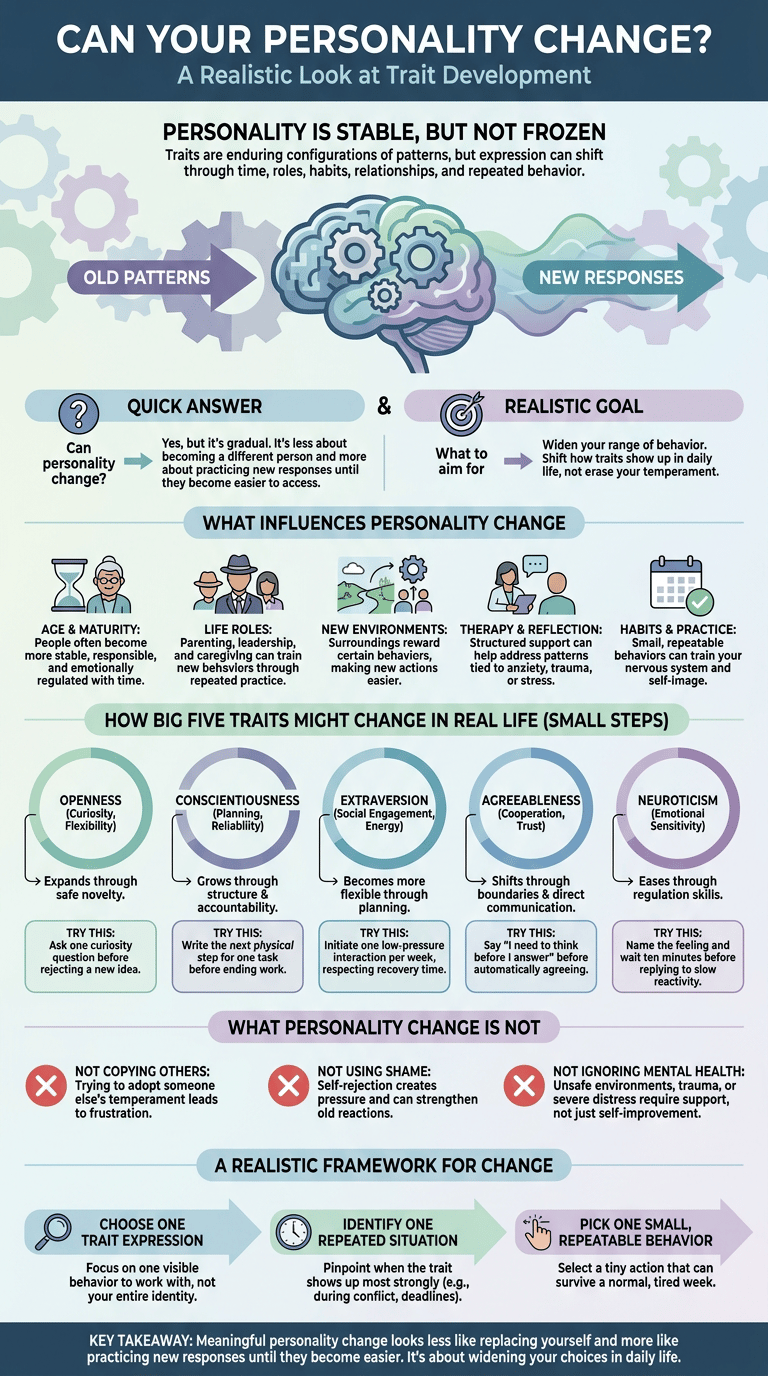
Many discussions about personality change use the Big Five personality traits because they give researchers a practical way to track broad patterns over time.
Personality change is also different from character growth because changing a trait is not always the same as changing values, ethics, or life choices.
FAQ
Can introverts become extraverts?
An introverted person may become more socially skilled, more assertive, or more comfortable initiating contact, but that does not always mean their core energy pattern becomes extraverted. A realistic goal is social flexibility. You can practice engagement while still respecting the need for quiet recovery.
Can neuroticism decrease?
Neuroticism can soften in how it shows up, especially when a person builds emotional regulation skills, reduces chronic stressors, receives support, and learns to separate feelings from immediate conclusions. If emotional distress is intense, persistent, or connected to self-harm thoughts, professional support is more appropriate than treating it only as a personality project.
Can conscientiousness increase?
Yes, many people can become more reliable, organized, and consistent through structure, routines, accountability, and smaller task design. The key is to build systems that support follow-through rather than relying only on pressure. Conscientiousness growth works best when it becomes practical, not perfectionistic.
Is personality change possible after adulthood?
Yes. Personality is often more stable in adulthood than in childhood, but stability is not the same as immobility. Adult roles, relationships, therapy, work demands, health changes, and repeated choices can all influence how traits develop and how they are expressed.
How long does personality change take?
It depends on the trait, the behavior, the environment, the level of support, and how consistently the new response is practiced. Some behavior changes can happen quickly, but deeper trait expression usually takes months or longer. A useful sign of progress is not that the old reaction disappears forever. It is that you notice it earlier and have more options than before.
Key Takeaways
- Personality traits are relatively stable patterns, but they are not completely fixed.
- Realistic personality change usually begins with one repeated behavior in one repeated situation.
- Trait change does not mean becoming a totally different person. It means widening your range of response.
- The Big Five traits can shift in expression through roles, habits, environments, maturity, and structured support.
- Shame is a poor change strategy because it hides the specific pattern you need to work with.
- If distress, trauma, self-harm thoughts, coercion, or safety concerns are involved, support and safety come before self-improvement goals.
So, can your personality change? Yes, in the ways that matter most for daily life, your responses can become more flexible, deliberate, and aligned with what you value. The best first step is not to redesign your whole identity. Choose one repeated situation, one small behavior, and one honest way to track what gets easier over time.

Michael Reed is the Founder and Lead Writer at Psychology Exposed. He writes about human behavior, relationships, emotional patterns, self-awareness, and practical psychology topics using research-informed, easy-to-understand content.
Read More About Michael Reed: https://psychologyexposed.com/michael-reed/