
The Big Five personality traits are useful because they describe personality as a set of broad patterns, not as a fixed label. Instead of telling you that you are one “type” of person, the Big Five gives you five dimensions to look at: openness, conscientiousness, extraversion, agreeableness, and neuroticism.
That difference matters. A type label can feel simple, but it can also make personality sound more rigid than it really is. A trait profile gives you more room to say, “I tend to be this way in many situations, but context still matters.” That is a more realistic way to understand yourself.
This guide explains what the Big Five means in everyday language, how the five traits work together, why high and low scores are not automatically good or bad, and how to use your results for reflection without turning them into a box.
Quick Answer
The Big Five describes five broad personality dimensions, not five personality types
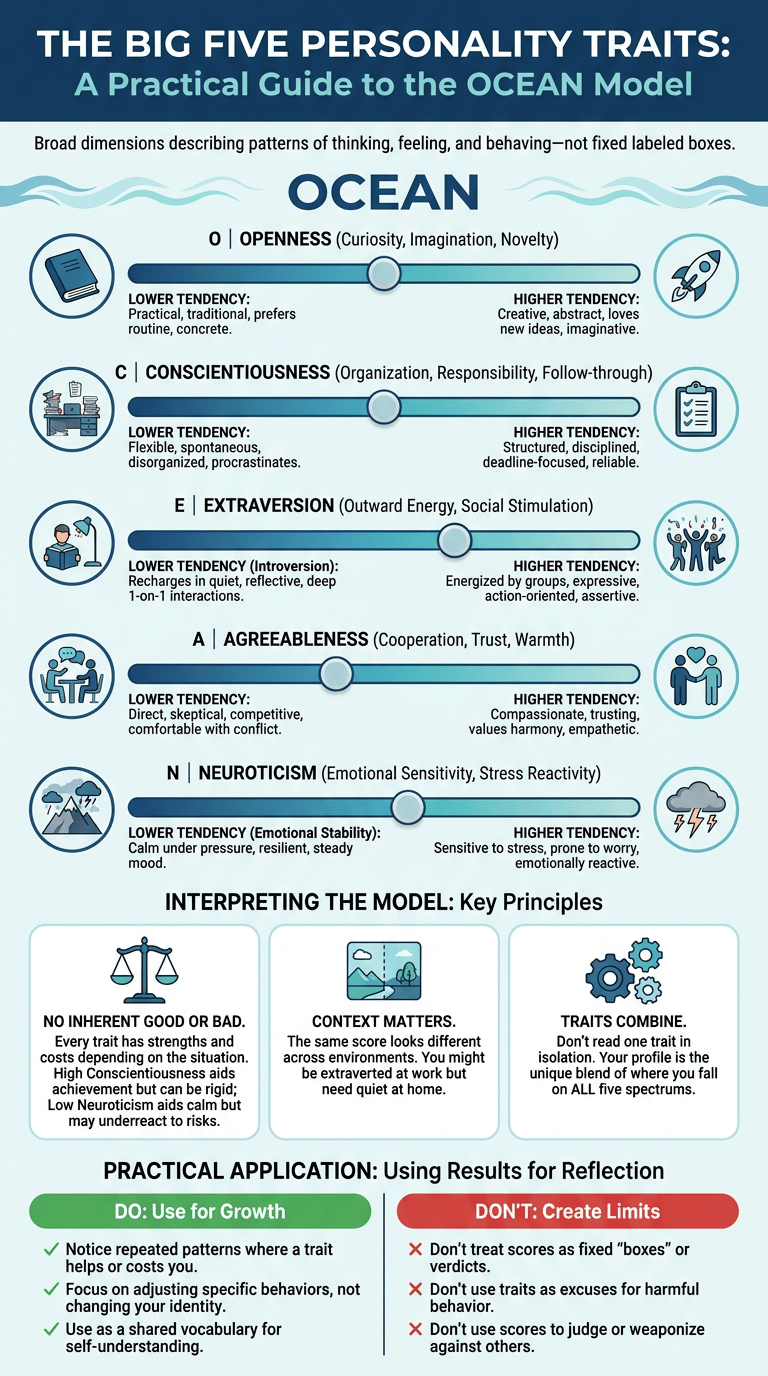
The Big Five personality traits are five broad dimensions used to describe common patterns in how people think, feel, relate, and behave. The model is often remembered with the acronym OCEAN: openness, conscientiousness, extraversion, agreeableness, and neuroticism. The APA Dictionary of Psychology describes the Big Five as primary dimensions of individual differences, which means each trait is better understood as a spectrum than a category.
In simple terms, you do not “have” one Big Five trait and lack the others. You have a profile across all five. Two people can both be high in openness, for example, while differing strongly in conscientiousness, agreeableness, or emotional reactivity. That is why the Big Five is most helpful when you look at combinations, not isolated scores.
Why the Big Five Model Matters
It explains patterns without forcing people into boxes
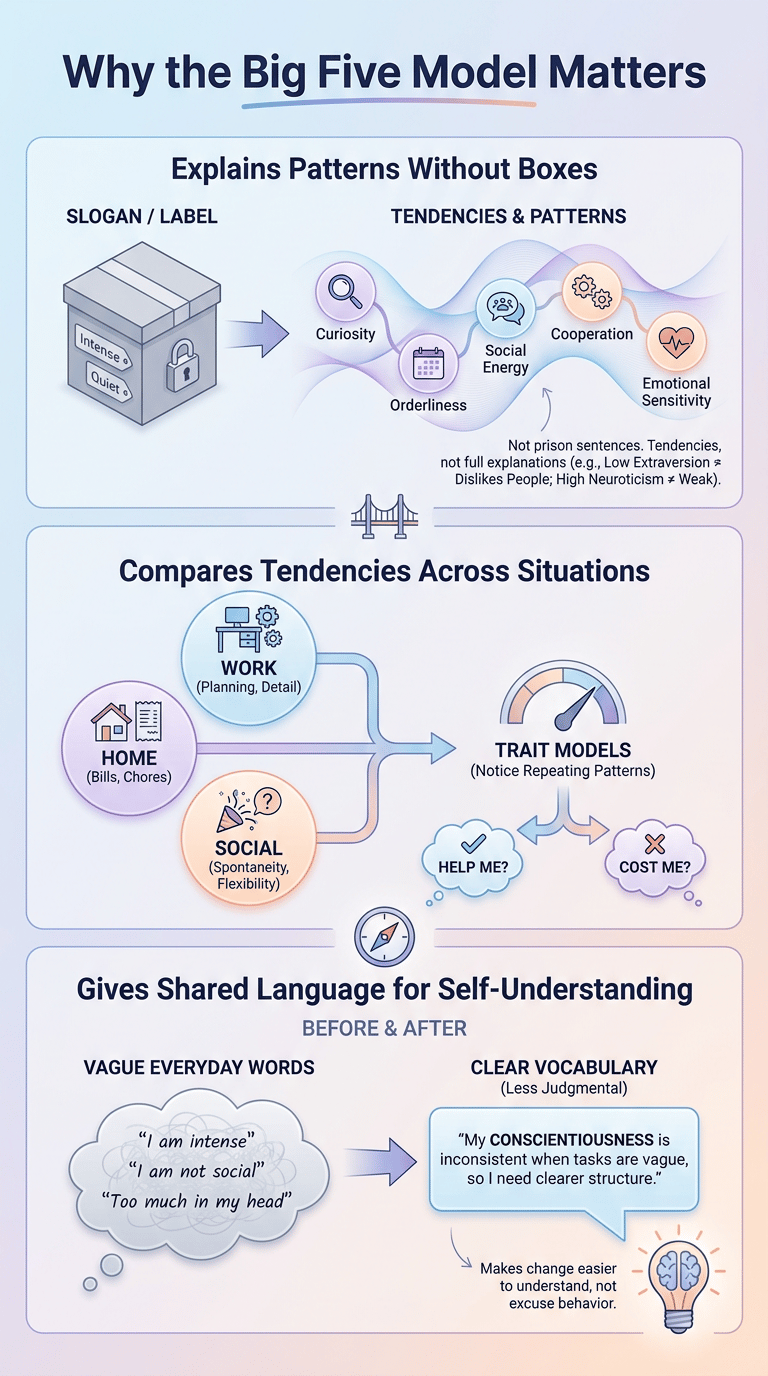
The Big Five model helps you talk about personality without reducing a person to a slogan. It gives language for tendencies such as curiosity, orderliness, social energy, cooperation, and emotional sensitivity. These are patterns that often show up across time, but they are not prison sentences.
For example, someone who scores lower in extraversion may prefer quieter environments, but that does not mean they dislike people. Someone who scores higher in neuroticism may react more strongly to stress, but that does not mean they are weak or unstable. The score points to a tendency, not a full explanation of the person.
It helps compare tendencies across situations
Trait models are useful because they help you notice patterns that repeat in different parts of life. A person who is highly conscientious may plan carefully at work, keep track of bills, and feel uncomfortable when others leave details unfinished. A person lower in conscientiousness may be more spontaneous, flexible, and comfortable figuring things out as they go.
The model does not say which style is morally better. It helps you ask better questions. Where does this trait help me? Where does it cost me? Which situations bring out the best version of this tendency, and which situations exaggerate the difficult side?
It gives a shared language for self-understanding
Many people struggle to describe personality because everyday words can be vague. “I am intense,” “I am not social,” or “I am too much in my head” may be emotionally true, but not very precise. The Big Five gives you a clearer vocabulary.
That vocabulary can make self-reflection less personal in the wrong way. Instead of saying, “I am bad at life because I procrastinate,” you might say, “My conscientiousness is inconsistent when tasks are vague, so I need clearer structure.” That shift does not excuse behavior, but it makes change easier to understand.
The Five Traits in the OCEAN Model
Openness: curiosity, imagination, and novelty
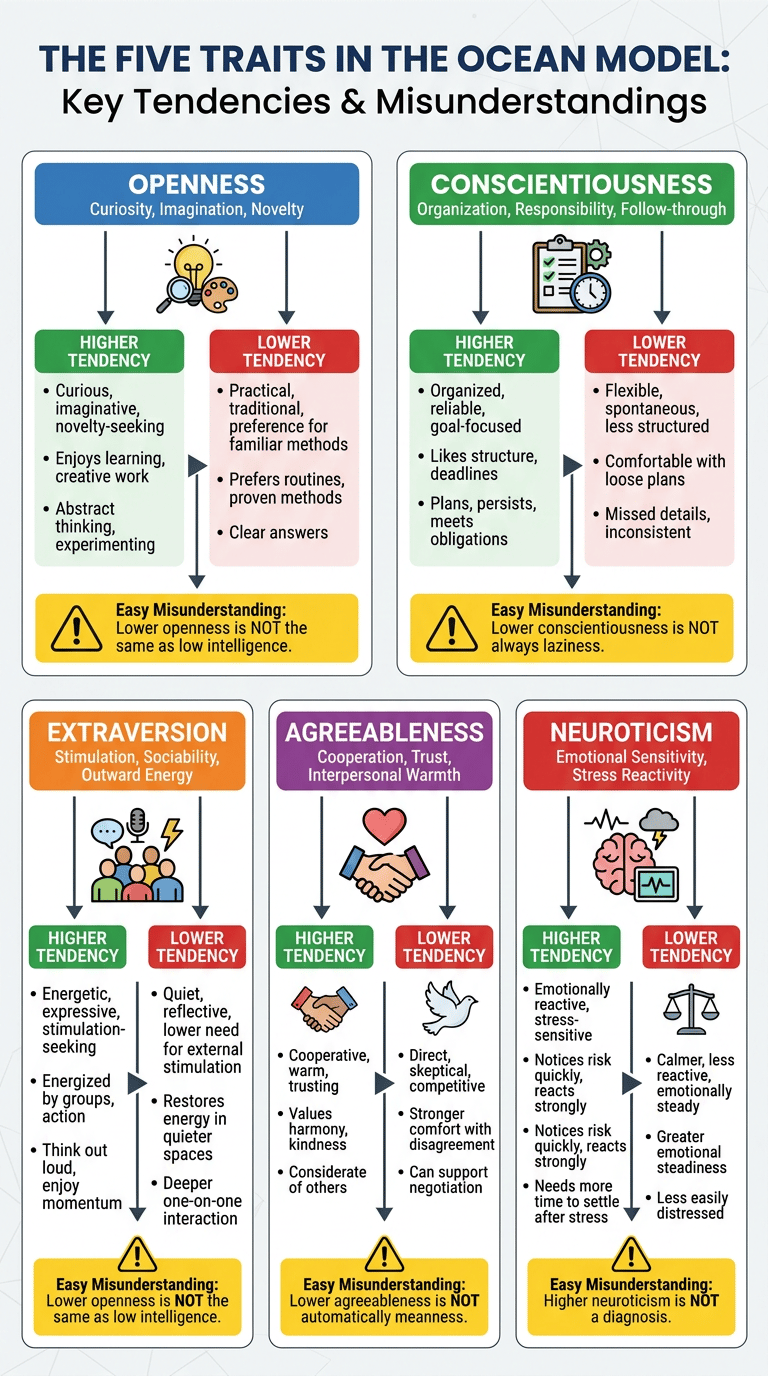
Openness describes a person’s tendency toward curiosity, imagination, new ideas, aesthetic interest, and willingness to consider unfamiliar perspectives. People higher in openness may enjoy learning, creative work, symbolic thinking, travel, abstract ideas, or experimenting with new ways of doing things.
People lower in openness may prefer familiarity, practical routines, proven methods, and clear answers. This can be a strength when stability, realism, and consistency matter. Lower openness does not mean someone is unintelligent. It often means they are less drawn to novelty for its own sake.
Conscientiousness: organization, responsibility, and follow-through
Conscientiousness describes how much a person tends to plan, organize, persist, meet obligations, and control impulses in service of a goal. Someone higher in conscientiousness may like structure, deadlines, checklists, reliability, and clear standards.
Someone lower in conscientiousness may be more flexible, improvisational, and comfortable with loose plans. The cost can be missed details, inconsistent follow-through, or difficulty finishing tasks. The benefit can be adaptability and less attachment to rigid systems.
Extraversion: stimulation, sociability, and outward energy
Extraversion is about orientation toward stimulation, expression, assertiveness, activity, and social reward. A highly extraverted person may feel energized by groups, conversation, action, and visible engagement. They may think out loud and enjoy momentum.
Lower extraversion, often discussed as introversion, does not mean social fear or poor social skill. It often means a person restores energy through quieter spaces, deeper one-on-one interaction, or more time to think before speaking. The key issue is energy direction, not whether someone is likable.
Agreeableness: cooperation, trust, and interpersonal warmth
Agreeableness describes tendencies around cooperation, empathy, trust, patience, and concern for others. A highly agreeable person may value harmony, kindness, generosity, and emotional consideration. They may notice how decisions affect other people.
Lower agreeableness can show up as bluntness, skepticism, competitiveness, or stronger comfort with disagreement. It is not automatically cruelty. In some contexts, lower agreeableness can support negotiation, direct feedback, or protection from people-pleasing. The tradeoff is that warmth and flexibility may need more conscious attention.
Neuroticism: emotional sensitivity and stress reactivity
Neuroticism describes how strongly and how often a person tends to experience distressing emotions such as worry, irritability, vulnerability, sadness, or tension. The APA Dictionary definition of the five-factor personality model includes neuroticism as one of the core dimensions, alongside extraversion, conscientiousness, agreeableness, and openness.
Higher neuroticism may mean a person notices risk quickly, reacts strongly to uncertainty, or needs more time to settle after stress. Lower neuroticism often means greater emotional steadiness. Neither side tells the whole story. Emotional sensitivity can be difficult, but it can also make a person attentive to danger, nuance, or relational tension.
| Trait | Higher tendency may look like | Lower tendency may look like | Easy misunderstanding |
|---|---|---|---|
| Openness | Curious, imaginative, novelty-seeking | Practical, traditional, preference for familiar methods | Lower openness is not the same as low intelligence |
| Conscientiousness | Organized, reliable, goal-focused | Flexible, spontaneous, less structured | Lower conscientiousness is not always laziness |
| Extraversion | Energetic, expressive, stimulation-seeking | Quiet, reflective, lower need for external stimulation | Introversion is not the same as social inability |
| Agreeableness | Cooperative, warm, trusting | Direct, skeptical, competitive | Lower agreeableness is not automatically meanness |
| Neuroticism | Emotionally reactive, stress-sensitive | Calmer, less reactive, emotionally steady | Higher neuroticism is not a diagnosis |
How Big Five Scores Work
High, low, and middle-range scores
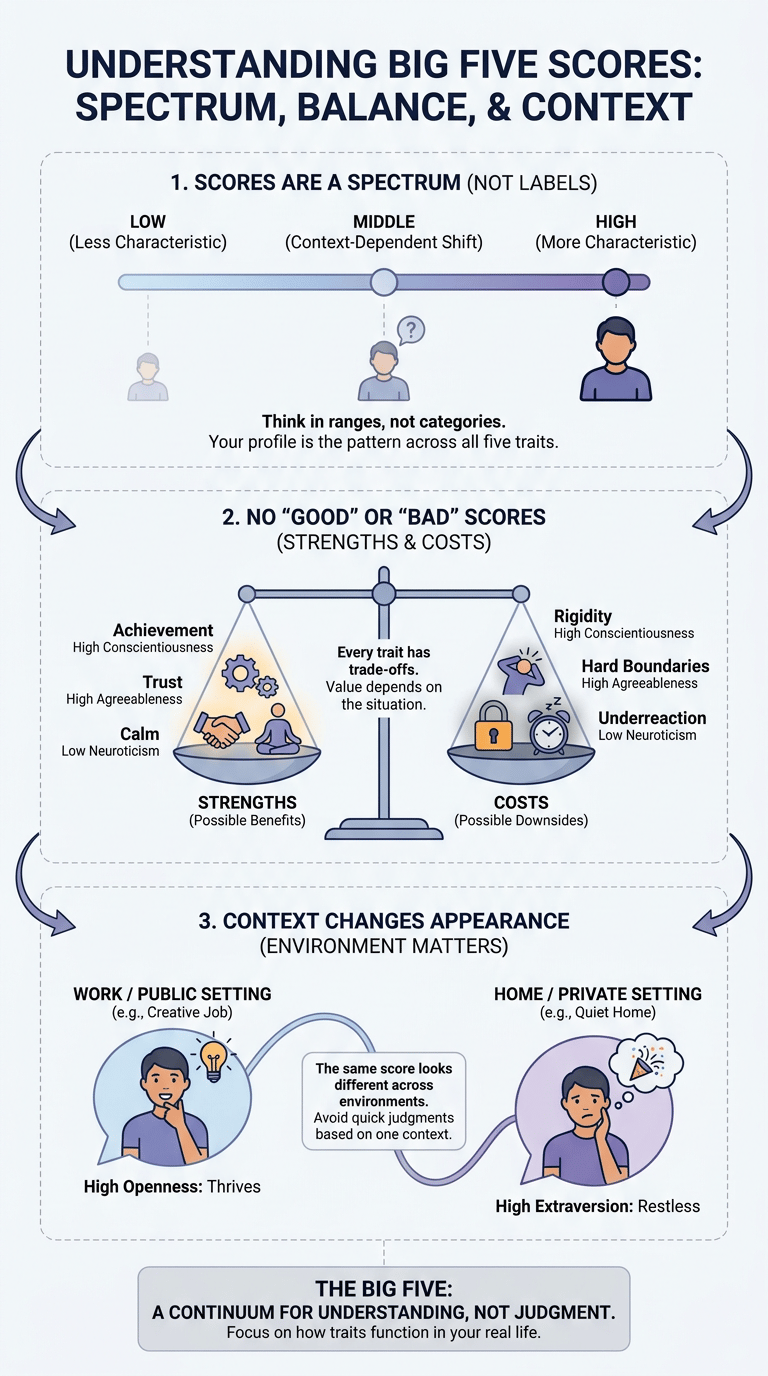
Big Five results are usually interpreted as positions on a spectrum. A high score means the trait is more characteristic of you compared with the reference group used by that test. A low score means the trait is less characteristic. A middle score often means the trait may shift more depending on context.
This is why it is better to think in ranges than in labels. A person is not “an openness person” or “a neuroticism person.” They may be high, low, or moderate in each dimension. Their full personality profile is the pattern across all five traits.
Why no score is automatically good or bad
Every trait has strengths and possible costs. High conscientiousness may support achievement, but it can also become rigid when plans change. High agreeableness may support trust, but it can make boundaries harder if a person avoids disappointing others. Low neuroticism may support calm, but it can also make someone underreact to problems that need attention.
A score becomes useful only when you connect it to real situations. Ask what the trait does in your life, not whether it makes you better or worse than someone else.
How context changes the way a trait appears
The same score can look different across environments. A person high in extraversion may seem confident at work but restless in a quiet home. A person high in openness may thrive in a creative job but feel frustrated in a role with strict routines. A person high in neuroticism may struggle in unstable situations but do well in environments with predictability and supportive communication.
This is one reason personality should not be used as a quick judgment. The OpenStax Psychology 2e overview of trait theorists explains the Big Five as factors that occur along a continuum. A continuum gives room for degree, context, and variation.
How Traits Combine Into a Personality Profile
Why two people with the same high trait can still look different
One of the biggest mistakes people make with the Big Five is reading one trait in isolation. A trait does not operate alone. It blends with the other four traits, your values, your skills, your history, your environment, and your current stress level.
Two people can both be high in openness. One may become a calm artist who loves abstract ideas. Another may become a restless entrepreneur who constantly experiments. The difference may come from conscientiousness, extraversion, emotional stability, life demands, and learned habits.
Example profile: high openness and low conscientiousness
A person high in openness and lower in conscientiousness may generate ideas easily but struggle to finish them. They may love possibility, learning, and creative exploration, yet feel trapped by schedules or repetitive systems.
The helpful move is not to shame the low conscientiousness side. It is to design structure that protects the creative side. For example, they may use short planning windows, visual project boards, body doubling, or deadlines attached to real-world accountability. The goal is not to become a different person. The goal is to support the trait mix they actually have.
Example profile: high conscientiousness and high neuroticism
A person high in conscientiousness and high in neuroticism may be responsible, prepared, and attentive to detail, but also easily stressed by mistakes or uncertainty. They may perform well because they care deeply, yet feel exhausted because their nervous system treats small errors as serious threats.
This profile may benefit from separating preparation from rumination. A useful question is, “Have I taken the responsible action, or am I repeating the worry because I still feel unsafe?” That distinction helps the person keep the strength of conscientiousness without letting anxiety-like spirals run the whole process.
Example profile: introverted but highly agreeable
A person lower in extraversion but high in agreeableness may care deeply about people while still needing a lot of quiet time. Others may misread them as distant, when in reality they are warm but easily drained by too much stimulation.
This profile may need language such as, “I enjoy being with you, and I also need quiet time after a lot of interaction.” That sentence protects connection without pretending to have more social energy than is realistic.
| Profile clue | What it may explain | Reflection question |
|---|---|---|
| High openness, lower conscientiousness | Many ideas, inconsistent completion | What simple structure would help me finish without killing creativity? |
| High conscientiousness, high neuroticism | Strong responsibility, high stress load | Am I solving a real problem, or trying to remove all uncertainty? |
| Lower extraversion, high agreeableness | Warmth plus social fatigue | How can I show care without overextending my energy? |
| High agreeableness, lower assertiveness | Kindness mixed with difficulty saying no | Where do I need a boundary that still sounds like me? |
Big Five vs Personality Types
Dimensions versus categories
Personality type systems usually sort people into categories. That can be memorable and emotionally satisfying because it gives a quick identity label. The Big Five works differently. It uses dimensions, which means you can be high, low, or somewhere in the middle on each trait.
Dimensions are less dramatic, but often more flexible. They allow a person to say, “I am moderately extraverted, high in openness, and lower in conscientiousness when tasks lack meaning.” That is more precise than saying, “I am just not a productive type.”
Why type labels feel easy but can become limiting
Type labels can become limiting when people start defending the label instead of observing their behavior. “I am an introvert, so I cannot lead.” “I am spontaneous, so I cannot plan.” “I am emotional, so I cannot stay calm.” These statements may contain a piece of truth, but they also close the door too quickly.
A trait approach leaves more room for growth. It lets you recognize a natural tendency while still choosing specific behaviors. You may be lower in extraversion and still practice public speaking. You may be higher in neuroticism and still learn ways to steady yourself after stress. You may be lower in conscientiousness and still build systems that help you follow through.
When personality tests are useful and when they mislead
Personality tests are useful when they help you reflect on patterns you can observe in daily life. They are less useful when you treat them as verdicts. A good test result should make you curious, not trapped.
Researchers also debate the limits of any single personality model. For example, a critical appraisal of the five-factor model argued that the Big Five can be an important model without being the only complete way to understand a person. That is a helpful reminder: traits describe patterns, but they do not replace your story, values, culture, relationships, or choices.
How To Use the Big Five for Self-Reflection
Notice repeated situations where a trait helps you
Start with strengths because they are often easier to see accurately. Look for repeated situations where a trait gives you an advantage. Maybe your high agreeableness helps you notice tension in a group before anyone else names it. Maybe your high openness helps you connect ideas across different fields. Maybe your lower neuroticism helps you stay calm in urgent situations.
Write down three examples from the past month. Keep them practical: a conversation, a work task, a decision, a conflict, or a moment where your natural response helped the situation.
Notice repeated situations where a trait costs you
Next, look for the cost of the same trait. A strength in one setting can become a problem in another. High openness may help with creativity but create boredom with necessary routines. High agreeableness may support connection but make direct disagreement uncomfortable. High conscientiousness may support reliability but make it difficult to rest.
The point is not to criticize yourself. It is to notice where a trait needs a support system. A trait cost usually becomes easier to manage when you stop seeing it as a personal defect and start seeing it as a predictable tradeoff.
Choose one behavior to adjust instead of trying to change your whole personality
The most practical use of the Big Five is behavior-level change. Do not begin with, “I need to change my personality.” Begin with, “Which repeated behavior would improve my life if I adjusted it slightly?”
If you are lower in conscientiousness, the behavior might be writing the next visible step before ending work. If you are high in neuroticism, it might be waiting ten minutes before sending a worry-driven message. If you are high in agreeableness, it might be saying, “I need to think about that before I answer.” Small behavior changes are easier to practice than identity changes.
Common Mistakes When Reading Big Five Results
Treating a score as an identity
A score is information, not an identity. “I scored high in neuroticism” is different from “I am a neurotic person.” The first statement describes a tendency. The second can start to feel like a fixed self-definition.
Use scores as clues. Then compare them with real life. Ask whether the result matches your behavior across situations, whether stress affected your answers, and whether people who know you well would recognize the pattern.
Assuming a trait explains every behavior
Traits influence behavior, but they do not explain everything. Sleep, culture, stress, money pressure, health, trauma history, relationship dynamics, work demands, and learned skills can all change how someone acts. A normally calm person can become irritable under chronic pressure. A normally organized person can fall apart after a major loss.
This is especially important when judging other people. It is easy to say, “They are just disagreeable,” when the fuller reality may include stress, poor communication habits, mistrust, or a mismatch in values.
Using traits to judge other people
The Big Five should not be used as a weapon. Telling someone, “You are low in agreeableness,” during an argument is unlikely to help. It may sound like a diagnosis or insult, even if you mean it as an observation.
A more useful approach is to describe the behavior and its impact. Instead of labeling someone’s trait, say, “When feedback is very blunt, I find it harder to hear the useful part. Could we slow down and be more specific?” That keeps the conversation grounded in behavior.
Bridge Guide: Which Trait Article Should You Read Next?
Read Openness if novelty, creativity, or change feels central
Openness is the next place to look if your main questions involve creativity, curiosity, imagination, unconventional ideas, boredom with routine, or difficulty relating to people who prefer familiar ways of doing things. A deeper openness guide can help you separate healthy curiosity from constant novelty seeking.
Read Conscientiousness if follow-through and structure feel central
Conscientiousness is the trait to explore if your main questions involve discipline, planning, reliability, procrastination, perfectionism, or frustration with unstructured environments. This guide gives the overview, but a trait-specific article can go deeper into how structure, responsibility, and flexibility interact.
Read Extraversion vs Introversion if social energy feels central
Extraversion deserves separate attention if you often wonder whether you are introverted, socially anxious, overstimulated, under-stimulated, or simply mismatched with your environment. A focused comparison can help you understand social energy without confusing introversion with fear or avoidance.
Read Agreeableness if boundaries and cooperation feel central
Agreeableness is worth exploring if you often struggle with saying no, being direct, trusting others, managing conflict, or balancing kindness with self-respect. A deeper article can help separate warmth from people-pleasing and directness from unnecessary harshness.
Read Neuroticism if stress reactivity feels central
Neuroticism is the next guide to read if your biggest questions involve worry, sensitivity, emotional swings, irritability, threat scanning, or difficulty settling after stress. A trait-specific article can explain emotional reactivity without turning it into a diagnosis or identity label.
When To Get Support
Get professional support if personality concerns come with severe distress, panic, self-harm thoughts, or unsafe relationship dynamics
The Big Five can help with self-understanding, but it is not a mental health diagnosis and it should not replace professional support. If your personality concerns are connected with severe distress, panic, ongoing inability to function, self-harm thoughts, or fear in a relationship, treat those concerns as more important than any personality score.
NIMH offers guidance on when to seek professional help for mental health concerns, including severe or distressing symptoms that last for two weeks or more. If there is immediate danger or self-harm risk, seek urgent help through local emergency services or a crisis resource in your country.
If a relationship involves threats, stalking, coercion, humiliation, retaliation, or fear of what may happen if you speak honestly, do not treat that as a personality mismatch to solve through better communication. Safety and support come first.
The Big Five makes more sense inside the broader psychology of personality.
These traits describe patterns, not moral worth, which is why personality is different from character.
The Big Five traits are relatively stable, but it is worth asking whether the Big Five traits can change through age, repeated behavior, environment, and major life experiences.
FAQ
What are the Big Five personality traits in simple terms?
The Big Five personality traits are openness, conscientiousness, extraversion, agreeableness, and neuroticism. In simple terms, they describe how curious you are, how organized you tend to be, how much stimulation and social energy you seek, how cooperative or direct you are with others, and how emotionally reactive you may be under stress.
Is OCEAN the same as the Big Five?
Yes. OCEAN is a memory tool for the Big Five traits: Openness, Conscientiousness, Extraversion, Agreeableness, and Neuroticism. Some researchers or tests may use slightly different wording, but the basic idea is the same: personality can be described through five broad dimensions.
Which Big Five trait is most important?
No single trait is the most important for every person or situation. The most important trait to understand depends on what is affecting your life right now. If you are struggling with follow-through, conscientiousness may matter most. If stress reactions are causing problems, neuroticism may be more relevant. If social energy is the question, extraversion may deserve closer attention.
Can you be high and low in different Big Five traits?
Yes. That is exactly how a Big Five profile works. You might be high in openness, moderate in conscientiousness, low in extraversion, high in agreeableness, and high in neuroticism. The combination is usually more useful than any single score because traits blend in real life.
Are Big Five personality tests accurate?
Big Five tests can be useful when they are well designed and when you answer honestly, but they are not perfect. Your mood, self-awareness, culture, test quality, and current life stress can affect results. Treat a test as a reflection tool, then compare it with real patterns in your behavior and feedback from people who know you well.
Key Takeaways
- The Big Five personality traits describe five broad dimensions, not five fixed personality types.
- OCEAN stands for openness, conscientiousness, extraversion, agreeableness, and neuroticism.
- High, low, and middle scores all have possible strengths and costs depending on context.
- A full personality profile is more useful than focusing on one trait in isolation.
- Personality scores should guide reflection, not become labels used to judge yourself or others.
- If personality concerns come with severe distress, self-harm thoughts, or unsafe relationship dynamics, professional or crisis support matters more than test interpretation.
Final Thoughts
The Big Five model is most useful when it helps you become more honest and less harsh with yourself. A trait score can show you where you have natural momentum, where you may need support, and where your environment may not fit your tendencies well.
Choose one trait that feels most relevant right now. Then choose one small behavior connected to it. That might mean adding structure, asking for quiet time, practicing directness, pausing before reacting to stress, or giving your curiosity a practical container. You do not need to turn your whole personality into a project. Start with one pattern you can observe in real life.

Michael Reed is the Founder and Lead Writer at Psychology Exposed. He writes about human behavior, relationships, emotional patterns, self-awareness, and practical psychology topics using research-informed, easy-to-understand content.
Read More About Michael Reed: https://psychologyexposed.com/michael-reed/