
Some people move through the world by looking for shared ground. They notice tension quickly, soften their words, give others the benefit of the doubt, and often feel uncomfortable when a conversation turns sharp. Other people are more skeptical, blunt, competitive, or willing to challenge an idea even when it makes the room less comfortable.

The agreeableness personality trait helps explain this difference. It is not a score for whether someone is good or bad. It is a broad personality tendency that shapes how a person usually handles trust, cooperation, empathy, disagreement, and other people’s needs.
According to the APA Dictionary of Psychology, agreeableness involves a tendency to act in a cooperative and unselfish way within the Big Five model. That definition is useful, but real life is more layered. High agreeableness can support kindness and emotional warmth, but it can also make boundaries harder. Lower agreeableness can support honesty and self-protection, but it can also create friction if directness becomes dismissiveness.
Quick Answer
Agreeableness describes a tendency toward cooperation, trust, empathy, warmth, and concern for others
Agreeableness is a Big Five personality trait that describes how strongly someone tends to value cooperation, goodwill, empathy, compromise, and social harmony. A highly agreeable person may be warm, trusting, and considerate, while a lower-agreeableness person may be more skeptical, direct, competitive, or less willing to accommodate. Neither side is automatically better. The healthiest expression of agreeableness usually combines care for others with clear self-respect.
What Agreeableness Means in Personality Psychology
Agreeableness as a Big Five dimension
In personality psychology, agreeableness is one of the five broad trait dimensions often discussed in the Big Five personality model. The other traits are openness, conscientiousness, extraversion, and neuroticism. Together, these dimensions describe common patterns in how people tend to think, feel, and behave.
Agreeableness is the interpersonal trait. It says less about whether you like parties, finish tasks, or enjoy new ideas, and more about how you usually relate to people. Do you assume goodwill or question motives? Do you soften disagreement or state it directly? Do you compromise quickly or push for your own position? Do you feel responsible for the emotional temperature of the room?
Why it is about interpersonal tendencies, not moral goodness
It is easy to hear “agreeable” and think “nice.” That can be misleading. Agreeableness is related to warmth and cooperation, but it is not the same thing as having good character. A highly agreeable person can avoid hard truths, enable unfair behavior, or say yes while feeling resentful. A lower-agreeableness person can be loyal, ethical, and protective while also being less concerned with keeping everyone comfortable.
Why lower agreeableness does not automatically mean unkindness
Lower agreeableness often gets misunderstood because it can look less warm on the surface. A lower-agreeableness person may ask sharper questions, resist emotional pressure, challenge weak arguments, or prefer direct feedback. That can feel harsh to someone who values harmony, but it does not always come from cruelty.
Sometimes lower agreeableness protects accuracy, fairness, or boundaries. The problem appears when skepticism turns into contempt, directness turns into unnecessary criticism, or independence turns into unwillingness to consider anyone else’s experience.
Core Parts of Agreeableness
Trust and goodwill
Trust is one of the clearest parts of agreeableness. A more agreeable person may assume that others mean well unless given a reason not to. This can make relationships feel easier at first because the person is not constantly scanning for hidden motives.
Compassion and empathy
Agreeableness often includes emotional sensitivity to other people’s discomfort. A highly agreeable person may notice when someone feels left out, embarrassed, tired, or hurt. This can make them supportive friends, patient coworkers, and caring partners.
Open-access research has linked agreeableness and empathic beliefs with prosociality, which means behavior meant to benefit others, in at least some contexts. One example is open-access research on agreeableness and prosociality that examined agreeableness, empathic self-efficacy, and prosocial behavior over time.
Cooperation and compromise
Agreeable people often prefer cooperation over competition. They may look for solutions that preserve connection, reduce tension, and help multiple people feel considered. This can be valuable in families, teams, friendships, and community settings.
The OpenStax Psychology 2e overview of trait theorists describes Big Five traits as broad dimensions that help explain consistent patterns in behavior. Agreeableness is one of the dimensions that helps explain why some people naturally move toward collaboration while others move toward challenge or independence.
Directness, skepticism, and competitiveness on the lower end
Lower agreeableness is not simply the absence of empathy. It may include a stronger preference for independence, debate, precision, fairness, or self-advocacy. A person lower in agreeableness may be less likely to agree just to keep peace, and more likely to say, “I do not see it that way.”
Signs of High Agreeableness
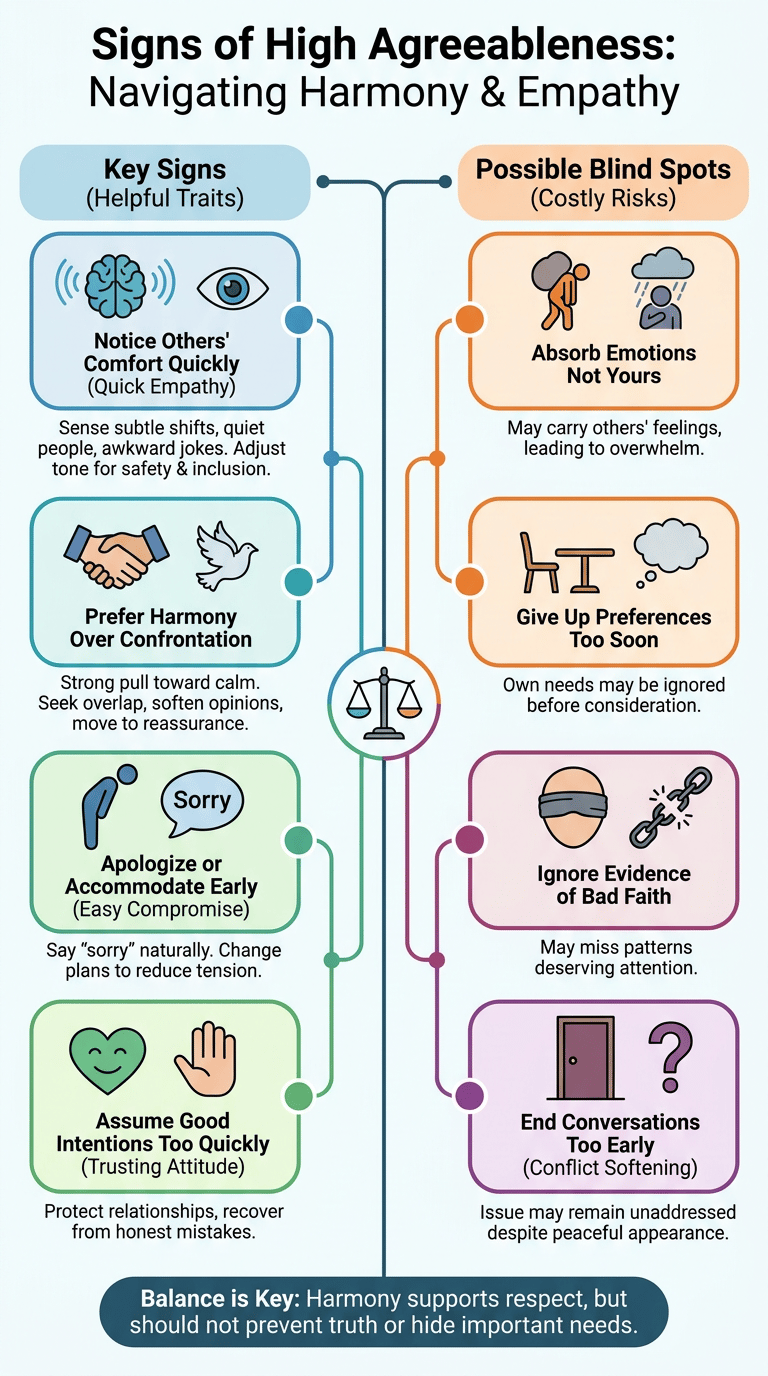
You notice other people’s comfort quickly
If you are high in agreeableness, you may sense small changes in the room before others do. You notice the quiet person who stopped speaking. You notice when someone’s joke landed badly. You may adjust your tone to help people feel safe or included.
You prefer harmony over confrontation
A highly agreeable person may feel a strong pull toward calm. During disagreement, you may look for overlap, soften your opinion, or move quickly toward reassurance. You may dislike conversations where people compete to be right.
Harmony is valuable when it supports respect. It becomes costly when it prevents truth. If you always smooth things over before the issue is named, the relationship may look peaceful while important needs stay hidden.
You may apologize or accommodate early
High agreeableness can make apology feel natural. You may say “sorry” even before you are sure what happened, simply because someone seems upset. You may change your plan, preference, or wording to reduce tension.
You may assume good intentions too quickly
Assuming good intentions can protect relationships from unnecessary suspicion. It helps people recover from awkward wording, bad timing, or honest mistakes. But high agreeableness may also make you explain away patterns that deserve attention.
| High-agreeableness signal | Helpful version | Possible blind spot |
|---|---|---|
| Quick empathy | You notice and care about others’ feelings. | You may absorb emotions that are not yours to carry. |
| Easy compromise | You help people find shared ground. | You may give up your preference before it is considered. |
| Trusting attitude | You avoid unnecessary suspicion. | You may ignore evidence that someone is not acting in good faith. |
| Conflict softening | You reduce tension and keep respect alive. | You may end the conversation before the issue is truly addressed. |
Signs of Lower Agreeableness
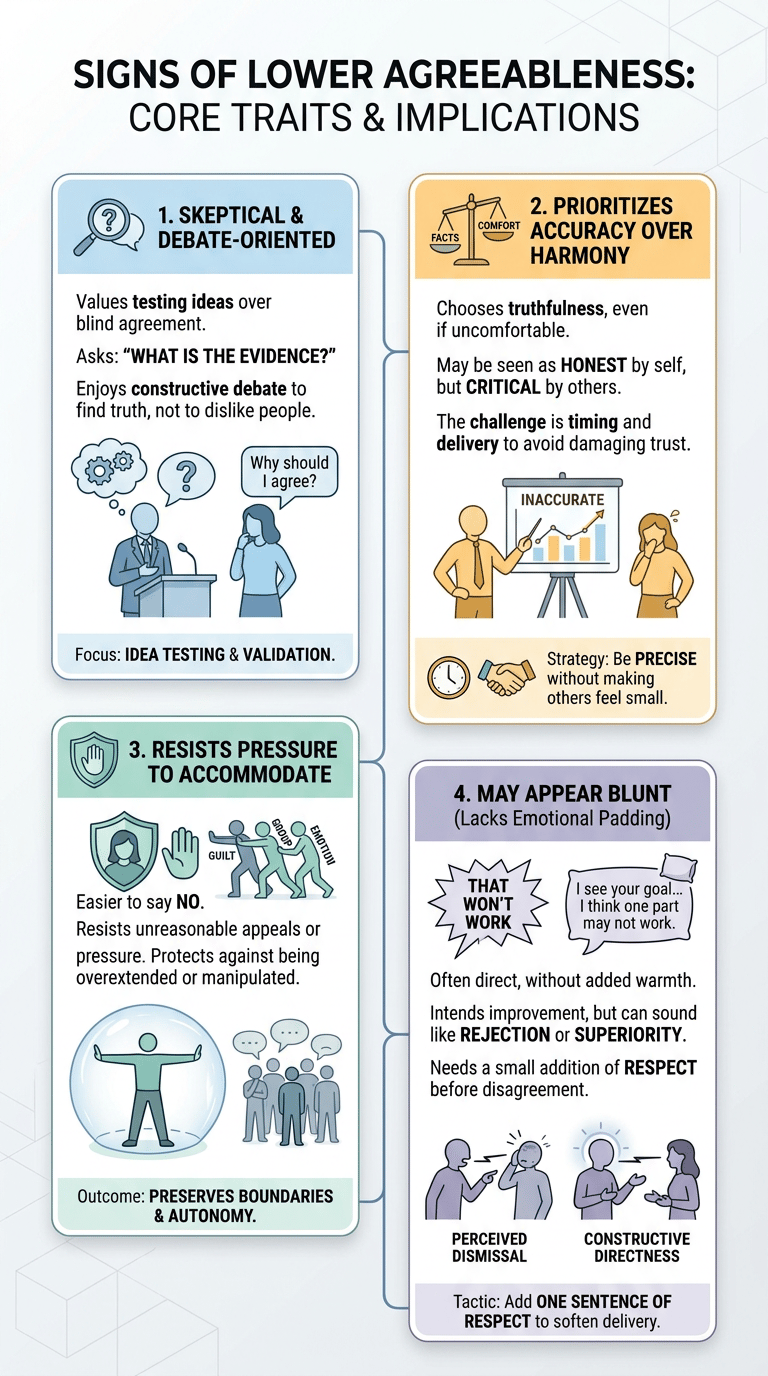
You may be more skeptical or debate-oriented
Lower agreeableness can show up as a readiness to question. You may ask, “What is the evidence?” or “Why should I agree with that?” You may enjoy debate, not because you dislike people, but because you value testing ideas.
You may prioritize accuracy over harmony
A lower-agreeableness person may choose truthfulness over comfort. If something seems inaccurate, unfair, or impractical, you may feel uncomfortable letting it pass. You might see yourself as honest, while others may experience you as critical.
Accuracy matters. So does timing. Being correct in a way that humiliates someone may damage trust even when your information is useful. The practical question is, “Can I be precise without making the other person feel small?”
You may resist pressure to accommodate
Lower agreeableness can make it easier to say no. You may resist guilt, group pressure, or emotional appeals that seem unreasonable. This can protect you from being overextended or manipulated.
You may appear blunt even when you are not trying to hurt people
Some people lower in agreeableness do not naturally add emotional padding. They may say, “That plan will not work,” while meaning, “I think we should improve the plan.” Others may hear rejection, impatience, or superiority.
If this happens often, you do not need to fake warmth. You may only need to add one sentence of respect before disagreement. “I see what you are trying to solve. I think one part may not work.” That small change can keep directness from sounding like dismissal.
Strengths and Blind Spots of High Agreeableness
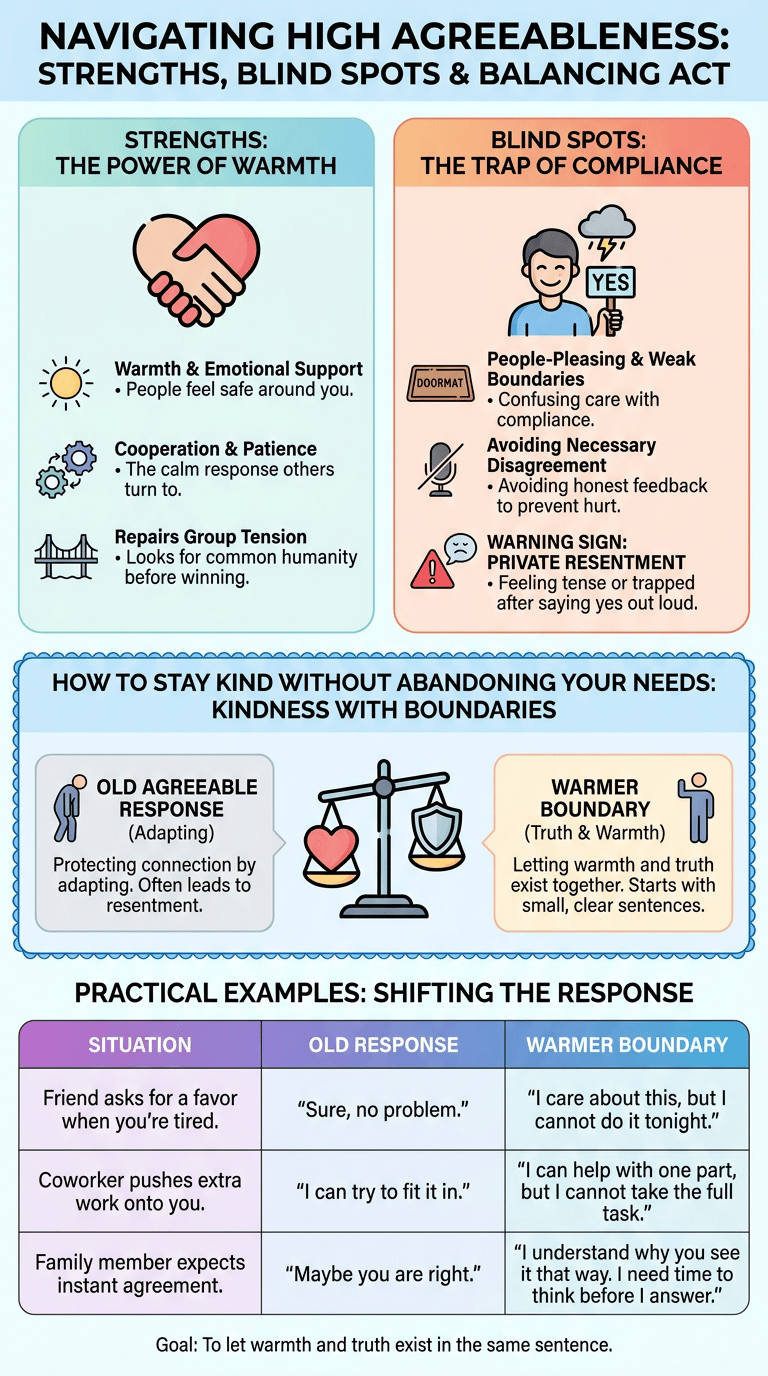
Strength: warmth, cooperation, and emotional support
High agreeableness can make people feel safe around you. You may be the person others turn to when they need patience, understanding, or a calm response. You may help groups repair tension because you look for common humanity before winning.
Blind spot: people-pleasing, weak boundaries, or avoiding necessary disagreement
The common trap is confusing care with compliance. People-pleasing is not the same as agreeableness, but high agreeableness can make people-pleasing easier to slip into. You may say yes because someone seems disappointed. You may avoid honest feedback because you do not want to hurt them. You may let resentment build because you were trying to be easy to love, easy to work with, or easy to be around.
A simple warning sign is private resentment after public agreement. If you often say yes out loud and then feel tense, trapped, or invisible later, your agreeableness may need stronger boundaries.
How to stay kind without abandoning your needs
Kindness with boundaries sounds simple, but it may feel unfamiliar if you usually protect connection by adapting. Start with small, clear sentences.
| Situation | Old agreeable response | Warmer boundary |
|---|---|---|
| A friend asks for a favor when you are already tired. | “Sure, no problem.” | “I care about this, but I cannot do it tonight.” |
| A coworker pushes extra work onto you. | “I can try to fit it in.” | “I can help with one part, but I cannot take the full task.” |
| A family member expects instant agreement. | “Maybe you are right.” | “I understand why you see it that way. I need time to think before I answer.” |
The goal is not to become cold. The goal is to let warmth and truth exist in the same sentence.
Strengths and Blind Spots of Lower Agreeableness
Strength: directness, realism, and boundary protection
Lower agreeableness can help a person see problems that others avoid. You may be willing to name unfairness, challenge weak reasoning, or refuse a request that does not respect your limits. In a group that avoids conflict, this can be valuable.
Direct people sometimes protect the truth when everyone else is protecting comfort. They may prevent hidden resentment by saying what is not working early. They may also be less likely to accept guilt as a reason to abandon their judgment.
Blind spot: unnecessary harshness, mistrust, or relational friction
The risk is that directness can become too sharp. If you often leave conversations feeling proud that you were honest while others leave feeling dismissed, there may be a style problem. If your first response to someone’s concern is suspicion, you may protect yourself from manipulation but also block genuine closeness.
Lower agreeableness becomes costly when it treats every difference as a contest. Not every conversation needs a winner. Sometimes the point is mutual understanding, not cross-examination.
How to be direct without being dismissive
Directness works better when people can tell you still respect them. You can keep your point strong while changing the entrance.
- Start with recognition: “I see why that matters to you.”
- Separate the person from the idea: “I disagree with the plan, not with your value.”
- Ask before correcting: “Do you want my honest concern about this?”
- Use impact language: “I worry this will create a problem later.”
- Leave room for response: “What am I missing from your side?”
These sentences do not weaken your position. They make it easier for another person to stay present while hearing it.
Agreeableness vs Nearby Ideas
Agreeableness vs kindness
Kindness is a value expressed through choices. Agreeableness is a personality tendency that may make kindness feel more natural in certain situations. A highly agreeable person may act kind because they quickly notice others’ needs. A lower-agreeableness person may act kind because they believe it is right, even if they do not naturally soften their style.
This difference matters because it prevents moral labeling. A gentle person is not automatically more ethical. A blunt person is not automatically less caring.
Agreeableness vs people-pleasing
Agreeableness involves cooperation and concern. People-pleasing involves over-adjusting to keep approval, avoid disappointment, or reduce anxiety. The difference is consent. A genuinely agreeable yes still feels chosen. A people-pleasing yes often feels like self-erasure.
If you want to tell the difference, notice what happens inside after you agree. Do you feel peaceful and clear, or tense and resentful? Your body may know the difference before your words do.
Agreeableness vs conflict avoidance
High agreeableness can make conflict avoidance more tempting, but the two are not identical. Agreeableness is a tendency toward harmony. Conflict avoidance is a pattern of dodging hard conversations, delaying issues, or staying silent to escape discomfort.
An agreeable person can still have honest conflict. They may simply prefer to handle it with warmth. The healthy version sounds like, “I care about us, so I want to talk about this carefully.”
Agreeableness vs character
Character asks what someone chooses when values are tested. Agreeableness may influence the style of those choices, but it does not determine them. A highly agreeable person can act unfairly by avoiding accountability. A lower-agreeableness person can act with integrity by telling a hard truth respectfully.
This is why personality language should be descriptive, not final. It gives you a map, not a verdict.
How Agreeableness Shows Up in Conflict
High agreeableness may smooth over issues too quickly
In conflict, a highly agreeable person may move fast toward peace. They may say, “It is fine,” before it is fine. They may reassure the other person before naming their own hurt. This can lower tension in the moment but leave the real issue untouched.
One practical rule is to avoid ending a conflict before each person can state the actual concern. Peace that depends on silence usually does not stay peaceful.
Lower agreeableness may escalate by challenging too quickly
A lower-agreeableness person may respond to conflict by questioning the complaint. “That is not what happened.” “You are exaggerating.” “Where is the proof?” Sometimes the challenge is fair. Sometimes it arrives too early and makes the other person feel cross-examined.
If this is your style, try adding a short listening step before the challenge. “I want to understand your concern first. Then I want to explain how I saw it.” That order can prevent a debate from replacing the conversation.
A balanced approach: warmth plus clarity
The most useful middle ground is not becoming more agreeable or less agreeable in a general way. It is combining warmth with clarity. Warmth says, “Your experience matters.” Clarity says, “My limits and perspective matter too.”
| Conflict tendency | Risk | Balanced move |
|---|---|---|
| High agreeableness | Smoothing over the issue too early | Name one honest need before reassuring. |
| Lower agreeableness | Challenging before understanding | Reflect the concern before disagreeing. |
| Both styles | Assuming the other person’s motive | Ask what the other person meant before reacting. |
Self-Check Questions for Agreeableness
Do you say yes to protect connection or because you truly agree?
Think of a recent yes. Did it feel chosen, generous, and clear? Or did it feel like the quickest way to avoid disappointing someone? A high-agreeableness pattern often becomes clearer after the conversation, when resentment or relief appears.
A helpful question is, “Would I still choose this if I knew the other person could handle my no?”
Do you challenge others to clarify truth or to regain control?
If you are lower in agreeableness, reflect on your challenges. Are you trying to understand reality more clearly, or are you trying to regain control when you feel vulnerable? Both can feel like “just being honest,” but they create different outcomes.
A useful question is, “Would I ask this the same way if I were trying to protect both truth and trust?”
Where does your level of agreeableness help your relationships and decisions?
Do not only look for flaws. High agreeableness may help you maintain closeness, notice feelings, and repair quickly. Lower agreeableness may help you resist pressure, challenge assumptions, and protect limits. The goal is to see where your natural style already serves you.
Then ask the second question: “Where does this same strength become too much?” That is usually where growth becomes useful.
What To Do Next With This Insight
If you are highly agreeable, practice one clear boundary
Choose a low-risk situation. Do not start with the hardest person in your life. Practice one sentence that is warm but firm: “I cannot do that this week,” “I need to think before I answer,” or “I care, but I do not agree.”
Notice what happens inside. Many highly agreeable people feel guilt when they first set clearer limits. Guilt does not always mean you did something wrong. Sometimes it means you are doing something unfamiliar.
If you are lower in agreeableness, practice one warm opening before disagreement
Before correcting, challenging, or refusing, add one sentence that shows respect. It might be, “I get why that matters,” “I appreciate the effort you put into this,” or “I want to be honest without being harsh.”
Use the trait as information, not a verdict
A personality trait can explain tendencies, but it should not become an excuse. “I am just agreeable” does not mean you must ignore your needs. “I am just direct” does not mean others must accept unnecessary harshness.
The best use of agreeableness is practical self-awareness. It helps you predict where you may over-adapt, over-challenge, over-trust, or over-defend. Once you can see the tendency, you have more choice.
Bridge Topics for the Personality Cluster
How agreeableness interacts with extraversion
Agreeableness and extraversion can combine in different ways. A highly agreeable extravert may be socially warm and expressive. A highly agreeable introvert may be gentle and considerate but need more quiet recovery. A lower-agreeableness extravert may debate openly, while a lower-agreeableness introvert may be selective, reserved, and firm.
Why agreeableness is easy to confuse with character
Because agreeableness affects how someone treats others on the surface, people often mistake it for character. Warmth can look ethical. Bluntness can look unkind. But character requires a longer view: Does the person take responsibility? Do they tell the truth? Do they respect boundaries? Do they act with care when it costs them something?
Agreeableness affects style. Character shows up in choices.
How personality change can involve boundaries and communication habits
Personality traits are relatively stable, but people can still build habits around them. A highly agreeable person can practice clearer boundaries. A lower-agreeableness person can practice more considerate delivery. These changes do not require becoming a different person.
Growth often means widening your range. You keep the strengths of your natural style while adding skills for situations where that style is not enough.
When To Get Support
Seek support if conflict includes fear, coercion, threats, humiliation, stalking, retaliation, or pressure to ignore your boundaries
Most differences in agreeableness are normal personality differences. Some people are softer. Some are more direct. Some accommodate quickly. Some need stronger evidence before trusting. These differences do not automatically mean something unsafe is happening.
However, safety matters more than personality analysis. If someone uses fear, coercion, threats, humiliation, stalking, retaliation, intimidation, isolation, or pressure to make you ignore your boundaries, that is not just a difference in agreeableness. The National Domestic Violence Hotline explains that abuse is not limited to physical violence and can include emotional and controlling behaviors. If you feel unsafe, consider reaching out to a trusted person or a qualified support service before trying to solve the situation through better communication.
If this topic brings up severe distress, panic, self-harm thoughts, or a sense that you cannot stay safe, seek immediate help from local emergency services or a crisis support resource in your area. Educational personality content cannot replace professional support in a high-risk situation.
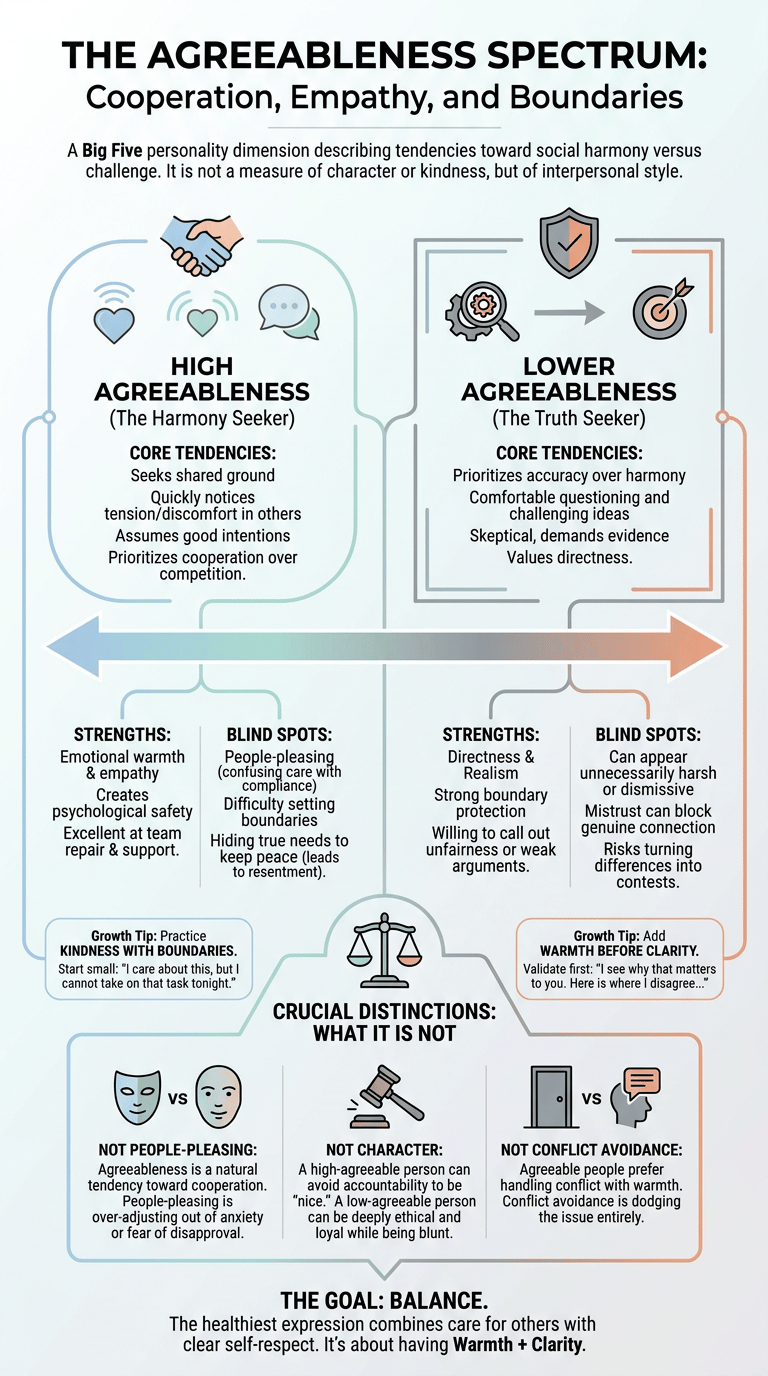
Agreeableness can look like kindness, but a personality trait is not the same as moral character: agreeableness is not the same as being morally good.
FAQ
Is high agreeableness always good?
No. High agreeableness often supports warmth, empathy, cooperation, and trust, but it can become costly if it leads to over-accommodation, conflict avoidance, or weak boundaries. The healthy version of high agreeableness includes care for others without abandoning your own needs.
Is low agreeableness the same as being mean?
No. Lower agreeableness may show up as skepticism, directness, independence, or a stronger willingness to disagree. Those traits can be useful when expressed with respect. The problem is not low agreeableness itself; the problem is when directness becomes contempt, harshness, or refusal to consider another person’s experience.
How is agreeableness different from people-pleasing?
Agreeableness is a broad personality tendency toward cooperation and concern for others. People-pleasing is a pattern of over-adjusting to gain approval, avoid conflict, or manage someone else’s disappointment. A person can be highly agreeable without people-pleasing if they can say no, express disagreement, and make choices from genuine consent.
Can agreeable people have strong boundaries?
Yes. Agreeable people can have strong boundaries, but they may need to practice stating them clearly. A strong boundary does not require coldness. It can sound warm and firm at the same time, such as, “I care about this, but I cannot take that on,” or “I understand your view, but I do not agree.”
Key Takeaways
- Agreeableness is a Big Five personality trait linked to cooperation, trust, empathy, warmth, and social harmony.
- High agreeableness can support emotional support and teamwork, but it can also make people-pleasing and weak boundaries more tempting.
- Lower agreeableness can support directness, realism, and boundary protection, but it can create friction if it becomes harsh or overly suspicious.
- Agreeableness is not the same as kindness, character, people-pleasing, or conflict avoidance.
- A balanced interpersonal style combines warmth with clarity, which means caring about others without erasing yourself.
- Use your level of agreeableness as information about your tendencies, not as a fixed verdict on who you are.
Final Thoughts
The most useful question is not whether you are agreeable enough. It is whether your usual interpersonal style helps you act with both care and honesty. If you are highly agreeable, your next step may be one clear boundary that does not require apology. If you are lower in agreeableness, your next step may be one warm opening before disagreement. Either way, agreeableness becomes more useful when it gives you more choice, not less.

Michael Reed is the Founder and Lead Writer at Psychology Exposed. He writes about human behavior, relationships, emotional patterns, self-awareness, and practical psychology topics using research-informed, easy-to-understand content.
Read More About Michael Reed: https://psychologyexposed.com/michael-reed/