
People often use personality and character as if they mean the same thing. Someone is “nice,” “difficult,” “quiet,” “honest,” “dramatic,” “reliable,” or “cold,” and the labels can blur together quickly. But in psychology and everyday self-understanding, the difference matters. Personality helps explain your typical patterns. Character helps describe how you use those patterns when values, responsibility, honesty, and impact are involved.
This distinction can be especially useful when you are trying to understand yourself without excusing everything, or trying to understand someone else without judging too quickly. A trait can explain why a certain response comes naturally. It does not automatically decide what someone should do next. Character shows up in the repeated choices a person makes after they know their actions affect others.
Psychology does not require turning personality into a moral scorecard. A reserved person is not less caring, and a sensitive person is not less mature. At the same time, personality language should not become a shield that blocks accountability. The useful question is: “What tendency is present, what choice is available, and what value do I want my behavior to reflect?”
Quick Answer
Personality describes typical patterns of thinking, feeling, and behaving, while character is more about values, integrity, responsibility, and repeated choices
Personality is the usual shape of your reactions, preferences, emotional style, and behavior. Character is how your values become visible through choices, especially when something is inconvenient, uncomfortable, or morally important. Personality may explain why something feels hard, natural, tiring, or tempting. Character matters when you decide whether to be honest, responsible, fair, respectful, or accountable anyway.
| Question | Personality focus | Character focus |
|---|---|---|
| What comes naturally? | Typical traits, preferences, emotional tendencies | Not the main focus |
| What do I choose when it matters? | May influence the difficulty level | Values, integrity, responsibility, follow-through |
| How do others usually experience me? | Style, energy, habits, emotional tone | Trustworthiness, fairness, honesty, care |
| Can it explain behavior? | Often, yes | Yes, especially repeated choices under pressure |
| Can it excuse harm? | No | No, but it helps evaluate accountability |
What Personality Means
Personality as trait tendencies and patterns
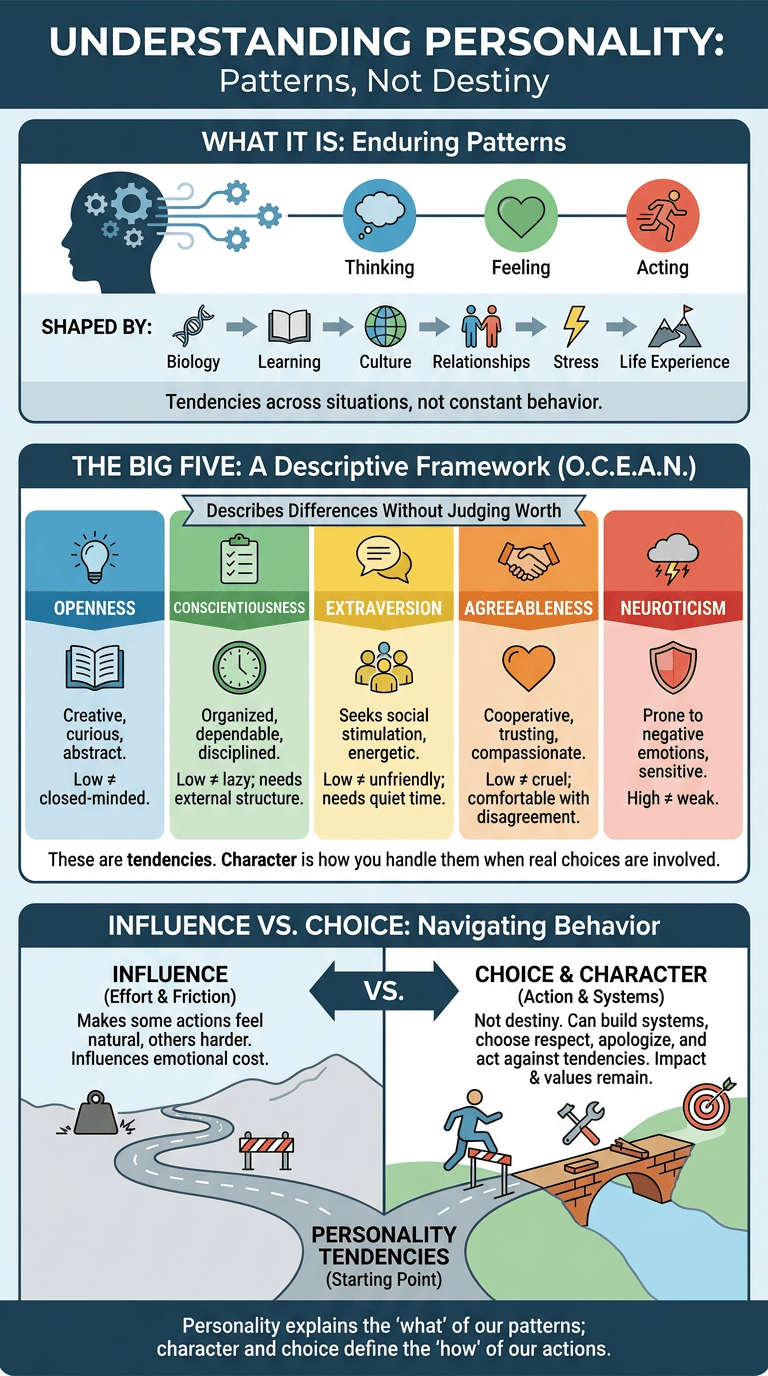
The APA Dictionary of Psychology describes personality as an enduring configuration of characteristics and behavior, including traits, interests, drives, values, self-concept, abilities, and emotional patterns. In simple terms, personality is how a person tends to think, feel, and act across situations.
A personality trait does not mean someone behaves the same way every minute. It means there is a pattern. One person may seek social stimulation, another may need quiet time, one may plan early, and another may start closer to the deadline. These patterns can be shaped by biology, learning, culture, relationships, stress, and life experience.
How the Big Five explains differences without judging worth
The Big Five model looks at broad personality dimensions: openness, conscientiousness, extraversion, agreeableness, and neuroticism. OpenStax explains trait theories as attempts to understand personality through stable characteristics and ways of behaving, with the Big Five commonly used as a major framework for describing differences among people in a nonjudgmental way.
That last part matters. The Big Five is descriptive before it is evaluative. Low extraversion does not mean someone is unfriendly. High neuroticism does not mean someone is weak. Lower agreeableness does not automatically mean someone is cruel. Traits describe tendencies. Character asks how a person handles those tendencies when real choices are involved.
Why personality can influence behavior without fully determining it
Personality can make some behaviors feel easier and others feel harder. A highly conscientious person may find routines more natural. A less conscientious person may need more external structure. A highly agreeable person may find cooperation easier, while a less agreeable person may be more comfortable with disagreement. These patterns matter because they influence effort, friction, and emotional cost.
But influence is not destiny. A quiet person can show warmth. A sensitive person can apologize. A blunt person can choose respect. A disorganized person can build systems to protect commitments. Personality helps explain the starting point. It does not remove impact, repair, values, or consequences.
What Character Means
Character as values in action
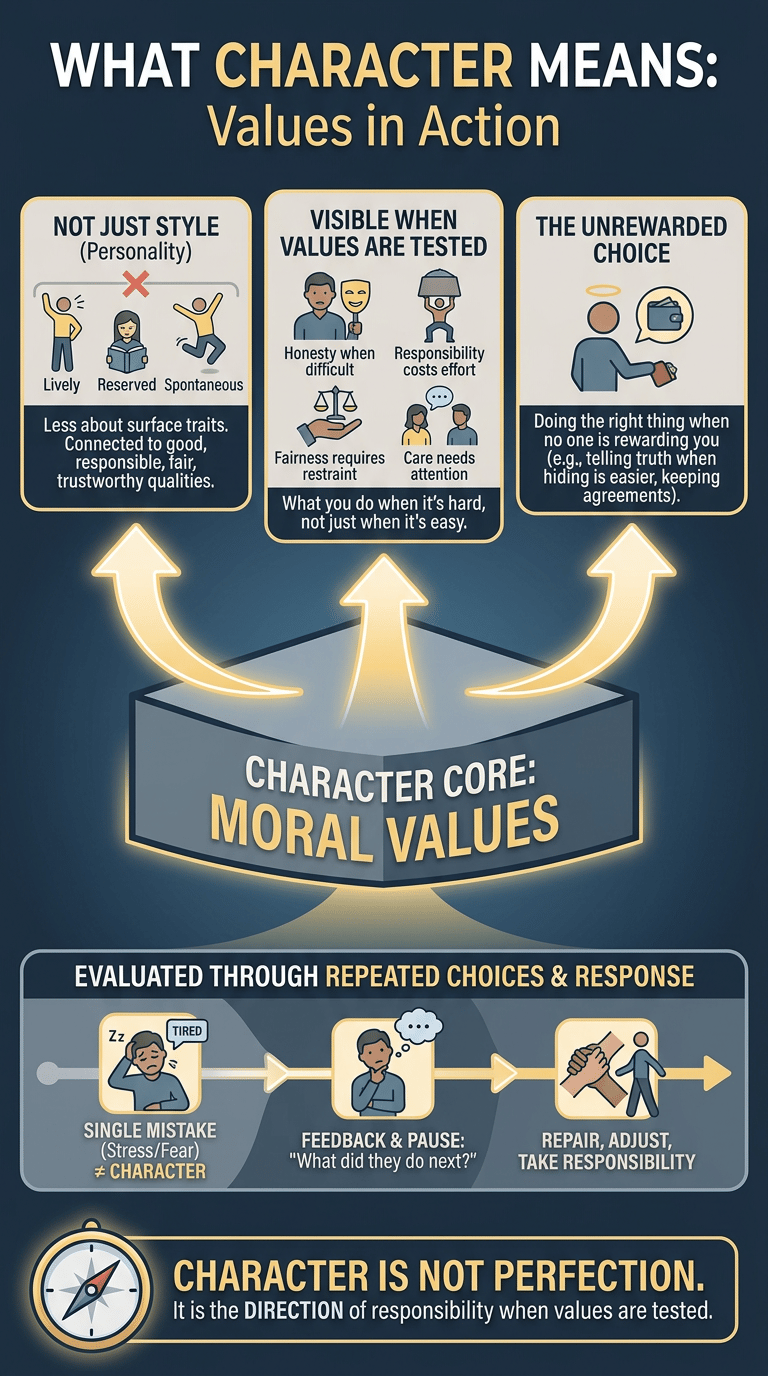
Character is often used to describe the moral and value-based side of behavior. It is less about whether someone is lively, reserved, intense, relaxed, spontaneous, or cautious. It is more about what they do when honesty is difficult, when responsibility costs effort, when fairness requires restraint, or when care requires attention to another person’s experience.
The APA Dictionary entry on character strength describes positive traits such as kindness, teamwork, or hope as morally valued in their own right. That language points to an important distinction: character is not just style. It is connected to qualities people tend to evaluate as good, responsible, fair, or trustworthy.
Integrity, honesty, responsibility, fairness, and courage
Character becomes visible through values such as integrity, honesty, responsibility, fairness, compassion, humility, and courage. These are not always loud qualities. A person can be charming and lack integrity. A person can be quiet and deeply trustworthy. A person can be awkward in conversation and still take responsibility when they cause harm.
Character also includes what someone does when no one is rewarding them for doing the right thing. Do they tell the truth when hiding is easier? Do they repair after hurting someone? Do they keep agreements when the excitement fades?
Why character is often evaluated through repeated choices
One single mistake does not define a person’s character. People are tired, stressed, immature in certain areas, poorly taught, defensive, or afraid at times. Character is clearer when you look at repeated choices, after feedback.
That is why the question “What did they do next?” matters. Did they deny the impact and repeat the same harm, or did they pause, repair, adjust, and take the next situation more seriously? Character is not perfection. It is the direction of responsibility when values are tested.
Personality vs Character in Simple Terms
Trait tendency versus value commitment
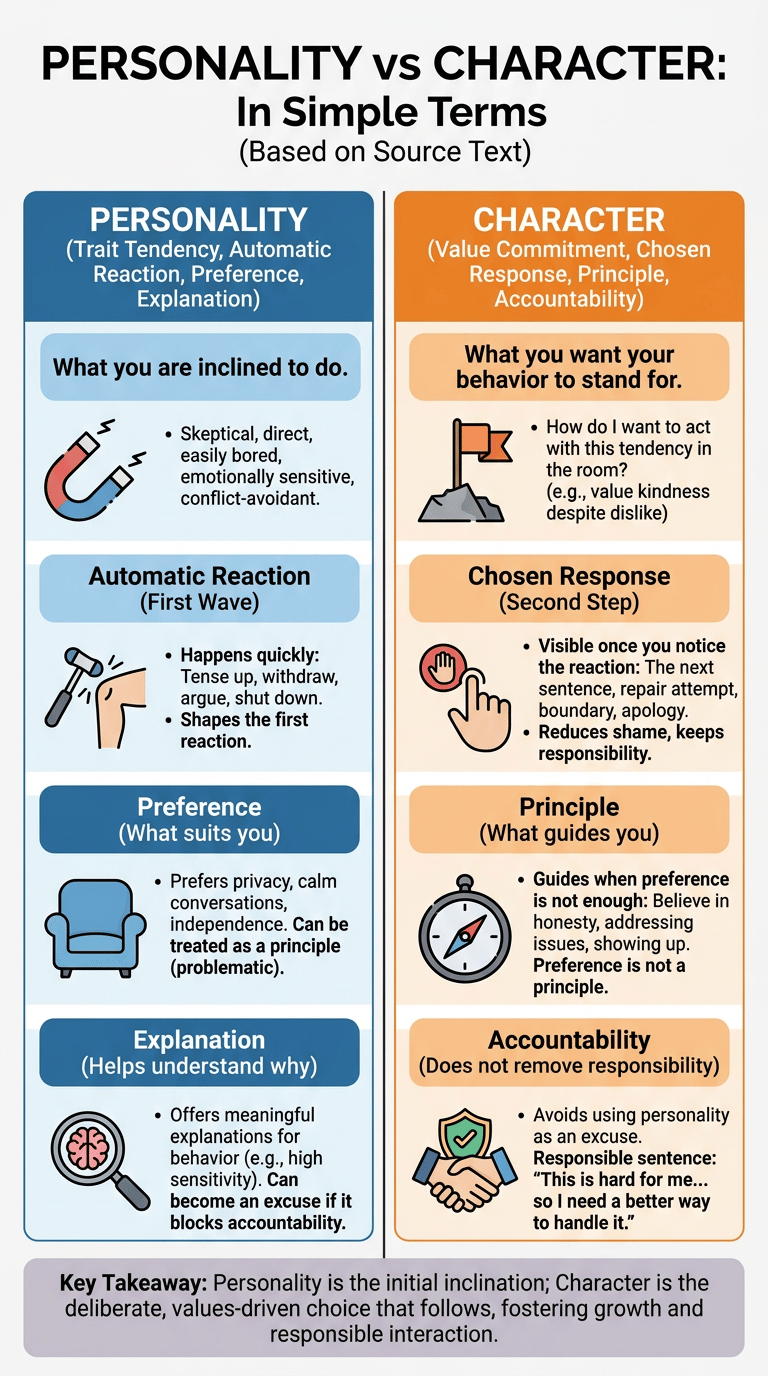
A trait tendency is what you are inclined to do. A value commitment is what you want your behavior to stand for. Someone may be naturally skeptical, direct, easily bored, emotionally sensitive, or conflict-avoidant. Those tendencies are real. But a value commitment asks, “How do I want to act with this tendency in the room?”
For example, a person may naturally dislike small talk. That is personality. They may still value kindness enough to greet a new coworker warmly. A person may naturally feel intense anger when criticized. That is a tendency. They may still value fairness enough to avoid insults and return later with a clearer response.
Automatic reaction versus chosen response
Automatic reactions often happen quickly. You tense up, withdraw, argue, joke, over-explain, please, interrupt, shut down, or rush to fix. Personality can shape which reaction appears first. Character becomes more visible in the second step: what you do once you notice the reaction.
This reduces shame without removing responsibility. You may not choose the first wave of discomfort, but you often have more influence over the next sentence, the repair attempt, the boundary, or the apology.
Preference versus principle
A preference is what suits you. A principle is what guides you when preference is not enough. You may prefer privacy, but still believe in honesty. You may prefer calm conversations, but still believe in addressing important issues. You may prefer independence, but still believe in showing up for people you have committed to.
Problems begin when preference is treated as a principle. “I do not like conflict” can be real, but it does not justify avoiding every important conversation. “I am just blunt” may describe style, but it does not justify humiliating someone.
Explanation versus excuse
An explanation helps you understand why a behavior happened. An excuse tries to remove responsibility for what happens next. Personality can offer meaningful explanations. A person may react strongly because they are high in emotional sensitivity. They may avoid planning because structure is harder for them. They may resist group settings because social energy drains them.
An explanation becomes an excuse when it blocks accountability. “This is my personality” is not enough when repeated behavior hurts people, breaks trust, or violates clear agreements. A more responsible sentence is: “This is hard for me because of my tendencies, so I need a better way to handle it.”
Examples That Show the Difference
Low extraversion versus being cold or dismissive
Low extraversion may mean someone needs more quiet, less stimulation, or more recovery time after social contact. It does not necessarily mean they are uncaring. A reserved person can still be warm, attentive, and loyal. Their care may show through consistency, thoughtful messages, remembering details, or showing up when needed.
Coldness or dismissiveness is different. If someone ignores others’ feelings, refuses basic courtesy, or treats people as unworthy of response, the issue is not simply low extraversion. The question shifts from energy preference to respect. Personality explains why constant socializing may be tiring. Character matters when another person is treated as disposable.
High neuroticism versus refusing accountability for hurtful reactions
High neuroticism can involve stronger stress reactivity, more worry, and more emotional intensity. A person may feel threatened sooner or need more time to calm down. This can explain why certain situations feel overwhelming. It should not be turned into a character attack.
Refusing accountability is a separate matter. If someone repeatedly lashes out, insults people, or creates fear and then says, “I am just sensitive,” personality language is being used to avoid responsibility. Emotional sensitivity may explain the intensity of the internal experience. Character shows up in whether the person learns repair, seeks support, and takes impact seriously.
Low agreeableness versus unnecessary cruelty
Lower agreeableness may involve being more skeptical, direct, competitive, or comfortable with disagreement. This can be useful in settings where honest critique is needed. A less agreeable person may ask hard questions, resist group pressure, or challenge ideas that others avoid.
Unnecessary cruelty is not the same thing. Being direct does not require contempt. Disagreeing does not require mockery. A person can be low in agreeableness and still be fair, honest, and humane. Character is revealed in whether directness is used to clarify truth or to dominate, belittle, and avoid care.
Lower conscientiousness versus repeatedly breaking commitments
Lower conscientiousness may mean planning, organization, and follow-through require more deliberate support. A person may underestimate time, lose track of details, or resist rigid routines. That does not automatically make them selfish or unreliable in character.
Repeatedly breaking commitments after knowing the impact is different. If someone keeps making promises, ignores the consequences, and expects others to absorb the damage, character questions become relevant. The issue is not only natural organization level. It is whether the person values trust enough to change the system, renegotiate commitments honestly, or stop promising what they will not protect.
Why People Confuse Personality and Character
Personality language feels less blaming
Personality language can feel safer because it sounds descriptive. Saying “I am introverted,” “I am emotional,” or “I am not very structured” may feel less painful than saying “I avoided responsibility,” “I was unfair,” or “I hurt someone.” This can be useful when it reduces shame enough for reflection to begin.
The risk is that softer language can become too soft. If personality terms are used to explain every behavior, the person may never ask what value was missing or what repair is needed. A useful explanation should make change more possible, not less necessary.
Character language can become moralizing
Character language can also be misused. Calling someone lazy, selfish, weak, dishonest, or bad may shut down reflection, especially when the situation is more complex. People may act poorly because they are overloaded, afraid, unskilled, stressed, immature, or repeating learned patterns. Moral labels can become too simple too quickly.
A careful approach separates evaluation from condemnation. It is fair to name harmful behavior and expect accountability. It is still usually more useful to ask, “What value was not practiced here?” than to decide that one moment reveals the whole person.
Both can influence the same behavior
The same behavior can involve personality and character at once. If someone cancels plans repeatedly, personality may play a role if they are easily overstimulated or poor at estimating energy. Character becomes more relevant if they know the cancellations hurt someone, keep promising anyway, and refuse to communicate honestly.
| Behavior | Possible personality piece | Possible character piece |
|---|---|---|
| Interrupting during disagreement | Fast verbal processing, high urgency, high emotional reactivity | Whether they make room for the other person after noticing |
| Avoiding group events | Low extraversion, high need for recovery | Whether they communicate respectfully and keep important commitments |
| Being blunt | Lower agreeableness, direct communication style | Whether honesty is paired with respect and fairness |
| Missing deadlines | Lower conscientiousness, weak planning systems | Whether they take responsibility and adjust future commitments |
When Personality Explains a Pattern
Repeated tendencies across many situations
Personality is more likely involved when a tendency appears across many settings, not just one relationship or one stressful week. If someone has always needed quiet time after social activity, that points toward a stable energy pattern. If someone consistently likes novelty, abstract ideas, and imaginative exploration, openness may be part of the picture.
Patterns are not proof by themselves, but they are clues. Personality is not usually about one isolated action. It is about recurring ways of approaching the world across work, friendships, family, stress, rest, and decision-making.
Behaviors that appear even without strong moral stakes
Personality often shows up in ordinary situations where no one’s integrity is being tested. Do you enjoy a crowded event or feel drained by it? Do you organize your desk or tolerate creative mess? Do you prefer familiar routines or seek new experiences?
These are not usually moral questions. They are differences in style, energy, and preference. Treating every difference as a character issue can make people feel judged for simply being wired or shaped differently. A personality-aware view gives people room to understand natural variation.
Preferences, energy patterns, and stress responses
Personality is especially useful when looking at preferences, energy patterns, and stress responses. It can help people build a life that fits them better. A person who knows they need recovery after social time can plan it instead of feeling guilty. A person who knows they get anxious under uncertainty can create grounding routines before making big decisions.
Research on values and traits suggests the relationship between personality and value systems can be meaningful but not identical. One open-access paper in PubMed Central examined how personality traits relate to personal values, which supports the practical idea that traits and values can interact without becoming the same thing.
When Character Matters More
When someone knows the impact and keeps choosing the same harm
Character matters more when the person knows the impact and continues the behavior without meaningful repair. This does not mean the person is beyond growth. It means the conversation has moved beyond “Why does this happen?” into “What responsibility is being avoided?”
For example, if someone forgets an important date once, personality and circumstance may explain a lot. If they repeatedly forget, receive feedback, promise change, and make no effort to protect the next commitment, the issue is also how seriously they treat another person’s trust.
When values, honesty, responsibility, or fairness are involved
Character becomes central when a choice involves truth, fairness, care, or responsibility. A person may be conflict-avoidant by temperament. But if they hide important information because honesty feels uncomfortable, the question is no longer only about avoidance. It is also about integrity.
A person may be naturally competitive. But if they cheat, undermine, or humiliate others to win, the issue is not simply ambition. A person may be emotionally reactive. But if they use that intensity to intimidate people, the issue is not simply sensitivity. Personality can explain pressure. Character concerns what is done with that pressure.
When repair and accountability are possible but avoided
Repair is one of the clearest places where character becomes visible. It does not require perfect words. It requires enough humility to recognize impact, enough honesty to name the behavior, and enough responsibility to change something practical.
Accountability is especially important when the same issue returns. A person who values repair does not only apologize. They look for the condition that keeps producing the behavior. They may need reminders, outside support, better systems, more rest, clearer boundaries, or honest renegotiation. Character is not shown by never struggling. It is shown by what someone protects when struggle appears.
How To Use This Difference Without Judging Yourself or Others Too Quickly
Ask what tendency is showing up
Start with curiosity before condemnation. Ask: “What tendency is present here?” Maybe the tendency is to withdraw, control, please, argue, avoid, over-explain, rush, or shut down. Naming the tendency reduces confusion. It can also reduce shame because you are looking at a pattern rather than attacking your whole identity.
This question is especially useful for self-reflection. Instead of saying, “I am a bad person,” you might say, “I tend to become defensive when I feel criticized.” That is more workable. It tells you where to intervene.
Ask what choice is available now
The next question is: “What choice is available now?” You may not instantly change your first reaction, but you may be able to pause, clarify, apologize, tell the truth, ask for time, keep your promise, or stop a harmful behavior before it grows.
This question keeps personality from becoming a cage. A person with strong emotional reactions may choose a calming pause. A person who dislikes conflict may choose one honest sentence. A person who struggles with routines may choose a smaller commitment they can actually keep. Character often grows through available choices, not dramatic identity changes.
Ask what value you want to practice next
Values are easier to practice when they become specific. “I want to be better” is vague. “I want to practice honesty before comfort” is clearer. “I want to practice respect when I disagree” gives you a behavioral target. “I want to practice reliability by confirming only what I can truly do” turns character into action.
Try this three-part reflection when the difference feels blurry:
- The tendency: What reaction or preference came naturally?
- The impact: How did this affect me or someone else?
- The value: What value should guide the next response?
This framework is not about self-punishment. It is about becoming more honest. You can respect your personality while still choosing behavior that reflects your values.
How This Difference Connects With Other Personality Questions
How agreeableness can be mistaken for goodness
Agreeableness often looks warm, cooperative, and considerate. That can overlap with kindness, but it is not the same as goodness. A highly agreeable person may avoid saying hard truths because they dislike tension. They may appear easygoing while silently building resentment. They may say yes without meaning it.
Good character requires more than pleasantness. It may require honesty, boundaries, courage, or fairness, even when those qualities disturb the peace.
How conscientiousness can be mistaken for worthiness
Conscientiousness is often rewarded because it looks organized, disciplined, and dependable. These qualities can support responsibility, but they do not make a person more worthy than someone who struggles with structure. A highly conscientious person can still be controlling, harsh, or prideful. A less conscientious person can still be caring, honest, generous, and willing to repair.
The useful distinction is between skill and value. Planning is a skill. Follow-through can express responsibility. Worth is not the same as productivity.
Why personality change often involves values-based behavior, not identity replacement
Many people who ask whether personality can change are really asking whether they are stuck. A better question may be: “Can I build behavior that reflects my values more often?” Personality can be relatively stable, but people can still develop habits, coping skills, communication patterns, and decision rules that change how traits show up in daily life.
You do not need to replace your whole identity to grow. A reserved person can practice warmth. A reactive person can practice repair. A spontaneous person can practice reliability. Growth often means your values become easier to see through your behavior.
When To Get Support
Seek support if repeated behavior involves coercion, threats, humiliation, retaliation, unsafe dynamics, or severe emotional distress
Most personality and character questions can be explored through reflection, honest feedback, and gradual behavior change. But safety comes first. If someone uses personality language to excuse coercion, threats, intimidation, humiliation, stalking, retaliation, or control, the issue is not a simple personality difference.
If you feel afraid of someone’s reaction, pressured to stay silent, punished for setting boundaries, or unsafe when you disagree, prioritize support over communication strategies. The National Domestic Violence Hotline explains emotional abuse and related control tactics in a safety-focused way. If you have self-harm thoughts or overwhelming distress, reach out to a mental health professional or local crisis resource.
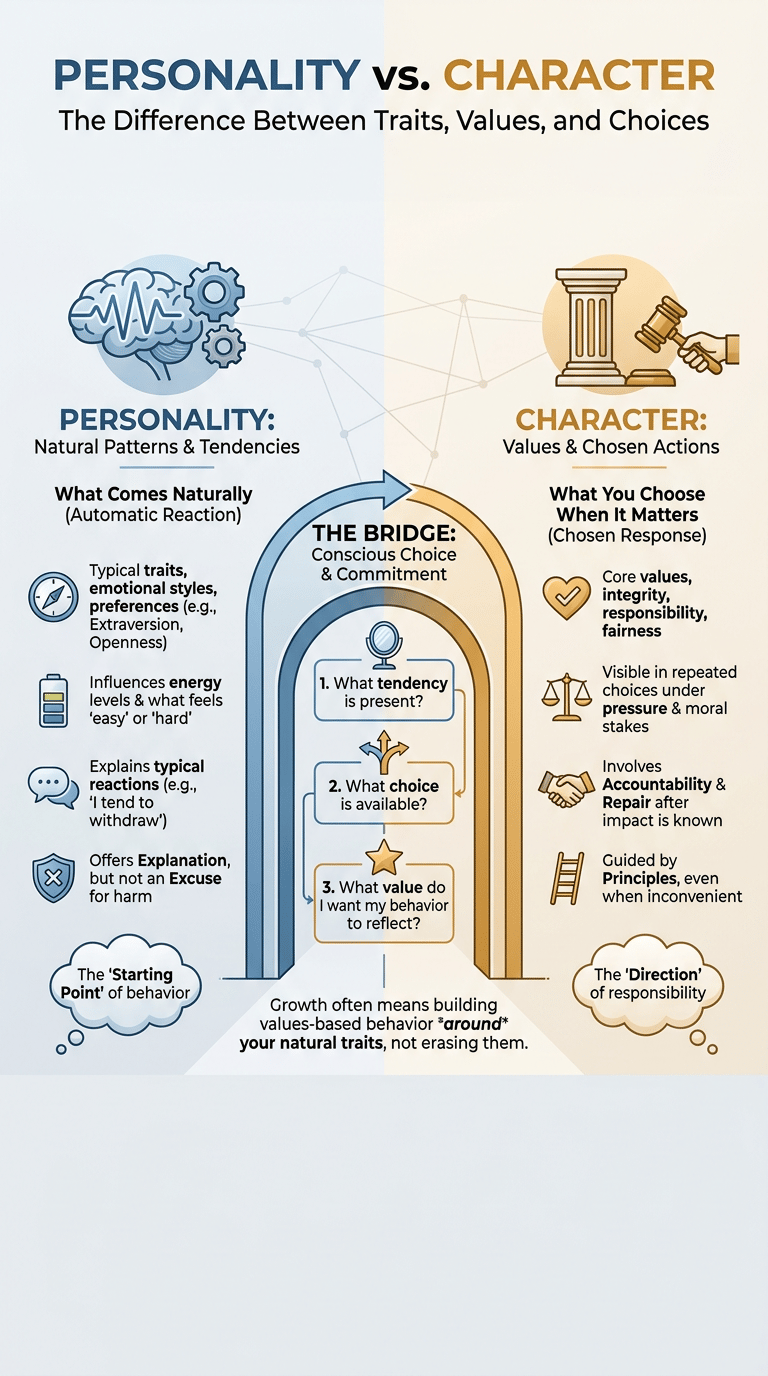
To understand the difference clearly, it helps to separate personality psychology from moral judgment.
FAQ
Is personality the same as character?
No. Personality refers to relatively consistent patterns in how someone thinks, feels, reacts, and behaves. Character refers more to values, integrity, honesty, responsibility, and repeated choices. They influence each other, but they are not identical. Personality may explain why a response feels natural. Character shows up in what someone chooses after they understand the impact.
Can someone have a difficult personality but good character?
Yes. Someone may be intense, blunt, reserved, anxious, skeptical, or disorganized and still have strong character. Good character is not the same as being easy for everyone to be around. A person with good character takes responsibility, tries to be fair, repairs harm, tells the truth, and keeps learning how their behavior affects others.
Can personality be used as an excuse?
It can be, but it does not have to be. Personality is helpful when it explains patterns and guides better strategies. It becomes an excuse when someone uses it to avoid responsibility, dismiss impact, or repeat harmful behavior without change. A more accountable use of personality language is: “This is a real tendency for me, so I need a better plan.”
Does character change more easily than personality?
Not always. Personality traits can be relatively stable, but behavior can still change through habits, insight, environment, support, and practice. Character also requires practice, especially when values are tested under stress. In many cases, growth is not about completely changing who you are. It is about making your values more visible in what you repeatedly choose.
How does the Big Five relate to character?
The Big Five describes broad personality traits such as openness, conscientiousness, extraversion, agreeableness, and neuroticism. These traits can influence behavior, relationships, and stress responses. Character is different because it focuses more on values and responsibility. For example, agreeableness may make cooperation easier, but character determines whether cooperation is honest, fair, and respectful.
Key Takeaways
- Personality describes typical patterns in thinking, feeling, energy, preference, and behavior.
- Character is more about values in action, especially honesty, integrity, fairness, responsibility, and repair.
- A trait can explain why something feels hard or natural, but it does not automatically excuse harmful behavior.
- The clearest character question is often what someone does after they understand their impact.
- Personality language can reduce shame, but it should not replace accountability.
- Growth often means building values-based behavior around your traits, not erasing your personality.
Final Thoughts
The difference between personality and character is not meant to help you label yourself or other people as good or bad. Personality asks, “What patterns are natural for me?” Character asks, “What do I choose when my values are tested?”
A practical next step is to choose one repeated situation and separate it into three parts: the trait tendency, the impact, and the value you want to practice next. You do not have to reject your personality to strengthen your character. You only need to stop using one as a way to avoid the other.

Michael Reed is the Founder and Lead Writer at Psychology Exposed. He writes about human behavior, relationships, emotional patterns, self-awareness, and practical psychology topics using research-informed, easy-to-understand content.
Read More About Michael Reed: https://psychologyexposed.com/michael-reed/