
Shame can make a small moment feel like a verdict on your whole self. You may make a mistake, receive criticism, get rejected, or reveal something vulnerable, then suddenly feel exposed, unworthy, or desperate to hide. The painful part is not only what happened. It is the meaning shame adds: something is wrong with me.
In psychology, shame is usually understood as a self-conscious emotion, meaning it involves how you see yourself through your own eyes and through the imagined eyes of others. The APA Dictionary of Psychology describes shame as an unpleasant self-conscious emotion linked with feeling that something about one’s conduct or circumstances is dishonorable or socially unacceptable.
This guide explains shame as an emotional experience, not as proof that you are defective. It will help you separate shame from guilt and embarrassment, recognize common shame responses, understand the shame spiral, and know when shame may need support. It is educational, not a diagnosis or a replacement for mental health care.
Quick Answer
What shame means in psychology
Shame is a painful self-conscious emotion that makes a person feel exposed, flawed, or unacceptable. While guilt often says, “I did something wrong,” shame tends to say, “Something is wrong with me.” It can push people to hide, withdraw, attack themselves, or defend against the feeling before they can understand it.
Why shame attacks identity, not just behavior
Shame feels personal because it attaches meaning to the self. Instead of staying with a specific event, such as “I made an awkward comment,” it expands into identity: “I am awkward,” “I am too much,” or “I should not be seen.” That identity leap is what makes shame feel heavier than ordinary regret.
What Shame Feels Like From the Inside

Shame is not always loud. Some people feel it as a sudden heat in the face. Others feel it as a collapse in the chest, a blank mind, a tight throat, or a strong need to disappear. Many people do not name it as shame in the moment. They only notice the urge to hide, apologize too much, explain themselves, or replay the event for hours.
The sense of being exposed
At the center of shame is often the feeling of being seen in a painful way. You may feel as if your mistake, need, weakness, body, background, desire, or emotion has been placed under a spotlight. Even if no one is actually judging you, shame can make imagined judgment feel real.
This is why shame often appears after moments of visibility: a public correction, a rejected confession, a failed presentation, an awkward social mistake, or a vulnerable conversation.
The urge to hide, disappear, or become small
Many shame responses are organized around escape. A person may stop talking, leave the room, avoid eye contact, delete a message, cancel plans, or stay silent even when they want connection. The body is trying to reduce exposure as quickly as possible.
Hiding is not a character flaw. It is often a protective response. The problem is that hiding can also make shame grow. When you disappear, you lose the chance to receive reality checks, repair a mistake, or discover that other people see you with more kindness than shame allows you to imagine.
The inner message of something is wrong with me
The sharpest part of shame is the inner message. It may sound like: “I am disgusting,” “I am weak,” “I ruin everything,” “I should have known better,” or “If they really saw me, they would leave.” These thoughts can feel true because shame is convincing, not because it is always accurate.
Why Shame Happens
Shame exists because humans are social beings. We care about belonging, dignity, and being seen as decent by others. In that sense, shame can have a social function. This identity-level response belongs to the wider system explored in emotion psychology, where meaning, body activation, and action urges work together.
The difficulty is that shame is not always proportionate. It can be triggered by real harm, but also by rejection, comparison, old criticism, impossible standards, or cruelty.
Shame as a self-conscious social emotion
Shame belongs to a group often called self-conscious emotions, which includes shame, guilt, embarrassment, and pride. A recent open-access review on self-conscious emotions connects them with self-evaluation, social behavior, and moral functioning.
Unlike fear, which can respond to immediate danger, shame usually requires a sense of self. You evaluate yourself against a standard, role, memory, or imagined audience. You are not only reacting to an event. You are reacting to what the event seems to say about you.
How shame protects belonging but can become painful
In small doses, shame may help a person notice that something felt socially important. For example, if you speak harshly in a meeting and feel embarrassed or ashamed afterward, that discomfort may push you to repair the moment and act more carefully next time.
But shame becomes painful when it stops being specific. Instead of helping you adjust behavior, it attacks your worth. Instead of saying, “That action did not match my values,” it says, “I am unacceptable.” Once shame becomes global, it often blocks learning and repair rather than supporting them.
Why criticism, rejection, comparison, and humiliation can trigger shame
Shame is especially likely when a moment touches belonging or social value. Criticism can trigger shame because it feels like exposure. Rejection can trigger shame because it seems to confirm unworthiness. Comparison can trigger shame because someone else’s success seems to highlight your own lack. Humiliation can trigger shame because another person is actively lowering your dignity.
These triggers do not always mean the same thing. A fair correction from a kind person is different from public mocking. A private mistake is different from ongoing humiliation. Shame may appear in all of those situations, but the safest response depends on the context.
Shame vs Guilt vs Embarrassment

Shame, guilt, and embarrassment often travel together, but they point to different meanings. Mixing them up can lead to the wrong next step. If you treat guilt like shame, you may attack yourself instead of repairing behavior. If you treat shame like embarrassment, you may minimize a wound that needs gentler attention. If the feeling is about responsibility for a specific action, guilt psychology is the better comparison; if it is mainly about being seen in an awkward moment, embarrassment psychology may fit more closely.
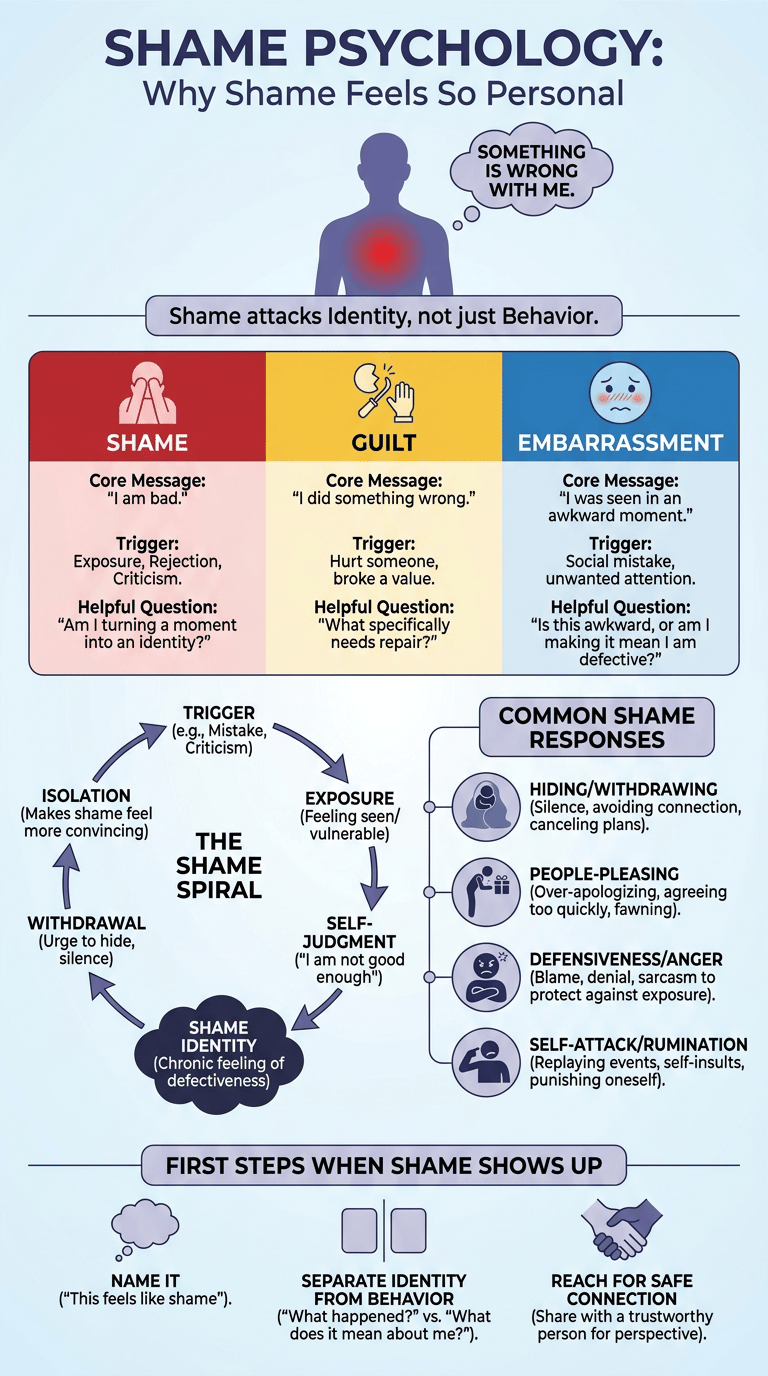
| Emotion | Core message | Common trigger | Helpful next question |
|---|---|---|---|
| Shame | Something is wrong with me. | Exposure, rejection, criticism, humiliation, comparison. | Am I turning a moment into an identity? |
| Guilt | I did something that may need repair. | Breaking a value, hurting someone, failing a responsibility. | What specifically needs repair, if anything? |
| Embarrassment | I was seen in an awkward moment. | Social mistake, visible mishap, unwanted attention. | Is this awkward, or am I making it mean I am defective? |
Shame: I am bad
Shame moves from the event to the self. It does not only notice that something went wrong. It says the wrongness belongs to you as a person. This is why shame can make people feel frozen, small, or unworthy of connection.
For example, after forgetting an important deadline, shame may say, “I am irresponsible.” The real issue may be a missed deadline that needs ownership, but shame turns it into a global identity judgment.
Guilt: I did something wrong
Guilt is usually more behavior-focused. It can be uncomfortable, but it often leaves more room for responsibility. If you forgot the deadline, guilt might say, “I need to acknowledge this, communicate clearly, and prevent it from happening again.”
Guilt can become excessive too, especially when people take responsibility for things they did not control. Still, the central difference matters. Guilt can guide repair. Shame often tells you that repair will not matter because you are the problem.
Embarrassment: I was seen in an awkward moment
Embarrassment is usually tied to social awkwardness or unwanted visibility. You trip, mispronounce a word, send a message to the wrong person, or blush when attention lands on you. It can feel intense, but it is often narrower than shame.
Embarrassment says, “That was awkward.” Shame says, “I am unacceptable.” The difference may sound small, but it changes how long the feeling lasts and how deeply it affects your self-image.
Why confusing these emotions makes shame harder to understand
If you call everything shame, you may miss chances for simple repair. If you call shame “just embarrassment,” you may dismiss a deeper wound. If you call guilt shame, you may punish yourself instead of taking clear responsibility.
A helpful question is: “Is this emotion asking for repair, proportion, or compassion?” Guilt often asks for repair. Embarrassment asks for proportion. Shame often asks you to protect your dignity without accepting a false identity sentence.
Common Shame Responses
People respond to shame in different ways. Some shut down. Some become overly agreeable. Some get defensive. Some attack themselves before anyone else can. These responses may look unrelated from the outside, but they can all be attempts to escape the feeling of being exposed. Repeated hiding may reduce exposure briefly, but it can also deepen the unwanted disconnection described in loneliness psychology.
Hiding or withdrawing
Hiding may look like going quiet, avoiding messages, skipping events, sleeping too much, canceling plans, or keeping secrets. The person may not be trying to be distant. They may be trying not to feel seen.
People-pleasing or over-apologizing
Some people respond to shame by trying to become instantly acceptable again. They apologize repeatedly, explain every detail, offer favors, agree too quickly, or take more blame than belongs to them. The emotional aim is to reduce the risk of rejection.
Defensiveness or anger as shame protection
Shame does not always look soft. It can look angry, dismissive, sarcastic, or argumentative. When being wrong feels unbearable, a person may deny, counterattack, blame, or prove.
Self-attack and rumination
Another common response is self-attack. A person replays the event, insults themselves, imagines what others must think, and tries to punish themselves into being better. It can feel like responsibility, but it often keeps the person stuck.
The Shame Spiral

A shame spiral is the process by which one painful moment expands into a broader sense of defectiveness. The original trigger may be small or serious, but shame adds layers of self-judgment, withdrawal, and isolation until the person feels trapped inside the emotion. When a small present cue reactivates an older belief about being unacceptable, emotional triggers psychology helps explain why the response can feel disproportionate to the visible event.
Trigger, exposure, self-judgment, withdrawal, more isolation
The spiral often moves through a sequence: something happens, you feel exposed, you judge yourself globally, you withdraw, then the isolation makes the shame feel more convincing. The longer you stay alone with the story, the more it can harden into identity.
| Stage | What it may sound like | What helps interrupt it |
|---|---|---|
| Trigger | “I made a mistake.” | Name the specific event without expanding it. |
| Exposure | “Everyone can see what I am.” | Check what is known, imagined, and assumed. |
| Self-judgment | “I am not good enough.” | Separate behavior, circumstance, and identity. |
| Withdrawal | “I should disappear.” | Choose one safe contact or one small grounding action. |
| Isolation | “No one would understand.” | Use language that invites support without oversharing. |
Why shame often grows in silence
Shame thrives when it has no outside perspective. In silence, your mind can replay the worst interpretation without interruption. You may imagine judgment, rejection, disgust, or abandonment, even when the other person has moved on or would respond with care.
Safe connection can reduce shame because it brings reality back into the room. That does not mean you must share everything with everyone. It means shame often softens when a trustworthy person can see the situation without reducing you to it.
How shame can distort memory and self-image
Shame can make memory selective. You may remember the one sentence you said poorly but forget the rest of the conversation. You may remember the facial expression that seemed disappointed but forget the person’s kind follow-up. Shame edits the scene around threat.
Over time, repeated shame can shape self-image. A person may begin to see themselves through old moments of exposure, rejection, or humiliation. A meta-analysis on shame and self-esteem discusses shame as involving painful global evaluations of the self, which helps explain why repeated shame can feel so identity-level.
Everyday Examples of Shame
Shame becomes easier to understand when you can see it in ordinary life. The examples below are not diagnoses. They are common emotional patterns that may help you notice when shame is present and what it may be trying to say.
Shame after making a mistake at work
Situation: You miss a detail in a report, and someone points it out in a meeting. You may feel heat in your face and think, “They all know I am not competent.” What it may mean: the mistake matters, but shame is adding a global identity judgment. What to do next: identify the correction, fix what needs fixing, and avoid turning one error into your whole capability story.
Shame after being rejected
Situation: someone does not return your feelings, a friend stops inviting you, or an opportunity falls through. You may feel disappointed, exposed, and unchosen. What it may mean: rejection can touch belonging and worth. What to do next: let the grief be real without using the rejection as proof that you are undesirable or replaceable.
Shame after emotional vulnerability
Situation: you share something personal and later regret saying so much. You may replay the conversation and wonder whether you sounded needy, dramatic, or weak. What it may mean: vulnerability can activate shame because you allowed yourself to be seen. What to do next: check whether the person responded poorly, or whether shame is reacting to the risk of being known.
Shame after comparing your life to someone else’s
Situation: you see someone buying a home, building a public career, getting married, traveling, or receiving praise. Your own life suddenly feels smaller. What it may mean: comparison can turn desire into defectiveness. What to do next: ask what the envy or sadness reveals about your values without letting another person’s timeline judge your worth.
When Shame Becomes Toxic or Chronic
Not every shame moment is toxic. Sometimes shame is brief, specific, and connected to a situation. It becomes more concerning when it becomes chronic, global, or central to identity. At that point, the person may not only feel shame. They may live as if shame is the truth about them.
The difference between a shame moment and a shame identity
A shame moment says, “I feel exposed because of what happened.” A shame identity says, “I am the kind of person who deserves exposure, rejection, or contempt.” The second one is much heavier and often harder to challenge alone.
One way to tell the difference is duration and scope. A shame moment usually softens when the event is repaired, understood, or put in perspective. A shame identity follows you across situations, even when nothing has gone wrong.
Why chronic shame may need deeper support
Chronic shame may be linked with repeated criticism, rejection, bullying, neglect, family roles, social exclusion, or experiences where a person’s dignity was repeatedly attacked. It may also coexist with anxiety, depression, isolation, or harsh perfectionism, but it should not be turned into a self-diagnosis from one article.
Support can be helpful when shame keeps affecting relationships, work, body image, emotional safety, or daily functioning. Mayo Clinic notes that patterns in thoughts, feelings, or behaviors can help people consider when to seek mental health help, especially when distress affects life and relationships.
How humiliation, bullying, abuse, or neglect can intensify shame patterns
Humiliation is different from ordinary embarrassment because another person may be actively degrading you. If shame is being created through repeated insults, threats, control, ridicule, isolation, or intimidation, the issue is not only an emotion inside you. It may be an unsafe or harmful dynamic around you.
The National Domestic Violence Hotline explains that emotional abuse can involve behaviors that demean, control, or frighten someone. If shame is being used to control you, punish you, or make you afraid to act freely, prioritize safety and support over trying to communicate perfectly.
What to Do First When Shame Shows Up
The first step with shame is not to win an argument against it. A steadier response is to slow the identity leap, name what is happening, and create enough space to choose your next action.
Name shame without arguing with it immediately
Try a simple sentence: “This feels like shame.” That sentence matters because it separates the emotion from the self. You are not saying, “I am shameful.” You are saying, “A shame response is happening.”
You do not have to decide right away whether shame is justified. Naming it creates room between the feeling and the story.
Separate identity from behavior
Ask: “What actually happened?” Then ask: “What is shame saying this means about me?” Those are different questions. The first one looks at facts. The second one reveals the identity judgment.
For example, “I forgot to reply to my friend” is a behavior. “I am a terrible friend” is a shame sentence. The behavior may need repair. The identity sentence needs caution.
Ask what shame is trying to protect
Shame may be trying to protect belonging, dignity, reputation, attachment, competence, or safety. Asking what it is protecting does not mean obeying it. It means listening beneath the self-attack.
You might ask, “Am I afraid of being rejected, exposed, laughed at, misunderstood, or seen as selfish?” The answer can point to the real need under the shame. That need may be repair, reassurance, boundaries, rest, support, or a more accurate interpretation.
Reach for safe connection instead of isolation when possible
Connection does not need to be dramatic. You might text a trusted person: “I feel ashamed about something. I do not need fixing, but I could use a grounded perspective.” Keep the details small until trust feels safe.
If a person tends to mock, shame, pressure, or use your vulnerability against you, they may not be the right person for this moment. The goal is not to confess to anyone available. The goal is to reduce isolation with someone capable of care.
How This Connects to Other Emotion Articles
Shame sits close to several other emotions. Understanding the difference helps you avoid turning every painful feeling into the same issue.
Read guilt when the focus is repair after behavior
If the main question is, “Did I hurt someone, break a promise, cross a value, or fail a responsibility?” guilt may be the more useful lens. Guilt can point toward repair when it stays specific.
Read embarrassment when the focus is awkward social exposure
If the main feeling is, “I was seen doing something awkward,” embarrassment may be the closer emotion. Embarrassment is often about proportion. It asks whether the social moment was truly as serious as it feels.
Embarrassment can become shame when the story changes from “That was awkward” to “I am humiliating as a person.” That shift is worth noticing because it tells you the feeling has moved deeper than the event.
Read emotional triggers when shame feels bigger than the current moment
Sometimes shame is much larger than the present situation can explain. A small correction, joke, delay, or facial expression may activate an old emotional association. That does not mean your reaction is fake. It means the present moment may be carrying extra emotional history.
In those cases, the question is not only, “What happened today?” It is also, “Why did this particular moment touch such a sensitive place?” That is where the emotional trigger lens becomes useful.
When to Get Support
Shame is common, but severe or ongoing shame can become heavy to carry alone. Support is especially important when shame affects your ability to function, connect, make decisions, or feel safe with yourself.
Shame linked to trauma, humiliation, self-harm thoughts, abuse, or severe isolation
Consider reaching out for professional or crisis support if shame is connected with self-harm thoughts, panic, trauma reminders, ongoing humiliation, threats, coercion, stalking, or fear of retaliation. If you are in immediate danger, contact local emergency services or a crisis line available in your area.
If shame comes from another person repeatedly degrading or controlling you, do not treat the situation as a simple communication problem. Safety, privacy, and support matter more than finding the perfect words.
Support options when shame feels impossible to challenge alone
Support might include a therapist, counselor, doctor, crisis service, advocate, trusted friend, support group, or another qualified resource. The right option depends on the level of distress and context.
You do not need to wait until everything is unbearable. If shame keeps isolating you, damaging your relationships, or making you feel unsafe with yourself, that is enough reason to ask for help.
FAQ About Shame Psychology
Is shame always unhealthy?
No. Brief, specific shame can sometimes signal that something matters socially or morally. The problem begins when shame becomes global, chronic, humiliating, or identity-based. Healthy learning says, “I want to act differently.” Harmful shame says, “I am beyond repair.”
Why does shame make me want to hide?
Shame often creates a sense of exposure. Hiding reduces that exposure quickly, so it can feel protective. The downside is that hiding may also keep you alone with the harshest version of the story. Safe connection can help challenge the belief that you must disappear to be acceptable.
Can shame look like anger?
Yes. Some people respond to shame with anger, defensiveness, sarcasm, or blame because the feeling of being exposed is too painful. This does not make hurtful behavior acceptable. It does mean anger sometimes protects a more vulnerable fear of being inadequate, rejected, or seen as wrong.
What is the difference between shame and low self-esteem?
Shame is an emotional state that often appears after exposure, criticism, rejection, or comparison. Low self-esteem is a broader pattern of evaluating yourself negatively. They can influence each other, but they are not identical. A person may have a shame moment without having low self-esteem, and chronic shame can slowly damage self-esteem over time.
Why do I feel shame even when I did nothing wrong?
Shame does not always mean you did something wrong. It can be triggered by rejection, difference, vulnerability, old criticism, social comparison, or someone else’s mistreatment. The better question is not only “Did I do wrong?” but also “What did this moment make me believe about my worth?”
Key Takeaways
Shame is about identity and exposure
- Shame usually feels deeper than embarrassment because it turns a moment into a statement about the self.
- Guilt is more behavior-focused and can guide repair, while shame often says the whole person is unacceptable.
- Common shame responses include hiding, people-pleasing, defensiveness, self-attack, and rumination.
- A shame spiral grows through exposure, global self-judgment, withdrawal, and isolation.
- One useful first step is to name shame, separate facts from identity, and reach for safe connection when possible.
- If shame is tied to abuse, coercion, threats, self-harm thoughts, or severe isolation, outside support is important.
Shame often pushes people toward hiding
Hiding makes sense as a protective response, but it can also keep shame alive. The more alone you are with a shame story, the more convincing it may sound. Even one safe, grounded person can help you remember that a painful moment is not the whole truth about you.
The first step is separating who you are from what happened
The next time shame appears, start with one small distinction: “This is what happened, and this is what shame says it means about me.” That gap matters. It lets you take responsibility where needed without letting one emotion define your entire identity.

Michael Reed is the Founder and Lead Writer at Psychology Exposed. He writes about human behavior, relationships, emotional patterns, self-awareness, and practical psychology topics using research-informed, easy-to-understand content.
Read More About Michael Reed: https://psychologyexposed.com/michael-reed/