
Loneliness can be confusing because it does not always match the facts on the outside. You may have friends, coworkers, family, followers, group chats, or a full calendar, yet still feel emotionally outside the circle. You may sit beside people and still feel unknown. You may receive messages and still feel like nobody really reaches you.
In psychology, loneliness is not simply the state of being physically alone. It is the painful feeling that the connection you need is missing, too thin, unsafe, unavailable, or not mutual. That is why loneliness can hurt in a crowded room, after a social event, inside a relationship, or during a life phase when everyone else appears to be moving forward.
This article explains loneliness as a social pain signal. It will help you separate emotional loneliness from social loneliness, loneliness from depression, and solitude from unwanted disconnection. It is not a dating strategy, a depression diagnosis, or a promise that one perfect conversation will fix everything. The aim is clearer understanding, less self-blame, and a smaller first step toward connection.
Quick Answer
What loneliness means in psychology
APA Dictionary of Psychology defines loneliness as emotional or cognitive discomfort that comes from perceiving yourself as alone or lacking meaningful connection. The key word is perceiving. Loneliness is not only about how many people are around you. It is about whether your relationships feel close, safe, mutual, and emotionally real.
Why loneliness is about perceived disconnection, not just being physically alone
The CDC explains that loneliness involves feeling alone, disconnected, or lacking meaningful relationships and belonging, and notes that even someone with many friends can feel lonely. Social isolation is more objective, meaning fewer relationships, contact, or support. Loneliness is more subjective, meaning your inner experience of connection does not meet your emotional need.
What Loneliness Feels Like
Feeling unseen, unwanted, forgotten, or outside the circle
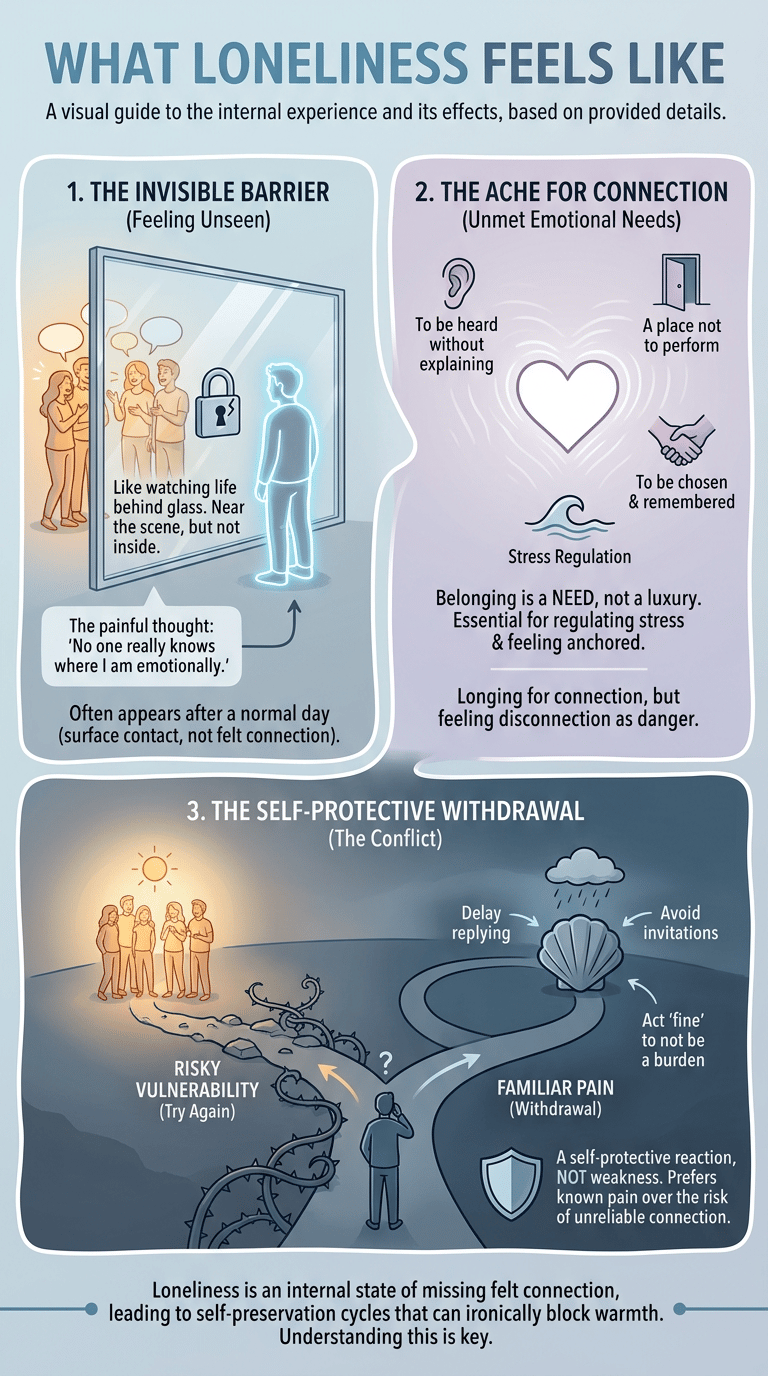
Loneliness often feels like watching life happen behind glass. Other people may be talking, laughing, dating, celebrating, or sharing private jokes, while you feel like you are near the scene but not inside it. The painful thought is not always “I have no one.” Sometimes it is “No one really knows where I am emotionally.”
This is why loneliness can appear after a normal day. You may have exchanged words with people, completed tasks, and replied to messages, but the contact stayed on the surface. The ache comes from missing felt connection, not merely missing sound, activity, or people in the room.
The ache of wanting connection but not feeling it
Loneliness can carry longing, sadness, envy, shame, anxiety, or numbness. You may want someone to check in without being asked. You may want a place where you do not have to perform. You may want to be chosen, remembered, included, or understood without explaining every detail of your inner life.
That need is not childish. Humans are social beings, and belonging is not a luxury emotion. The need for connection helps people regulate stress, make meaning, and feel anchored in the world. When that need is unmet, the mind can interpret disconnection as danger, even when no one is intentionally rejecting you.
Why loneliness can create self-protective withdrawal
Loneliness often creates a strange conflict: you want connection, but reaching out feels risky. A lonely person may delay replying, avoid invitations, cancel plans, or act like they are fine because they fear being a burden. The protective move keeps them from possible rejection, but it also reduces chances for warmth.
This is not weakness. It is a self-protective reaction. If connection has felt unreliable, embarrassing, one-sided, or unsafe, the nervous system may prefer the pain it knows over the vulnerability of trying again.
Why Loneliness Exists
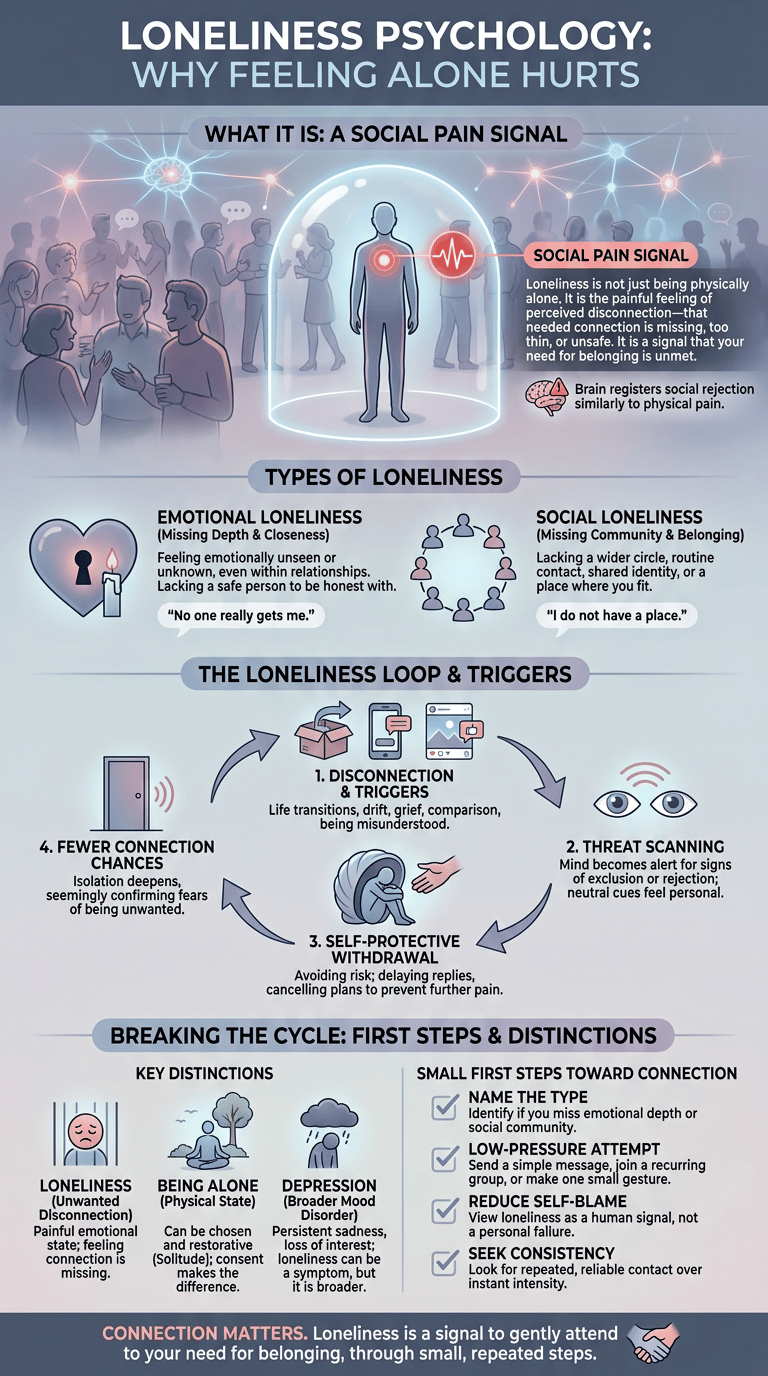
Loneliness as a social pain signal
Physical pain tells you that something needs attention in the body. Loneliness does something similar for social connection. It signals that your need for closeness, belonging, recognition, or emotional safety may not be met. That does not mean every lonely thought is accurate, but the feeling deserves attention. As a signal that meaningful connection is missing, loneliness belongs within the wider system described in emotion psychology.
Research on social rejection has shown that rejection can activate brain regions involved in the distressing experience of physical pain. A PubMed Central study on social rejection and physical pain helps explain why social disconnection can feel bodily, not just mental. Loneliness can sit in the chest, stomach, throat, or shoulders because the body is part of the emotional system.
How the need to belong shapes emotion and behavior
People do not only want contact. They want signs that they matter. A birthday message, a returned call, a seat saved at a table, or a friend remembering something small can feel deeply regulating because it says, “You are included here.”
When belonging feels uncertain, the mind may work harder to read social cues. A short reply may feel like distance. A missed invitation may feel like proof. A friend being busy may feel like abandonment. The social need is real, but the interpretation can become harsher when loneliness is already active.
Why loneliness can make people scan for rejection
Loneliness can put the brain on alert for signs of exclusion. You may notice who did not text, who did not ask a follow-up question, who looked away, or who posted photos without you. This scanning is meant to protect you from social pain, but it can also make neutral signals feel personal.
Classic research indexed in PubMed describes rejection sensitivity as the tendency to anxiously expect, readily perceive, and strongly react to possible rejection. That does not mean a lonely person is “too sensitive.” It means loneliness can change what the mind highlights, especially when past experiences have made disconnection feel familiar.
Emotional Loneliness vs Social Loneliness
Emotional loneliness: missing closeness or being known
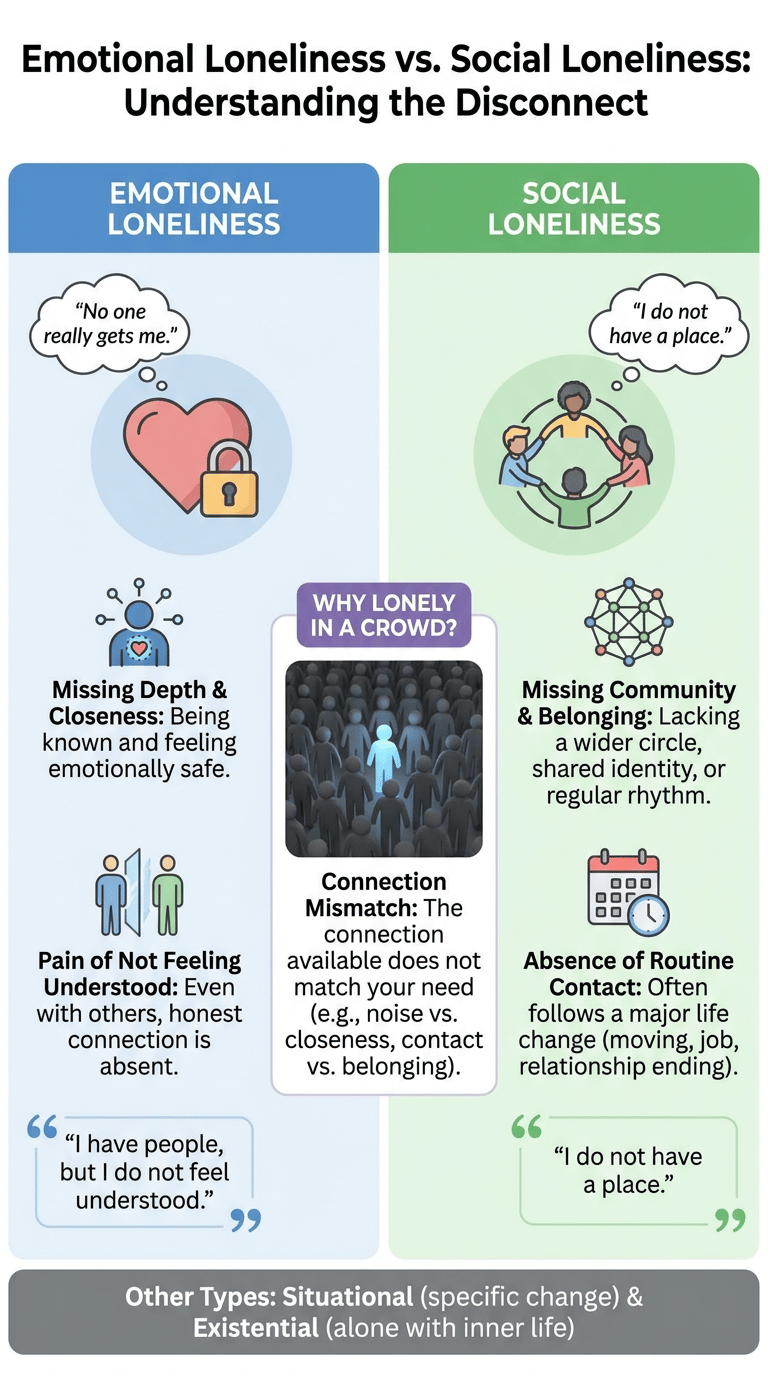
Emotional loneliness is the pain of not feeling deeply known, held in mind, or emotionally close to someone. You may have people to talk to, but no one you feel safe being honest with. You may have a partner, but still feel emotionally alone if the relationship lacks warmth, curiosity, or attunement.
This type of loneliness often sounds like: “I have people, but I do not feel understood.” It is less about the number of contacts and more about the depth of connection.
Social loneliness: missing community, contact, or belonging
Social loneliness is the pain of lacking a wider circle, routine contact, shared identity, or community. You may have one close person but still feel lonely because you do not have a group, a local network, or a place where you naturally belong.
This type of loneliness often appears after moving, leaving school, changing jobs, becoming a parent, ending a relationship, working remotely, or outgrowing a group. The problem is not always emotional intimacy. Sometimes it is the absence of regular social rhythm.
Why someone can feel lonely in a crowd
You can feel lonely around people when the connection does not match what you need. A party may offer noise but not closeness. A work meeting may offer contact but not belonging. A family gathering may offer history but not emotional safety.
| Type of loneliness | What is missing | What it may sound like inside |
|---|---|---|
| Emotional loneliness | Depth, closeness, being known | “No one really gets me.” |
| Social loneliness | Community, routine contact, shared belonging | “I do not have a place.” |
| Situational loneliness | Connection during a specific life change | “Everything shifted, and I have not rebuilt yet.” |
| Existential loneliness | A sense of being alone with your inner life | “Even when people care, they cannot fully enter this with me.” |
Loneliness vs Being Alone vs Depression vs Rejection
Being alone can be chosen and peaceful
Being alone is a circumstance. Loneliness is an unwanted emotional state. Many people need solitude to think, rest, create, pray, recover, or feel like themselves. Solitude can feel peaceful when it is chosen and balanced with enough connection.
The difference is consent. Alone time feels restorative when it matches your need. Loneliness hurts when the distance feels unwanted, imposed, or emotionally empty.
Loneliness is unwanted disconnection
Loneliness says, “I need more meaningful connection than I am experiencing.” That connection may be more honesty, more community, more emotional safety, more shared time, or more mutual effort. The solution is not always “meet more people.” Sometimes it is finding one safer person, one deeper conversation, or one more reliable social rhythm.
Depression can include loneliness but is broader
Depression can involve loneliness, but depression is not the same thing as loneliness. Mayo Clinic describes depression as a mood disorder involving persistent sadness or loss of interest that can affect thoughts, behavior, and daily functioning. Loneliness may be one part of that picture, but depression can also include sleep changes, appetite changes, hopelessness, low energy, loss of pleasure, or thoughts that life is not worth living.
Rejection is a social event that may trigger loneliness
Rejection is something that happens, or feels like it happened. Loneliness is the emotional state that may follow. Not being invited, being ignored, losing a friendship, or feeling unwanted can trigger loneliness, but loneliness can also appear without one clear rejection event.
| Experience | Main difference | Helpful first question |
|---|---|---|
| Being alone | Physical state, which may be chosen | “Do I want solitude or connection right now?” |
| Loneliness | Unwanted perceived disconnection | “What kind of connection is missing?” |
| Depression | Broader mood and functioning concern | “Is this affecting daily life, hope, sleep, energy, or safety?” |
| Rejection | A social event or perceived exclusion | “What happened, and what story did my mind add?” |
Common Loneliness Triggers
Moving, life transitions, or outgrowing a group
Loneliness often increases when a familiar social structure disappears. Moving cities, changing jobs, graduating, becoming a caregiver, leaving a religious community, ending a relationship, or shifting into remote work can remove the repeated contact that used to create belonging. When exclusion cues repeatedly activate an intense response, emotional triggers psychology can explain why present disconnection carries older emotional meaning.
Outgrowing a group can be just as lonely as losing one. You may still care about people, but the old conversations no longer fit. The ache comes from standing between who you were and who you are becoming.
Friendship drift or lack of depth
Friendship drift can feel painful because there may be no dramatic ending. People simply text less, cancel more, forget details, or stop making space. The absence is quiet, which can make it harder to name. When distance is interpreted as being replaced in a valued bond, jealousy psychology may help name the fear without turning the article into a relationship dispute.
A lack of depth can hurt even when a friendship is active. You may joke, share updates, or meet for coffee, but never talk about what truly matters. That can leave you socially busy and emotionally hungry.
Grief, breakup, or emotional distance
Grief can create loneliness because one specific person, role, routine, or future is missing. A breakup can do the same, even when the relationship was not fully healthy. The loss is not only the person; it is the pattern of being someone to someone.
Emotional distance inside a relationship can also be lonely. You may live with someone, sleep beside someone, or speak daily, but still feel alone if your inner world is not met with care.
Social media comparison and feeling left behind
Social media can intensify loneliness because it shows connection without context. You see dinners, trips, weddings, friend groups, milestones, and inside jokes, but not the tension, boredom, loneliness, or effort behind the image. The comparison can also evoke envy when other people seem to have the belonging you want.
This is where loneliness can overlap with envy. The feeling may not only be “I want what they have.” It may also be “Why does everyone seem included somewhere but me?”
Being misunderstood in close relationships
Few things feel lonelier than trying to explain something important and feeling misunderstood by someone close. If your feelings are minimized, fixed too quickly, mocked, ignored, or turned into a debate, you may stop sharing. The relationship continues, but emotional access narrows.
This does not mean every misunderstanding is emotional harm. People miss each other sometimes. But repeated misunderstanding can create a private loneliness where you feel you must edit yourself to stay connected.
The Loneliness Loop
Disconnection, threat scanning, withdrawal, fewer connection chances
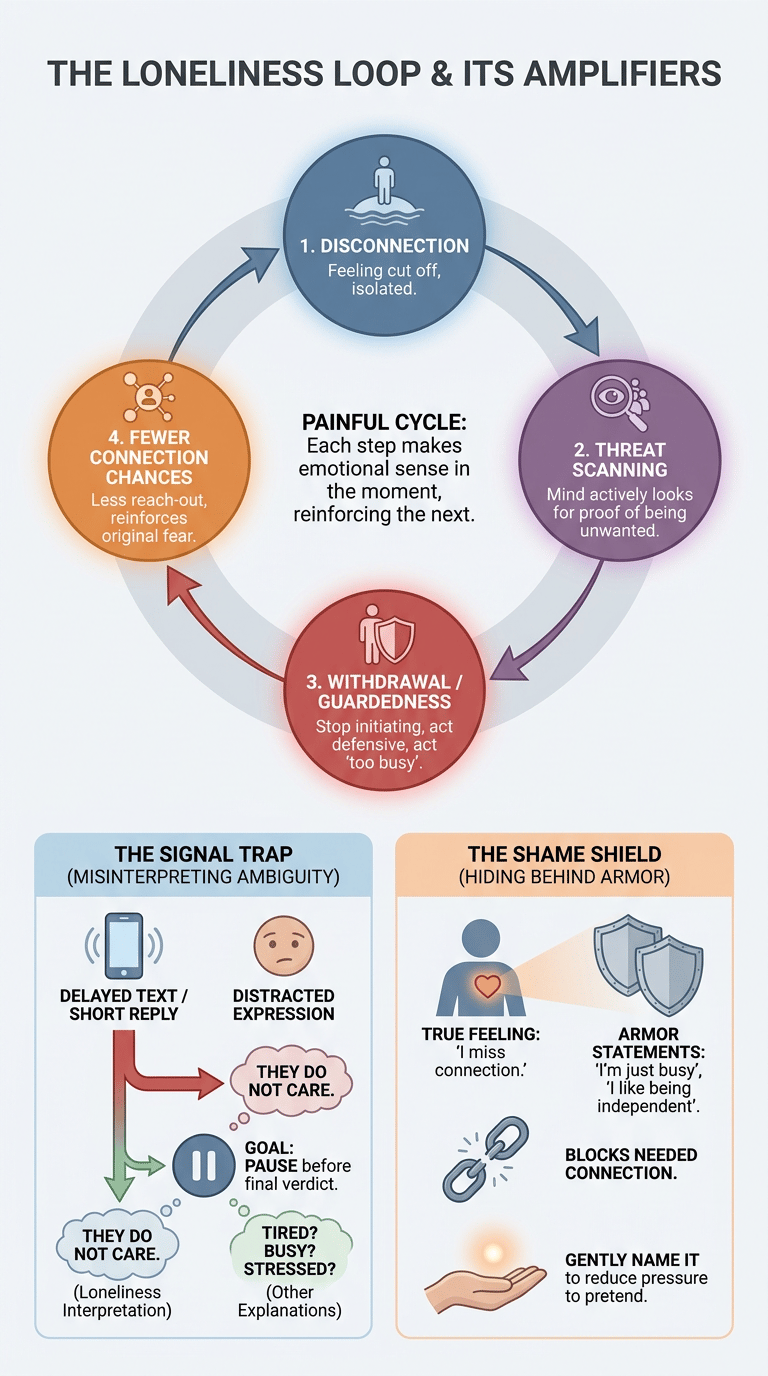
Loneliness can become a loop. First, you feel disconnected. Then your mind scans for proof that you are unwanted. Then you withdraw, act guarded, or stop initiating. Then fewer people reach you, which seems to confirm the original fear. If withdrawal is driven by the belief that the self is unacceptable, shame psychology helps identify the self-judgment reinforcing the loop.
This loop is painful because each step makes emotional sense in the moment. If you feel unwanted, it feels safer not to try. If you do not try, connection has less chance to happen. If connection does not happen, loneliness gets louder.
Why loneliness can make neutral signals feel rejecting
A delayed text, a distracted facial expression, or a short reply may have many explanations. The person could be tired, busy, stressed, or simply not expressive. But loneliness may read the cue as: “They do not care.”
That interpretation is understandable, but not always complete. The goal is not to shame yourself for feeling sensitive. The goal is to pause before treating every ambiguous signal as a final verdict.
Why shame can make loneliness harder to admit
Loneliness often carries shame because people fear it means they are undesirable, boring, needy, or socially behind. That shame can make loneliness more private. Instead of saying, “I miss connection,” a person may say, “I am just busy,” “I like being independent,” or “I do not care.”
Sometimes those statements are true. But when they become armor, they can block the very connection the person needs. Naming loneliness gently can reduce the pressure to pretend.
What Loneliness May Be Telling You
You may need deeper connection, not just more contact
If you feel lonely despite being around people, your need may be depth rather than quantity. More plans may not help if every conversation stays safe, polished, or performative. You may need one relationship where you can be more honest.
A helpful question is: “Where do I have contact, and where do I have closeness?” The answer can show whether the gap is social access, emotional intimacy, or both.
You may need belonging, recognition, or emotional safety
Loneliness can point to different needs. Belonging says, “I need a place where I fit.” Recognition says, “I need someone to notice my effort, pain, or presence.” Emotional safety says, “I need connection where I am not punished for being honest.”
These needs ask for different next steps. Belonging may need community. Recognition may need clearer expression. Emotional safety may need more careful choice about who gets access to vulnerable parts of you.
You may need a smaller first step rather than a complete life change
Loneliness can make the whole life feel wrong. But the first step does not have to be a complete social rebuild. Often it is one small repeatable action: texting one person, joining one recurring group, walking somewhere familiar, returning one call, or asking one more honest question.
Small steps matter because connection usually grows through repeated signals, not one dramatic moment. A tiny action done consistently can become a doorway.
First Steps When Loneliness Shows Up
Name the type of loneliness you are feeling
Before you try to fix loneliness, name what kind it is. Are you missing emotional closeness, regular contact, shared community, physical presence, or a sense of being understood? A clear name prevents you from using the wrong solution.
- If you miss depth, choose one person and share one honest sentence.
- If you miss community, look for recurring contact rather than one-time events.
- If you miss being understood, practice naming the specific feeling or need.
- If you miss safety, choose people who have shown consistency, not just intensity.
Choose one low-pressure connection attempt
Loneliness often asks for a step that is simple enough to actually do. A low-pressure attempt could be: “I was thinking of you today,” “Want to catch up this week?” or “I have been a little quiet lately, but I would like to reconnect.”
Do not make the first step a full confession if that feels too exposed. Connection can begin with a small bridge.
Reduce self-blame before reaching out
Self-blame makes reaching out harder. If the story is “No one cares because I am not worth caring about,” every message feels like a test of your worth. Try changing the frame to: “I am lonely, and loneliness is asking for connection.”
That shift does not magically remove the pain, but it makes the next action less humiliating. You are responding to a human need, not proving a personal failure.
Look for consistency, not instant closeness
Instant closeness can feel comforting, but consistent connection is often more stabilizing. Look for people and places that allow repeated, low-pressure contact: a class, a walk with a neighbor, a weekly call, a hobby group, a support group, or a shared project.
The CDC notes that social isolation and loneliness can affect health, which is one reason small connection habits are worth taking seriously. The point is not to force yourself into constant social activity. The point is to build enough meaningful contact that your system does not have to carry disconnection alone.
How This Connects to Other Emotion Articles
Read envy when loneliness is intensified by comparing your life to others
If your loneliness gets sharper when you see someone else’s friendships, relationship, family, career, or social life, envy may be part of the picture. The pain may include both disconnection and comparison: “They have the belonging I want.”
Read jealousy when loneliness comes from fear of being replaced
If loneliness appears when someone important gives attention to someone else, jealousy may be involved. The emotional center is not only absence. It is threat: “I may be losing my place.”
Read shame when loneliness turns into I am unlovable
Loneliness becomes heavier when it turns into an identity story. “I feel disconnected” becomes “I am unwanted.” “I need closeness” becomes “I am too much.” That is where shame may need attention.
Read emotional triggers when loneliness feels sudden and old
Sometimes loneliness arrives with an intensity that seems bigger than the current moment. A small delay, a brief silence, or a minor exclusion can bring up an old emotional state. In that case, the issue may be both loneliness and an emotional trigger.
When to Get Support
Loneliness with depression symptoms, hopelessness, self-harm thoughts, severe isolation, or unsafe relationships
Consider extra support if loneliness comes with persistent hopelessness, loss of interest, major sleep or appetite changes, panic, self-harm thoughts, or the feeling that life is not worth living. Also consider support if loneliness is connected to coercion, threats, stalking, humiliation, retaliation, or being isolated by someone else.
This article is educational and cannot tell you whether you have a mental health condition. But loneliness that affects safety, daily functioning, or hope deserves more than self-help pressure. A mental health professional, crisis line, doctor, trusted person, or local support service may be an important next step depending on what is happening.
Why support can matter when loneliness becomes chronic
Chronic loneliness can change how people interpret social cues, how much energy they have to initiate, and how safe connection feels. Support can help separate real social needs from self-attacking stories and can help you rebuild connection in a way that fits your life.
The NCBI Bookshelf overview on loneliness and social isolation describes loneliness as a subjective experience of lacking desired interaction, while social isolation is more objective. That distinction matters because support may need to address both the outer structure of connection and the inner experience of feeling connected.
FAQ About Loneliness Psychology
Why do I feel lonely even with friends?
You can feel lonely with friends if the connection lacks depth, emotional safety, consistency, or mutual understanding. Having people around you is not the same as feeling known by them. Sometimes the next step is not adding more people, but gently increasing honesty with one trustworthy person.
Is loneliness the same as being alone?
No. Being alone is a physical state. Loneliness is the unwanted feeling of disconnection. Some people feel peaceful when alone because solitude is chosen and restorative. Others feel lonely around people because the contact does not meet their need for closeness or belonging.
Can loneliness make me more sensitive to rejection?
Yes, it can. When you already feel disconnected, your mind may scan for signs that you are unwanted or excluded. This can make neutral cues feel rejecting. That does not mean your feelings are fake, but it does mean it helps to pause before treating every ambiguous cue as proof.
Why is loneliness hard to admit?
Loneliness can feel embarrassing because many people fear it says something negative about their worth. They may worry they will seem needy, unpopular, or behind in life. Naming loneliness as a human signal, rather than a personal failure, can make it easier to respond with care.
What is the first step when loneliness feels overwhelming?
Start by naming what kind of connection is missing. Then choose one low-pressure action that does not depend on a perfect response: send a simple message, join a recurring space, step outside, or tell a trusted person, “I have been feeling disconnected lately.” If loneliness includes hopelessness or self-harm thoughts, seek immediate support from a qualified professional or crisis resource.
Key Takeaways
Loneliness is a social pain signal
- Loneliness points to a gap between the connection you need and the connection you feel.
- It is not only about being physically alone. It is about perceived closeness, belonging, and emotional safety.
- Emotional loneliness is about missing depth. Social loneliness is about missing community or regular contact.
- Loneliness can make neutral cues feel rejecting, which can lead to withdrawal and fewer chances for connection.
- A useful first step is to name the type of loneliness, then choose one low-pressure connection attempt.
- Support matters if loneliness becomes chronic, unsafe, tied to hopelessness, or connected to self-harm thoughts.
More people around you does not always mean more connection
Being surrounded by people may reduce silence, but it does not automatically create belonging. Loneliness often softens when contact becomes more honest, safe, consistent, and mutual.
Understanding the type of loneliness helps you choose a better next step
If you need depth, look for one honest conversation. If you need community, look for repeated contact. If you need emotional safety, choose people who have shown care over time. Loneliness does not mean you are failing. It means connection matters, and some part of you is asking not to be left alone with the ache.

Michael Reed is the Founder and Lead Writer at Psychology Exposed. He writes about human behavior, relationships, emotional patterns, self-awareness, and practical psychology topics using research-informed, easy-to-understand content.
Read More About Michael Reed: https://psychologyexposed.com/michael-reed/