
Embarrassment can make a small moment feel enormous. You stumble over a sentence, send the wrong message, forget a name, blush when attention turns toward you, or realize that people saw something you wish they had missed. The event may last five seconds, but your mind can replay it for hours.

In psychology, embarrassment is usually understood as a self-conscious social emotion. It is not just “feeling awkward.” It often appears when you believe you have been seen in a way that breaks a social expectation, exposes a private detail, or makes you look less composed than you wanted to look.
The key point is that embarrassment is not the same as shame, guilt, humiliation, or social anxiety. It may overlap with those experiences, but its core is different: embarrassment is usually about awkward exposure. Understanding that difference can help you respond with proportion instead of treating every awkward moment as proof that something is wrong with you.
Quick Answer
Embarrassment psychology explains why awkward social exposure can feel so intense, even when the actual mistake is small. Embarrassment often involves self-awareness, imagined judgment, body signals such as blushing, and a desire to hide or repair the moment. It is usually about being seen awkwardly, not necessarily being a bad person or causing harm.
What embarrassment means in psychology
The APA Dictionary of Psychology describes embarrassment as a self-conscious emotion connected with awkwardness, discomfort, or confusion in social situations. That matters because embarrassment needs a sense of the self being viewed, or at least imagined, by other people.
You can feel embarrassed even when no one actually cares very much. What matters is the felt exposure: “I was seen,” “I looked awkward,” “I violated a norm,” or “I revealed something I meant to keep private.”
Why embarrassment is linked to being seen and judged
Embarrassment often depends on an audience, even a tiny one. The audience may be a room full of people, one coworker, a stranger, a friend, or an imagined group in your mind. The emotion becomes stronger when you believe others have noticed the moment and formed an opinion about you.
This is why private mistakes can feel irritating, while public mistakes feel exposing. Dropping a glass alone in your kitchen may be annoying. Dropping one during a quiet dinner may feel embarrassing because the mistake becomes visible.
What Embarrassment Feels Like
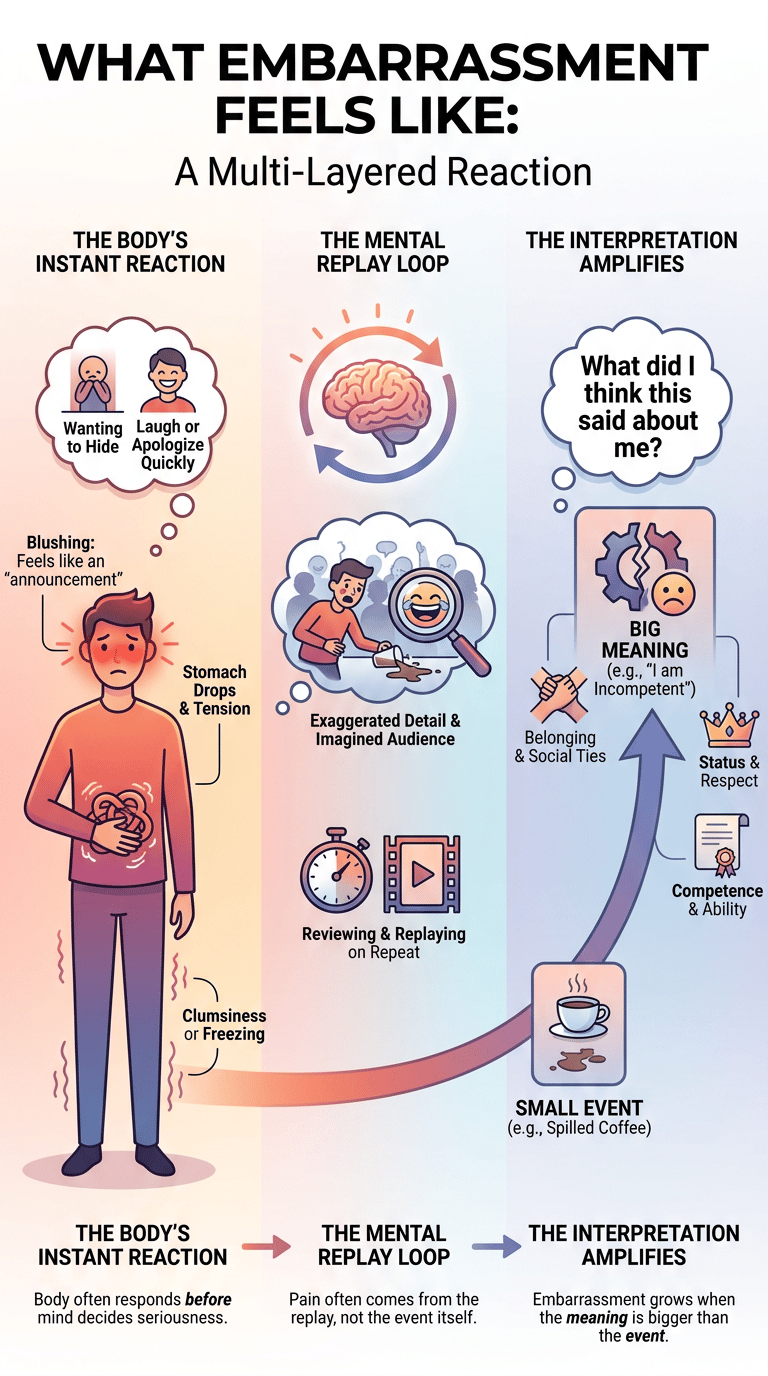
Embarrassment is not only a thought. It can be a body reaction, a mental replay, and a social impulse all at once. The body may react before your mind has finished deciding how serious the moment actually was.
Heat, blushing, freezing, laughing, or wanting to hide
Many people notice embarrassment first in the body. Their face gets hot, their stomach drops, their voice changes, or they suddenly feel clumsy. Some people laugh, apologize quickly, or make a joke. Others freeze and hope the moment passes without more attention.
Blushing can be especially frustrating because it feels like the body is announcing the emotion. The more you want to look calm, the more noticeable the heat can feel. That does not mean everyone is judging you. It means your body is responding to social exposure.
The mental replay of everyone noticed
After an embarrassing moment, the mind often tries to review the event. It checks what happened, who saw it, how they reacted, and what it might mean. This replay can feel like problem-solving, but it can easily become exaggerated.
The most painful part is often not the mistake itself. It is the imagined audience in your head, watching the moment again and again. You may remember one person’s facial expression, a silence, or a laugh, then treat that detail as proof that the moment was worse than it was.
Why embarrassment can feel bigger than the actual event
Embarrassment grows when the meaning attached to the event becomes larger than the event itself. “I spilled coffee” becomes “I looked incompetent.” “I forgot a name” becomes “I am socially terrible.” “I blushed” becomes “now everyone knows I am nervous.”
The emotional size of embarrassment often comes from interpretation. A small event can feel large when it touches belonging, respect, attraction, competence, or status. The question is not only “What happened?” It is also “What did I think this said about me?”
Why Embarrassment Exists
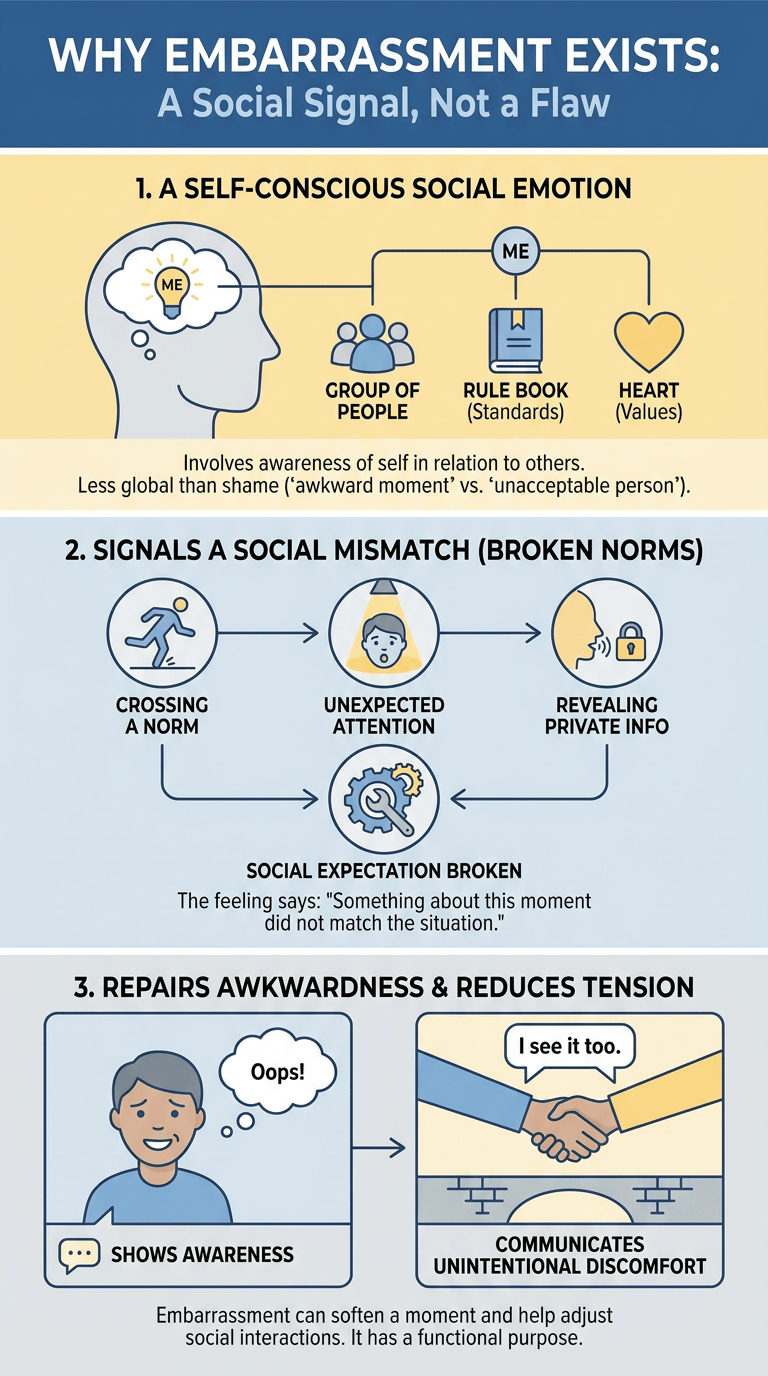
Embarrassment can be uncomfortable, but it is not useless. Like many emotions, it carries social information. It may tell you that you crossed a norm, drew unexpected attention, revealed something private, or care about how you are perceived. Its social function is one example of how emotion psychology links meaning, body response, and behavior.
Embarrassment as a self-conscious social emotion
Self-conscious emotions involve some awareness of the self. Embarrassment, shame, guilt, and pride all involve a sense of “me” in relation to standards, values, or other people. A review on self-conscious emotions in PubMed Central discusses shame, guilt, embarrassment, and pride as emotions connected with self-evaluation and social meaning.
Embarrassment tends to be less global than shame. It often says, “That moment looked awkward,” not “I am fundamentally unacceptable.” When those two meanings blur, embarrassment can become much heavier.
How embarrassment can signal awareness of social norms
Embarrassment often appears when a social expectation is broken. You interrupt someone, misread a joke, trip in front of others, wear the wrong thing, or reveal a private detail by accident. The feeling says, “Something about this moment did not match the social situation.”
That signal can help people adjust. A short laugh, a quick correction, or a simple apology can show that you noticed the mismatch. In many everyday situations, that is enough.
Why showing embarrassment can sometimes repair social awkwardness
Embarrassment can communicate that you did not mean to create discomfort. A sheepish smile, a brief “Sorry, that came out wrong,” or a light correction can reduce tension because it shows awareness. It tells others, “I see the awkwardness too.”
This does not mean you need to perform embarrassment to be liked. It simply means the emotion can have a social function. It can soften a moment when something awkward happens and nobody knows how to respond.
Embarrassment vs Shame vs Guilt vs Humiliation

These emotions can feel similar because they all involve discomfort about the self in a social or moral context. Still, they point to different meanings. Mixing them together can make an awkward moment feel more damaging than it needs to be. If the moment becomes a judgment about the entire self, shame psychology may be the better frame; if the central issue is responsibility for harm, guilt psychology is more precise.
| Emotion | Core meaning | Common impulse | Useful first question |
|---|---|---|---|
| Embarrassment | I was seen in an awkward moment. | Hide, laugh, correct, or move on. | Was this awkward, or am I making it personal? |
| Shame | I feel exposed as defective or unacceptable. | Withdraw, attack the self, or disappear. | Am I turning a moment into an identity judgment? |
| Guilt | I may have caused harm or violated a value. | Repair, apologize, or change behavior. | Is there actual harm that needs repair? |
| Humiliation | I feel degraded, mocked, or put down by others. | Protect, leave, seek support, or set limits. | Was someone using the moment to shame or control me? |
Embarrassment: I was seen in an awkward moment
Embarrassment is usually event-based. Something happened, and you believe it made you look awkward, unprepared, clumsy, exposed, or socially out of sync. The feeling may be sharp, but it often fades when the moment is placed back in proportion.
A useful phrase is: “That was awkward, not defining.” This phrase does not erase the discomfort. It keeps the discomfort from becoming a verdict on your whole self.
Shame: I feel exposed as defective
Shame goes deeper than awkwardness. The APA Dictionary of Psychology defines shame as a painful self-conscious emotion often linked with feeling dishonorable, improper, or exposed in one’s conduct or circumstances. Shame can make a person want to hide not just from the moment, but from being seen at all.
Embarrassment can turn into shame when the thought changes from “I did something awkward” to “I am embarrassing.” That shift matters. The first is about an event. The second attacks identity.
Guilt: I may have caused harm
Guilt is usually more connected to responsibility and repair. If you accidentally reveal someone’s private information, you may feel embarrassed because people saw the mistake, and guilty because someone may have been hurt.
The repair question belongs to guilt: “Did I cause harm, and what would help now?” Embarrassment does not always require repair. Sometimes it only requires a breath and a return to the moment.
Humiliation: I feel degraded or put down by others
Humiliation is different because it often involves being lowered, mocked, exposed, or treated as less worthy by someone else. A person can feel embarrassed after a harmless awkward moment, but humiliated when another person uses that moment to degrade them.
If embarrassment comes from repeated mocking, public shaming, intimidation, or control, the issue may no longer be simple awkwardness. The National Domestic Violence Hotline explains emotional abuse in terms that include behaviors meant to undermine, control, or frighten a person. Safety and support matter more than trying to be less embarrassed in that kind of situation.
Common Embarrassment Triggers
Embarrassment triggers vary from person to person, but many involve visibility. The stronger your wish to appear competent, composed, attractive, respectful, or accepted in that setting, the more exposed the mistake can feel. When a familiar setting or social cue produces a reaction much larger than the present event, emotional triggers psychology can help explain the learned association.
Making a visible mistake
Visible mistakes are classic embarrassment triggers: tripping, dropping something, mispronouncing a word, forgetting your train of thought, or clicking the wrong button during a meeting. The mistake becomes embarrassing because it happens in view of others.
What you may feel: heat, panic, a rushed apology, or the urge to leave. What it may mean: your nervous system registered unexpected attention. What to do next: make a simple correction, then resist turning the moment into a full character judgment.
Saying something awkward
Social awkwardness can sting because words feel tied to intelligence and belonging. You may make a joke that lands badly, answer too quickly, overshare, misunderstand the topic, or realize your tone sounded different than intended.
What you may feel: a sudden wish to rewind. What it may mean: you care about how the interaction affected others. What to do next: correct the meaning if needed. A short “I said that clumsily” is often better than over-explaining for ten minutes.
Being corrected in public
Public correction can feel embarrassing even when the correction is fair. The pain often comes from being seen as wrong, not only from the content of the correction. A person may feel exposed, especially in a classroom, workplace, family gathering, or group chat.
What you may feel: defensiveness, heat, silence, or a forced smile. What it may mean: your status or competence felt threatened. What to do next: take in the correction first, then decide later whether the way it was delivered also needs a boundary.
Physical mishaps, blushing, or body sounds
Embarrassment often appears when the body does something you cannot fully control. Blushing, stomach noises, sweating, voice cracks, stumbling, or spilling food can feel exposing because they interrupt the image of control.
What you may feel: a wish to hide the body itself. What it may mean: your body reacted under attention or pressure. What to do next: treat the body like a body, not a personal failure. Most people have had moments like this, even if they do not advertise them.
Receiving unexpected attention
Embarrassment is not always caused by mistakes. Praise, compliments, birthday attention, being singled out in a meeting, or having everyone turn toward you can also create embarrassment. The emotion comes from sudden visibility.
What you may feel: awkward gratitude, nervous laughter, or the need to deflect. What it may mean: attention arrived faster than your comfort level. What to do next: use a simple response, such as “Thank you, I appreciate that,” without needing to disappear from the moment.
Why We Replay Embarrassing Moments
The replay loop after embarrassment can be more painful than the original event. The mind tries to protect your social standing by studying what happened. The problem is that review can become rumination when it repeats without giving you new information.
The spotlight effect and overestimating how much others noticed
One reason embarrassment lingers is the spotlight effect. In the original spotlight effect research indexed in PubMed, people tended to overestimate how much others noticed their appearance or actions. That finding matches a common embarrassment experience: the moment feels brighter in your mind than it likely looked to everyone else.
This does not mean nobody noticed. It means people are often more occupied with themselves than your embarrassed mind assumes. The event may be one of the biggest moments in your day, while for another person it may be a passing detail.
Why memory becomes sticky when emotion is high
Embarrassing moments often stick because emotion tells the brain, “This matters.” The memory may keep returning because your mind wants to prevent the same exposure from happening again. That protective intent can become exhausting when it keeps replaying a harmless event.
A helpful question is: “Is this replay giving me new information, or is it only making the feeling louder?” If the answer is only louder, the next step is not more analysis. It is returning attention to the present and choosing proportion.
How embarrassment can turn into shame if the meaning becomes personal
Embarrassment becomes heavier when it turns into a story about identity. “I had an awkward moment” becomes “I am awkward.” “I sounded nervous” becomes “I am pathetic.” “They laughed” becomes “I am not respected.”
That is the bridge from embarrassment to shame. The event may still be small, but the meaning becomes global. Noticing that shift early helps you challenge the identity story before it hardens.
Embarrassment in Everyday Examples
Real examples make embarrassment easier to understand because the same emotion can come from very different situations. In each example, the event matters less than the meaning the person attaches to being seen.
Tripping in public
Situation: You trip while walking into a room, and several people look up. You may feel heat in your face and a sudden wish to move faster, laugh, or pretend it did not happen.
What it may mean: the body made you visible before you were ready. What to do next: regain balance, check that you are physically okay, and let the moment be ordinary. A stumble does not require an identity review.
Sending the wrong message
Situation: You send a message to the wrong person or drop a typo into an important chat. You may feel embarrassed because the mistake is visible and saved in writing.
What it may mean: you fear being seen as careless, unprofessional, or exposed. What to do next: correct the message plainly. If no harm was done, avoid turning a small digital mistake into proof that you are incompetent.
Forgetting someone’s name
Situation: You recognize a person but cannot remember their name. The pause feels too long, and your mind starts calculating whether they noticed.
What it may mean: you care about respect and connection. What to do next: use a direct repair, such as “I remember our conversation, but I’m blanking on your name.” Most people have been on both sides of that moment.
Being praised when you did not expect attention
Situation: Someone compliments you in a group, and everyone looks at you. You may smile, deflect, or feel awkward even though the attention is positive.
What it may mean: being seen still feels exposing, even when the message is kind. What to do next: practice receiving without disappearing. A short thank you can be enough.
What to Do First After an Embarrassing Moment
The first goal is not to erase embarrassment. The goal is to keep the moment in proportion so it does not become shame, rumination, or avoidance. You do not need a complicated strategy for every awkward moment.
Let the body settle before rewriting the story
Embarrassment can create a rush of heat and urgency. During that rush, the mind may make dramatic interpretations. Give the body a little time before deciding what the event means.
Try a simple reset: breathe slowly, relax your jaw, feel your feet, and name the emotion: “I am embarrassed right now.” Naming the emotion does not make it vanish, but it can stop the mind from treating it as an emergency.
Separate what happened from what you imagine others think
Write the event in plain language, without interpretation. “I mispronounced a word.” “I blushed when asked a question.” “I sent a message with a typo.” Then write the story your mind added: “Everyone thinks I am foolish.”
This separation is powerful because embarrassment often hides inside imagined judgment. You may not be able to know what others thought. You can know what actually happened.
Use proportion: awkward does not mean catastrophic
Ask: “How would I judge another person if they did this?” Most people are kinder toward others than toward themselves. You might notice another person’s awkward moment, then forget it quickly or feel sympathetic.
Proportion does not mean pretending the moment felt fine. It means refusing to treat discomfort as evidence of disaster. Awkward moments are part of social life, not proof that you should withdraw from it.
Repair lightly if repair is actually needed
Some embarrassing moments need a small repair. If you interrupted someone, use “Sorry, go ahead.” If you said something unclearly, use “Let me say that better.” If you made a mistake in a message, send the correction.
Other moments need no repair. They only need continuation. Over-apologizing can sometimes keep the spotlight on the moment longer than necessary. A light repair works best when the problem is light.
How This Connects to Other Emotion Articles
Embarrassment sits close to several other emotions in the broader emotion psychology cluster. Knowing which emotion is actually present helps you choose the right next step.
Read shame when embarrassment becomes I am defective
If the awkward moment turns into a belief that you are unworthy, disgusting, unacceptable, or fundamentally flawed, shame may be the stronger emotion. Shame needs a different kind of response because it attacks identity rather than one event.
The bridge question is: “Am I upset about what happened, or am I using what happened to judge who I am?”
Read guilt when the event involved actual harm
If someone was hurt, disrespected, exposed, or inconvenienced by what happened, guilt may be present along with embarrassment. The repair question becomes more important than the image question.
The bridge question is: “Is there someone I need to repair with, or am I mainly trying to escape feeling awkward?”
Read emotional triggers when embarrassment feels unusually intense or old
Sometimes embarrassment feels much bigger than the current situation. A mild correction feels like humiliation. A small mistake brings back memories of being mocked. A blush feels unbearable because it reminds you of earlier exposure.
The bridge question is: “Does this reaction fit only this moment, or does it feel connected to older experiences?” If it feels older, emotional triggers may be part of the story.
When to Get Support
Embarrassment is common, but it deserves support when it begins to shrink your life. Support does not mean the feeling is strange or shameful. It means you do not have to keep handling the pattern alone.
When fear of embarrassment leads to avoidance, panic, isolation, or severe distress
If fear of embarrassment keeps you from work, school, friendships, dating, speaking, eating around others, or normal daily activities, consider talking with a qualified mental health professional. Cleveland Clinic notes that social anxiety disorder can involve fear of negative judgment and avoidance of social situations, but only a qualified professional can assess whether that fits your situation.
Occasional embarrassment is not the same as social anxiety disorder. The concern rises when fear and avoidance become persistent, intense, and limiting.
When embarrassment is connected to bullying, humiliation, harassment, or abuse
If someone repeatedly uses embarrassment to control you, silence you, mock you, expose you, or make you afraid of consequences, the priority is safety and support. Communication tips are not enough when humiliation is part of a pattern of intimidation or coercion.
Consider reaching out to trusted people, a counselor, workplace or school support, or a safety organization if you feel afraid, trapped, threatened, stalked, or at risk of retaliation. You do not have to prove that the situation is “bad enough” before asking for help.
FAQ About Embarrassment Psychology
These questions focus on embarrassment as an everyday emotional experience, not on diagnosis. If embarrassment is severe, persistent, or connected to safety concerns, individualized support is the better next step.
Why do I blush when embarrassed?
Blushing is a body response linked with social exposure and self-consciousness. It can feel frustrating because it makes the emotion visible. The fact that you blush does not mean you did something wrong. It usually means your nervous system registered attention, judgment, or awkwardness.
Why do I remember embarrassing moments for years?
Embarrassing memories can stick because they carry emotional intensity and social meaning. Your mind may store them as warnings: “Do not let this happen again.” The memory lasting a long time does not prove the event was as important to other people as it feels to you.
Is embarrassment the same as social anxiety?
No. Embarrassment is a common emotion that can happen to anyone after awkward exposure. Social anxiety is more persistent and can involve strong fear of judgment, avoidance, and distress across situations. Frequent embarrassment may be part of social anxiety for some people, but embarrassment alone is not a diagnosis.
Why do small mistakes feel so humiliating?
A small mistake can feel humiliating if it touches a deeper fear about being judged, laughed at, rejected, or seen as incompetent. It can also feel humiliating if someone else uses the mistake to mock or degrade you. The difference is important because a private emotional reaction needs proportion, while repeated public degrading may need boundaries or support.
Can embarrassment be socially useful?
Yes, in small doses. Embarrassment can show that you noticed an awkward moment and did not intend harm. It can help smooth social interactions after a minor mistake. The problem is not embarrassment itself. The problem is when it becomes shame, rumination, avoidance, or a tool other people use against you.
Key Takeaways
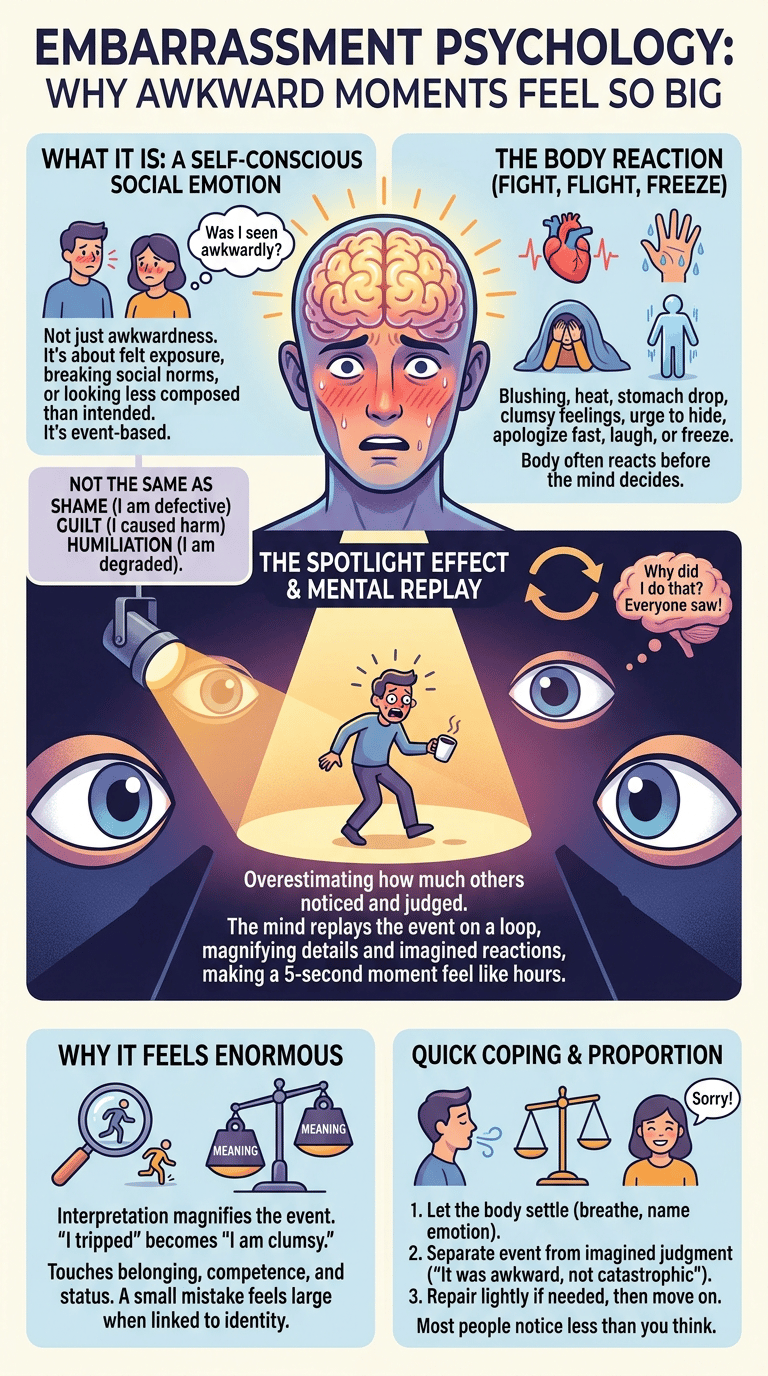
- Embarrassment is usually about being seen in an awkward, exposed, or socially out-of-sync moment.
- It differs from shame because shame attacks identity, while embarrassment usually centers on a specific event.
- It differs from guilt because guilt asks whether repair is needed after harm, while embarrassment often asks whether others noticed.
- The spotlight effect can make you overestimate how much other people noticed or remembered the moment.
- A light repair is useful when repair is actually needed, but many embarrassing moments only need proportion and continuation.
- Support is worth considering when fear of embarrassment leads to avoidance, severe distress, or unsafe dynamics involving humiliation or control.
Final Thoughts
The next time embarrassment shows up, try naming the exact event before judging yourself. “I stumbled over my words” is different from “I am terrible with people.” “I blushed” is different from “Everyone thinks I am weak.” The more specific you are, the less room shame has to take over.
Embarrassment is uncomfortable because belonging matters. That does not make the embarrassed story automatically true. Let the body settle, separate the event from the imagined judgment, repair lightly if needed, and allow the moment to become one human moment among many.

Michael Reed is the Founder and Lead Writer at Psychology Exposed. He writes about human behavior, relationships, emotional patterns, self-awareness, and practical psychology topics using research-informed, easy-to-understand content.
Read More About Michael Reed: https://psychologyexposed.com/michael-reed/