
An emotional trigger can make a small moment feel strangely large. A tone of voice, a delay in a reply, a look on someone’s face, a joke, a criticism, a certain place, or even a date on the calendar can pull a strong feeling to the surface before you have had time to think clearly.
That reaction can be confusing. Part of you may know the present situation is not the whole story, but your body still tightens. Your thoughts speed up. You may feel shame, guilt, jealousy, envy, embarrassment, loneliness, fear, anger, or shutdown. The emotional response can feel bigger than what just happened because the cue has touched meaning, memory, threat, identity, or belonging.
This article explains emotional triggers as a psychology concept, not as an insult and not as a diagnosis. It will help you understand what a trigger is, what it is not, why triggers can feel so physical, and how to separate the present cue from the older meaning it may activate. It is not a trauma treatment plan or a full emotional regulation guide. If a trigger is tied to panic, dissociation, self-harm thoughts, abuse, coercion, threats, or unsafe dynamics, support and safety matter more than trying to analyze the reaction alone.
Quick Answer
Here is the simple version before the deeper mechanism.
What emotional triggers mean in psychology
In psychology, a trigger is a cue that sets off a reaction. The APA Dictionary of Psychology defines a trigger as a stimulus that elicits a reaction, including a cue that may bring up a memory and emotional arousal. An emotional trigger is usually not the whole emotion itself. It is the cue that activates the emotional response.
Why a trigger is not the same as simply having an emotion
An emotion can arise because of the present meaning of a situation. A trigger involves a cue that carries extra emotional charge because of association, memory, stress, past experience, or perceived threat. For example, criticism may naturally feel unpleasant. But if criticism has been linked with humiliation, rejection, or punishment in your history, a small comment may activate a much stronger response.
What Being Triggered Can Feel Like
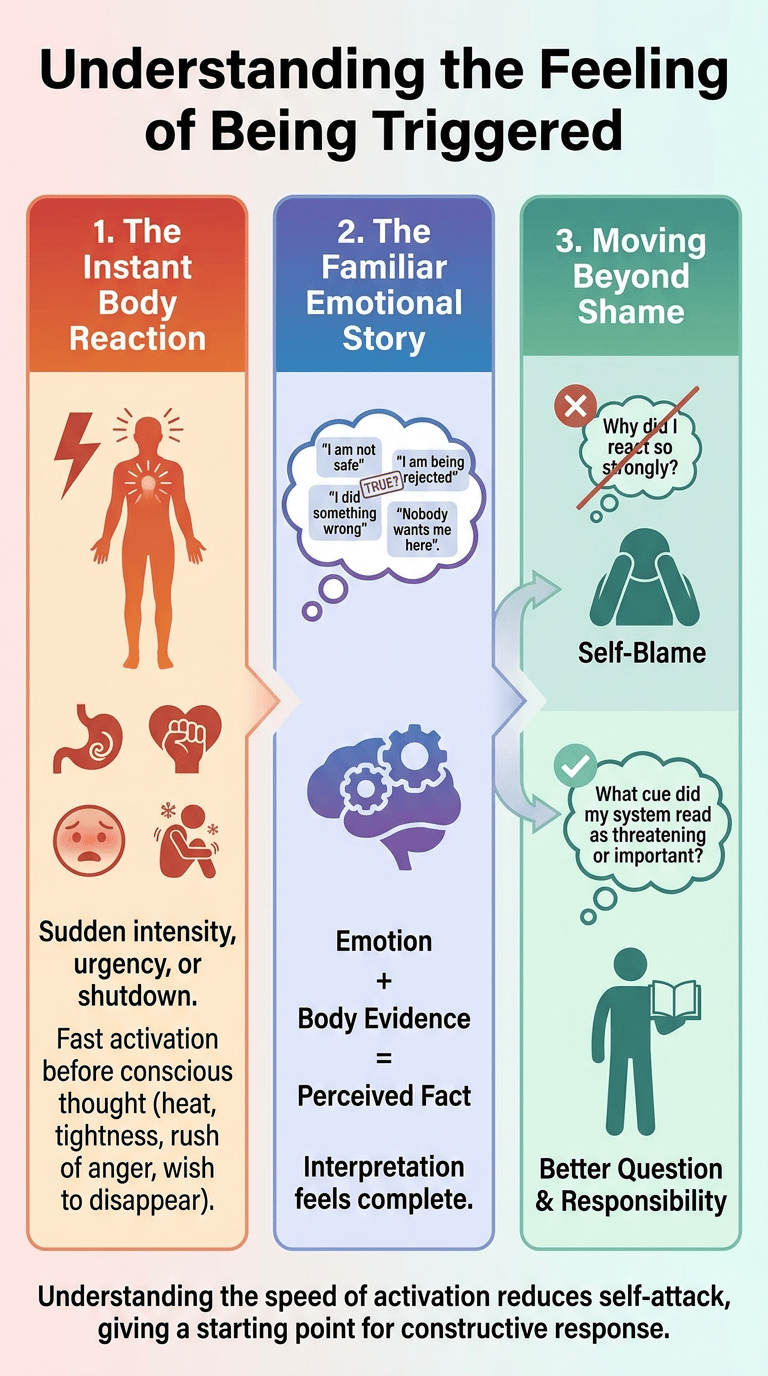
A trigger is often noticed first through speed, body change, or urgency.
Sudden intensity, body activation, urgency, or shutdown
Being triggered often feels fast. Your body may react before your conscious mind has formed a full explanation. You may feel heat in your face, a drop in your stomach, tightness in your chest, a frozen feeling, a rush of anger, a strong need to defend yourself, or a sudden wish to disappear.
The speed of the reaction is one reason people blame themselves. They think, “Why did I react so strongly?” A more useful question is: “What cue did my system read as important, threatening, exposing, or familiar?” That question does not excuse harmful behavior. It simply gives you a better starting point than shame.
Feeling pulled into a familiar emotional story
A trigger often brings a story with it. The story may sound like: “I am being rejected,” “I am not safe,” “I am about to be embarrassed,” “I am going to be replaced,” “I did something wrong,” or “Nobody really wants me here.”
The story can feel true because it arrives with emotion and body evidence. If your chest tightens and your thoughts rush, your mind may treat the conclusion as fact. But a trigger tells you that something was activated. It does not automatically prove that your first interpretation is complete.
Why the reaction may feel faster than conscious thought
Emotions are not only ideas. The APA describes emotion as involving feeling and engagement with the world, which means an emotional response can include bodily readiness, attention, facial expression, action urges, and meaning. Triggers can move through that system quickly because the brain is built to notice meaningful cues, especially cues linked with threat or belonging.
This is why a trigger can feel like an instant body event rather than a deliberate choice. You still have responsibility for what you do next, but understanding the speed of activation can reduce the extra layer of self-attack.
Why Emotional Triggers Happen

Triggers develop when cues become tied to meaning, memory, threat, or stress. This rapid meaning-making process sits within the broader framework of emotion psychology.
The brain links cues with meaning, memory, and threat
A cue becomes emotionally powerful when it is linked with meaning. The cue may be obvious, such as someone yelling. It may also be subtle, such as silence after you share something vulnerable. Your mind does not only process the cue itself. It also asks, often quickly and automatically, “What does this mean for me?”
Appraisal is the process of evaluating what a situation means. A PubMed Central article on appraisals and emotion discusses how appraisals relate to emotional responses. In everyday language, this means the same event can trigger different emotions depending on what it seems to say about safety, fairness, loss, status, identity, or connection.
How past experiences can sensitize present reactions
Past experiences can teach the nervous system what to watch for. If a certain tone once came before criticism, that tone may later feel dangerous. If silence once meant withdrawal of love, silence may later feel like abandonment. If public attention once led to humiliation, being noticed may later feel threatening rather than flattering.
This does not mean every trigger is trauma. It means emotional learning can happen through repeated experiences, painful moments, social rejection, family patterns, betrayal, bullying, embarrassment, or stress. The present cue may be small, but the emotional association attached to it can be large.
Why stress and exhaustion lower the threshold for triggers
People are usually easier to trigger when they are exhausted, hungry, overloaded, lonely, anxious, ashamed, or under pressure. The same comment that feels manageable on a rested day may feel unbearable after a week of poor sleep and constant stress.
This matters because triggers are not only about the cue. They are also about your current capacity. When capacity is low, the emotional threshold drops. The brain has less room to pause, check facts, and choose a response.
Trigger, Emotion, Trauma Reminder, or Overreaction?

These terms overlap in real life, but they do not mean the same thing. The distinction becomes clearer when you first understand what an emotional response contains beyond the conscious feeling alone.
Trigger: a cue activates a learned emotional response
A trigger is the cue or stimulus that activates the response. It may be a word, sound, place, smell, facial expression, memory, type of person, situation, or interaction pattern. The trigger matters because it helps you locate the doorway into the reaction.
For example, the emotion may be shame, but the trigger may be being corrected in front of others. The emotion may be jealousy, but the trigger may be seeing a partner give warm attention to someone else. The emotion may be loneliness, but the trigger may be not being invited.
Emotion: a response to present meaning
An emotion is the felt response that takes over after the cue is interpreted. The emotion may be anger, fear, sadness, shame, guilt, envy, jealousy, embarrassment, or loneliness. The same trigger can activate different emotions in different people.
If someone does not reply for hours, one person may feel worry, another may feel anger, another may feel shame, and another may feel numb. The cue is similar, but the meaning is different.
Trauma reminder: a cue linked to past danger or helplessness
A trauma reminder is a cue that connects with a traumatic experience or a period of danger, helplessness, or intense threat. Not every emotional trigger is a trauma reminder. But some triggers are tied to trauma, especially when they involve flashback-like feelings, panic, dissociation, body memories, intrusive memories, or strong avoidance.
The National Institute of Mental Health explains PTSD symptoms such as being on guard, avoiding reminders, intrusive memories, and strong reactivity after trauma. This article cannot diagnose PTSD, but it is worth seeking professional support if reminders create severe distress, interfere with daily life, or make you feel unsafe.
Overreaction: a judgment label that may hide useful information
“Overreaction” is often a label people use after seeing intensity they do not understand. Sometimes the reaction is disproportionate to the present facts. Still, the label can shut down curiosity. It may make the person feel ashamed instead of helping them understand what was activated.
A more useful phrase is: “The reaction was bigger than the present moment seemed to call for.” That leaves room for accountability and curiosity. It asks what meaning, memory, stress, or unmet need made the cue so powerful.
| Term | Main focus | Example |
|---|---|---|
| Trigger | The cue that activates the response | A sharp tone, silence, criticism, a certain place |
| Emotion | The feeling and action urge that follows meaning | Shame, guilt, jealousy, envy, embarrassment, loneliness |
| Trauma reminder | A cue linked with past danger or helplessness | A sound, smell, date, or situation that brings back intense distress |
| Overreaction | A judgment about intensity | Calling a response “too much” without understanding the trigger chain |
Common Types of Emotional Triggers
Most triggers are ordinary cues that carry extra emotional meaning.
Tone of voice, facial expression, silence, or criticism
Many emotional triggers are social cues. A short tone may feel like anger. A blank face may feel like rejection. Silence may feel like punishment. Criticism may feel like proof that you are failing. When criticism or public correction is interpreted as proof of personal defectiveness, shame psychology helps identify the specific emotion activated by the cue.
These cues are powerful because humans read safety and belonging through other people. When a cue seems to signal disapproval, distance, or threat, the body may react before you know whether that meaning is accurate.
Rejection, comparison, exclusion, or being misunderstood
Some triggers touch belonging. Being left out of a plan, misunderstood in a conversation, compared to someone else, ignored in a group, or corrected publicly can activate shame, loneliness, envy, anger, or embarrassment. A sign of possible replacement may activate jealousy, while seeing another person possess something you want may activate envy.
The pain may not be only about the event. It may be about the meaning attached to it: “I do not matter,” “I am behind,” “I am not wanted,” “I am not respected,” or “I am easy to replace.”
Shame triggers, guilt triggers, jealousy triggers, envy triggers, embarrassment triggers, loneliness triggers
Different emotions have different trigger themes. Shame triggers often involve exposure, criticism, rejection, or feeling defective. Guilt triggers involve possible harm, responsibility, broken values, or disappointing someone. Jealousy triggers involve threat to a bond, place, role, or attention.
Envy triggers involve seeing someone else have what you want. Embarrassment triggers involve awkward public attention. Loneliness triggers involve disconnection, exclusion, or not feeling held in mind. These categories overlap, but naming the emotion helps you understand what the trigger touched.
Sensory cues, dates, places, or repeated relationship patterns
Triggers are not always words. A smell, song, room, neighborhood, season, anniversary date, car sound, clothing style, or lighting can carry emotional memory. A repeated pattern can also become a trigger, such as being interrupted, ignored, watched closely, teased, criticized, or left without explanation.
When a cue is sensory or pattern-based, the reaction may feel especially confusing because the conscious explanation arrives late. You may only know that something in you changed.
The Trigger Chain Framework
This framework slows the reaction down into parts you can actually examine.
Cue: what happened
The first step is identifying the cue as neutrally as possible. Instead of “They rejected me,” start with the observable fact: “They looked at their phone while I was talking,” “They used a sharp tone,” “They did not reply,” or “I saw photos from a gathering I was not invited to.”
This matters because the cue and the interpretation are often fused together during a trigger. Separating them gives the brain a little more space.
Meaning: what your brain believed it meant
The second step is naming the meaning. Did your brain read the cue as rejection, failure, danger, disrespect, abandonment, humiliation, replacement, unfairness, or proof that you are not enough?
This meaning is where the reaction usually gains power. Two people can experience the same cue but give it different meanings based on history, values, expectations, and current stress.
Body response: what changed physically
Next, notice the body response. Did your throat tighten? Did your face get hot? Did your stomach drop? Did you feel frozen, restless, numb, shaky, tense, or ready to argue?
The body response is not just background noise. It tells you how strongly your system registered the cue. It can also warn you that you may need a pause before you speak or act.
Emotion: what feeling took over
After the body response, name the primary emotion if you can. Is it shame, guilt, jealousy, envy, embarrassment, loneliness, fear, sadness, anger, or something mixed?
Many people skip this step and go straight to the story. Naming the emotion helps you avoid treating every trigger as anger or anxiety. The emotion points to the need or meaning underneath.
Impulse: what you wanted to do next
Triggers often come with action urges. You may want to withdraw, apologize repeatedly, check someone’s phone, defend yourself, make a sarcastic comment, seek reassurance, send a long message, cancel plans, or pretend nothing happened.
An impulse is not the same as a decision. Naming it creates a small gap between activation and action. That gap is often where better choices begin.
Story: what conclusion formed afterward
Finally, notice the story that formed after the trigger. Maybe it was “I always ruin things,” “People leave when they know me,” “I am not respected,” “They do not care,” or “I have to protect myself.”
The story may contain useful information, but it may also be intensified by old pain. The goal is not to dismiss the story. The goal is to check whether the present facts fully support it.
| Part of the chain | Question to ask | Example |
|---|---|---|
| Cue | What happened that I can observe? | They replied with one short sentence. |
| Meaning | What did my brain think it meant? | They are annoyed and pulling away. |
| Body | What changed physically? | Chest tight, face hot, stomach dropped. |
| Emotion | What feeling took over? | Shame and fear. |
| Impulse | What did I want to do? | Send several messages or shut down. |
| Story | What conclusion did I form? | I am too much and people get tired of me. |
Why Triggers Can Feel So Personal
The strongest triggers usually touch something deeper than the surface event.
Triggers often touch identity, belonging, safety, or control
Triggers feel personal when they touch a core need. If the cue seems to threaten identity, the emotion may be shame. If it threatens belonging, the emotion may be loneliness or jealousy. If it threatens fairness or status, envy or anger may appear. If it threatens control or safety, fear and urgency may rise.
This is why telling someone “just ignore it” often fails. The trigger is not always about the surface event. It is about what the event seems to say about who they are, where they belong, and what might happen next.
Why shame and loneliness can intensify triggers
Shame makes triggers feel like evidence against the self. A small correction becomes “I am incompetent.” A forgotten invitation becomes “I am unwanted.” A joke becomes “I am ridiculous.” When shame enters the chain, the emotion stops being only about the event and becomes about identity.
Loneliness can also intensify triggers because it makes social cues feel heavier. If you already feel disconnected, a delayed reply or a missed invitation may feel like proof that you are not held in anyone’s mind. The current cue lands on an already sore place.
Why jealousy and envy can be triggered by small social cues
Jealousy and envy are especially sensitive to comparison and position. A partner laughing with someone else, a coworker being praised, a friend making new plans, or someone online showing a life you want can activate fear of loss, replacement, inferiority, or unfairness.
The cue may be small, but the meaning can be large: “I am losing my place,” “They have what I cannot have,” or “I am falling behind.” That meaning is what makes the trigger feel personal.
First Step After Noticing a Trigger
The first step is not perfect calm. It is clearer noticing.
Identify the cue without blaming yourself
Start with the cue. Say to yourself, “Something got activated when that happened.” This wording is simple, but it is important. It names the reaction without turning it into a character flaw.
If you begin with self-blame, the trigger may turn into shame. If you begin with curiosity, you have a better chance of understanding the chain before reacting.
Separate the present fact from the old meaning
Write or mentally separate two columns: what happened and what it meant to me. The present fact may be “They were quiet at dinner.” The meaning may be “They are disappointed in me and about to leave.”
Both columns matter, but they are not the same. The present fact deserves attention. The old meaning deserves compassion and checking.
Ask what emotion was activated
After naming the cue and meaning, ask which emotion took over. Was it shame, guilt, jealousy, envy, embarrassment, loneliness, fear, sadness, or anger? If several emotions are present, name the strongest one first.
This step helps you choose the right next move. Guilt may need repair. Shame may need identity separation. Jealousy may need a fact check and respectful conversation. Loneliness may need connection. Embarrassment may need proportion. Envy may need honest desire without self-attack.
Choose a pause or support step before acting when possible
A trigger can create urgency, but urgency is not always wisdom. If you are safe, a short pause can prevent the impulse from becoming damage. The pause might be taking a few breaths, stepping away from a screen, writing the first message without sending it, drinking water, or saying, “I need a few minutes before I respond.”
This is not about suppressing the emotion. It is about not letting the most activated moment make the full decision. The Cleveland Clinic discusses emotional triggers as intense emotional and physical reactions connected to pain, trauma, or stress, and notes that support such as therapy may help when triggers are hard to manage. If triggers are frequent or overwhelming, you do not have to handle them only through willpower.
How This Connects to Other Emotion Situations
The same trigger mechanism can activate different emotions in this cluster.
Read shame when the trigger says I am defective
If the reaction becomes “There is something wrong with me,” shame may be the main emotion. The cue may be criticism, rejection, comparison, or exposure, but the deeper pain is identity-based.
Read guilt when the trigger says I caused harm
If the reaction centers on responsibility, repair, or fear that you hurt someone, guilt may be active. The useful question is not only “Do I feel bad?” but “What exactly was my responsibility here?”
Read jealousy when the trigger says I may lose someone or something
If the trigger involves a threat to a bond, role, attention, trust, or place in someone’s life, jealousy may be the emotion underneath. The cue may be small, but the fear of loss may be large.
Read loneliness when the trigger says I am being left out or forgotten
If the reaction is about exclusion, being unseen, not being remembered, or feeling emotionally outside the circle, loneliness may be active. The trigger may have touched the need for belonging.
When to Get Support
Some triggers need more than self-reflection, especially when safety is involved.
Triggers linked to trauma memories, panic, dissociation, self-harm thoughts, fear, or unsafe situations
Consider getting support if triggers bring panic, dissociation, intrusive memories, self-harm thoughts, intense fear, or a sense that you are not safe. Support is also important if your triggers are connected to abuse, coercion, threats, stalking, humiliation, retaliation, or someone using your emotional reactions against you.
In an unsafe dynamic, the priority is not to communicate better with the person causing fear. The priority is safety, support, and planning. The National Domestic Violence Hotline offers safety planning resources for people experiencing abuse or preparing for safer options.
When professional support can help with repeated intense activation
Professional support can help when triggers repeatedly interfere with work, relationships, sleep, daily functioning, or your sense of self. A therapist or qualified mental health professional can help you understand the trigger chain, reduce shame, and work with the underlying associations safely.
Seeking support does not mean you are broken. It means the reaction may be carrying more than the present moment, and you deserve help that does not blame you for having a nervous system.
FAQ About Emotional Triggers Psychology
These answers clarify common questions without turning triggers into diagnosis.
Why do small things trigger big emotions?
Small things can trigger big emotions when the cue carries a larger meaning. A short reply may not only feel like a short reply. It may feel like rejection, abandonment, criticism, disrespect, or proof of not being valued. The size of the reaction often reflects the meaning and association attached to the cue, not just the cue itself.
Are emotional triggers always connected to trauma?
No. Some triggers are connected to trauma, but many are connected to repeated stress, past rejection, family patterns, shame, social comparison, betrayal, embarrassment, or unmet emotional needs. It is better not to diagnose yourself from one reaction. Look at intensity, repetition, impairment, and whether the cue brings panic, dissociation, intrusive memories, or strong avoidance.
Can a person be a trigger?
A person can be associated with a trigger, but it is usually more precise to identify the cue or pattern. Is it their tone, unpredictability, criticism, silence, dismissiveness, resemblance to someone from the past, or the role they hold in your life? Naming the exact cue gives you more useful information than saying “they trigger me” without detail.
What is the difference between a trigger and a boundary?
A trigger is something that activates an emotional response. A boundary is a limit or decision about what you will participate in, accept, or do next. A trigger may help you notice that something matters, but it does not automatically define the boundary. You still need to check the facts, the pattern, the safety context, and your values.
Why do triggers feel physical?
Triggers feel physical because emotions involve the body. The nervous system can prepare for defense, withdrawal, repair, or social protection before your conscious mind has finished interpreting the situation. This is why a trigger may show up as tightness, heat, nausea, shaking, numbness, or urgency.
Key Takeaways
Use these points as a quick review of the article.
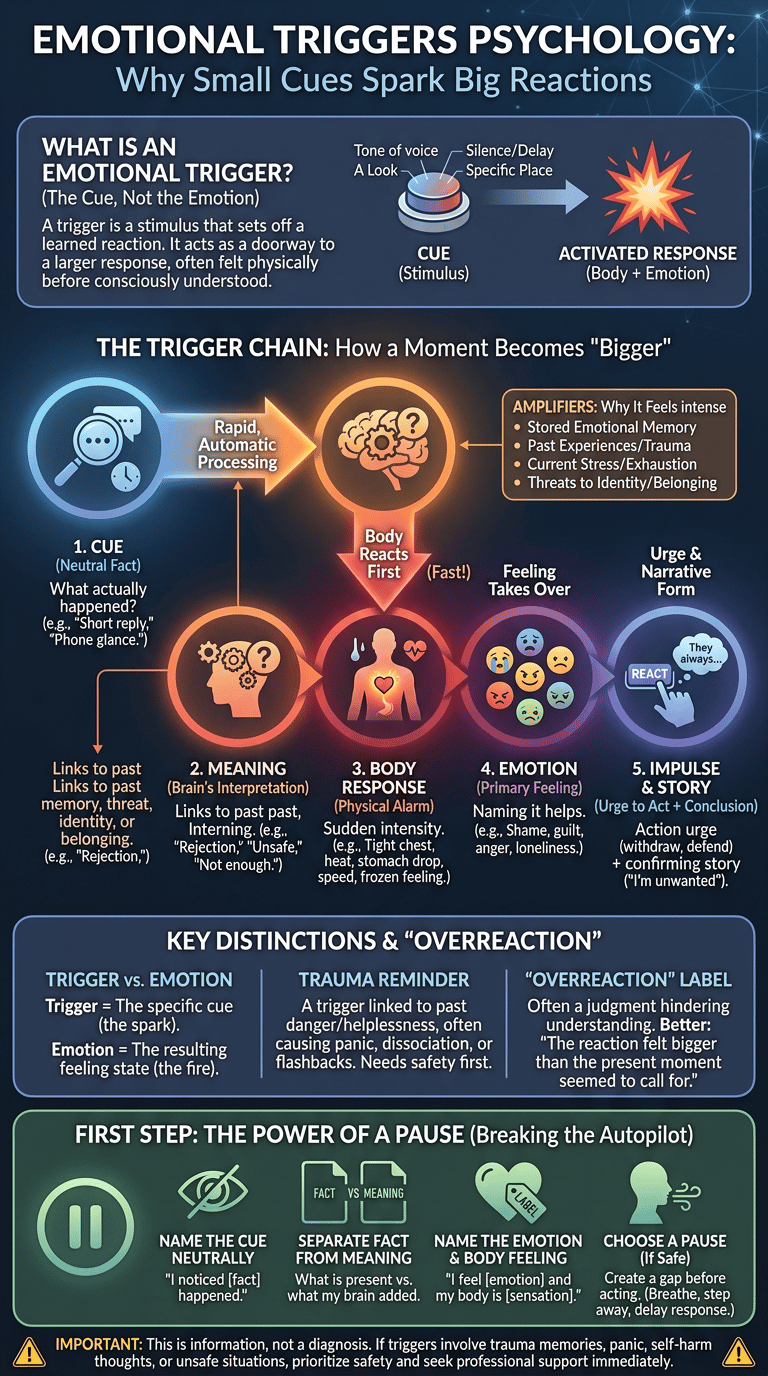
Triggers are cues that activate learned emotional responses
- An emotional trigger is the cue that activates a response, not the whole emotion itself.
- Triggers feel intense because they connect present cues with meaning, memory, threat, identity, or belonging.
- A trigger can activate shame, guilt, jealousy, envy, embarrassment, loneliness, fear, anger, or mixed emotions.
- The trigger chain includes cue, meaning, body response, emotion, impulse, and story.
- Calling something an overreaction may hide useful information. It is better to ask why the reaction felt bigger than the moment.
- Support matters if triggers involve trauma reminders, panic, dissociation, self-harm thoughts, abuse, coercion, threats, or unsafe situations.
A trigger does not prove the present moment is the whole cause
A trigger means something was activated. It does not automatically prove that your first conclusion is complete, and it does not mean your feeling is fake. The clearest path is to separate the present fact from the meaning your system gave it.
Understanding the trigger chain helps you understand the emotion without immediately acting on it
The next time a reaction feels bigger than the moment, start small: name the cue, name the meaning, notice the body, identify the emotion, and pause before acting if you can. You do not have to shame yourself for being triggered. You can treat the reaction as information, then decide what support, boundary, conversation, or care is actually needed.

Michael Reed is the Founder and Lead Writer at Psychology Exposed. He writes about human behavior, relationships, emotional patterns, self-awareness, and practical psychology topics using research-informed, easy-to-understand content.
Read More About Michael Reed: https://psychologyexposed.com/michael-reed/