
Envy is one of the emotions people often hide from others and sometimes from themselves. It can show up when a coworker gets promoted, a friend buys a home, a sibling receives praise, a creator grows faster than you, or someone online seems to have the body, confidence, relationship, money, ease, or recognition you want.

The painful part is not always that the other person has something good. The painful part is the comparison your mind makes afterward: “They have it, and I do not.” That gap can feel like proof that you are behind, less chosen, less successful, less attractive, less loved, or less safe.
This article explains envy as a social comparison emotion. It is not a moral judgment and it is not a diagnosis. It will help you understand what envy means, how it differs from jealousy, admiration, resentment, and shame, and what the emotion may be pointing toward without turning it into self-attack.
Quick Answer
What envy means in psychology
In psychology, envy is the painful feeling that can arise when someone else has a quality, achievement, possession, relationship, status, or advantage that you want. The APA Dictionary of Psychology defines envy as discontent or resentment generated by desire for another person’s possessions, qualities, or achievements.
Why envy is about comparison, desire, and perceived gap
Envy usually contains three pieces: you notice someone else has something, you compare it with your own situation, and you feel the gap between their position and yours. That gap may involve real circumstances, imagined meaning, or both. Envy is not only about wanting an object. It may be about wanting the feeling the object represents, such as freedom, belonging, beauty, ease, attention, respect, or security.
What Envy Feels Like
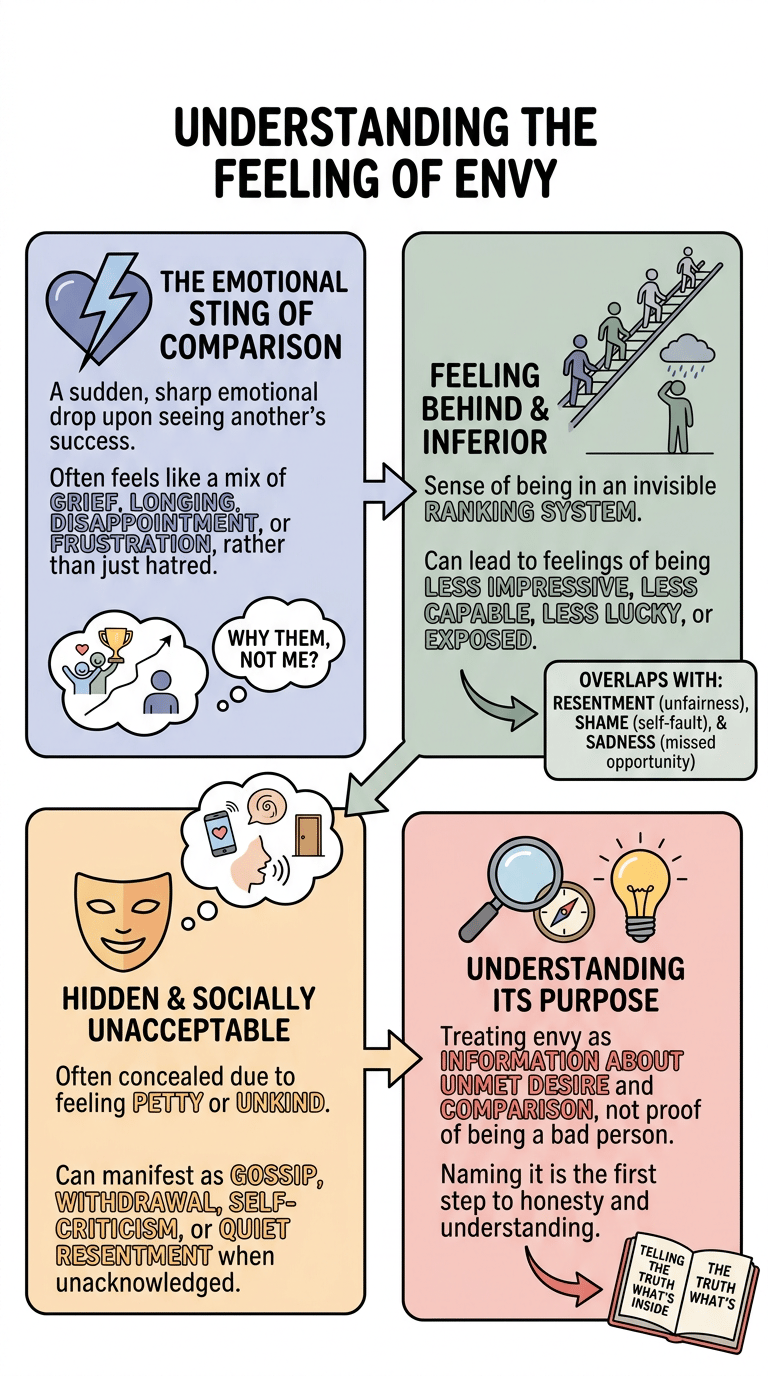
The sting of seeing someone have what you want
Envy often arrives as a sharp emotional sting. You may feel fine one moment, then suddenly feel smaller after seeing someone else’s good news. A friend announces an engagement, and your stomach drops. A colleague shares a win, and your mind starts counting your own delays. A stranger online posts a polished life update, and you feel embarrassed by your own ordinary day.
This sting is not always hatred. It may be grief, longing, disappointment, frustration, or a wish that your life looked different. Envy becomes easier to understand when you stop treating it as proof that you are a bad person and start treating it as information about comparison and unmet desire.
Feeling behind, inferior, resentful, or exposed
Envy can feel like being pushed into a ranking system you did not consciously choose. Suddenly, someone else’s success seems to say something about your worth. You may feel behind in life, less impressive, less lucky, less chosen, or less capable.
Sometimes envy comes with resentment: “Why them and not me?” Sometimes it comes with shame: “What is wrong with me that I do not have that?” Sometimes it comes with sadness: “I wanted that too.” These reactions can overlap, but they are not identical. Resentment focuses on unfairness, shame focuses on the self, and envy focuses on the painful comparison.
Why envy is often hidden because it feels socially unacceptable
Many people do not want to admit envy because it feels petty, immature, or unkind. They may say they are “just annoyed,” “not impressed,” or “happy for them, but tired.” Sometimes those things are true. Other times, envy is hiding underneath because it feels safer to criticize the other person than to admit longing.
Hidden envy can become more intense because it has nowhere honest to go. When you cannot name it, you may turn it into gossip, withdrawal, comparison scrolling, self-criticism, or quiet resentment. Naming envy does not mean approving every impulse that comes with it. It means telling the truth about what is happening inside you.
Why Envy Happens
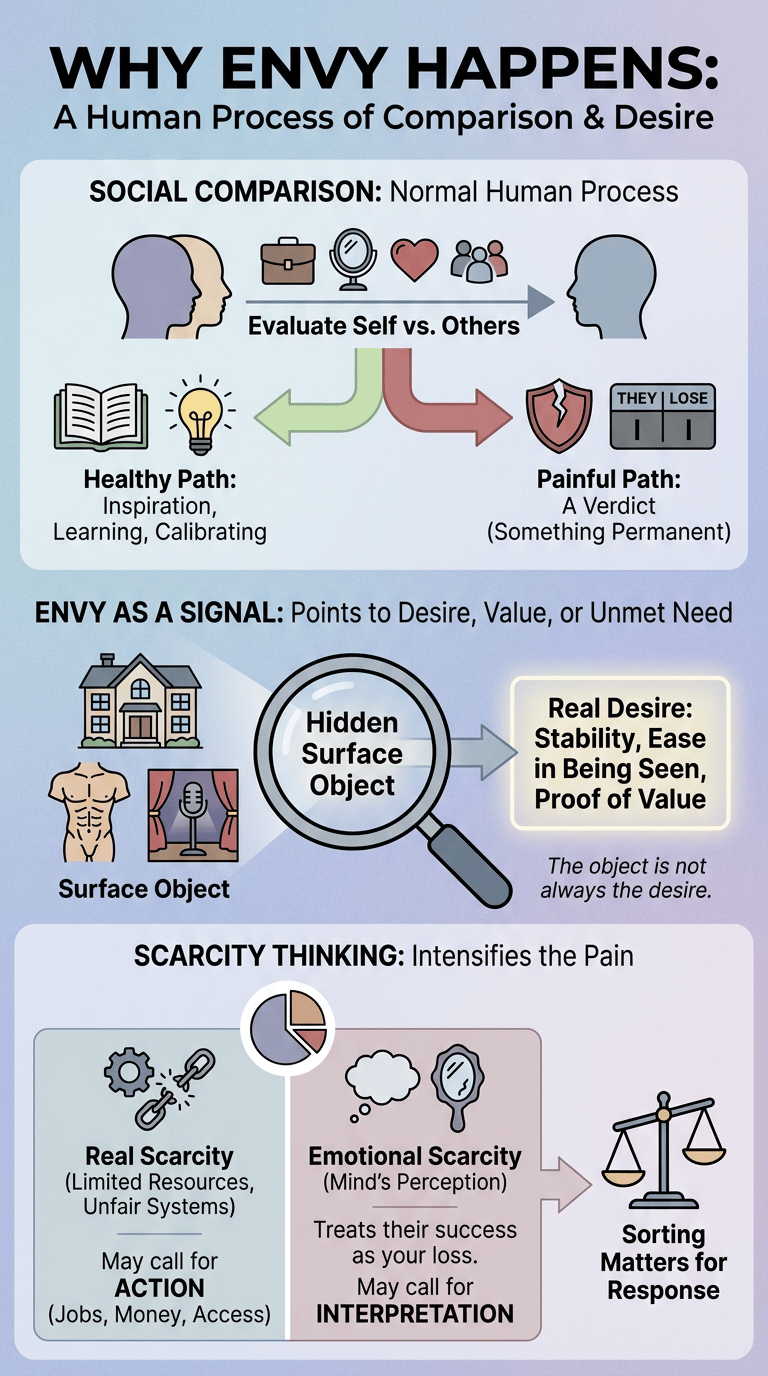
Social comparison as a normal human process
Humans naturally compare themselves with others. The APA Dictionary entry on social comparison theory describes how people evaluate themselves in relation to comparison groups or reference groups. In everyday life, that may mean comparing your career, looks, relationships, confidence, income, popularity, parenting, creativity, discipline, or social life with the people around you. As a signal about comparison and desire, envy fits within the broader account of emotion psychology.
Comparison is not automatically unhealthy. It can help you learn, calibrate, find inspiration, or understand what matters to you. It becomes painful when the comparison turns into a verdict: they are winning, I am losing, and this means something permanent about me.
Why envy points to desire, value, or unmet need
Envy often points toward something you care about. You may envy someone’s public recognition because you want your work to matter. You may envy someone’s relationship because you want emotional safety. You may envy someone’s confidence because you want to move through life without constantly doubting yourself.
The surface object is not always the real desire. You may think you envy someone’s house, but what you really want is stability. You may think you envy someone’s body, but what you really want is ease in being seen. You may think you envy someone’s audience, but what you really want is proof that your voice has value.
How scarcity thinking intensifies envy
Envy becomes harsher when the mind treats another person’s success as evidence that there is less available for you. Their promotion feels like your lost opportunity. Their attention feels like your invisibility. Their beauty feels like your inadequacy. Their confidence feels like your failure.
Sometimes scarcity is real. There may be limited jobs, limited money, limited recognition, limited family approval, or unfair systems that create unequal access. Other times, scarcity is emotional. The mind may act as if another person’s good moment removes your chance of ever having a good moment too. Sorting those two apart matters because real unfairness may call for action, while emotional scarcity may call for a different interpretation.
Envy vs Jealousy vs Admiration vs Resentment
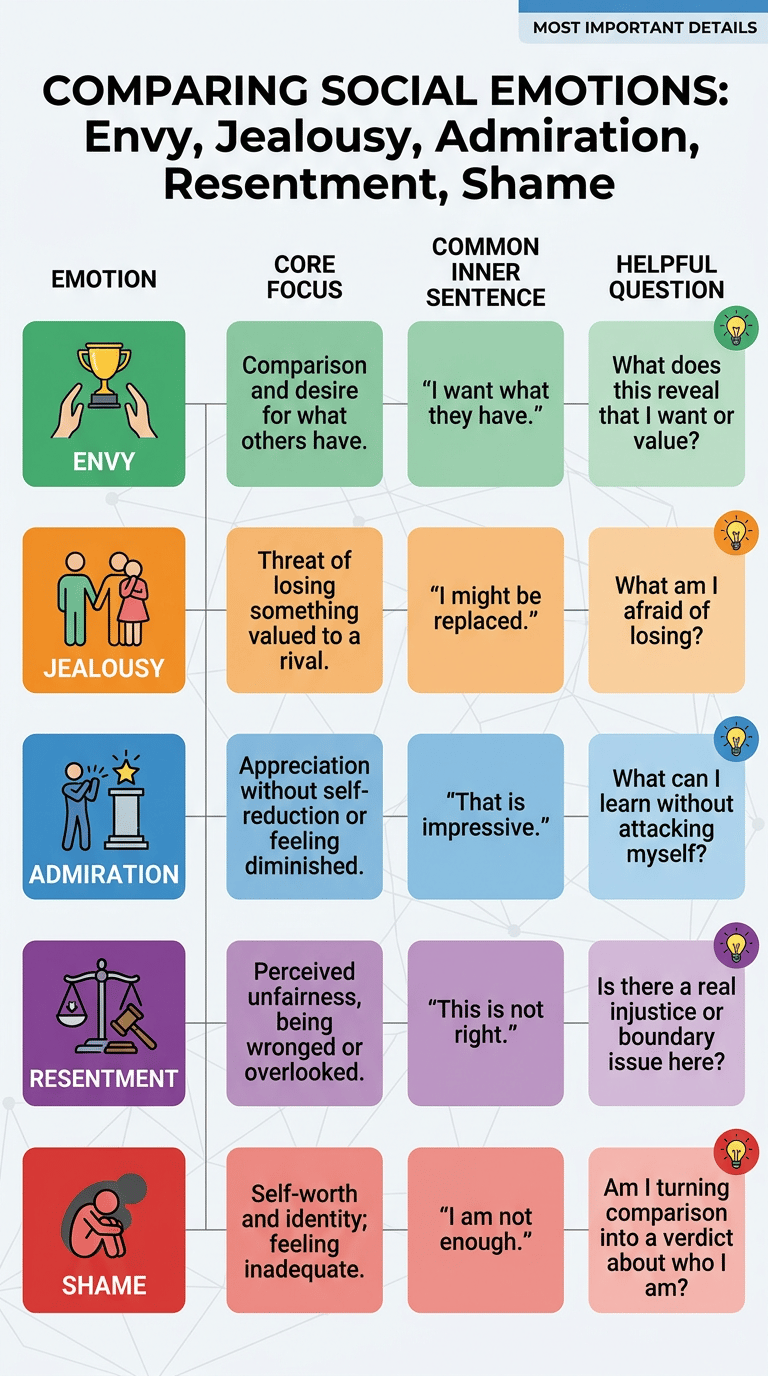
Envy: I want what they have
Envy is mainly about wanting something that belongs to, appears in, or is represented by another person. It may involve their status, success, lifestyle, relationship, talent, beauty, confidence, ease, freedom, or approval. The emotional sentence underneath envy is often: “I want that too.” If the central fear is losing a valued bond, role, or attention rather than wanting an advantage, jealousy psychology is the better distinction.
Jealousy: I fear losing what I value
Jealousy is different because it usually involves fear of losing a valued person, position, bond, role, or attention to someone else. With jealousy, the emotional question is often: “Am I being replaced?” With envy, the question is more often: “Why do they have that and I do not?” This is why envy can happen between strangers online, while jealousy usually involves something you feel attached to already.
Admiration: I value what they have without feeling diminished
Admiration lets you appreciate another person’s qualities without feeling reduced by them. You may admire someone’s discipline, kindness, style, skill, or courage and feel inspired rather than threatened. Research on envy and admiration has found that these emotions can motivate differently, including work showing that benign envy can motivate improvement in ways admiration may not.
Resentment: I feel wronged, overlooked, or treated unfairly
Resentment often includes a sense of unfairness or injury. You might resent a coworker’s promotion if you believe the process was biased. You might envy their title because you want that level of recognition. You might feel both at once, but separating them helps. Resentment asks, “Was something unfair?” Envy asks, “What do I want that they have?”
| Emotion | Core focus | Common inner sentence | Helpful question |
|---|---|---|---|
| Envy | Comparison and desire | I want what they have | What does this reveal that I want or value? |
| Jealousy | Threat of loss | I might be replaced | What am I afraid of losing? |
| Admiration | Appreciation without self-reduction | That is impressive | What can I learn without attacking myself? |
| Resentment | Perceived unfairness | This is not right | Is there a real injustice or boundary issue here? |
| Shame | Self-worth and identity | I am not enough | Am I turning comparison into a verdict about who I am? |
Benign Envy vs Malicious Envy
Benign envy can reveal aspiration or direction
Benign envy is the kind that says, “I want to move closer to that.” It can still hurt, but it points toward aspiration. You may see someone doing work you respect and feel uncomfortable because it reveals your own desire to try. You may envy someone’s calm confidence and realize you want to build a steadier relationship with yourself. Comparison becomes especially painful when desire turns into a verdict about personal worth, where shame psychology may help explain the urge to hide or attack the self.
Benign envy is not always pure or pleasant. It may contain comparison, frustration, and sadness. Still, it often leaves room for the other person’s good fortune to exist while you ask what your own next step could be.
Malicious envy wants the other person lowered
Malicious envy is more hostile. It does not only want the desired thing. It wants the other person to lose status, fail, be exposed, or be taken down. A review of research in PubMed Central describes benign and malicious envy as distinct forms that can involve different motivations and social behaviors, including socially undesirable tactics in some cases.
Research on benign and malicious envy is a reminder that envy is not automatically constructive just because it motivates action. The key question is not only, “Did envy push me?” It is also, “Did it push me toward growth, honesty, resentment, comparison, or harm?”
Why shame can push envy toward hostility
Envy becomes more dangerous when it fuses with shame. If someone else’s success feels like proof that you are worthless, you may feel desperate to reduce the pain. One way the mind tries to do that is by reducing the other person: criticizing their effort, mocking their appearance, dismissing their achievement, or hoping they fail.
This does not make you monstrous. It means the emotion has moved from desire into self-protection. A useful pause is: “Am I trying to learn from this, or am I trying to make them smaller so I do not feel so small?”
Common Envy Triggers
Career success and public recognition
Career envy often appears when someone else receives visible proof of progress: a promotion, award, raise, viral post, successful launch, praise from leadership, or a level of stability you want. The envy may be less about the job title and more about being seen as capable. When the same comparison cue repeatedly produces a strong response, emotional triggers psychology can clarify the older meaning attached to it.
What you may feel: urgency, resentment, embarrassment, or fear that you are falling behind. What it may mean: recognition matters to you, or you may need clearer standards for measuring your own progress. What to do next: name the specific thing you want before deciding whether it is actually your path.
Relationships, family, and social belonging
You may envy someone’s close friendships, supportive family, engagement, marriage, children, social invitations, or ease in being included. This kind of envy can be especially tender because it touches belonging. It may not mean you want their exact life. It may mean you want to feel chosen, remembered, wanted, or emotionally safe.
What you may feel: sadness, bitterness, loneliness, or a sense of being excluded from life. What it may mean: the comparison is touching a real need for connection. What to do next: ask whether the envy is pointing toward one relationship to invest in, one invitation to make, or one grief that needs gentler attention.
Beauty, confidence, lifestyle, or money
Envy around appearance, confidence, money, travel, homes, clothes, or lifestyle often carries a hidden meaning: “Their life looks easier than mine.” It can seem as though another person has escaped the insecurity, pressure, or limitation you still feel.
What you may feel: inferiority, body shame, frustration, or the urge to compare every detail. What it may mean: you may be measuring your inner life against someone else’s outer presentation. What to do next: separate what is visible from what is assumed, then identify the deeper feeling you want, such as ease, safety, pleasure, or agency.
Social media comparison and curated lives
Social media can intensify envy because it compresses many people’s highlights into one scroll. You may see someone’s vacation, another person’s body transformation, another person’s engagement, another person’s business success, and another person’s perfect kitchen within two minutes. Your brain may read that as one giant comparison, even though those are separate lives.
Mayo Clinic has warned that social media can be a painful place to measure self-worth because what appears online is not the full picture. The Mayo Clinic discussion of social media and self-worth is useful here because envy often grows when curated images are treated as complete evidence.
Seeing someone receive what you needed but did not get
Some envy is not about greed. It is about witnessing someone else receive care, protection, encouragement, money, mentorship, affection, patience, or opportunity that you needed and did not receive. That can bring up grief as much as comparison.
What you may feel: anger, sadness, numbness, or a sense of injustice. What it may mean: envy is touching an old unmet need. What to do next: acknowledge the grief instead of shaming yourself for the comparison. Sometimes the sentence is not only, “I want that.” It is also, “I needed that.”
What Envy May Be Telling You
A desire you have not admitted
Envy may reveal a desire you have dismissed, minimized, or judged. You may say you do not care about recognition, then feel envy when someone else is celebrated. You may say you are fine being single, then feel envy when someone else feels deeply loved. You may say money does not matter, then feel envy toward someone’s freedom and options. Sometimes the painful comparison is intensified by exclusion or missing connection, which overlaps with loneliness psychology without making the two emotions identical.
The goal is not to chase every desire. The goal is to be honest enough to evaluate it. Some desires are yours. Some were borrowed from family, culture, social media, or old insecurity. Envy gives you a starting point, not a final instruction.
A value you care about
Behind envy, there is often a value. Envy of a writer may point to creative expression. Envy of a peaceful couple may point to emotional safety. Envy of a disciplined friend may point to steadiness. Envy of someone’s close community may point to belonging.
Values are less brittle than comparisons. A comparison says, “They are ahead of me.” A value says, “This matters to me.” When envy is translated into values, it becomes less about defeating someone else and more about understanding your own direction.
A wound around fairness, timing, or opportunity
Sometimes envy is sharpened by real unfairness. Maybe you worked hard and were overlooked. Maybe someone with more support moved faster. Maybe your starting point was harder. Maybe you had responsibilities, discrimination, financial stress, illness, grief, or family pressure that others did not see.
Envy does not require you to pretend life is equally fair. It simply asks you to separate pain from action. You can acknowledge unfairness without making another person the entire symbol of your wound.
A belief that someone else’s success reduces your worth
One of the most painful beliefs under envy is: “Their success makes me less.” That belief is common, but it is not always true. Another person’s beauty does not logically erase yours. Another person’s progress does not prove your life is over. Another person’s relationship does not mean you are unlovable.
Still, the belief can feel true in the body. That is why envy is not solved by scolding yourself. It is better approached by asking, “What story did this comparison create about me?” Once the story is visible, you can decide whether it deserves to guide your behavior.
The Envy Reflection Framework
What exactly do I want that they seem to have?
Start with precision. Do not stop at “I envy their life.” Ask what part of it stings. Is it their money, freedom, beauty, attention, discipline, family, relationship, audience, calmness, confidence, or sense of being supported?
Precision reduces emotional fog. When envy is vague, it can turn into global self-attack. When it becomes specific, you can see whether the desire is realistic, symbolic, borrowed, or deeply important.
Do I want the result, the feeling, the status, or the safety it represents?
Sometimes you do not want the exact thing another person has. You want what you imagine it gives them. Their money may represent freedom. Their relationship may represent being chosen. Their appearance may represent being accepted. Their career may represent permission to respect yourself.
This question matters because chasing the wrong object can leave the original need untouched. You might pursue status when you actually need belonging. You might chase appearance when you actually need safety in being seen. You might chase applause when you actually need to believe your work matters before anyone claps.
What part is inspiration and what part is pain?
Envy often contains both. One part of you may feel inspired by what is possible. Another part may feel hurt by where you are. If you only focus on inspiration, you may bypass grief. If you only focus on pain, you may miss direction.
Try separating the two sentences. Inspiration says, “This shows me something I might want.” Pain says, “This reminds me of what I do not have yet.” Both can be true at the same time.
What is one grounded next step without self-attack?
A grounded next step is not a dramatic life overhaul. It may be sending one email, practicing one skill, limiting one comparison trigger, telling one trusted person the truth, applying for one opportunity, or giving yourself one hour for the thing you keep postponing.
The words “without self-attack” matter. Envy often tries to motivate through humiliation. That may create short bursts of action, but it usually makes the emotional wound deeper. A better next step begins with honesty, not contempt.
| Reflection question | Why it helps | Example answer |
|---|---|---|
| What do I want? | Turns vague envy into specific desire | I want recognition for my work |
| What does it represent? | Finds the deeper need under the object | I want to feel respected and not invisible |
| What story did I tell about myself? | Separates emotion from identity | I told myself I am too late |
| What is one grounded step? | Moves from comparison to agency | I will share one finished piece this week |
How This Connects to Other Emotion Situations
Read jealousy when the fear is losing a person, role, or bond
If the emotion is mainly about someone else having what you want, envy is the closer word. If the emotion is mainly about someone taking your place, replacing you, or threatening something you already value, jealousy may be the better fit. The two can overlap, especially in relationships and social groups, but the central fear is different.
Read shame when envy turns into I am not enough
Envy can quickly turn into shame when comparison becomes identity. “They have something I want” becomes “I am nothing because I do not have it.” When the emotion attacks your worth rather than revealing a desire, shame is probably involved.
Read loneliness when comparison makes you feel excluded from life
Some envy is really loneliness with a comparison layer. You see other people being invited, celebrated, partnered, supported, or included, and the pain is not only that they have something. It is that you feel outside of the circle. In that case, the deeper topic may be disconnection.
When to Get Support
When envy becomes obsessive, hostile, humiliating, or tied to severe self-worth distress
Envy is a normal emotion, but it may deserve extra support when it becomes obsessive, humiliating, or hard to control. If you cannot stop checking, comparing, attacking yourself, or imagining the other person losing what they have, it may help to talk with a mental health professional or a trusted support person.
Cleveland Clinic notes that social media breaks can be helpful when online use affects mood, comparison, or daily functioning. Their guidance on when to step back from social media may be useful if envy is repeatedly triggered by scrolling.
When comparison leads to self-harm thoughts or intense hopelessness
If comparison leads to thoughts of self-harm, not wanting to be alive, or feeling unable to stay safe, treat that as more than ordinary envy. Reach out to local emergency services, a crisis line in your country, or a trusted person who can stay with you. You do not have to decide whether the feeling “counts” as serious before seeking immediate support.
If envy is tied to bullying, public humiliation, harassment, coercion, stalking, or retaliation, prioritize safety over trying to have a perfect conversation. Emotional insight is helpful, but it should not be used to keep you in a situation where you are being threatened, degraded, or controlled.
FAQ About Envy Psychology
Is envy a bad emotion?
Envy is not pleasant, but the emotion itself does not make you bad. It becomes harmful when it turns into cruelty, sabotage, chronic self-attack, or constant comparison. If you can name envy honestly, it may reveal a desire, value, or wound that needs attention.
Why do I envy people I love?
You can love someone and still envy something they have. Envy does not automatically mean you want to hurt them or that you are not happy for them. It may mean their good news touched a place where you feel behind, unseen, unsupported, or afraid you will never have something similar.
What is the difference between benign and malicious envy?
Benign envy tends to move toward self-improvement, aspiration, or learning, although it can still hurt. Malicious envy wants the other person lowered, exposed, or deprived of the thing they have. The difference is not whether envy feels uncomfortable. The difference is where the discomfort tries to go.
Why does social media make envy worse?
Social media can create rapid upward comparisons with many people at once. You may compare your full life, including stress, boredom, debt, uncertainty, and private pain, with someone else’s selected image or announcement. That does not mean every post is fake. It means your brain may treat incomplete information as a complete measure of your worth.
Can envy show me what I actually want?
Yes, envy can be useful when you slow it down. Ask what exactly you envy, what it represents, and whether the desire belongs to you. Some envy points to a real value or neglected dream. Some points to grief, unfairness, scarcity, or pressure from other people’s standards. The emotion is a clue, not a command.
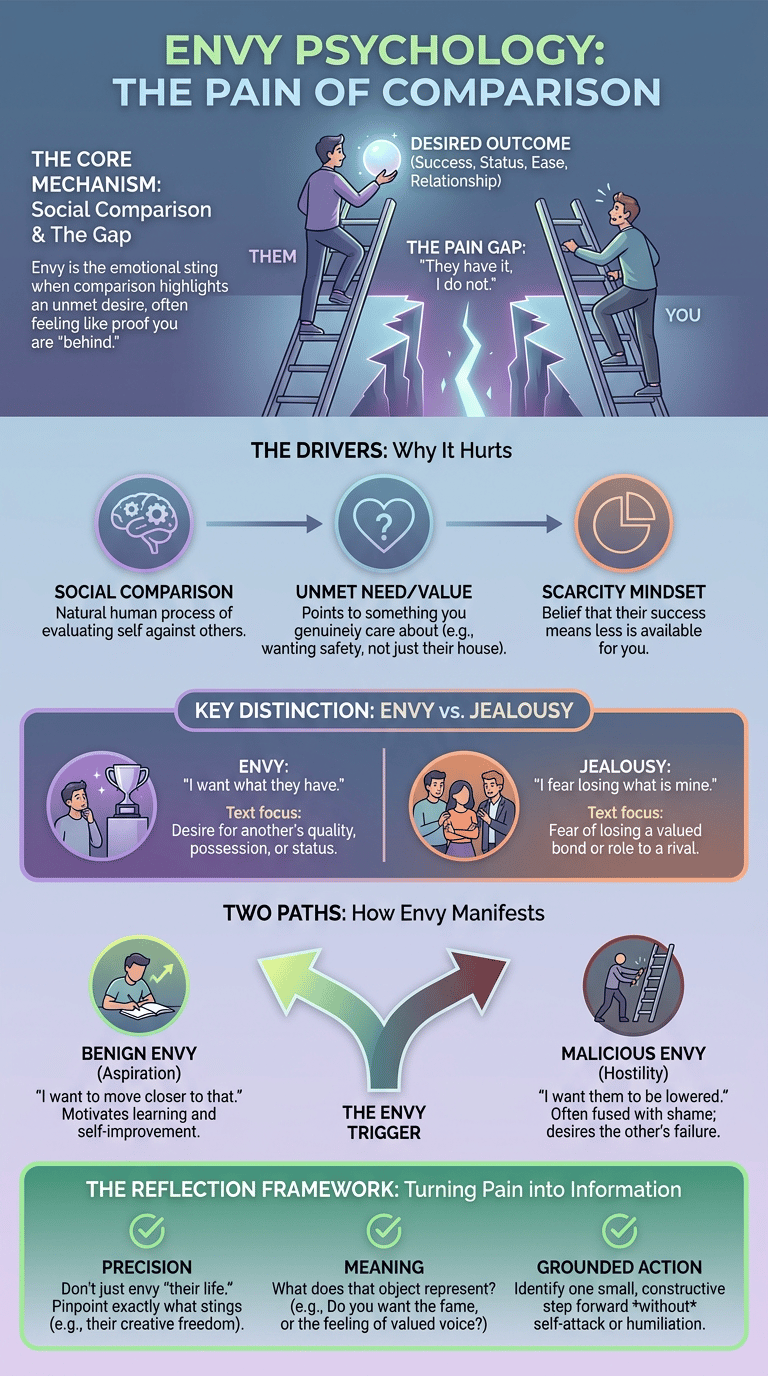
Key Takeaways
- Envy is the pain of comparison when someone else has something you want, or something that represents a feeling you want.
- Envy is different from jealousy because jealousy is usually about fear of losing a valued bond, role, or place.
- Envy often hides under criticism, shame, resentment, or forced indifference because it can feel socially unacceptable to admit.
- Benign envy may point toward aspiration, while malicious envy wants the other person reduced or deprived.
- The most useful question is not “How do I stop being envious immediately?” but “What does this comparison reveal about my desire, value, wound, or story about myself?”
- Seek support if envy becomes obsessive, hostile, tied to severe self-worth distress, or connected to self-harm thoughts or unsafe dynamics.
Final Thoughts
Envy is uncomfortable because it places desire and comparison in the same room. It shows you someone else’s advantage, then asks what that means about your own life. If you answer too quickly, envy may turn into self-attack or quiet hostility. If you slow it down, it can become more specific and less shameful.
The next time envy appears, try naming it without performing goodness or cruelty. You might say to yourself, “Something about this touches a desire in me.” Then ask what the desire is, what it represents, and what one grounded step would look like without trying to punish yourself or reduce someone else.

Michael Reed is the Founder and Lead Writer at Psychology Exposed. He writes about human behavior, relationships, emotional patterns, self-awareness, and practical psychology topics using research-informed, easy-to-understand content.
Read More About Michael Reed: https://psychologyexposed.com/michael-reed/