
Guilt can feel like a weight that follows you after a mistake, a boundary, a hard conversation, or a decision someone else did not like. Sometimes guilt is useful. It tells you that your behavior may have affected someone and that repair might be needed. Other times, guilt becomes vague and punishing. It keeps repeating, even when there is nothing clear left to fix.

In psychology, guilt is usually understood as a self-conscious moral emotion. The APA Dictionary of Psychology defines guilt as a painful appraisal of having done or thought something wrong, often with readiness to undo or reduce that wrong. That definition matters because guilt is usually about behavior, responsibility, and values, not your entire identity.
The important question is not simply, “How do I stop feeling guilty?” A better question is, “What kind of guilt is this?” Healthy guilt can guide repair. Excessive guilt can pull you into self-punishment. Misplaced guilt can make you carry responsibility that does not belong to you. Understanding the difference helps you respond with more clarity and less self-attack.
Quick Answer
What guilt means in psychology
Guilt is a painful emotion that often appears when you believe you have violated a value, caused harm, failed a responsibility, or disappointed someone important. Unlike shame, which tends to say, “I am bad,” guilt more often says, “I did something wrong, or I may need to make something right.”
Why guilt often points to behavior, responsibility, or values
Guilt can be useful when it stays specific. It may help you notice a broken promise, apologize, repair harm, or change a repeated behavior. It becomes less helpful when it turns vague, global, endless, or tied to responsibility you could not realistically control.
What Guilt Feels Like

Guilt is not only a thought. It can show up in the body, in memory, in behavior, and in the way you interpret yourself around others. Some people feel guilt as a heavy stomach or tight chest. Others feel it as mental replay: the same scene returns again and again, asking whether they should have done something differently.
The inner pressure to repair or make things right
The most recognizable feature of guilt is the pressure to fix. You may want to apologize, explain, replace what was lost, change your behavior, confess, or prove that you care. That pressure is not automatically bad. In the right context, it can help you move from avoidance to responsibility.
The problem begins when the pressure has no clear target. You may feel guilty but cannot identify what harm happened, what repair would help, or what responsibility was actually yours. In that case, guilt can become a loop rather than a guide.
The mental replay of what happened
Guilt often brings a mental replay. You may remember the tone you used, the message you sent, the boundary you set, the chance you missed, or the look on someone’s face. Replay can be useful if it helps you understand what happened and choose a next step.
Replay becomes harmful when it keeps asking the same question without accepting any answer. If you have already repaired what you reasonably can, repeated mental review may not be accountability anymore. It may be self-punishment, fear of disapproval, or anxiety wearing the mask of responsibility.
Body tension, heaviness, or unease
Guilt can feel physical because emotions involve the body as well as meaning. A person may feel restless, tense, tired, or unable to relax until something feels resolved. The body may act as if there is unfinished social business.
Why Guilt Exists
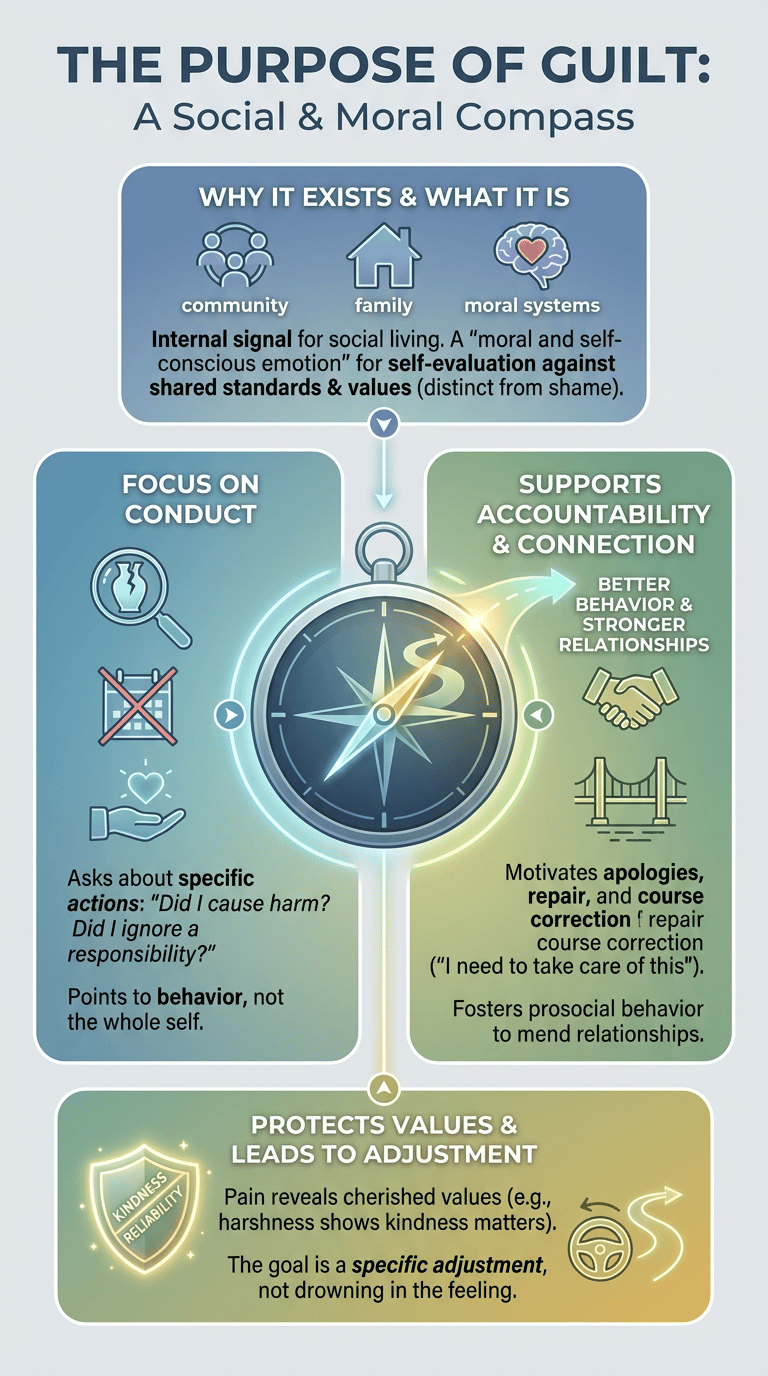
Guilt exists because humans live in relationships, families, teams, communities, and moral systems. We need an internal signal that tells us when our behavior affects others or violates what we care about. Its focus on values and corrective action makes sense within the broader account of emotion psychology.
Guilt as a moral and social emotion
Guilt belongs to the family of moral and self-conscious emotions. These emotions involve self-evaluation, social standards, and the question of how our behavior fits our values. A review in PubMed Central on shame and guilt discusses how guilt and shame are closely related but meaningfully different emotional experiences.
Guilt usually asks about conduct: Did I act in a way that caused harm? Did I ignore a responsibility? Did I violate something I believe matters? Because it is tied to conduct, guilt can point toward a specific response.
How guilt supports accountability and connection
When guilt is proportionate, it can support accountability. It helps you notice when you need to apologize, change course, return something, tell the truth, or stop repeating a hurtful behavior. It can move you from “I do not want to think about this” to “I need to take care of this.”
Research on guilt, empathy, and prosocial behavior connects guilt with concern for others and actions that may benefit social relationships. That does not mean guilt always leads to good behavior, but it explains why guilt often contains an impulse to repair.
Why guilt can protect values and relationships
Guilt often hurts because values matter. If you feel guilty after lying, ignoring someone, losing patience, or failing to follow through, the pain may be connected to the kind of person you want to be. In that sense, guilt can reveal values rather than only mistakes.
For example, guilt after speaking harshly may show that kindness matters to you. Guilt after missing a commitment may show that reliability matters to you. The goal is not to drown in the feeling. The goal is to let the feeling point toward a specific adjustment.
Healthy Guilt vs Excessive Guilt
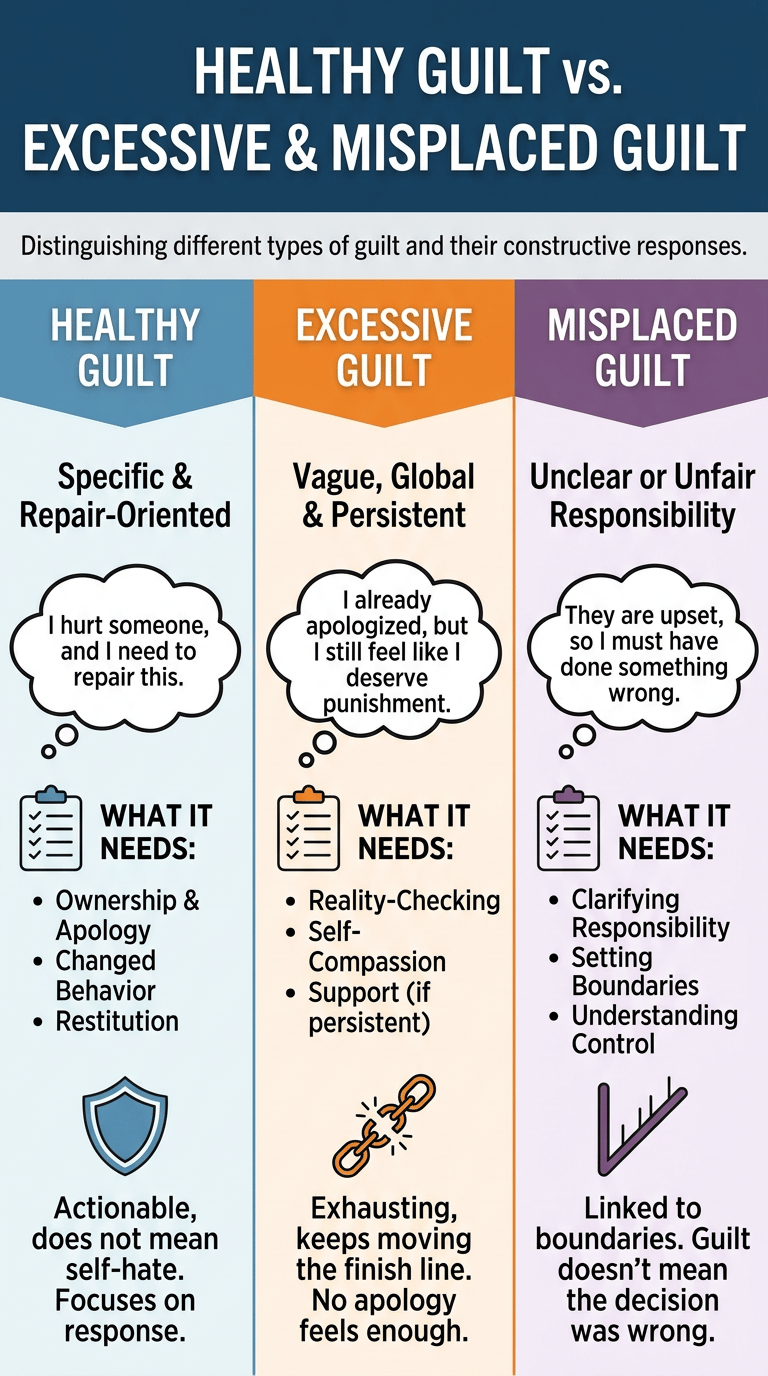
Not all guilt deserves the same response. Healthy guilt is usually specific, proportionate, and connected to repair. Excessive guilt is broad, repetitive, and difficult to resolve. Misplaced guilt may appear when you are taking responsibility for another person’s disappointment, mood, expectations, or choices.
| Type of guilt | What it sounds like | What it usually needs |
|---|---|---|
| Healthy guilt | “I hurt someone, and I need to repair this.” | Ownership, apology, changed behavior, or restitution. |
| Excessive guilt | “I already apologized, but I still feel like I deserve punishment.” | Reality-checking, self-compassion, and possibly support if it is persistent. |
| Misplaced guilt | “They are upset, so I must have done something wrong.” | Clarifying responsibility, boundaries, and what is actually within your control. |
Healthy guilt is specific and repair-oriented
Healthy guilt has a clear object. You can usually name the behavior, the affected person, the value that was violated, and the repair that may help. For example: “I snapped at my friend when I was stressed. I need to apologize and be more careful next time.”
This kind of guilt is uncomfortable, but it is workable. It does not need you to hate yourself. It asks you to respond.
Excessive guilt is vague, global, or impossible to resolve
Excessive guilt often sounds less specific. It may say, “I am a terrible person,” “I should have known everything,” or “I am responsible for everyone feeling okay.” It may continue even after you have apologized, changed behavior, or discovered that you did not actually cause the harm.
Excessive guilt can become exhausting because it keeps moving the finish line. No apology feels enough. No explanation settles it. No amount of self-punishment creates relief for long.
Misplaced guilt happens when responsibility is unclear or unfair
Misplaced guilt often appears in situations where someone else is disappointed, angry, lonely, or uncomfortable. Their feeling may be real, but that does not automatically make you responsible for fixing it. You can care about someone’s feelings without owning every cause of them.
This matters especially around boundaries. You may feel guilty for saying no, asking for space, changing your mind, leaving a role, ending a conversation, or not meeting someone’s expectation. The guilt may be telling you that the decision was emotionally hard, not that the decision was wrong.
Guilt vs Shame vs Regret
Guilt, shame, and regret can overlap, but they lead to different questions. If you confuse them, you may choose the wrong response. Guilt asks about repair. Shame attacks identity. Regret looks backward at a choice and imagines a different outcome. When concern about an action becomes a verdict on the whole self, shame psychology is the more accurate frame; when discomfort comes mainly from awkward public exposure, embarrassment psychology may fit better.
| Emotion | Main focus | Common next step |
|---|---|---|
| Guilt | Behavior, harm, responsibility, values. | Repair what can be repaired. |
| Shame | Identity, exposure, feeling defective. | Separate the event from your whole self. |
| Regret | A past choice that you wish had gone differently. | Learn from the choice without pretending you knew then what you know now. |
Guilt focuses on what you did
Guilt is most useful when it stays connected to behavior. “I interrupted someone.” “I forgot a commitment.” “I hid information I should have shared.” These statements are uncomfortable, but they are specific enough to work with.
Specific guilt can lead to action. You can apologize, clarify, pay back, correct, reschedule, explain honestly, or change the pattern. The action gives guilt somewhere constructive to go.
Shame focuses on who you think you are
Shame takes the event and turns it into identity. Instead of “I lied,” shame says, “I am a liar and can never be trusted.” Instead of “I disappointed someone,” shame says, “I ruin things for people.” That shift makes repair harder because the problem suddenly feels like the whole self.
If guilt turns into shame, it helps to return to the smallest truthful statement. What exactly happened? What part was yours? What can be repaired? What does not need to become a permanent label?
Regret focuses on wishing something had gone differently
Regret can exist even when you did not do anything morally wrong. You may regret moving too quickly, staying too long, missing an opportunity, trusting someone, or not speaking up sooner. The pain is real, but the question is not always guilt.
A useful distinction is this: guilt asks, “Did I violate a responsibility or value?” Regret asks, “What do I wish I had known, chosen, or done differently?” Sometimes both are present, but they are not the same emotion.
Why the distinction changes what you do next
If the feeling is guilt, repair may help. If the feeling is shame, self-condemnation needs to soften before repair is possible. If the feeling is regret, the next step may be grieving, learning, or adjusting future decisions.
One emotion can hide under another. A person may say they feel guilty when they are actually afraid of being disliked. Another person may say they feel regret when they are avoiding a real apology. Naming the emotion more accurately gives you a better next step.
Common Situations That Trigger Guilt
Guilt often appears in situations where responsibility, care, loyalty, and boundaries collide. The situation does not need to be dramatic. Small daily moments can activate guilt when they touch a value or an expectation. If a minor cue repeatedly activates intense self-blame, emotional triggers psychology can help separate present responsibility from older emotional learning.
Hurting someone unintentionally
You can feel guilty even when you did not mean to hurt anyone. Intent matters, but impact matters. If your words or actions caused pain, guilt may be the signal that repair is worth considering.
The repair does not need to become theatrical. A grounded apology often names the behavior, acknowledges the impact, and explains what will change. The focus is not on proving you are a good person. The focus is on taking care of the harm.
Setting boundaries
Boundary guilt is common because a boundary may disappoint someone. You may say no, leave early, stop lending money, ask for privacy, or refuse a role you used to accept. Even when the boundary is reasonable, guilt can appear because someone else is unhappy.
That feeling deserves attention, but it does not automatically mean the boundary is wrong. A boundary can be kind and still uncomfortable. Guilt after a boundary may simply mean you are not used to protecting your limits.
Saying no or disappointing others
Some people experience guilt whenever they disappoint someone, even when they have done nothing unfair. This can happen if love, approval, or safety once felt tied to being agreeable. In adulthood, the body may still treat disappointment as danger.
The question to ask is: “Did I harm them, or did I fail to give them what they wanted?” Those are different situations. You may still care, but care does not require automatic compliance.
Outgrowing expectations
Guilt can show up when you change. You may feel guilty for choosing a different career, ending a relationship, moving away, becoming less available, or no longer fitting an old family role. Growth can disturb systems that were organized around your old behavior.
This guilt can be confusing because no obvious harm has occurred. The discomfort may come from leaving a familiar role, not from doing something morally wrong.
Remembering past mistakes
Old guilt can return years later, especially when a memory appears during a quiet moment or after seeing someone connected to the past. Sometimes there is still repair to consider. Other times, the guilt is asking for integration rather than action.
The Guilt Check Framework
When guilt is intense, it can be hard to think clearly. The guilt check framework helps you slow down before you apologize automatically, collapse into shame, or dismiss the feeling too quickly.
What exactly did I do or not do?
Start with behavior, not identity. Write the facts in one or two plain sentences. Avoid words like “always,” “never,” “awful,” or “unforgivable” at this stage. For example: “I canceled at the last minute without explaining,” is more useful than, “I am a selfish friend.”
What part was actually my responsibility?
Responsibility has limits. You may be responsible for your words, actions, promises, omissions, and choices. You are not automatically responsible for another adult’s entire emotional state, interpretation, or refusal to respect a boundary.
A fair responsibility statement might be: “I was responsible for speaking honestly earlier.” An unfair responsibility statement might be: “I was responsible for making sure no one ever felt disappointed.”
Is repair possible, useful, or needed?
Repair should fit the situation. Sometimes repair means an apology. Sometimes it means a practical correction, changed behavior, returning money, telling the truth, giving space, or not repeating the behavior. Sometimes repair is not possible, and the work becomes learning.
Am I trying to fix guilt that belongs to someone else’s expectations?
Sometimes guilt is activated by another person’s expectation rather than by actual wrongdoing. A parent may expect constant availability. A friend may expect immediate replies. A partner may expect you to avoid all discomfort. A workplace may expect unlimited energy.
Expectations can be meaningful without becoming automatic moral obligations.
When Guilt Becomes a Trap
Guilt becomes a trap when it no longer guides repair. Instead, it keeps you stuck in apology, fear, self-punishment, or over-responsibility. The emotion may still feel morally serious, but it is not helping anyone move forward.
Over-apologizing without clear harm
Over-apologizing can feel like a way to reduce tension. You may apologize for needing time, asking a question, taking up space, being quiet, being emotional, or not replying instantly. The apology may calm the moment, but it can teach your nervous system that existing requires permission.
A more precise response might be: “Thank you for waiting,” instead of “I am so sorry I took too long,” or “I cannot take that on,” instead of “I am sorry I am letting you down.” Precision protects accountability without turning every need into wrongdoing.
Taking responsibility for other people’s feelings
Other people’s feelings matter, but they are not always your fault. Someone can feel disappointed because you made a fair choice. Someone can feel angry because you held a boundary. Someone can feel sad because a situation changed.
When you automatically treat every uncomfortable feeling as your failure, guilt becomes too large. Compassion asks you to care. Over-responsibility asks you to carry what is not yours.
Confusing guilt with fear of disapproval
Sometimes the feeling called guilt is actually fear of being judged, excluded, punished, misunderstood, or seen as selfish.
Ask: “Would I still think I did something wrong if this person were not upset with me?” If the answer is no, the feeling may be more about disapproval than moral responsibility.
Using self-punishment instead of repair
Self-punishment can look like replaying the mistake for hours, refusing comfort, rejecting kindness, overworking to prove worth, or telling yourself you do not deserve peace. It can feel like accountability, but it often avoids the harder and healthier work of repair.
Repair faces the impact and changes future behavior. Self-punishment keeps the focus on your suffering. One may help the situation. The other often keeps you stuck.
What to Do First With Guilt
The first response to guilt should not be panic. It should be orientation. You are trying to find out whether the emotion points to repair, self-compassion, a boundary, or support.
Name the specific behavior
Say the behavior plainly: “I raised my voice,” “I forgot,” “I avoided the conversation,” “I said yes when I meant no,” or “I did not follow through.” Naming the behavior prevents guilt from spreading into your whole identity.
If you cannot identify a behavior, name that too: “I feel guilty, but I do not yet know what I did wrong.” That sentence creates space between the feeling and the conclusion.
Decide whether repair is possible
Repair should be respectful to everyone involved. A repair attempt may sound like: “I was sharp earlier, and I am sorry. You did not deserve that tone. I am going to step away sooner next time instead of snapping.”
If repair would pressure someone to comfort you, reopen a wound they have asked to close, or center your need for relief, pause. Sometimes the best repair is changed behavior without demanding immediate reassurance.
Make a clear apology or adjustment when appropriate
A clear apology is usually simple. It names what happened, acknowledges the effect, and avoids turning into a speech about your guilt. For example: “I missed our plan and did not communicate. I understand why that felt disrespectful. I will put reminders in place and tell you earlier if something changes.”
The adjustment matters because guilt is not resolved only by words. If the same behavior continues, the apology becomes less trustworthy.
Release impossible responsibility when guilt is misplaced
If the guilt is misplaced, the next step is not repair. It may be a boundary, a reality check, or a compassionate release. You might say to yourself: “I can care that they are disappointed, and I can still choose what is sustainable for me.”
Releasing misplaced guilt does not mean becoming cold. It means refusing to treat every negative reaction as proof that you did something wrong.
How This Connects to Other Emotion Situations
Guilt is easier to understand beside nearby emotions. The same situation can produce guilt, shame, embarrassment, anxiety, or a trigger response.
Read shame when guilt becomes “I am a bad person”
If guilt turns into global self-attack, shame may be the deeper emotion. The focus has moved from “What did I do?” to “What does this prove about me?”
Read embarrassment when the event involved being seen
If the pain is mostly about awkward exposure, public attention, or imagining that everyone noticed, embarrassment may be the closer lens. You may not need repair as much as proportion and perspective.
Read emotional triggers when guilt feels much larger than the event
If a small mistake creates overwhelming guilt, the present moment may have touched an older emotional pattern. This does not mean the guilt is fake. It means the intensity may be partly about past learning, not only today’s facts.
When to Get Support
Guilt is common, but persistent or severe guilt can become hard to carry alone. Support is especially important when guilt becomes obsessive, interferes with sleep or daily functioning, or is connected to self-harm thoughts, trauma reminders, coercion, or fear.
When guilt becomes obsessive, severe, tied to trauma, or linked to self-harm thoughts
If guilt comes with severe stress, panic, hopelessness, or thoughts of hurting yourself, reach out for immediate support in your area. Cleveland Clinic notes that severe stress or thoughts of self-harm deserve urgent support through emergency or crisis resources, including 988 in the United States, in its education on stress and mental health.
You do not need to prove your guilt is serious enough before asking for help. If the feeling is making you unsafe or unable to function, support is appropriate.
When guilt is used by others to control, threaten, or coerce
Sometimes guilt is not coming from your conscience. It is being pressed into you by another person. Repeated humiliation, threats, blame-shifting, monitoring, isolation, or pressure to make you responsible for someone else’s behavior may be part of emotional abuse or coercive control. The National Domestic Violence Hotline explains that emotional abuse can include nonphysical patterns that control or degrade another person.
If you feel afraid of what will happen when you say no, disagree, leave, or tell the truth, do not focus only on better communication. Prioritize safety, privacy, and support from a qualified local resource.
FAQ About Guilt Psychology
Is guilt always a bad emotion?
No. Guilt can be useful when it is specific and connected to repair. It may help you notice that your behavior did not match your values. The problem is not guilt itself. The problem is guilt that becomes vague, endless, inflated, or used as a reason to punish yourself instead of making a clear change.
Why do I feel guilty after setting boundaries?
Boundary guilt often happens because someone else is disappointed or because you are not used to protecting your limits. Feeling guilty does not automatically mean the boundary was wrong. Ask whether you caused unfair harm or whether you simply stopped giving more than you could sustainably give.
What is toxic guilt?
People often use “toxic guilt” to describe guilt that becomes chronic, disproportionate, or disconnected from actual responsibility. It may make you apologize for normal needs, carry other people’s emotions, or feel bad even after reasonable repair. The term is not a diagnosis, but it can be a useful way to describe guilt that no longer helps.
How do I know if guilt is misplaced?
Guilt may be misplaced if you cannot identify a specific harmful behavior, if the expectation was unfair, if you are being blamed for another adult’s choices, or if the only “wrong” was disappointing someone. Misplaced guilt often softens when you separate care from responsibility.
Can guilt be useful without self-punishment?
Yes. In fact, guilt is usually more useful when it does not become self-punishment. A useful response is: name the behavior, repair what can be repaired, change what needs to change, and let the lesson inform future behavior. Punishing yourself may feel moral, but it does not automatically help anyone.
Key Takeaways
Guilt can support repair when it is specific
- Guilt is usually about behavior, responsibility, values, or possible harm, not your entire identity.
- Healthy guilt points toward a clear repair, such as apology, correction, honesty, or changed behavior.
- Excessive guilt is often vague, repetitive, and difficult to resolve, even after reasonable repair.
- Misplaced guilt can appear when you treat another person’s disappointment as proof that you did something wrong.
- Guilt is different from shame because guilt asks what happened, while shame often attacks who you are.
- If guilt is tied to self-harm thoughts, coercion, threats, fear, or severe distress, outside support matters.
Excessive guilt often takes responsibility beyond reality
If guilt keeps expanding, return to three questions: What exactly happened? What part was mine? What repair is actually useful? These questions do not excuse harmful behavior. They prevent guilt from turning every uncomfortable outcome into your personal failure.
Guilt is different from shame because it does not have to define you
A guilty feeling can become a turning point when it leads to honest repair and better future behavior. The next time guilt appears, try to keep it specific. Let it teach you what needs care without letting it decide your entire worth.

Michael Reed is the Founder and Lead Writer at Psychology Exposed. He writes about human behavior, relationships, emotional patterns, self-awareness, and practical psychology topics using research-informed, easy-to-understand content.
Read More About Michael Reed: https://psychologyexposed.com/michael-reed/