
Quick Answer
Quick answer: Conflict avoidance happens when hard conversations are delayed to keep peace, but the avoided issue often returns with more pressure. The most useful starting point is to notice the loop of concern, silence, short term calm, and long term resentment before deciding who is right.
This guide explains conflict avoidance in relationships as an educational communication pattern. It does not diagnose either partner. It gives readers a way to describe what repeats, choose a calmer next move, and recognize when safety matters more than wording.
What Conflict Avoidance Means
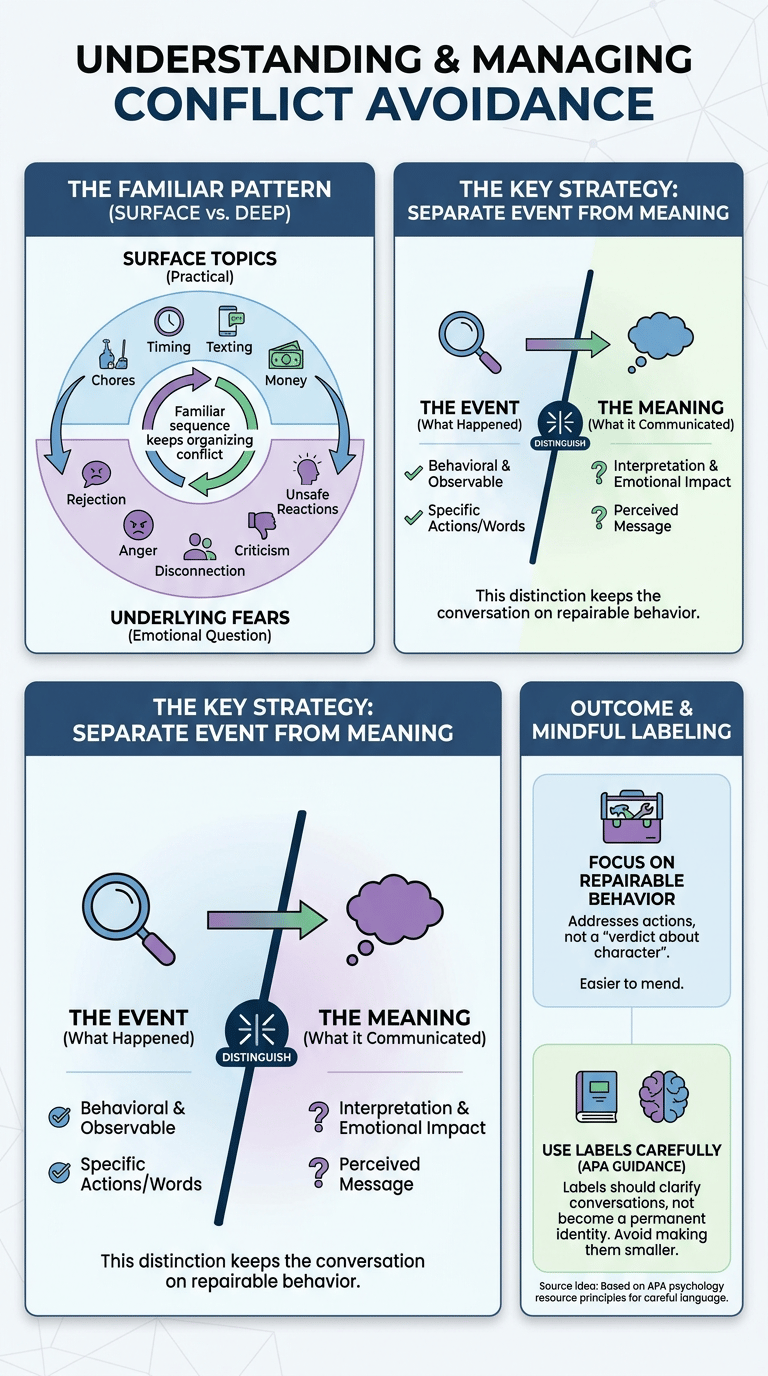
Conflict Avoidance means that a familiar sequence keeps organizing conflict. The topic may be practical, such as chores, timing, texting, tone, planning, or money, but the emotional question underneath often involves fear of rejection, anger, disconnection, criticism, or unsafe reactions.
The pattern is easier to work with when partners separate event from meaning. The event is what happened. The meaning is what the event seemed to communicate. That distinction keeps the conversation close to behavior, which is more repairable than a verdict about character.
For careful language around psychology concepts, APA psychology resources can help readers avoid turning a useful label into a permanent identity. Labels should make a conversation clearer, not smaller.
Why This Pattern Repeats
Conflict Avoidance repeats because each partner is usually trying to protect something real. One person may protect connection, another may protect calm, dignity, fairness, autonomy, or the hope of being taken seriously.
The protective move can be understandable and still costly. A person who explains too fast may be trying to prevent shame. A person who pulls away may be trying to prevent overwhelm. A person who repeats the complaint may be trying to finally be received.
Research and clinical education about relationships often point readers toward patterns rather than isolated moments, which is why PubMed relationship research is useful background for readers who want evidence-aware context without invented statistics.
The Loop: Trigger, Meaning, Reaction, Repair
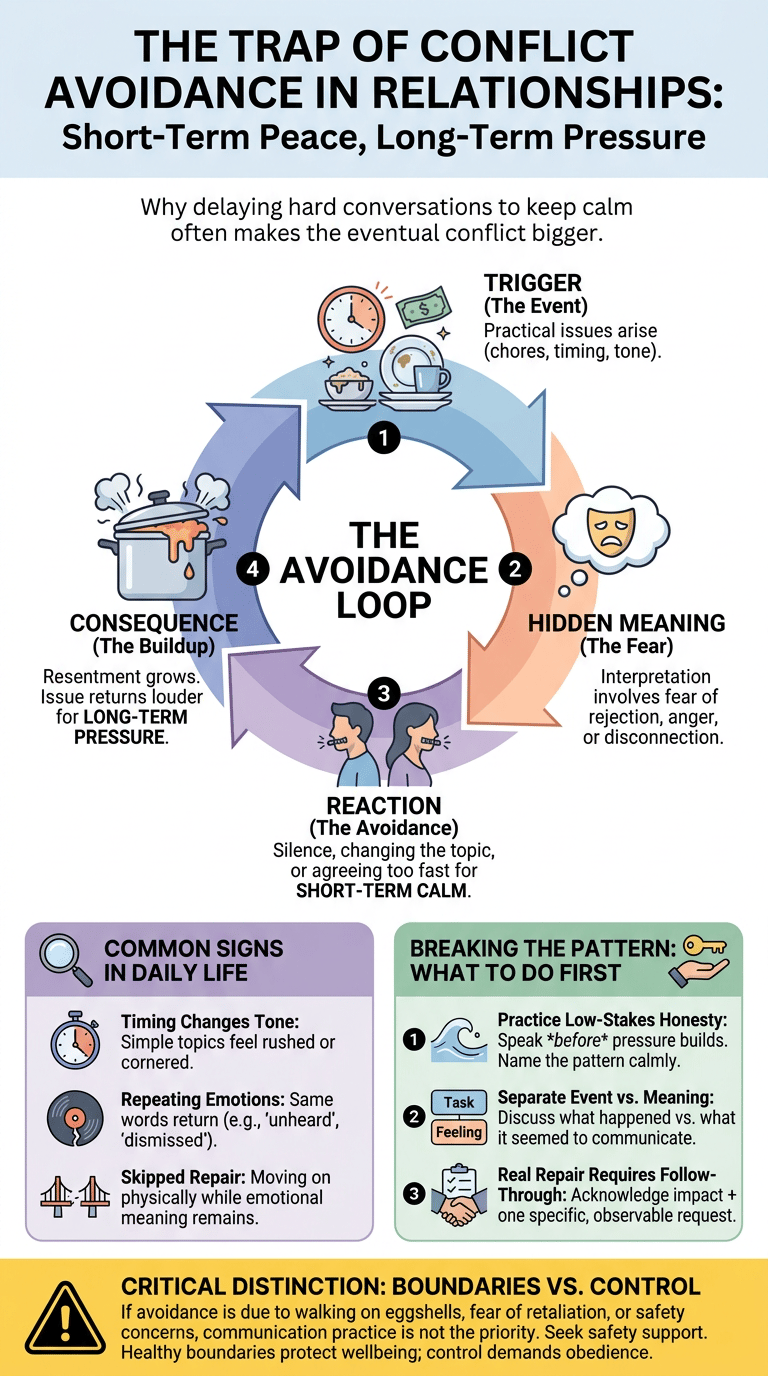
The simplest map for conflict avoidance has four parts. First, a trigger starts the tension. Second, the trigger receives a meaning. Third, each person reacts to protect something. Fourth, the couple either repairs the moment or leaves it unfinished.
| Part of the loop | What to notice | Helpful next move |
|---|---|---|
| Trigger | someone says I am fine, changes topic, agrees too fast, or waits until the issue erupts | Pause and name the moment without accusation |
| Meaning | fear of rejection, anger, disconnection, criticism, or unsafe reactions | Ask what this seemed to communicate |
| Reaction | concern, silence, short term calm, and long term resentment | Practice low stakes honesty before pressure builds |
| Repair | What needs to happen next | Use a clear request plus follow through |
For example, a money worry is postponed for months until resentment speaks louder than the original concern. The surface issue matters, but the repeated emotional sequence is what makes the moment feel bigger than one conversation.
Common Signs In Daily Life
Readers can look for signs of conflict avoidance in the ordinary moments that happen before a major argument. The earliest signs are often small enough to miss.
- Timing changes the tone: a simple topic becomes harder because one partner feels rushed, ignored, or cornered.
- The same emotional word returns: one person keeps saying they feel disrespected, alone, dismissed, pressured, or unimportant.
- Repair gets skipped: the couple moves on physically, but the emotional meaning remains active.
- The next argument starts faster: both partners react to the remembered pattern before the new topic is fully discussed.
Examples That Make The Pattern Clear
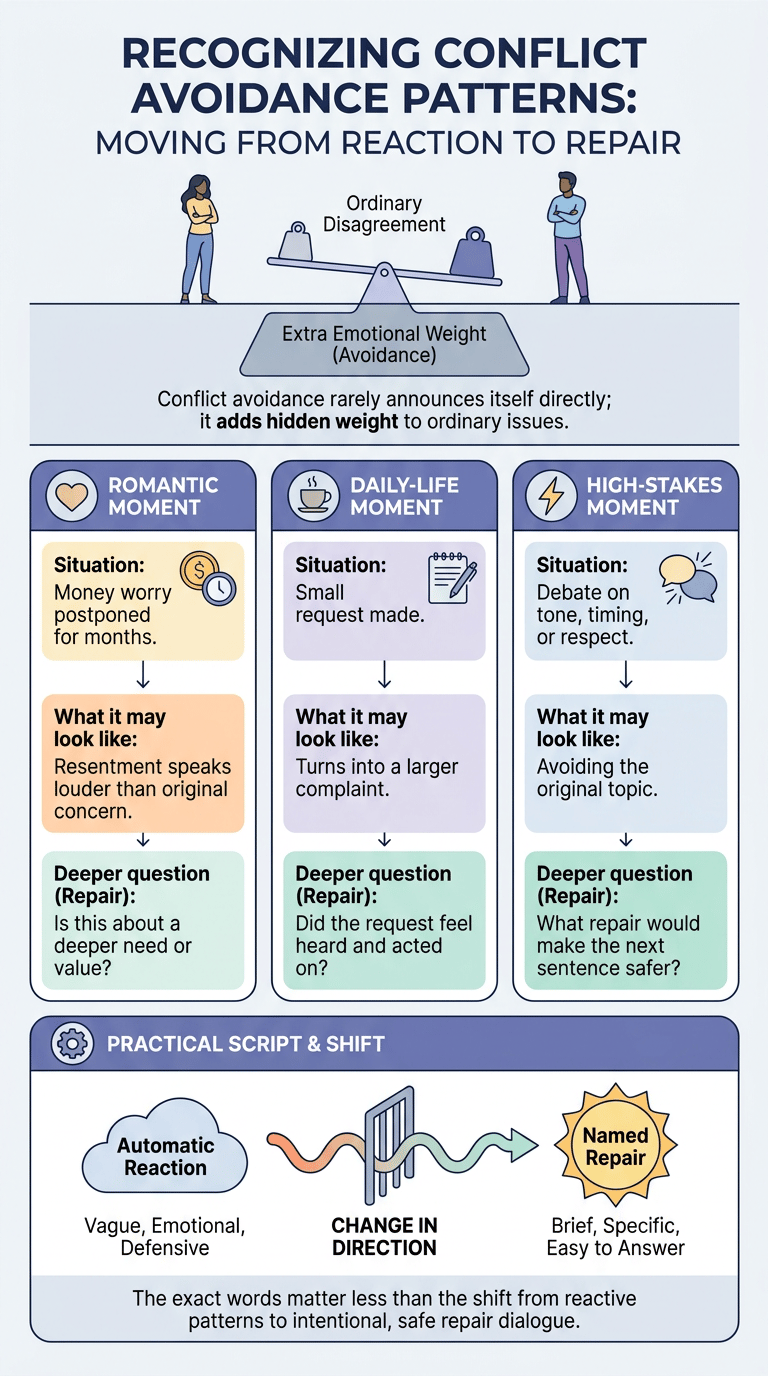
Examples help because conflict avoidance rarely announces itself directly. It usually appears through an ordinary disagreement that starts carrying extra emotional weight.
| Situation | What it may look like | Deeper question |
|---|---|---|
| Romantic moment | a money worry is postponed for months until resentment speaks louder than the original concern | Is this about a deeper need or value? |
| Daily-life moment | A small request turns into a larger complaint | Did the request feel heard and acted on? |
| High-stakes moment | The couple debates tone, timing, or respect instead of the original topic | What repair would make the next sentence safer? |
A practical example script should be brief, specific, and easy to answer. The exact words matter less than the change in direction: from automatic reaction to named repair.
How This Differs From Nearby Patterns
Conflict Avoidance can overlap with stonewalling, pursuer distancer dynamic, feeling unheard. The difference is not always the visible behavior. The difference is the main problem the couple needs to solve first.
If the main issue is the repeated topic itself, stay with this pattern. If the main issue is shutdown, dismissal, pressure, avoidance, or lack of follow-through, compare the pattern carefully before choosing a repair step.
| Question | Points to this article | May point nearby |
|---|---|---|
| What repeats? | concern, silence, short term calm, and long term resentment | stonewalling or pursuer distancer dynamic |
| What helps first? | Practice low stakes honesty before pressure builds | A different repair matched to the adjacent loop |
| What is unsafe? | walking on eggshells, fear of consequences, retaliation, or coercive control | Support and protection before communication practice |
What To Do First
The first step is to practice low stakes honesty before pressure builds. This step works because it slows the conversation before partners become locked into familiar roles.
Use a sentence that names the loop without naming a villain. Then ask one concrete question, such as what did you hear me asking for, or what return time would help us continue this calmly?
- Start with one event: do not summarize the whole relationship during the first repair attempt.
- Name one feeling: choose the emotion that matters most in this moment.
- Ask for one behavior: make the next step observable enough that both partners know whether it happened.
- Check understanding: ask the other person to reflect the meaning before debating the solution.
Conversation Scripts
Scripts are not magic words. They are training wheels for a different emotional direction. The aim is to create enough calm for accountability and listening.
- To name the loop: I think we are in our conflict avoidance pattern, and I want to slow down.
- To separate task and meaning: The task is one issue, but the meaning I am reacting to is the part we need to understand.
- To invite repair: This is small now, and I want to talk while it is still small.
- To pause safely: I need a short break, and I will come back with a time instead of disappearing.
- To check listening: Before we solve it, can you tell me what you heard me say?
Decision Guide For The Next Conversation
A decision guide helps readers avoid doing too much at once. With conflict avoidance, the first choice is not what final solution will satisfy everyone. The first choice is what kind of conversation is actually possible right now.
For a related next step, see this guide to the pursuer-distancer dynamic.
If both people are calm enough to listen, start with meaning. Ask what the moment communicated and what each person wanted protected. If one person is flooded or shutting down, start with pacing. Choose a return time, a shorter agenda, or a written note before the live conversation continues.
If the same issue has been discussed many times without follow-through, start with behavior. A new explanation will not help much unless the next action changes. In that case, define what will happen, when it will happen, and how both people will know it happened.
| Conversation state | Best focus | Example move |
|---|---|---|
| Both people can listen | Meaning and impact | Name what the moment seemed to communicate |
| One person is overwhelmed | Pacing and return | Pause with a specific time to continue |
| The issue repeats often | Behavior and follow-through | Agree on one observable next action |
| Safety feels uncertain | Support and protection | Stop skill practice and seek appropriate help |
Before And After Repair
Before repair, conflict avoidance often feels like a closed room. Each partner may believe the other person is missing the obvious point. The pursuer may feel abandoned, the distancer may feel trapped, the hurt partner may feel dismissed, or the defensive partner may feel accused.
After repair, the topic may still be unfinished, but the emotional direction changes. A partner might say, I understand why that landed badly, or I can see the part I played. The goal is not instant agreement. The goal is enough safety and clarity to keep talking without repeating the exact injury.
A useful repair includes three pieces. First, acknowledge the impact without immediately debating intent. Second, make one specific request or offer. Third, return later to check whether the repair actually helped. This keeps repair from becoming a performance that sounds kind but changes nothing.
- Before repair: the couple argues about who is right.
- During repair: one person names impact, need, and next step.
- After repair: both people watch whether the next behavior matches the words.
- If repair fails: the couple slows down and chooses a smaller, safer conversation.
Self-Check Questions
Self-check questions make conflict avoidance less vague. They help each person notice their own contribution without taking responsibility for everything. The point is accountability, not self-blame.
Ask yourself what you did when the pattern began. Did you push harder, go silent, explain too fast, dismiss the feeling, agree before you meant it, or turn the complaint back around? The answer is useful because it identifies the moment you can practice differently next time.
Also ask what you needed but did not say directly. Many conflict loops intensify because the real request stays hidden behind tone, timing, or criticism. A clearer request gives the other person a better chance to respond, even if the deeper issue still takes time.
- What did I think this moment meant about me, us, or the relationship?
- What did I do to protect myself?
- What did my reaction make harder for the other person?
- What request would be clearer than my usual reaction?
- What boundary do I need if the pattern becomes unsafe or humiliating?
Boundaries Versus Control
Boundaries are important in conflict avoidance, but boundaries and control are not the same thing. A boundary describes what you will do to protect your wellbeing. Control tries to force the other person to think, feel, or behave in a specific way through pressure or fear.
A healthy boundary might sound like: I can continue this when we are not insulting each other, or I will take a break and return at a specific time. A controlling move might sound like a threat, a punishment, or a demand that the other person prove love by abandoning their own limits.
This distinction matters because some relationship advice accidentally treats all conflict as a skill issue. If a partner uses fear, humiliation, isolation, monitoring, or retaliation, the priority is safety and support. Communication tools are for relationships where both people are allowed to have needs.
Reader Scenarios
Scenario one: the topic looks small, but the reaction is big. In this case, conflict avoidance may be carrying an older meaning. The next step is not to mock the size of the topic. It is to ask what the topic came to represent.
Scenario two: one partner wants a solution immediately and the other cannot think clearly. The next step is structure. Agree on a short pause, a return time, and one question to answer when the conversation resumes.
Scenario three: one partner apologizes, but the same action keeps returning. The next step is follow-through. A repair without changed behavior can start to feel like another layer of the conflict.
Scenario four: one person feels afraid to bring up concerns. The next step is not a better script. The next step is support, perspective, and a safety-aware plan that does not depend on persuading the unsafe person to be fair.
Common Mistakes
A common mistake with conflict avoidance is treating the pattern as proof that one partner is the problem. That may feel clear for a moment, but it usually makes both people defend themselves.
Another mistake is creating a rule before understanding the need. Rules can help with logistics, but they do not repair the emotional meaning unless the couple also names what felt hurtful, lonely, unfair, or unsafe.
A third mistake is rushing forgiveness. Repair is not the same as pretending nothing happened. Good repair includes acknowledgment, a changed next action, and room for the hurt partner to see whether the change continues.
Prevention And Maintenance
Prevention for conflict avoidance is built in calm moments. A weekly check-in can ask what started tension, what each person protected, what helped, and what should be tried next time.
Keep maintenance small. Five focused minutes can be enough if both people stay with one recent example. The goal is not to perform a perfect relationship review. The goal is to make the next conflict easier to recognize earlier.
- What was the first sign that the loop was starting?
- What did each of us think the moment meant?
- Which reaction made sense emotionally but created more distance?
- What repair helped even a little?
- What small action will we test before the next hard conversation?
When To Seek Help
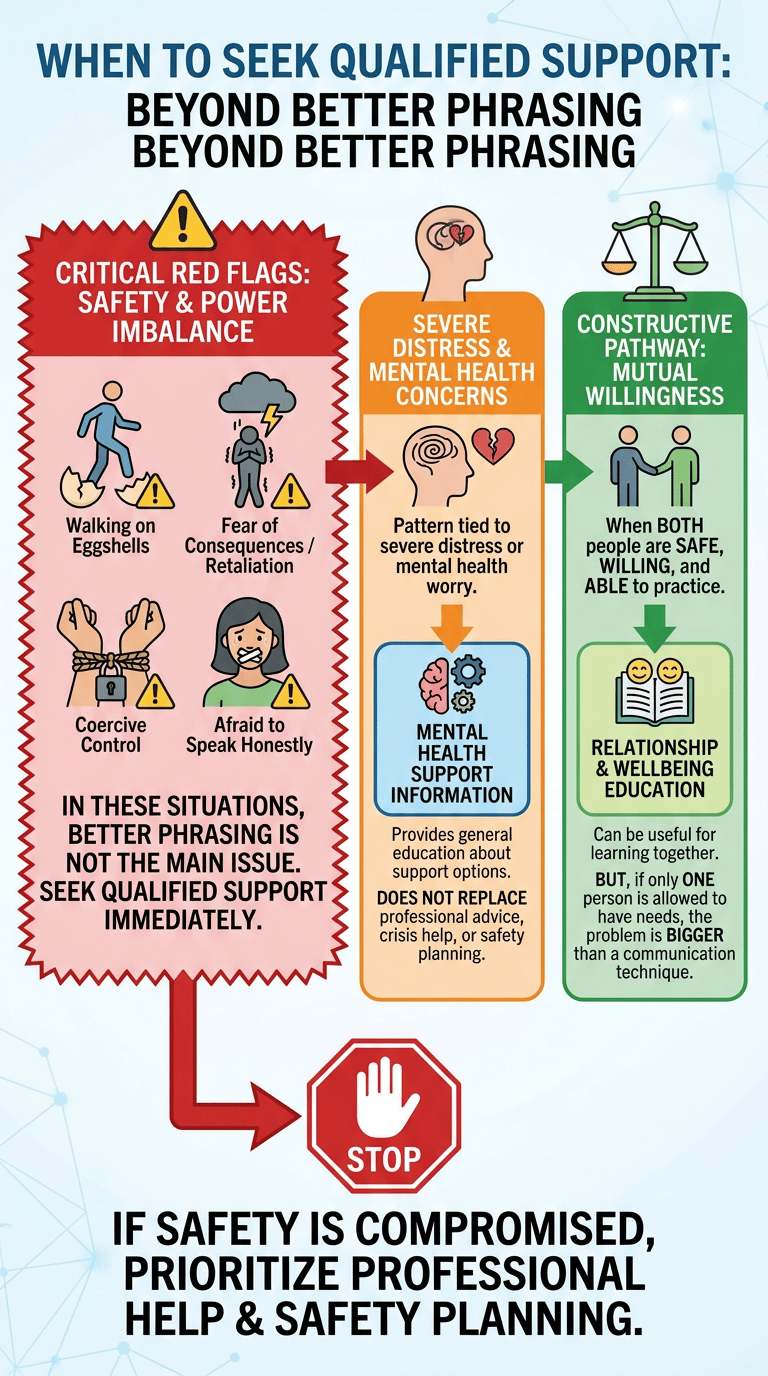
Seek qualified support if conflict avoidance includes walking on eggshells, fear of consequences, retaliation, or coercive control, or if either person feels afraid to speak honestly. In those situations, better phrasing is not the main issue.
If the pattern is tied to severe distress, fear, or mental health concerns, mental health support information can give general education about support options. This article cannot replace professional advice, crisis help, or safety planning.
Relationship education from sources such as relationship and wellbeing education can be useful when both people are safe, willing, and able to practice. If only one person is allowed to have needs, the problem is bigger than a communication technique.
Mini Workbook For Practicing The Pattern
This mini workbook turns conflict avoidance into a short reflection exercise. Use it after a calm moment, not in the middle of a heated argument. The point is to make the next conversation more observable, less global, and easier to repair.
Start with the first minute of the conflict. Write down the exact moment when the emotional temperature changed. It might be a word, a facial expression, a delay, a silence, a joke, a forgotten task, or a sentence that sounded sharper than intended.
For broader context, see this guide to relationship conflict patterns.
Next, write the story your mind attached to that moment. The story may involve feeling ignored, crowded, judged, dismissed, controlled, unimportant, or alone. Naming that story does not make it automatically true. It simply shows what your expectations reacted to.
Then identify your protective move. Did you pursue, defend, withdraw, minimize, agree too quickly, repeat yourself, or try to fix the feeling before hearing it? Choose one verb. A single verb is more useful than a long case against yourself or your partner.
Finally, choose a repair experiment for next time. An experiment is smaller than a promise to change forever. It might be one softer opening, one reflective sentence, one written request, one timed pause, or one check-in after the conversation ends.
| Workbook prompt | Write this down | Keep it specific |
|---|---|---|
| First signal | The moment the tone changed | One sentence or behavior |
| Attached meaning | What the moment seemed to say | A need, fear, or value |
| Protective move | What I did next | One verb if possible |
| Repair experiment | What I will try next time | One observable action |
This exercise is not meant to decide who was right. It is meant to create a shared map. Once the map is visible, both partners can talk about timing, tone, needs, boundaries, and follow-through with less guessing.
How To Review Progress
Progress with conflict avoidance is usually gradual. Do not measure it only by whether conflict disappears. A better measure is whether the loop starts later, softens sooner, ends with clearer repair, or creates less emotional residue the next day.
Look for small evidence: one partner pauses before counterattacking, one request becomes more specific, one timeout includes a return time, or one apology is followed by a changed action. These small changes matter because patterns are maintained through repetition and changed through repetition too.
If nothing changes after repeated attempts, treat that as information. It may mean the repair plan is too vague, the timing is wrong, one person does not feel safe enough to participate, or outside support is needed. Honest review prevents the couple from mistaking effort for progress.
FAQ
Is conflict avoidance normal?
Some repeated tension is common in close relationships, but conflict avoidance becomes more concerning when it creates chronic resentment, fear, withdrawal, humiliation, or a sense that repair never lasts.
Can this pattern change?
Yes, when both partners can notice the sequence early, take responsibility for their part, and practice a specific repair. Change is less likely when one person must do all the emotional work.
What if my partner will not talk about it?
Start by making one clear request and one calm boundary. If the refusal includes punishment, intimidation, or repeated dismissal, consider outside support instead of trying to solve it through better wording alone.
Key Takeaways
- Conflict Avoidance is a repeated loop, not a single bad moment.
- The core sequence is concern, silence, short term calm, and long term resentment.
- The first move is to practice low stakes honesty before pressure builds.
- Good repair includes both emotional acknowledgment and observable follow-through.
- Safety concerns come before communication practice.
Use the article slowly. Pick one section that matches the next real conversation, practice that part, and review what changed. Relationship patterns become less powerful when they are noticed earlier, named more kindly, and repaired with behavior that can actually be seen. The smallest reliable change is often more useful than a dramatic promise, especially when both people can repeat it during ordinary stress. Keep the focus on the next observable moment, because that is where a new pattern can actually begin together.
The practical goal is to notice conflict avoidance earlier, speak about it more specifically, and make repair concrete enough that the next conversation has a different path.

Michael Reed is the Founder and Lead Writer at Psychology Exposed. He writes about human behavior, relationships, emotional patterns, self-awareness, and practical psychology topics using research-informed, easy-to-understand content.
Read More About Michael Reed: https://psychologyexposed.com/michael-reed/