
What Does an Attachment Style Test Measure?
Emotional patterns in close relationships
An attachment style test is designed to summarize recurring emotional patterns you are likely to show in close relationships. Rather than diagnosing a disorder, these quizzes and validated questionnaires aim to identify tendencies in how you feel and behave when you become close to someone, when you need support, and when you perceive threat to a relationship. For clear definitions of psychological terms related to emotions and relationships, the APA Dictionary of Psychology is a reliable reference for commonly used concepts in attachment research.

How you respond to intimacy and distance
One of the main things attachment measures is the way you handle intimacy and distance. Some people tend to move toward closeness and reassurance, others pull away to protect independence, and some shift between approaches depending on context. Tests typically ask about your comfort with closeness, how much you seek reassurance from partners, and how you react when someone becomes emotionally distant.
How you handle trust, conflict, and reassurance
Attachment items often probe your default strategies for trust and conflict. For example, a test may capture whether you automatically assume a partner will be available and trustworthy, whether you worry about abandonment, or whether you prefer to manage problems on your own. These patterns shape how you ask for support, how often you need reassurance, and how you respond when a relationship is strained.
Important Warning Before Reading Your Result
An attachment test is not a diagnosis
It is important to remember that an attachment style test is a tool for reflection and self-understanding, not a clinical diagnosis. Attachment styles are descriptive categories based on common patterns, not labels that define your entire personality. If you are concerned about symptoms that interfere with daily life, consider consulting a qualified professional for assessment and guidance. For general information about mental health topics and when to seek help, reputable resources include the National Institute of Mental Health and MedlinePlus.
Results can change over time
Attachment tendencies are not fixed. People can shift toward more secure patterns over time through life experiences, new relationships, and intentional work. Tests capture a snapshot of tendencies at the time you take them. When interpreting results, keep in mind your score could change with new knowledge, practice, or changes in your life circumstances.
Your relationship context matters
Your attachment pattern can vary by partner and situation. The same person may feel secure with a long-term partner and anxious with a new relationship, or avoidant in romantic partnerships but comfortable with friends. Tests provide a general tendency, but they do not predict every reaction in every relationship. The American Psychological Association offers resources on how context and individual differences shape behavior.
Use the result as a reflection tool
Treat your attachment test result as an invitation to reflect. A helpful approach is to ask how the result matches your real interactions: does it explain recurring tensions, requests for reassurance, or moments when you shut down? Use the outcome to notice patterns rather than to label yourself permanently. Reflection can point to small, practical changes you might experiment with in your relationships.
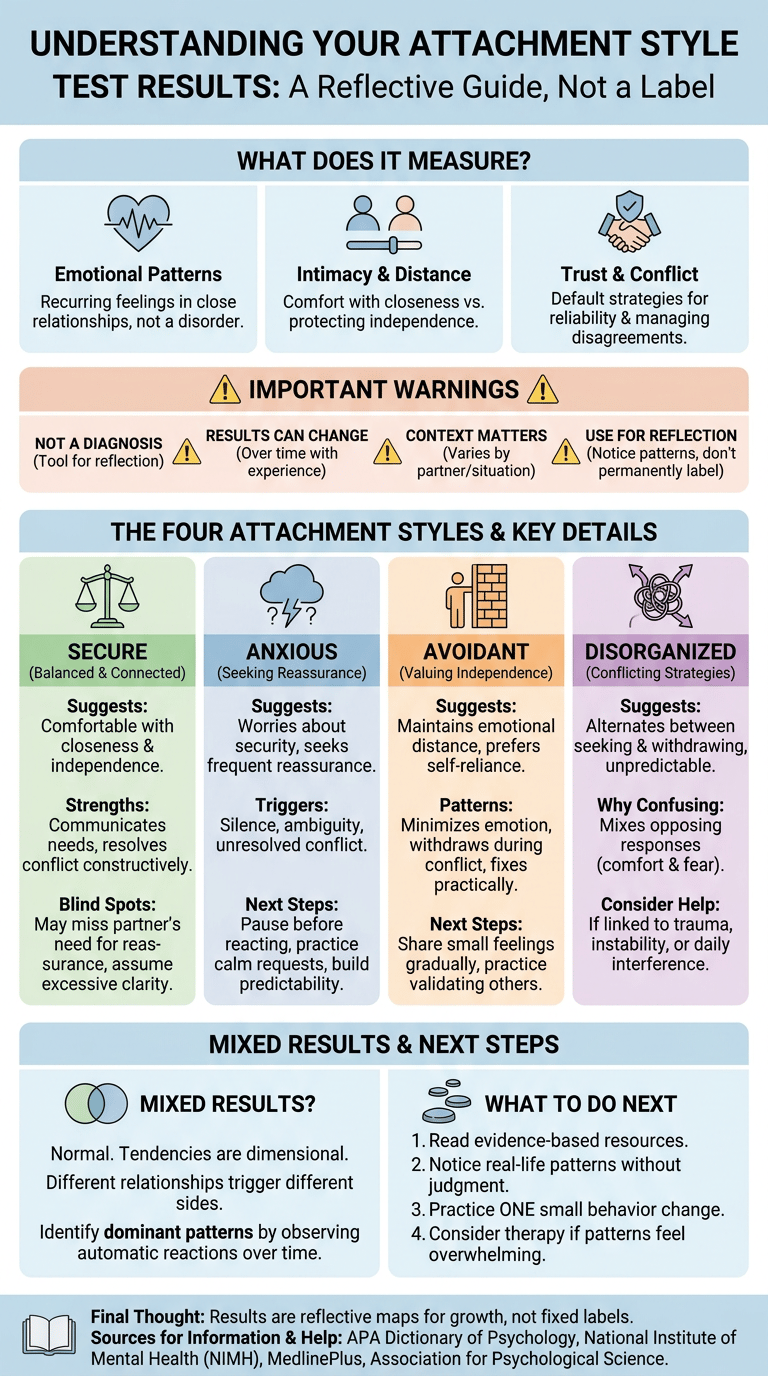
Secure Attachment Test Result Meaning
What it usually suggests
A secure attachment test result typically suggests you tend to feel comfortable with closeness and with depending on others, while also tolerating independence in relationships. People who test as secure generally report trusting partners, communicating needs without severe anxiety, and recovering from conflict in ways that restore connection. Secure does not mean you never worry or encounter difficulties; it means you usually have a balanced approach to intimacy and autonomy.
Common strengths
Common strengths associated with a secure result include the ability to:
- Ask for support when needed and offer support without excessive fear or withdrawal
- Communicate feelings and needs in a way that maintains connection
- Manage conflicts with the expectation that issues can be resolved or worked through
- Maintain emotional stability across changing circumstances
Possible blind spots
Even a secure pattern has blind spots. People who are generally secure may:
- Underestimate how much a partner needs reassurance and therefore miss signs of distress
- Assume communication is clearer than it is, leading to surprise when needs are unmet
- Avoid addressing long-standing issues early because they expect problems to resolve on their own
Recognize these blind spots as opportunities for growth rather than failures. Small, deliberate conversations about expectations and needs can strengthen relationships further.
Anxious Attachment Test Result Meaning
What it usually suggests
An anxious attachment result usually suggests a tendency to worry about relationship security and to seek frequent reassurance. People who test as anxious often feel heightened sensitivity to signs of rejection or withdrawal and may interpret ambiguous behavior as negative or threatening. This pattern reflects a desire for closeness paired with concern that closeness might be lost.
Common emotional triggers
Frequently reported triggers for anxious patterns include:
- Perceived silence or delayed responses from a partner
- Ambiguous comments or unclear expressions of commitment
- Conflict that leaves needs unspoken or unresolved
When triggered, someone with an anxious pattern may escalate efforts to reconnect, ask for reassurance repeatedly, or experience intense worry until clarity is restored.
What to work on next
If you receive an anxious result and wish to shift toward greater balance, consider small, practical steps:
- Practice noticing your physiological signs of anxiety and pause before responding in the moment
- Experiment with clear, calm requests for what you need rather than escalating urgency
- Build repeated experiences of predictable responsiveness with trusted partners to create new evidence that relationships can be reliable
Reading about attachment patterns and trying manageable behavior changes can be useful first steps. If worry about relationships is intense, persistent, or disrupts daily functioning, seeking professional support can help you develop tailored strategies. For general mental health information and guidance on when to seek help, consult the National Institute of Mental Health.
For a simple foundation, see this guide to what attachment styles are.
For broader context, see this guide to attachment styles in psychology.
Avoidant Attachment Test Result Meaning
What it usually suggests
An avoidant attachment test result typically points to a pattern of maintaining emotional distance to protect independence. People who test as avoidant may prefer to handle problems on their own, value self-reliance, and sometimes downplay the importance of close emotional sharing. This approach can support autonomy but can also create barriers to intimacy when partners need emotional engagement.
Common distancing patterns
Common behaviors associated with avoidant patterns include:
- Minimizing emotional expression or changing the subject when conversations become intense
- Withdrawing physically or emotionally during conflict
- A preference to fix practical problems rather than explore feelings
These patterns often develop as protective strategies. While they reduce perceived vulnerability, they can leave partners feeling unheard or unimportant if emotional needs are not acknowledged.
What to work on next
To move toward more flexible responses, consider gradual experiments:
- Share one small feeling with a partner and observe their response before sharing more
- Practice validating a partner’s feelings even when you prefer practical solutions
- Set limits that protect autonomy while agreeing on routines for emotional check-ins
These steps aim to expand your comfort with emotional closeness without sacrificing independence. If distancing patterns lead to repeated relationship breakdowns or emotional isolation, a therapist can help explore how early experiences shaped current strategies and support sustainable changes. For overviews of relationship and emotional health topics, see the American Psychological Association.
Disorganized Attachment Test Result Meaning
What it usually suggests
A disorganized attachment test result generally suggests conflicting strategies around closeness and safety. People with this pattern may alternate between seeking closeness and withdrawing, and their reactions can appear unpredictable or confusing to themselves and others. Disorganized patterns sometimes reflect early experiences where caregivers were a source of both comfort and fear or where caregiving was inconsistent.
Why the result can feel confusing
Because disorganized patterns mix opposing responses, they can be emotionally confusing. You might notice rapid switches between wanting reassurance and pushing people away, or you may feel overwhelmed by strong, unstable emotions in relationships. This can make it harder to form a coherent plan for asking for support, and it can leave you exhausted or puzzled by your own responses.
When professional support may help
If a disorganized pattern is linked to painful memories, repeated relationship instability, or symptoms that interfere with daily life, professional support can be helpful. A trained clinician can offer structured approaches for building emotional regulation, processing past trauma, and forming safer relational habits. For information about mental health resources and how to find help, consult patient-focused resources such as MedlinePlus. If you experience severe distress, thoughts of self-harm, or thoughts of suicide, reach out to emergency services or a crisis line in your area immediately.
What If You Get Mixed Results?
Why people can show more than one pattern
Many people receive mixed results because attachment tendencies are dimensional rather than strictly categorical. Life history, current stressors, partner dynamics, and coping strategies all influence how you respond in relationships. Tests sometimes report primary and secondary patterns, reflecting a blend of strategies you use in different situations.
Why different relationships trigger different sides
Different relationships can activate different parts of your attachment profile. A relationship that feels familiar and safe may bring out secure responses, while a high-stakes or ambiguous relationship may trigger anxious or avoidant strategies. Observing which relationships bring out which responses can be instructive and guide targeted changes.
How to identify your dominant pattern
To identify a dominant pattern, look for the style that appears most frequently across relationships and over time. Ask:
- Which reactions are automatic when I feel threatened in a relationship?
- What do I do first when I feel hurt by a partner?
- Which patterns leave me frustrated or stuck most often?
Keeping a relationship journal for several weeks can help reveal consistent tendencies. You can also compare notes with a trusted friend or therapist to gain perspective.
What to Do After Learning Your Attachment Style
Read about your specific style
Start by learning more about the tendencies associated with your result. Focus on educational, evidence-aware resources rather than anecdotal or prescriptive content. The Association for Psychological Science offers accessible articles that summarize research findings and can help place attachment patterns in a broader behavioral context.
Notice real-life patterns
Turn your attention to real interactions. Notice situations that reliably produce anxiety, withdrawal, or secure connection. Pay attention to bodily sensations, thoughts, and timing of reactions. Observing patterns without self-judgment creates the data you need to try different responses.
Practice one behavior change at a time
Small, consistent experiments are more effective than trying to change everything at once. Choose one manageable behavior aligned with a healthier pattern and practice it in low-stakes situations. For example, if you are anxious, practice asking for a small clarification calmly. If you are avoidant, try offering a brief supportive statement when a partner is upset. Track the outcome and adjust what you practice.
Consider therapy if patterns feel overwhelming
If attachment patterns cause ongoing distress, repeated relationship ruptures, or interfere with work or daily functioning, therapy can offer targeted support. A skilled clinician can help you understand origins of your pattern, develop emotional regulation skills, and practice new relational habits in a safe environment. For information about mental health care and finding professional support, see guidance at MedlinePlus and the National Institute of Mental Health. If you are in crisis or at risk of harm, contact emergency services or a crisis line immediately.
Final Thoughts
Attachment style test results are best used as reflective maps rather than fixed labels. They can highlight patterns that explain recurring relationship dynamics and point to practical next steps. Use your result to observe, experiment, and slowly build experiences that support healthier, more satisfying connections. When patterns feel entrenched or cause significant distress, consider reaching out to a qualified mental health professional for support. For further reading, see the APA Dictionary of Psychology, the American Psychological Association resources on relationships and behavior, and public-facing mental health information from the National Institute of Mental Health and MedlinePlus.

Michael Reed is the Founder and Lead Writer at Psychology Exposed. He writes about human behavior, relationships, emotional patterns, self-awareness, and practical psychology topics using research-informed, easy-to-understand content.
Read More About Michael Reed: https://psychologyexposed.com/michael-reed/