
Attachment styles describe common patterns in how people form and maintain emotional bonds. These patterns influence feelings of safety, trust, intimacy, and how we respond to conflict in close relationships. This article provides an overview of attachment styles in psychology, where they come from, how they shape adult relationships, and pathways for becoming more securely attached.

What are attachment styles in psychology?
Definition
In psychology, attachment styles are recurring ways people think, feel, and behave in close relationships based on expectations about whether others will be available, responsive, and safe. These patterns operate across romantic partnerships, friendships, and sometimes toward family members. For concise definitions and topic context, see the American Psychological Association’s topics page for overviews and related materials on psychological topics.
How attachment styles develop from early caregiving
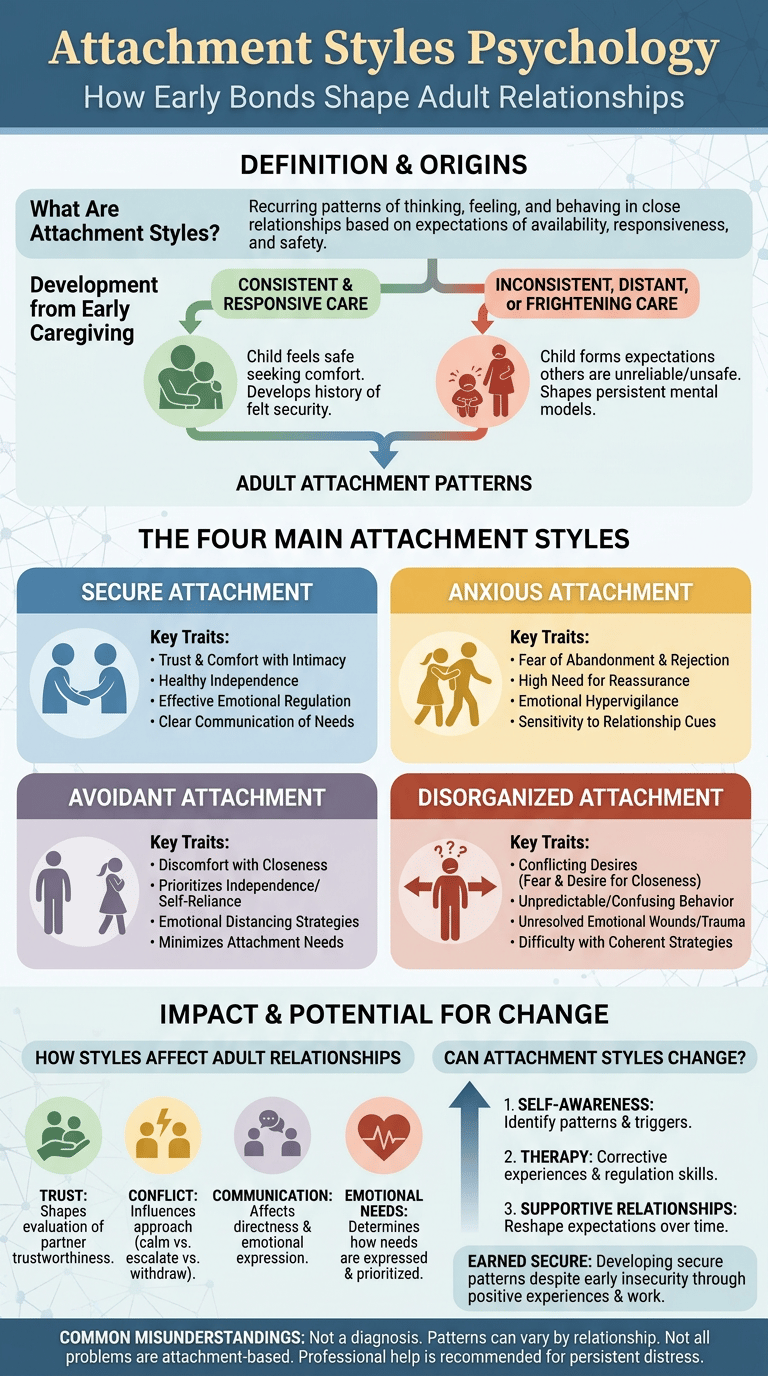
Attachment patterns originate in early interactions with primary caregivers. When caregivers are consistently responsive and emotionally available, a child is more likely to develop a history of feeling safe seeking comfort. When care is inconsistent, distant, or frightening, a child may form expectations that others are unreliable or unsafe. These early interpersonal experiences shape mental models of relationships that can persist into adulthood. For background on these developmental roots and related research themes, see the APA Dictionary and topic materials in the APA Dictionary.
Why attachment patterns can continue into adulthood
Attachment patterns tend to be stable because they are reinforced over time by similar relationship dynamics and by internal working models that guide attention, memory, and expectation. For example, if someone learns that seeking closeness sometimes leads to rejection, they may start minimizing attachment needs or scanning relationships for signs of threat. Although these patterns were adaptive in certain contexts, they can become a source of difficulty in adult relationships when they limit emotional safety, intimacy, or flexible problem solving. Research summaries and accessible commentary on the persistence and functions of attachment-related patterns are available through psychological science resources that summarize behavioral research.
The psychology behind attachment theory
John Bowlby and the foundation of attachment theory
Attachment theory was first developed by John Bowlby, who proposed that humans are biologically predisposed to form close bonds that promote survival and emotional regulation. Bowlby emphasized that early bonds provide a secure base for exploration and a source of comfort during distress. His framework linked evolutionary, developmental, and cognitive ideas to explain how early caregiving relationships influence later social and emotional functioning. Contemporary summaries of Bowlby’s ideas and their influence on developmental psychology are available through APA materials on the APA topics page.
For a relationship-focused view, see this guide to avoidant attachment in relationships.
For a related next step, see this guide to the signs of anxious attachment.
For a related next step, see this guide to understanding an attachment style test.
For a practical next step, see this guide on how to heal avoidant attachment.
For a practical next step, see this guide on how to heal anxious attachment.
For a relationship-focused view, see this guide to anxious attachment in relationships.
For a related next step, see this guide to the signs of avoidant attachment.
For a related next step, see this guide to the disorganized attachment style.
For a related next step, see this guide to the avoidant attachment style.
For a related next step, see this guide to the anxious attachment style.
Mary Ainsworth and early attachment research
Mary Ainsworth expanded empirical work in attachment through observational studies, notably the “Strange Situation” procedure, which classified infant-caregiver interactions into patterns that later formed the basis for describing different attachment styles. Ainsworth’s work highlighted how caregiver sensitivity and responsiveness related to secure patterns in infants. For historical and research context on early attachment studies and their outcomes, consult psychology research summaries and educational content from psychological science resources.
Why attachment is connected to emotional safety
Attachment is fundamentally about emotional safety: whether a person expects support and comfort when stressed. These expectations influence the ability to regulate emotion, seek help, and form close bonds. Feeling secure with another person tends to lower physiological and emotional arousal during stress and supports cooperative problem solving. Conversely, insecure expectations can create hypervigilance, withdrawal, or chaotic responses that undermine feeling safe. For information about how attachment patterns relate to mental and emotional health, see national mental health resources from the National Institute of Mental Health.
The four main attachment styles
Secure attachment
Secure attachment reflects a pattern of trust in others’ availability, comfort with closeness, and effective emotional regulation. People with secure attachment generally feel comfortable seeking support and also allowing partners independence. They tend to be responsive, communicate needs clearly, and manage conflict constructively.
Emotional trust
Emotional trust means expecting others to offer comfort and support when needed. A secure person is more likely to believe that asking for help will be met with care rather than rejection.
Healthy independence
Securely attached individuals balance closeness with autonomy. They can pursue personal goals without sacrificing relationship connection and can tolerate separations without excessive anxiety.
Comfort with intimacy
Comfort with intimacy involves ease in sharing feelings, relying on others, and responding empathetically to a partner’s needs. This typically supports open communication and mutual problem solving.
Anxious attachment
Anxious attachment is characterized by heightened worry about rejection or abandonment, a strong desire for closeness, and sensitivity to relationship cues. People with this pattern may seek frequent reassurance and interpret ambiguous signals as signs of disconnection.
Fear of abandonment
Fear of abandonment leads to vigilance for signs that a partner might leave and may drive persistent seeking of closeness or reassurance.
Need for reassurance
Frequent need for reassurance can help reduce immediate anxiety but may place strain on partners if reassurance feels insufficient or temporary.
Emotional hypervigilance
Emotional hypervigilance means being highly tuned to cues of rejection, which can amplify distress and influence interpretations of partner behavior in ways that maintain worry.
Avoidant attachment
Avoidant attachment involves discomfort with closeness and a tendency to maintain emotional distance. People with this style prioritize independence and may downplay attachment needs to reduce perceived vulnerability.
Discomfort with closeness
Discomfort with closeness can limit emotional sharing and reduce opportunities for reciprocal support, sometimes leaving both partners feeling less connected.
Emotional distancing
Emotional distancing includes strategies such as minimizing feelings, redirecting conversations, or creating physical or emotional space to manage perceived threats to autonomy.
Strong need for independence
An emphasis on self-reliance can be adaptive in some contexts, but when it consistently prevents mutual support it can undermine relationship satisfaction.
Disorganized attachment
Disorganized attachment reflects conflicting or disoriented patterns, often emerging when caregiving is frightening, inconsistent, or when the child experiences unresolved trauma. In adults, this style can look like fluctuating between seeking closeness and withdrawing, or engaging in behaviors that confuse partners.
Fear and desire for closeness at the same time
People with disorganized patterns may simultaneously want connection and feel fearful of it. This internal conflict can produce unpredictable responses to intimacy.
Confusing relationship behavior
Confusing behavior may include sudden shifts in approach or avoidance, mixed messages, or difficulty maintaining coherent strategies for getting needs met.
Unresolved emotional wounds
Unresolved early stressors, loss, or trauma can contribute to disorganized patterns. When severe or ongoing, such wounds can make consistent emotion regulation and trust more difficult.
How attachment styles affect adult relationships
How attachment shapes trust
Attachment expectations shape how people evaluate a partner’s trustworthiness. Securely attached individuals are more likely to give partners the benefit of the doubt and to interpret ambiguous behavior as nonthreatening. Anxiously attached people may assume threat and seek reassurance, while avoidant people may withhold trust to protect autonomy. These tendencies influence whether partners feel safe relying on each other and how forgiveness and repair occur after misunderstandings.
How attachment shapes conflict
Attachment style affects how couples approach conflict. Secure people tend to manage disagreements with calm problem solving and mutual respect. Anxious partners may escalate conflict to gain closeness, while avoidant partners may withdraw to reduce discomfort. When partners have mismatched patterns, cycles of demand and withdraw can develop, prolonging conflict and making resolution harder.
How attachment shapes communication
Communication patterns are influenced by attachment-based expectations. Those with secure attachment usually communicate needs and boundaries more directly. Anxious individuals may communicate through heightened emotion or repeated requests for reassurance. Avoidant individuals may use indirect strategies, minimize emotional content, or change topics to avoid vulnerability. Recognizing these tendencies can help partners adjust their communication to prevent misunderstandings.
How attachment shapes emotional needs
Attachment patterns shape how people express and prioritize emotional needs. Secure individuals generally feel comfortable expressing needs and receiving support. Anxious individuals often need frequent validation, and avoidant individuals may need space and autonomy. Understanding these differences can help partners negotiate care in a way that respects both closeness and independence.
Can your attachment style change?
Why attachment styles are patterns, not permanent labels
Attachment styles are enduring tendencies rather than fixed destinies. They reflect learned patterns that can be flexible, especially when new relational experiences provide corrective information. Describing attachment as a pattern avoids stigmatizing individuals and highlights the potential for growth and adaptation.
What earned secure attachment means
Earned secure attachment refers to people who, despite insecure early experiences, develop more secure ways of relating through later positive experiences, self-reflection, or therapeutic work. This shift can occur when people form relationships that consistently provide responsiveness, or when they learn skills for emotion regulation and perspective taking. For discussion of how therapy and supportive relationships can foster healthier relational patterns, see national mental health information from the National Institute of Mental Health.
How self-awareness, therapy, and healthy relationships can help
Several pathways can support change toward more secure attachment patterns:
- Self-awareness: Learning to identify one’s patterns, triggers, and needs can interrupt automatic reactions and create space for different choices.
- Therapy: Psychotherapy can provide a consistent corrective relationship, teach regulation skills, and help reframe maladaptive beliefs about relationships. Trusted mental health resources explain treatment options and when to seek professional help in patient-friendly overviews.
- Supportive relationships: Ongoing relationships that are responsive and predictable can gradually reshape expectations about closeness and safety.
- Practical skill-building: Practicing clear communication, setting boundaries, and learning calming strategies can improve day-to-day interactions.
If relationship patterns are causing persistent distress or significantly interfere with daily life, consider consulting a qualified mental health professional for assessment and individualized support. National mental health agencies provide educational guides about symptoms, treatment options, and how to find care through their information pages.
Common misunderstandings about attachment styles
Attachment style is not a diagnosis
Attachment styles describe patterns of relating and are not clinical diagnoses. They can inform understanding about relationship habits and emotional responses, but they do not replace clinical assessment for mental health conditions. For accurate definitions and topic guidance, consult professional psychology resources in the APA Dictionary.
People can show different patterns in different relationships
Attachment tendencies may vary across relationships and over time. For example, someone may feel secure with close friends yet anxious in romantic relationships. Context, partner behavior, life stress, and personal growth all influence how attachment patterns are expressed.
Not every relationship problem is caused by attachment
Attachment offers a useful lens for understanding relational dynamics, but relationship difficulties also arise from communication skills, practical stressors, incompatible values, life transitions, and mental or physical health issues. Attachment explanations are one piece of a broader puzzle. When problems are severe, persistent, or tied to mental health concerns, reliable health resources recommend seeking professional evaluation and support for guidance on finding help.
Final thoughts: why attachment styles matter
Attachment styles are a psychology-based way to understand recurring relationship patterns connected to emotional safety, intimacy, trust, and conflict. Knowing your attachment tendencies can clarify why certain interactions feel familiar or fraught, and it can point to specific skills and relationships that support change. Importantly, attachment patterns are not moral judgments; they are learned strategies that can be modified through awareness, supportive connections, and professional help when needed. For readers who want to explore the psychological foundations and research background further, behavioral science summaries provide reliable resources through Psychological Science.
If you experience ongoing relationship distress, intense emotional symptoms, or signs that interfere with your daily functioning, consider reaching out to a licensed mental health professional or a trusted healthcare provider for evaluation and support. National mental health organizations offer information about treatment options and how to find care from reputable resources.

Michael Reed is the Founder and Lead Writer at Psychology Exposed. He writes about human behavior, relationships, emotional patterns, self-awareness, and practical psychology topics using research-informed, easy-to-understand content.
Read More About Michael Reed: https://psychologyexposed.com/michael-reed/