
Secure attachment is often described as a stable, trusting way of relating to others. That description can miss what is most useful about this style: emotional flexibility and a sense of relationship safety that supports growth, intimacy, and repair after conflict. This article explains what secure attachment means, the core traits you are likely to see in securely attached people, how it develops, what it looks like in adult relationships, and whether less secure patterns can shift toward greater security.

What is secure attachment style?
Simple definition
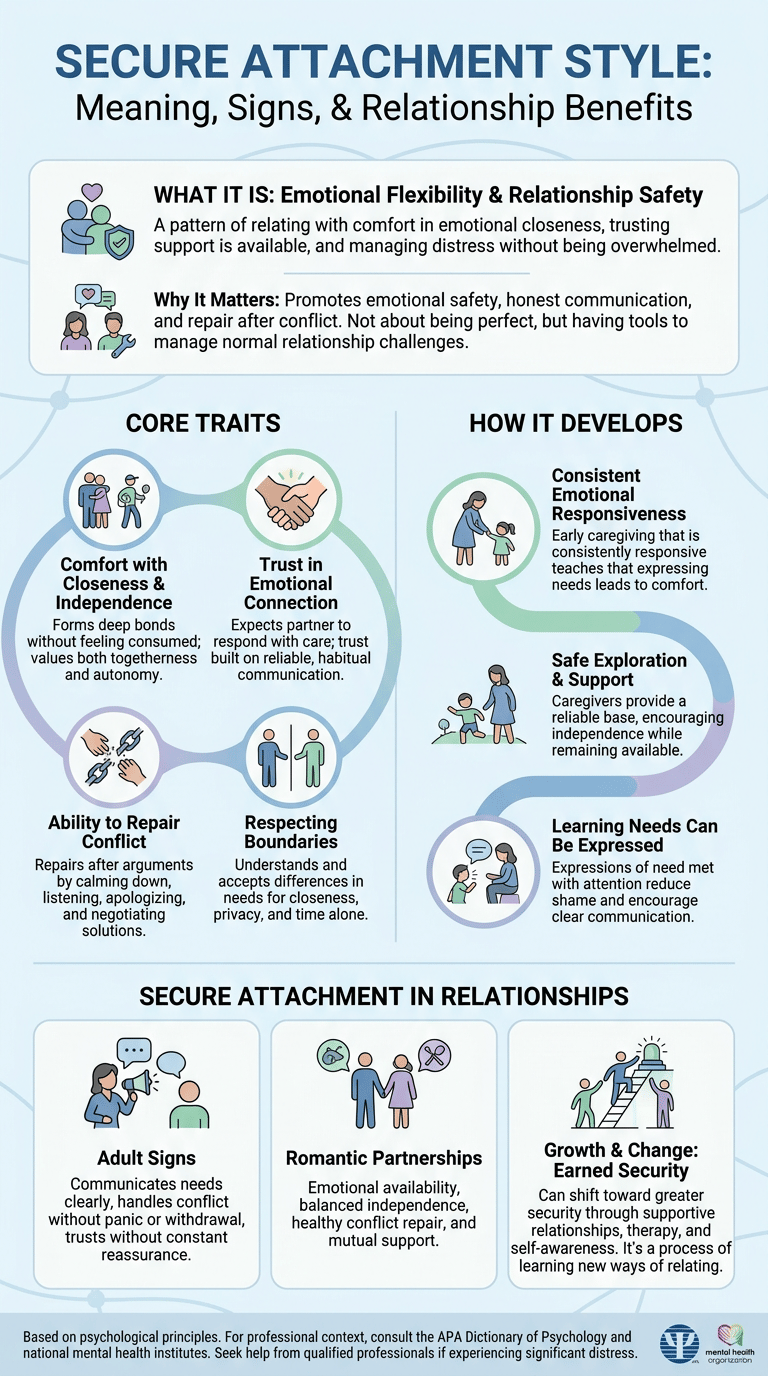
Secure attachment describes a pattern of relating to close others in which a person is comfortable with emotional closeness, trusts that support will be available when needed, and can manage distress without becoming overwhelmed or shutting down. Psychologists use the term in both developmental and adult relationship contexts to summarize these consistent patterns of thought, feeling, and behavior. For a concise professional definition, see the APA Dictionary of Psychology (APA Dictionary of Psychology).
Why secure attachment is linked to emotional safety
Secure attachment tends to promote emotional safety because securely attached people expect that others will respond in supportive, reliable ways when they express needs or distress. That expectation reduces chronic anxiety about rejection and encourages honest communication, which in turn allows both partners to repair misunderstandings and maintain connection. The American Psychological Association outlines how predictable, responsive interactions help form a foundation of emotional safety in relationships (APA Topics).
Why secure does not mean perfect
Secure attachment is not the same as being emotionally flawless or never feeling jealous, anxious, or unsure. People with a secure style still have normal insecurities and conflicts. The difference is that they generally have tools and expectations that make it easier to manage those emotions. They can bring worries into conversations, ask for support without expecting rejection, and recover from setbacks rather than allowing one difficulty to define an entire relationship.
Core traits of secure attachment
Comfort with closeness
One hallmark of secure attachment is comfort with intimacy. Securely attached people usually form close bonds without feeling consumed by the relationship. They are able to engage deeply with a partner or friend, share vulnerabilities, and accept closeness as a source of support rather than a threat.
Comfort with independence
Secure attachment also includes comfort with autonomy. People who are securely attached do not interpret a partner’s need for space as rejection. They value both interdependence and personal interests, and can maintain identity and friendships outside the primary relationship.
Trust in emotional connection
Trust is central. Securely attached individuals tend to expect that their partner will respond with care when needed. That trust is built from past experiences of reliable responsiveness and from habitual communication that reinforces reliability over time.
Ability to repair conflict
Conflict is inevitable in close relationships. Secure attachment is associated with an ability to repair after conflict by calming down, listening to the other person’s point of view, apologizing when necessary, and negotiating solutions. The presence of repair processes is more important than never having disagreements.
How secure attachment develops
Consistent emotional responsiveness
Early caregiving that is consistently responsive to a child’s signals tends to support secure attachment. That responsiveness teaches a child that expressing needs leads to comfort and that others can be counted on. The American Psychological Association summarizes how early interactions shape expectations about connection and support (APA Topics).
Safe exploration and support
Secure attachment develops when caregivers provide a reliable base for exploration. That means encouraging independence while remaining available. A child who is allowed to explore and return to a reliable caregiver learns that independence and connection can coexist. This pattern of support helps form flexible emotional regulation strategies that last into adulthood.
Learning that needs can be expressed
When expressions of need are met with attention and care, people internalize the belief that asking for help is acceptable and effective. That learning reduces shame about vulnerability and increases the likelihood that needs will be communicated clearly rather than avoided or exaggerated.
Signs of secure attachment in adults
Communicating needs clearly
Adults with secure attachment typically state their feelings and needs in direct, calm ways. Clear communication does not mean that they always get what they want, but it makes misunderstandings less likely and invites cooperative responses.
Handling conflict without panic or withdrawal
Securely attached people tend to handle disagreements without escalating immediately into panic or shutting down. They are more likely to use a calm tone, ask clarifying questions, and seek solutions rather than assign blame. When emotions run high, they can pause and return to the conversation later if needed.
Trusting without constant reassurance
Trust in a relationship does not eliminate occasional doubts, but people with secure attachment generally do not require constant reassurance. They can tolerate uncertainty for reasonable periods and draw on a history of reliable interactions rather than seeking continual validation.
Respecting boundaries
Secure attachment includes respect for both personal boundaries and the boundaries of others. Securely attached adults understand and accept differences in needs for closeness, privacy, and time alone, and they negotiate boundaries without hostility.
Secure attachment in romantic relationships
Emotional availability
Secure partners are emotionally available: they can listen without defensiveness, offer empathy, and share their inner experience in ways that deepen connection. Emotional availability makes it easier to coordinate needs and to respond to one another during stress.
Balanced independence
In romantic partnerships, a secure attachment promotes a balance between togetherness and individuality. Partners support each other’s goals and friendships, and they feel confident that pursuing separate activities will not lead to abandonment.
Healthy conflict repair
Repair is a foundational skill in secure partnerships. After an argument, partners who are securely attached use strategies like de-escalation, expressing regret, and revisiting the issue with curiosity rather than accusation. These repair attempts reduce lingering resentments and rebuild trust.
Mutual support
Mutual support in secure relationships is reciprocal and flexible. Partners provide help when it is needed and accept help without feeling weak. Support is given with respect for autonomy and without controlling the other person.
Can insecure attachment become secure?
Earned secure attachment
People who grew up with less consistent caregiving can develop what psychologists call earned secure attachment. This process often involves new experiences that contradict old expectations, such as stable friendships or relationships with responsive partners, which gradually reshape beliefs about trust and closeness. Research and clinical literature describe how later-life experiences can change attachment-related expectations and behaviors (Psychological Science).
Therapy and self-awareness
Therapy can be a practical pathway for people who want to understand their attachment patterns and learn different ways of relating. Psychotherapy provides a consistent, corrective relational experience and offers skills for communication, emotion regulation, and conflict repair. Educational resources from mental health organizations outline how therapy can support relationship functioning and personal well-being (NIMH Mental Health Information; MedlinePlus Mental Health).
If relationship difficulties or persistent patterns are causing significant distress or interfering with daily life, it is appropriate to seek help from a qualified mental health professional or a licensed therapist. If you or someone else is in crisis or at risk of harming themselves, contact emergency services immediately or use crisis resources in your area.
Secure relationship experiences
Developing secure attachment often involves repeated, real-world experiences of reliable care and respectful boundaries. This can occur in friendships, romantic partnerships, family relationships, or therapeutic relationships. Over time, these experiences reinforce a new internal sense of safety and make it easier to rely on others while maintaining independence.
Final thoughts
Secure attachment is best understood as functional emotional flexibility combined with a baseline expectation of safety in relationships. It is not an absence of fear or conflict. Rather, it is a pattern that supports honest communication, cooperative conflict repair, balanced independence, and mutual support. People can move toward greater security through supportive relationships, learning practical skills, and, when needed, professional help. For clear definitions and professional context about attachment concepts and emotional health, consult authoritative psychological resources such as the APA Dictionary of Psychology (APA Dictionary of Psychology) and mental health overviews from national institutes (NIMH Mental Health Information; MedlinePlus Mental Health).
Understanding your attachment tendencies can be a helpful step toward building more satisfying relationships. If learning about attachment raises concerns or uncovers painful memories, consider reaching out to a mental health professional who can provide guidance tailored to your situation.
For broader context, see this guide to attachment styles in psychology.
For a simple foundation, see this guide to what attachment styles are.

Michael Reed is the Founder and Lead Writer at Psychology Exposed. He writes about human behavior, relationships, emotional patterns, self-awareness, and practical psychology topics using research-informed, easy-to-understand content.
Read More About Michael Reed: https://psychologyexposed.com/michael-reed/