
What Is Avoidant Attachment Style?
Simple definition
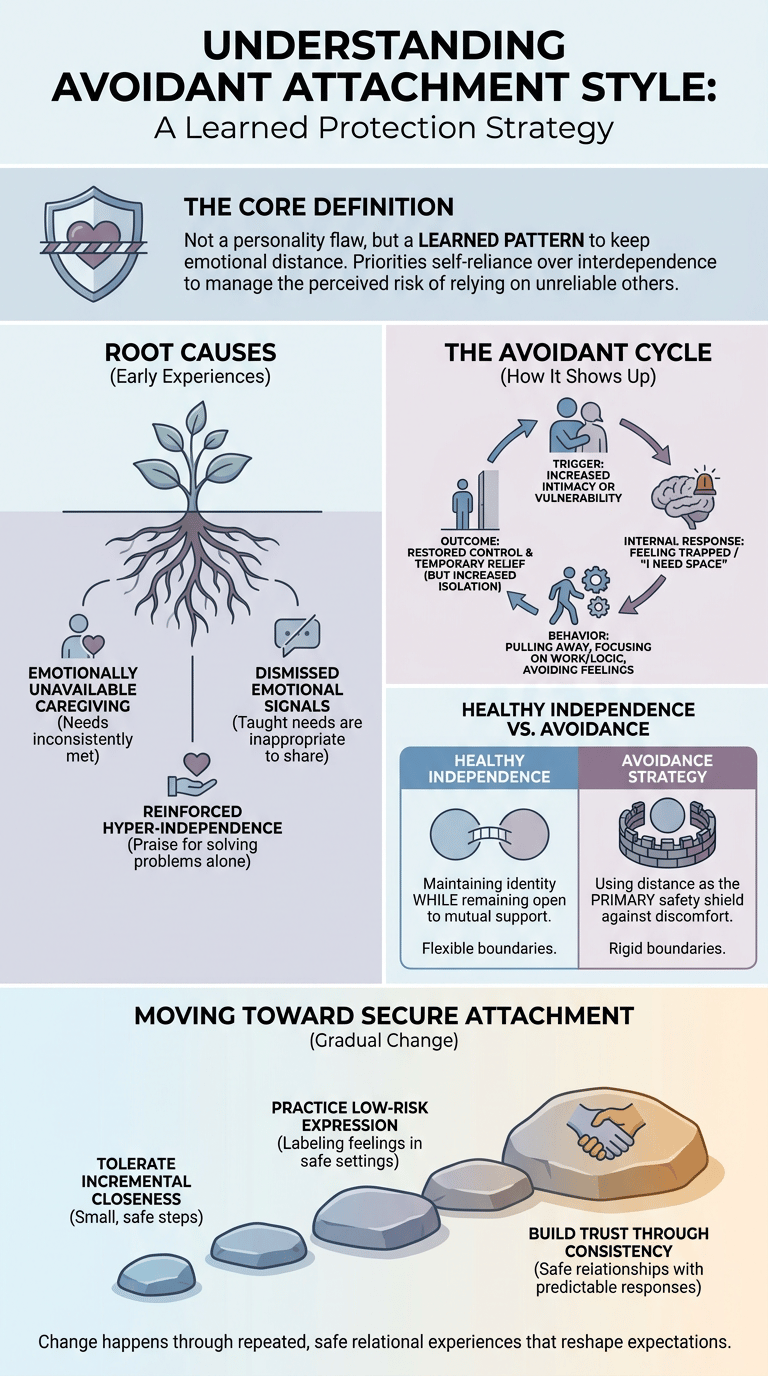
Avoidant attachment style describes a pattern in which people keep emotional distance from others and prefer self-reliance over close interdependence. This pattern reflects how a person typically approaches emotional closeness, comfort, and dependence in relationships rather than a fixed personality trait. For concise terminology and broader definitions used in psychology, see related entries in the APA Dictionary of Psychology.

Why avoidant attachment is connected to emotional distance
Avoidant patterns often look like emotional distance because they reduce moments of felt vulnerability. When someone expects emotional requests to be uncomfortable, unpredictable, or dismissed, creating distance becomes a way to limit those uncomfortable experiences. Research and clinical descriptions frame attachment patterns as expectations about how others respond to needs, which helps explain why avoidance centers on keeping feelings and needs private rather than sharing them openly. For an overview of how psychological science studies caregiving and relational patterns, see resources from Psychological Science.
Why avoidance is often a protection strategy
Viewed as a learned protection strategy, avoidance helps a person manage the risk of depending on someone who may not reliably meet emotional needs. When expressed as a strategy, avoidance serves functions: it lowers immediate emotional intensity, reduces the chance of rejection, and preserves autonomy. Understanding avoidance in this way shifts the perspective from judging the person as cold to recognizing a history of adaptive choices meant to keep them safe from emotional harm.
Core Emotional Pattern of Avoidant Attachment
Strong need for independence
People with avoidant attachment often describe independence as a core value. That independence feels emotionally necessary, not merely preferable. In relationships, this can mean prioritizing personal routines, boundaries, or solitary problem solving. Valuing autonomy can be healthy, but in avoidance it becomes a primary lens for evaluating closeness and support.
Discomfort with emotional dependence
Emotional dependence can feel risky for someone with an avoidant style. The discomfort is not a moral failing; it is a learned response to situations where relying on others was unpredictable or led to disappointment. Over time, the mind organizes expectations to anticipate that emotional requests will be met with distance, criticism, or lack of support, and avoidance reduces exposure to those outcomes.
Pulling away when things feel too close
When intimacy increases, people with avoidant tendencies commonly experience a stress response that motivates distance. This pulling away can be subtle, such as quieting emotional disclosure, or more obvious, such as creating physical or conversational space. The pattern serves to restore a sense of control and reduce anxiety that comes with perceived dependence.
Preference for self-reliance
Self-reliance is often protective. Relying on oneself reduces the need to test others’ reliability and prevents repeated experiences of unmet needs. While self-reliance is a strength in many situations, when it consistently replaces opportunities for supportive connection it can limit resources for coping with sustained stress or grief.
What Causes Avoidant Attachment?
Emotionally unavailable caregiving
Attachment patterns form in the context of early caregiving relationships and repeated experiences with caregivers. When caregivers are frequently emotionally unavailable, a child may adopt strategies that minimize expressed need because those needs were not consistently met. Descriptions of caregiving influences and relational development appear in standard psychological references that outline how early experiences shape expectations about support; see the APA’s pages on behavior and relationships for accessible summaries on APA Topics.
Dismissed emotional needs
If a child’s emotional signals are ignored, minimized, or met with discouragement, those signals can be internalized as inappropriate to share. Over time, people who experienced dismissed needs may stop signaling their distress and rely on internal coping. This tendency reduces exposure to repeated dismissals but also narrows opportunities to receive attuned support from others.
Learning not to rely on others
Repeated experiences where support was unavailable teach the predictive model that others are unlikely to respond reliably. Learning not to rely on others is a pragmatic adaptation to that environment. In adulthood, this learned model can persist even when current relationships are more stable, because patterns formed in early life shape expectations and automatic responses.
Positive reinforcement for independence
Independence often receives positive feedback in families and cultures that prize autonomy. When independence is praised, the behavior of solving problems alone or minimizing emotional needs can be reinforced. That reinforcement strengthens avoidant patterns because the person receives both internal and external validation for maintaining distance.
How Avoidant Attachment Shows Up
In thoughts
I need space
Thoughts like “I need space” or “I value my independence” often arise reflexively. They can be accurate reflections of personal preferences, or automatic responses that protect against closeness felt as risky. When these thoughts appear, they act as internal rules that quickly shape behavior.
This is becoming too much
When emotional closeness grows, avoidant individuals can experience escalating thoughts that the situation is too intense. Those cognitions increase emotional distance because they justify stepping back. Recognizing the automatic nature of such thoughts can help a person pause before acting on them.
In emotions
Feeling trapped by closeness
Emotional responses commonly include sensations of being trapped, overwhelmed, or hyper-alert to loss of autonomy. Those emotions are part of a protective response system that signals perceived threats to safety in relationships.
Feeling overwhelmed by emotional demands
Requests for emotional disclosure or demonstrations of closeness can produce a sense of being flooded. That overwhelm motivates distancing behaviors aimed at restoring manageable emotional levels. In some situations, stepping back briefly is sensible; chronic avoidance, however, can reduce intimacy and mutual support over time.
In behavior
Pulling away after intimacy
One common behavioral pattern is withdrawing after emotional closeness, sometimes called a distancing cycle. After a moment of vulnerability—either their own or their partner’s—an avoidant person may reduce contact, minimize future disclosures, or create reasons to be apart. The move away from intimacy functions to reduce perceived risk.
Avoiding vulnerable conversations
Avoidant individuals may steer conversations toward practical topics, humor, or neutral content to avoid discussing feelings. This avoidance reduces immediate discomfort but also limits opportunities to repair misunderstandings and to build deeper trust.
For a simple foundation, see this guide to what attachment styles are.
For broader context, see this guide to attachment styles in psychology.
Focusing on work, hobbies, or logic
Shifting attention to work, hobbies, or intellectualizing emotions are common coping behaviors. These activities provide safe outlets for energy and meaning when relational closeness feels unsafe. While healthy engagement in interests supports well-being, it can also serve as a way to sidestep emotionally intimate moments.
Avoidant Attachment vs Healthy Independence
Healthy independence allows connection
Healthy independence means maintaining personal identity and boundaries while staying open to mutual support. Someone who practices healthy independence can seek help when needed and can also enjoy time alone without it being a defense against relationships. The distinction is about flexibility rather than rigid distance.
Avoidance uses distance to feel safe
By contrast, avoidance relies on distance as the primary safety strategy. Where healthy independence tolerates occasional emotional discomfort in the service of connection, avoidance prioritizes distance in order to prevent discomfort. That choice can protect from immediate hurt but at the cost of sustained closeness and shared coping.
The difference shows up during emotional conflict
During conflict, healthy independence typically leads to constructive engagement: expressing needs, negotiating boundaries, and repairing ruptures. Avoidant responses more often look like withdrawal, minimizing emotional concerns, or refusing to engage in sustained vulnerability. Observing how a person responds in stress helps distinguish secure independence from avoidant strategies.
Can Avoidant Attachment Become More Secure?
Learning to tolerate closeness gradually
Change toward greater security is usually gradual because attachment patterns are built from repeated experiences. Small, manageable steps that increase tolerated closeness help reshape expectations without overwhelming the person. For example, incrementally sharing minor worries and noticing how a trusted person responds can provide corrective experiences that reshape beliefs about safety.
Practicing emotional expression
Practicing emotional expression in low-risk settings can expand comfort with vulnerability. This practice might include labeling feelings in a journal, rehearsing short disclosures with a supportive friend, or using structured formats such as brief daily check-ins. The goal is not to force deep disclosure immediately but to build confidence that expressing emotions does not inevitably lead to harm.
Building trust through safe relationships
Trust grows through repeated experiences where needs are heard, respected, and met in reasonable ways. Secure relationships offer predictable responses, calm repair after conflict, and respect for autonomy. Seeking or cultivating relationships that provide those qualities supports gradual revision of expectancies formed by earlier caregiving patterns.
If strong avoidance is causing distress, persistent relationship problems, or interfering with daily functioning at work or home, consider reaching out to a qualified mental health professional for evaluation and guidance. Reliable general information about mental health resources and how to find help is available from the National Institute of Mental Health at NIMH and from patient-friendly summaries on MedlinePlus.
Final Thoughts
Understanding avoidant attachment as a protection strategy reframes common frustrations. Distance, withdrawal, and strong self-reliance are often efforts to reduce emotional risk rather than evidence of deliberate coldness. Recognizing that avoidance evolved to manage real relational challenges helps create compassion for oneself or for others who use these strategies.
Change toward more secure patterns is possible but typically occurs through repeated, safe relational experiences and thoughtful practice of small changes. Learning to notice automatic thoughts, to tolerate incremental increases in intimacy, and to test trusted relationships can slowly alter expectations shaped by earlier experiences. For accessible explanations of how behavior, emotion, and relationships interact in psychological science, see Psychological Science and topic summaries on APA Topics.
If avoidant patterns coincide with strong distress, recurring relationship breakdowns, or problems that interfere with daily life, a calm conversation with a trained mental health professional can provide confidential assessment and practical, evidence-based support tailored to your situation.

Michael Reed is the Founder and Lead Writer at Psychology Exposed. He writes about human behavior, relationships, emotional patterns, self-awareness, and practical psychology topics using research-informed, easy-to-understand content.
Read More About Michael Reed: https://psychologyexposed.com/michael-reed/