
What Is Anxious Attachment Style?
Simple definition
Anxious attachment style, sometimes called anxious-preoccupied attachment, is a pattern of feeling and behaving in close relationships that centers on intense concern about emotional connection and fear of losing it. This pattern tends to include repeated worry about whether a partner cares enough, a strong desire for closeness, and a tendency to seek reassurance when uncertain. For a concise, reader-friendly overview of what anxious attachment looks like in adults, see the Cleveland Clinic explanation of anxious attachment style here.
Why anxious attachment is linked to fear of abandonment
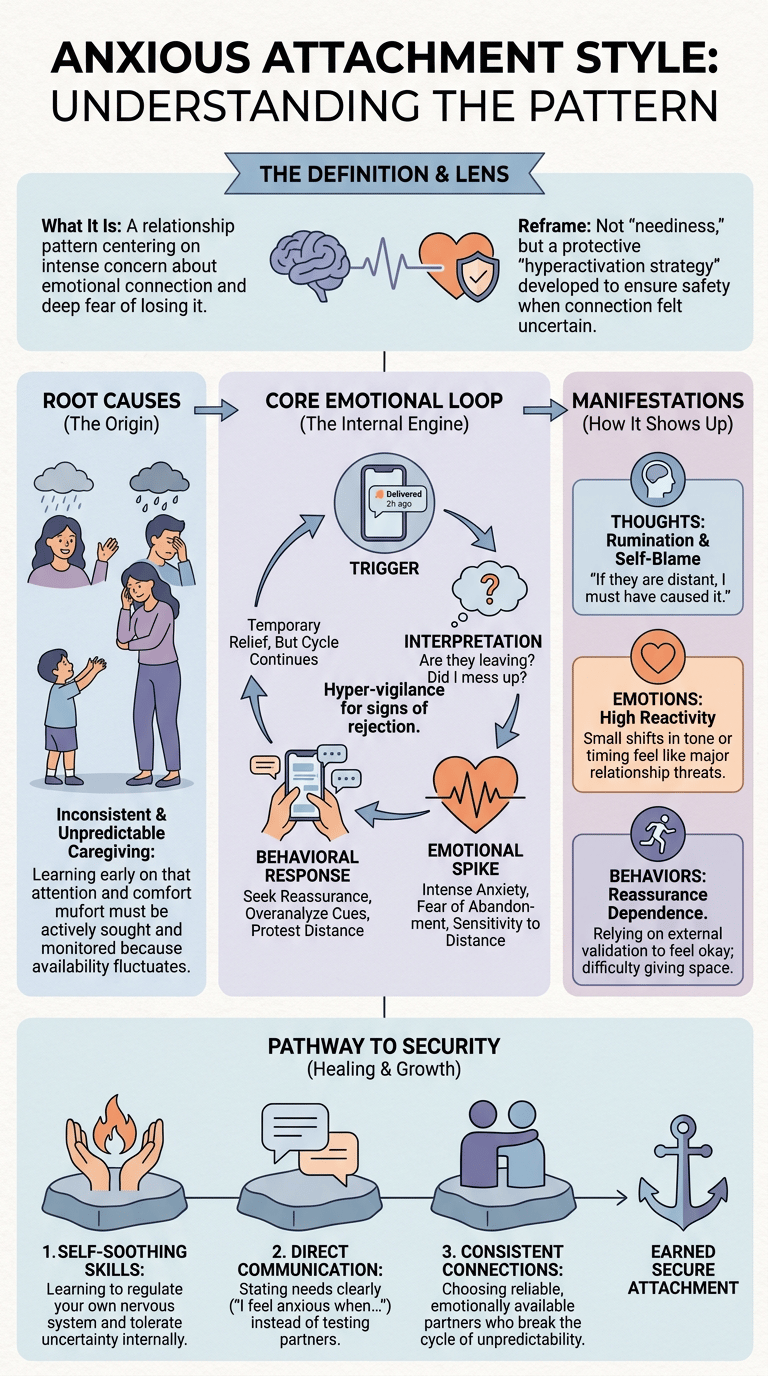
From a psychological perspective, anxious attachment reflects an emotional strategy that amplifies closeness-seeking when a person perceives threat to the relationship. Researchers describe this as a hyperactivation strategy toward attachment needs, where the nervous system and attention become tuned to signs of separation or rejection. A narrative review that integrates attachment classifications and emotion-regulation strategies summarizes how inconsistent or unpredictable caregiving in early life is associated with this pattern in adulthood, linking anxious or preoccupied attachment to worry about abandonment and amplified emotional responses to relationship threat in this review.
Why it is not the same as being too needy
Labeling someone as “needy” can feel shaming and misses the underlying logic of anxious attachment. The behaviors associated with anxious attachment often serve a protective purpose: they are attempts to restore a sense of safety when attachment needs feel uncertain. Rather than a character flaw, anxious attachment is better understood as an understandable pattern that developed because it increased the chances of detecting and addressing separation or inconsistency in relationships. Describing it as a safety strategy helps reframe the pattern without moral judgment and opens the door to learning new coping responses.
Core Emotional Pattern of Anxious Attachment
Strong need for closeness
People with anxious attachment tend to experience a persistent and vivid desire for emotional closeness. This need goes beyond enjoying intimacy; it often feels essential for emotional stability. When closeness is present, it provides relief. When closeness is uncertain or withdrawn, distress intensifies. That pattern reflects a heightened motivational focus on attachment cues and signals from partners.
Fear of being rejected or replaced
A central feature of anxious attachment is repetitive worry that a partner may leave, lose interest, or prefer someone else. These fears often show up as mental scenarios of abandonment and take up significant mental energy. The fear is not simply low self-esteem; it is tied to vigilance for signs of detachment and an emotional readiness to respond if the relationship seems threatened.
Sensitivity to emotional distance
Small changes in tone, timing, or availability can feel like major threats to someone with anxious attachment. Emotional distance, even when brief or unintentional, may trigger a cascade of worry, intrusive thoughts, or emotional reactivity. This sensitivity is consistent with attachment research that shows anxious individuals are particularly attuned to cues of potential separation or exclusion.
Difficulty feeling secure without reassurance
Anxious attachment often involves relying on external signals to feel safe. Affirmations of care, physical closeness, or timely replies can reduce anxiety temporarily, but the relief may not last. Over time, dependence on reassurance can feel unsatisfying when it does not build a lasting internal sense of security.
What Causes Anxious Attachment?
Inconsistent emotional availability
One common pathway toward anxious attachment involves growing up with caregivers who were inconsistently responsive. When a child’s needs are sometimes met but other times ignored or delayed, the child learns that attention and comfort must be actively sought and monitored. Over time, this creates heightened sensitivity to cues that previously predicted care or neglect. The integrative review of attachment and emotion regulation explains how this inconsistency can promote hyperactivation strategies associated with anxious/preoccupied orientations in the review.
Unpredictable caregiving
Unpredictability creates uncertainty about whether help will arrive when needed. Caregivers who are warm at times and unavailable at others make it adaptive for a child to remain alert and to escalate bids for comfort. As an adult, the same vigilance can appear as repeated checking for signs of interest or reassurance seeking in romantic relationships.
Past rejection or relationship instability
Experiences of rejection, abrupt separations, or repeated relationship breakups can reinforce anxious patterns. Those experiences can create learned expectations that relationships are fragile, and they can shape how threats to attachment are interpreted and responded to in later relationships. Research on relationship processes shows how anxious attachment interacts with partner responses and relationship contexts to influence thinking, feeling, and behavior in this interactionist perspective.
Emotional reinforcement patterns
Once anxious strategies succeed in restoring closeness temporarily, those behaviors are reinforced. For example, if sending a worried message leads to a comforting reply, the message-sending behavior is learned as effective. Over time, such reinforcement can solidify patterns of vigilance and reassurance seeking, even when they create new tensions in relationships.
How Anxious Attachment Shows Up
In thoughts
Anxious attachment often shapes a recurring set of mental questions and scenarios about the relationship. These thoughts tend to focus on perceived threats to connection.
Are they losing interest?
One common line of thought is persistent questioning about a partner’s level of interest. Small changes in behavior may be interpreted as a sign of growing disinterest, which can trigger attempts to repair or test the bond.
Did I do something wrong?
Another frequent cognitive pattern is immediate self-attribution of blame. When someone seems distant, a person with anxious attachment may quickly assume they have caused the problem and ruminate on what to change to regain closeness.
In emotions
Emotional responses tied to anxious attachment can be intense and fluctuating. Emotions often track perceived safety in the relationship, so they may shift rapidly with changes in perceived availability.
Anxiety after delayed replies
Waiting for a message or call can provoke disproportionate anxiety. A delayed reply may be experienced as a signal of weakening interest rather than as an ordinary life event. This emotional reaction reflects the underlying sensitivity to cues of distance.
Fear during conflict
Conflict can feel particularly threatening because it activates fears of rejection. Even routine disagreements may trigger fear rather than calm problem solving, which can escalate the emotional tone of interactions.
In behavior
Behavioral patterns in anxious attachment are often aimed at restoring or securing closeness when it feels threatened.
Seeking reassurance
Reassurance seeking can take many forms: asking directly whether a partner cares, testing loyalty, or requesting frequent affirmations. While reassurance can soothe temporarily, it may not build long-term internal security on its own.
Overanalyzing tone and timing
Attention often shifts to small social signals: the exact words a partner used, the timing of a response, or subtle changes in tone. This overanalysis aims to detect possible threats early, but it can also produce false alarms and unnecessary stress.
For a related next step, see this guide to the signs of anxious attachment.
For a simple foundation, see this guide to what attachment styles are.
For broader context, see this guide to attachment styles in psychology.
Difficulty giving space
Giving a partner space can feel risky for someone with anxious attachment because distance may be interpreted as a sign of withdrawal. This can make it hard to tolerate separations, even when they are healthy for both partners.
Anxious Attachment vs Normal Relationship Anxiety
When worry is temporary
It is normal for anyone to feel anxious when a relationship faces a clear problem, such as a betrayal or a significant life stress. Temporary worry that matches the situation and decreases after reassurance or problem-solving is typical and does not necessarily indicate an attachment orientation pattern.
When worry becomes a repeating pattern
Anxious attachment is indicated when worry about the relationship becomes chronic or repetitive across different situations and partners. If the same pattern of vigilance, intrusive questions, and reassurance seeking appears repeatedly and interferes with enjoyment of relationships, it suggests an attachment-based pattern rather than situational anxiety.
When reassurance never feels enough
A helpful sign that worry has moved from normal to attachment-driven is when reassurance or corrective experiences fail to produce lasting relief. If affirmations temporarily calm anxiety but the pattern reappears quickly, that suggests the underlying internal security system still relies heavily on external signals.
Can Anxious Attachment Become More Secure?
Building self-soothing skills
One route toward greater security is learning methods to calm the nervous system and tolerate uncertainty without immediately seeking external fixes. Practices for self-soothing include grounding techniques, breathing exercises, and strategies to shift attention away from repetitive worry. These practices do not erase attachment needs; rather, they help a person carry those needs without intense distress while working on relationship skills. For accessible guidance on prioritizing your own needs as a path to healing anxious attachment, see the Greater Good Science Center piece on healing by prioritizing needs here.
Learning direct communication
Clear, calm communication about needs and concerns reduces guesswork in relationships. Instead of testing or assuming, practicing direct statements about feelings and requests for support can allow partners to respond intentionally. Communication skills include using “I” statements, describing observable behaviors rather than intentions, and asking for specific actions that provide reassurance without leading to dependency.
Choosing emotionally consistent relationships
While change often comes from within, the relationship context matters. Seeking partners who are reasonably predictable and emotionally available supports the development of security. Choosing relationships that show consistent responsiveness gives corrective experiences that help the nervous system update expectations about close others.
Final Thoughts
Anxious attachment style is best understood as an emotional safety strategy shaped by past experiences of inconsistency or unpredictability in caregiving and relationships. It produces a core pattern of intense need for closeness, fear of abandonment, sensitivity to emotional distance, and reliance on reassurance. These responses are understandable and can be changed or managed over time through self-soothing, clearer communication, and relationships that provide emotional consistency.
If anxiety about relationships is severe, persistent, or interferes with day-to-day functioning at work, school, or home, consider reaching out to a qualified mental health professional for personalized support. A clinician can help distinguish between situational worries and longstanding attachment patterns and provide skills-based approaches for building greater security. For clinical descriptions and practical tips related to anxious attachment, see the Cleveland Clinic overview on anxious attachment here.
For readers who want to learn more about the research foundations of anxious attachment, consider the integrative review that links caregiving patterns and emotion-regulation strategies available through PubMed Central here, and the review of how anxious attachment shapes relationship processes on PubMed here.

Michael Reed is the Founder and Lead Writer at Psychology Exposed. He writes about human behavior, relationships, emotional patterns, self-awareness, and practical psychology topics using research-informed, easy-to-understand content.
Read More About Michael Reed: https://psychologyexposed.com/michael-reed/