
Why Focus Is Different With ADHD
ADHD affects attention regulation, not intelligence
ADHD is primarily a difference in attention regulation and executive function rather than a measure of intelligence or willpower. People with ADHD can be highly capable but may struggle to direct attention when tasks are uninteresting, repetitive, or poorly structured. Describing ADHD in terms of regulation helps shift the focus from personal blame to practical solutions that change the demands placed on attention.
For accessible information on attention and mental health conditions, the National Institute of Mental Health maintains clear overviews of mental health topics and symptoms that can help with basic understanding and next steps, including when to seek professional evaluation from the National Institute of Mental Health.
Interest, urgency, and stimulation strongly affect focus
Many people with ADHD notice that tasks that are inherently interesting, novel, or urgent usually attract attention more easily. Tasks that are boring, slow, or low in stimulation tend to be avoided because the brain produces less internal drive to sustain attention. Recognizing that attention is often stimulus-driven can help you arrange work and environment so the stimulation you get matches the task demands.
Forcing focus through shame usually makes things worse
Self-criticism and shame about attention lapses increase stress and reduce the cognitive resources available for planning and starting tasks. Instead of insisting on rigid self-discipline, ADHD-friendly strategies reduce friction and supply external prompts. This approach treats attention as a skill to support with tools and environment rather than a moral failing.
Start by Reducing Executive Function Load
Make the task visible
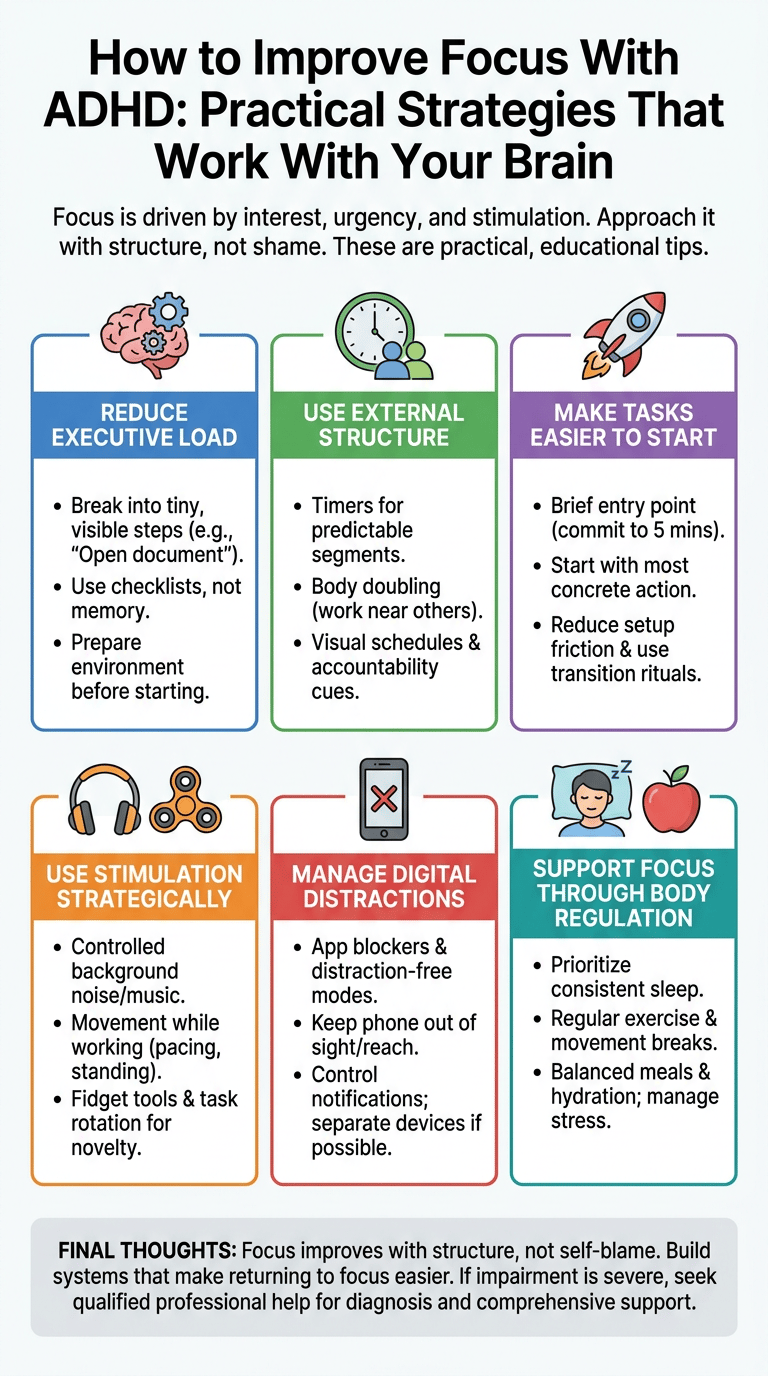
Out of sight often means out of mind for those with attention regulation challenges. Make tasks and materials visible and obvious. Place the next physical item you need where you will see it when you sit down to work, or keep an ongoing to-do list in a single, highly visible place. Visibility reduces the need to remember and keeps attention anchored to what matters.
Break work into very small steps
Large tasks become overwhelming because planning and sequencing require executive control. Break tasks into extremely small, concrete steps. Instead of “write report,” use “open document,” “write one sentence,” or “save file.” Small steps make starting easier and provide frequent, visible progress cues that help sustain attention.
Use checklists instead of memory
Relying on memory increases cognitive load and the chance of forgetting. Use simple checklists for routines and multi-step tasks. Checklists create clear external cues, reduce anxiety about forgetting steps, and provide a satisfying sense of completion that supports sustained work.
Prepare the environment before starting
Set up everything you need before starting a task so you do not have to hold setup steps in working memory. If you need a notebook, pen, reference materials, and a charged device, gather them first. Preparation lowers the barrier to entry and reduces the number of interruptions that break emerging focus.
Use External Structure
Timers
Time-based structure can harness the ADHD brain’s responsiveness to clear, external constraints. Use short, repeatable timers to create predictable work segments followed by breaks. Timers act as an impartial external cue that reduces the need to self-monitor time.
Body doubling
Body doubling means working near another person who is also focused on their tasks. The presence of someone else provides subtle accountability and social cueing that help maintain attention. Body doubling can be done in person or via video and is a practical strategy for many people with ADHD to reduce distraction and increase sustained effort.
Visual schedules
Visual schedules provide an external representation of time and sequence. Use whiteboards, sticky notes, or printed schedules to map the day in concrete blocks. Visual schedules make transitions predictable and reduce the decision-making burden that can derail attention.
Accountability cues
External accountability helps when internal motivation is inconsistent. Set up low-stakes accountability systems like brief check-ins with a colleague, partner, or coach. Publicly committing to a small, concrete outcome increases the likelihood of follow-through without relying solely on internal willpower.
Make Tasks Easier to Start
Use a brief entry point
Starting is often the hardest step. Commit to engaging with the task for a very short, defined period. Once you begin, you can decide whether to stop or continue. Often, the initial movement reduces inertia and leads to longer sustained work.
Start with the most concrete action
When a task has abstract steps, begin with the most concrete, physical action available. For example, if you need to study, start by opening the relevant chapter and placing a highlighter on the page. Concrete actions are easier to initiate and quickly create a momentum that supports abstract thinking.
Reduce setup friction
Friction points like logging into accounts, locating files, or finding supplies are common derailers. Streamline workflows: create bookmarked folders, prepare templates, keep commonly used tools at hand, and automate repetitive setup tasks. Reducing setup time preserves attention for the work itself.
Use transition rituals
Rituals signal the brain that it is time to shift modes. Create a short, consistent transition routine to move into focused work: make a cup of tea, tidy the desk briefly, and start a timer. Over time the ritual itself becomes a cue that helps attention settle into a work state.
Use Stimulation Strategically
Background noise versus distraction
Some people with ADHD benefit from low-level background stimulation, while others need minimal sensory input. Experiment with controlled background sounds such as instrumental music, white noise, or ambient soundscapes to see whether they aid sustained attention. Avoid content that competes with the task, like podcasts or videos that demand semantic processing.
Movement while working
Incorporating movement can support attention. Standing desks, pacing while reading, or gentle stretching between tasks supply sensory input that helps maintain engagement. Small, regular movement breaks can prevent attention from waning during longer sessions.
Fidget tools
Fidget tools provide low-effort sensory feedback that can anchor attention without becoming the main activity. Simple items like stress balls, textured objects, or small hand tools can satisfy sensory needs while allowing cognitive focus to remain on the task.
Novelty and task rotation
Because ADHD brains often respond well to novelty, introduce controlled variations in how you work. Rotate task types, alternate focus modalities (reading, typing, drawing), or change scenery periodically. Novelty can refresh attention but should be managed so it does not become a source of distraction.
Manage Digital Distractions
App blockers
Tools that limit access to distracting websites and apps during focused periods reduce the temptation to switch tasks. Timed website blockers or distraction-focus modes can be configured to allow controlled breaks, balancing restriction with flexibility.
Phone distance
Out of sight reduces the urge to check devices. Keep phones in a different room or in a drawer during focused blocks, or use simple enclosures that make checking inconvenient. Physical separation decreases automatic checking and preserves attention for the task at hand.
Notification control
Manage notifications to minimize interruptions. Turn off nonessential alerts, use priority-only modes, and allow only critical communications during deep work. Fewer interruptions mean fewer opportunities for attention to fragment.
Separate entertainment from work devices when possible
If feasible, use different devices for entertainment and for work. A dedicated work device reduces the temptation to switch to entertainment during work periods and helps maintain a clear boundary between work and leisure contexts.
Support Focus Through Body Regulation
Sleep
Sleep quality and consistency influence attention, mood, and executive control. Establish regular sleep patterns and prioritize sleep hygiene practices such as dimming lights before bed and limiting stimulating activities in the hour before sleep. If sleep problems persist or significantly impair daily functioning, consider consulting a healthcare provider for evaluation and guidance.
Exercise
Regular physical activity supports attention and alertness. Even short bursts of movement before a demanding task can increase arousal and readiness to focus. Choose activities you enjoy to maintain consistency rather than relying on willpower alone.
Meals and hydration
Skip or irregular meals and dehydration can reduce cognitive energy. Regular, balanced meals and adequate hydration help stabilize energy and reduce fluctuations that make attention inconsistent. These are supportive habits rather than cures and work best as part of a broader routine.
Stress management
High stress consumes cognitive resources and makes planning, starting, and sustaining tasks more difficult. Integrate stress-reduction practices such as brief breathing exercises, progressive muscle relaxation, or short walks. When stress becomes chronic or overwhelming, seek professional support to address the underlying sources.
When to Seek Professional Help
If focus problems seriously affect life, school, or work
If attention difficulties significantly interfere with daily responsibilities, safety, relationships, academic performance, or employment, it is appropriate to seek professional evaluation. A clinician can help identify contributing factors, assess whether ADHD or another condition is present, and recommend appropriate supports.
Diagnosis and treatment options
Professional assessment can clarify whether attention regulation challenges meet criteria for ADHD or are related to other factors such as sleep disorders, mood conditions, medication effects, or medical issues. The National Institute of Mental Health provides general information about mental health topics and pathways to care that can help you learn about diagnostic and treatment options from the National Institute of Mental Health. MedlinePlus also offers patient-friendly mental health overviews that explain what to expect during evaluation and treatment planning on MedlinePlus.
Medication, therapy, coaching, and skills support
Treatment for attention regulation challenges can include a range of supports such as medication, behaviorally oriented therapy, skills coaching, or workplace and academic accommodations. A qualified clinician can discuss options, benefits, and potential side effects, and help build a comprehensive plan that fits your goals. Resources from professional psychology organizations describe therapeutic approaches and behavioral strategies available through the American Psychological Association.
When attention problems involve safety risks, severe impairment, or thoughts of harming yourself or others, please seek immediate help from local emergency services or a crisis line. A trained professional can provide urgent support and guidance.
Final Thoughts
ADHD focus improves with structure, not self-blame
Improving focus with ADHD is less about pushing harder and more about designing conditions that support attention. Structure, external cues, and environment changes reduce reliance on fragile internal motivation. Adopting systems that respect how your brain responds to stimulation and novelty helps you get more consistent results with less stress.
Build systems that make attention easier to return to
Combine several strategies: reduce executive load, use timers and body doubling, design tiny starting steps, manage stimulation, and support your body with sleep and movement. Over time, these practical systems create reliable pathways back into focus when attention drifts. If difficulties persist at a level that affects daily functioning, a clinician can help tailor supports such as skill-based therapy, coaching, or medical treatments.
These approaches are about creating a helpful environment and set of practices that work with your brain rather than against it. Small, consistent adjustments often produce meaningful improvements in how reliably you can start and sustain tasks.
For a broader overview, see this guide on how to improve focus.
For a related next step, see this guide to improving mental focus.
For a related next step, see this guide to understanding why you can’t focus.

Michael Reed is the Founder and Lead Writer at Psychology Exposed. He writes about human behavior, relationships, emotional patterns, self-awareness, and practical psychology topics using research-informed, easy-to-understand content.
Read More About Michael Reed: https://psychologyexposed.com/michael-reed/