

You Are Not Lazy Just Because You Can’t Focus
Focus depends on mental state, not just discipline
Concentration is not a single muscle you either have or lack. Psychologists describe attention as a set of processes, including selecting relevant information, maintaining task goals, and inhibiting distractions. These processes change with your current mental state, energy level, and environment, which means fluctuations in focus are normal and often explainable. For an overview of behavior and attention-related topics from a psychological perspective, consult the American Psychological Association topics pages for reliable definitions and context.
Your brain may be protecting, avoiding, or seeking stimulation
What looks like laziness is often a protective or adaptive response. The brain prioritizes what it perceives as urgent, avoids tasks that trigger shame or anxiety, or seeks stimulation when understimulated. These patterns are rooted in basic learning and emotion systems that shape where attention goes.
The real cause matters before choosing a solution
Different causes require different approaches. For example, when difficulty concentrating results from sleep loss, rest is the most direct remedy. When it results from avoidance of a high-stakes task, breaking the task into smaller steps helps. The rest of this article helps you match common focus problems to their likely causes so you can pick targeted responses.
Reason 1: Your Task Is Too Vague
Vague tasks create resistance
A task that lacks a clear next step produces mental friction. Your brain cannot evaluate progress when the goal is fuzzy, so motivation drops and attention wanders. Common examples include “work on my project” without a defined subtask, or “clean the house” without a starting point.
Your brain avoids unclear effort
Ambiguity raises expected effort and decreases perceived reward. Without a clear target, the decision system favors easier or more instantly rewarding activities, such as checking your phone or browsing. This is a normal cost-benefit calculation in the brain, not a personal failing.
How to make the next step specific
Turn vague tasks into concrete, time-bound actions. Examples: instead of “study chapter,” write “read pages 20 to 30 and summarize three key points in 20 minutes.” Specificity reduces decision weight and makes it easier to start.
Reason 2: You Are Mentally Overloaded
Too many open loops split attention
Your mental workspace fills up with unfinished obligations, worries, and reminders. Each open loop competes for attention, producing a feeling of being scattered. Writing short reminders or using an external list can free cognitive capacity by moving those loops out of working memory.
Working memory has limits
Working memory is the mind’s short-term workspace for holding and manipulating information. It has limited capacity, so when too many items are active, the ability to focus on a single task drops. For a concise reference on psychological concepts including memory and attention, see the APA Dictionary of Psychology.
Write down what your mind is holding
Create a quick brain dump: list everything you are holding mentally for the moment. Externalizing commitments reduces cognitive load and can restore focus by freeing working memory for the task at hand.
Reason 3: Your Brain Is Used to Fast Stimulation
Short-form content trains quick switching
Frequent exposure to rapid, highly variable media—short videos, constant social updates, or quick alerts—teaches the attention system to expect novelty and immediate reward. Over time, slower tasks that require sustained focus feel comparatively dull and are harder to maintain. Discussions of how media environments influence attention and behavior appear in accessible psychological science resources such as Psychological Science.
Normal tasks start feeling too slow
When your baseline stimulation level is high, lower-stimulation activities such as reading or planning can feel slow and unrewarding. The contrast makes distraction more tempting because quick switching reliably produces short bursts of reward.
Rebuild boredom tolerance gradually
Reducing fast stimulation and practicing short, uninterrupted focus periods helps rebuild tolerance for slower tasks. Start with brief sessions that stretch slightly beyond your current comfortable limit and increase them gradually. This is a training process rather than an overnight fix.
Reason 4: You Are Stressed or Anxious
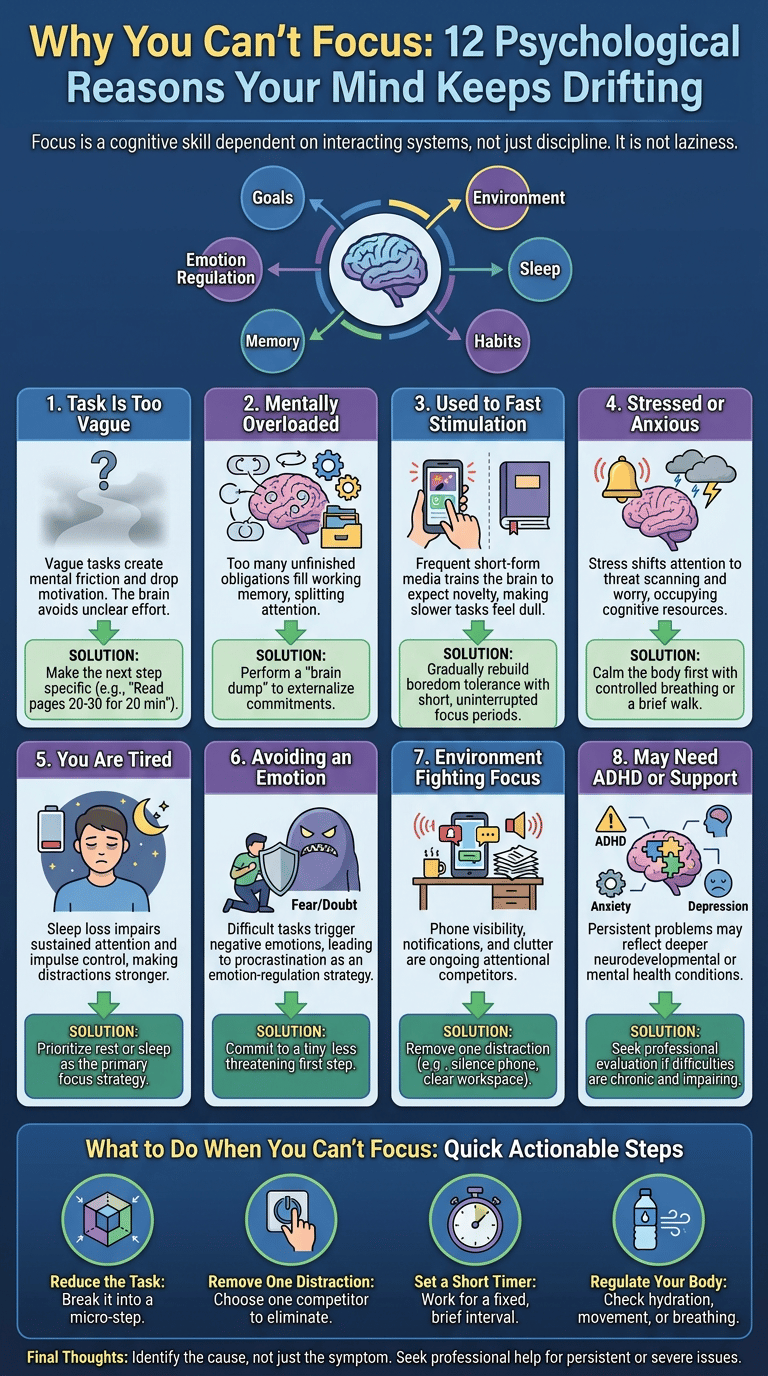
Stress shifts attention toward threat scanning
Under stress or anxiety, attention is biased toward perceived threats or negative outcomes. This hypervigilance pulls resources away from goal-directed tasks and into scanning for possible problems, which reduces sustained concentration.
Worry competes with concentration
Ruminative thoughts occupy the same cognitive resources needed for focused work. The more intrusive the worry, the harder it becomes to maintain attention on external tasks. For information on how anxiety and related conditions can affect daily functioning, consult mental health resources from the National Institute of Mental Health.
Calm the body before demanding focus
If stress is high, brief physiological regulation can improve readiness for focused work. Techniques such as controlled breathing, a short walk, or a grounding exercise reduce bodily arousal and free cognitive capacity. These are preparatory steps, not substitutes for professional care when anxiety is persistent or disabling.
Reason 5: You Are Tired
Sleep loss reduces attention control
Insufficient sleep impairs the brain regions involved in sustained attention and impulse control, making it harder to stay on task and resist distractions. Sleep-related impacts on cognition and mood are discussed in general mental health resources such as MedlinePlus.
Fatigue makes distractions stronger
When energy is low, the immediate cost of effort feels higher and the appeal of low-effort distractions increases. Tasks that demand sustained cognitive control become more vulnerable to interruption by tempting alternatives.
Rest is sometimes the focus strategy
Before pushing through demanding mental work, assess whether brief rest or sleep is the most effective step. When concentration problems trace to fatigue, restorative sleep or a nap can be the most direct and productive intervention.
Reason 6: You Are Avoiding an Emotion
Difficult tasks can trigger fear or self-doubt
Some tasks evoke feelings such as fear of failure, shame, or doubt about competence. The attention system shifts away from the task toward mood regulation strategies, which often look like distraction. This avoidance preserves short-term emotional comfort at the expense of long-term goals.
Avoidance often looks like distraction
Procrastination is not only poor time management; it is frequently an emotion-regulation strategy. Recognizing that distraction is serving an emotional function helps you choose targeted tactics, such as lowering task stakes or addressing the underlying emotion directly.
Start with a smaller action
One way to test whether avoidance is driving distraction is to reduce the perceived emotional intensity of the task. Commit to a tiny, less threatening first step of a couple of minutes. If you can complete it, momentum and reduced anxiety often follow.
Reason 7: Your Environment Is Fighting Your Focus
Phone visibility
Having a phone in sight increases the likelihood of checking it, even without conscious intention. Visual access to devices turns them into ongoing attentional competitors.
Notifications
Audible and visual notifications interrupt sustained attention and create expectations of further messages, which fragment work. Turning off nonessential notifications or placing the device in another room reduces involuntary interruptions.
Clutter and noise
Excess sensory input, such as visual clutter or background noise, draws attention and reduces the signal-to-noise ratio for task-relevant information. Simplifying the immediate workspace or using noise-masking solutions can decrease unhelpful distractions.
Easy access to distractions
When tempting alternatives are a keystroke away, the decision cost of switching decreases. Increasing the friction for nonessential behaviors, such as logging out of distracting sites or using an app blocker, raises the activation energy required to switch tasks and helps sustain attention for longer periods.
Reason 8: You May Need ADHD or Mental Health Support
Persistent focus problems can have deeper causes
For some people, chronic and pervasive attention difficulties reflect underlying neurodevelopmental or mental health conditions. Attention differences, mood disorders, and burnout can all influence concentration in ways that simple behavioral tweaks do not fully resolve. For general information about how conditions like ADHD, anxiety, and depression affect functioning and where to find help, see educational material from the National Institute of Mental Health.
ADHD, anxiety, depression, and burnout can affect attention
Each condition affects attention through different mechanisms. ADHD often involves ongoing challenges with sustained attention and impulse control. Anxiety leads to threat-focused attention and rumination. Depression can reduce motivation and cognitive energy. Burnout drains emotional resources and makes sustained effort feel costly. If concentration problems are lifelong or significantly interfere with work, school, or relationships, consider discussing them with a qualified clinician.
When to seek professional help
Consider professional evaluation when focus problems are persistent, severe, or worsening, or when they accompany depressed mood, intense anxiety, panic, or functional impairment. Seeking assessment from a mental health professional or medical provider can clarify whether a diagnosable condition or a combination of factors is contributing, and it opens access to appropriate supports and treatments.
What to Do When You Can’t Focus
Reduce the task
Diagnose whether the core barrier is task size or emotional avoidance. If the task feels overwhelming, shrink it into a binary micro-step: a short timer to make a single decision, sketch an outline, or write one sentence. Small wins reduce resistance and provide information about whether the task is primarily vague or emotionally aversive.
Remove one distraction
Choose one environmental competitor to remove right now. That might mean putting your phone in another room, silencing notifications, or clearing the immediate workspace. Removing a single, high-probability distractor often produces measurable improvement.
Set a short timer
Short, bounded focus intervals reduce internal resistance and provide a clear contract with yourself. Work for a fixed short period, then take a brief break. This creates predictable structure without demanding long continuous attention, which is particularly useful when rebuilding focus stamina.
Regulate your body first
Check basic needs before blaming motivation. Hydration, a brief movement break, regulated breathing, and, when necessary, restorative sleep can all restore cognitive resources. When fatigue or high arousal are present, these bodily steps are often more effective than pushing through without adjustment.
Final Thoughts
Focus problems usually have a reason
Difficulty concentrating is rarely just a moral failing. It is an indicator that one or more systems are out of alignment: clarity of goals, cognitive load, stimulation history, sleep, emotion regulation, or the environment. Identifying the most likely cause narrows the set of useful responses and reduces self-blame.
Fix the cause, not just the symptom
Short-term tricks can help in the moment, but lasting change comes from fixing the underlying cause. That might mean improving sleep, managing stress, simplifying the environment, developing clearer planning habits, or seeking assessment if attention problems are longstanding and impairing. If your difficulties are severe or interfering with daily life, reach out to a qualified mental health or medical professional for assessment and support.
For reliable overviews of psychological concepts and mental health information referenced in this article, see the American Psychological Association topics pages, the APA Dictionary of Psychology, Psychological Science, the National Institute of Mental Health, and MedlinePlus.
If you are feeling overwhelmed, having persistent thoughts of harming yourself, or are worried about someone else’s immediate safety, contact local emergency services or a crisis line right away. For reliable information about finding care and understanding symptoms, see the National Institute of Mental Health and MedlinePlus.
For a broader overview, see this guide on how to improve focus.
For a related next step, see this guide to improving your attention span.

Michael Reed is the Founder and Lead Writer at Psychology Exposed. He writes about human behavior, relationships, emotional patterns, self-awareness, and practical psychology topics using research-informed, easy-to-understand content.
Read More About Michael Reed: https://psychologyexposed.com/michael-reed/