
Finding focus at work is less about willpower and more about protecting attention from the constant noise of messages, meetings, and shifting priorities. This article walks through practical, evidence-aware steps you can apply during the workday to reduce fragmentation, protect deep work, and recover attention when it drifts. The goal is not perfection but a system that makes focused work more likely and interruptions less costly.
Why It Is Hard to Focus at Work
Workplaces create many of the conditions that pull attention away from the task that matters. Understanding the common mechanisms behind distraction helps you design realistic protections.
Work creates constant interruptions
In many jobs, interruptions are built into the flow of work: colleagues pop in, meetings reschedule, systems flag issues. Research on interruption timing shows that the cognitive cost of being interrupted depends on when the interruption occurs and how much mental context needs to be rebuilt afterward. Interruptions can increase the time it takes to finish a task and raise the chance of errors, especially when they arrive during complex or poorly defined work. For a detailed review of how interruption timing affects performance, see this peer-reviewed analysis of interruption timing effects and cognitive mechanisms on PubMed Central.
Emails and messages fragment attention
Every incoming email, chat message, or alert invites a context switch. Each switch requires your brain to reorient, which consumes cognitive resources even if the new task is small. Psychological research on task-switching highlights these switch costs: moving between tasks quickly reduces efficiency and makes sustained concentration harder to maintain. For an accessible summary of the cognitive impact of multitasking and switching, see the American Psychological Association’s discussion of task-switching and switch costs on their website.
Unclear priorities create mental overload
When priorities are fuzzy, your mind spends energy deciding what to do next. That decision cost adds to everyday cognitive load: you experience more small interruptions internally as you weigh options or wonder whether you should be working on something else. Reducing the number of open questions about what to do next is one of the most direct ways to reduce this internal fragmentation.
Stress makes your brain reactive
Stress and high workloads can make attention more reactive and less selective, pushing people to respond to what feels urgent rather than what is important. Practical strategies that reduce stress-reactivity around tasks can help preserve focused attention, particularly during deadlines or challenging periods. For clinician-reviewed strategies to support concentration and reduce stress during work, see guidance from Harvard Health Publishing on concentration and focus.
Start Your Workday With Priority Clarity
How you begin the day sets the frame for attention. A few minutes of clear prioritization removes friction and makes it easier to choose focused work over busywork.
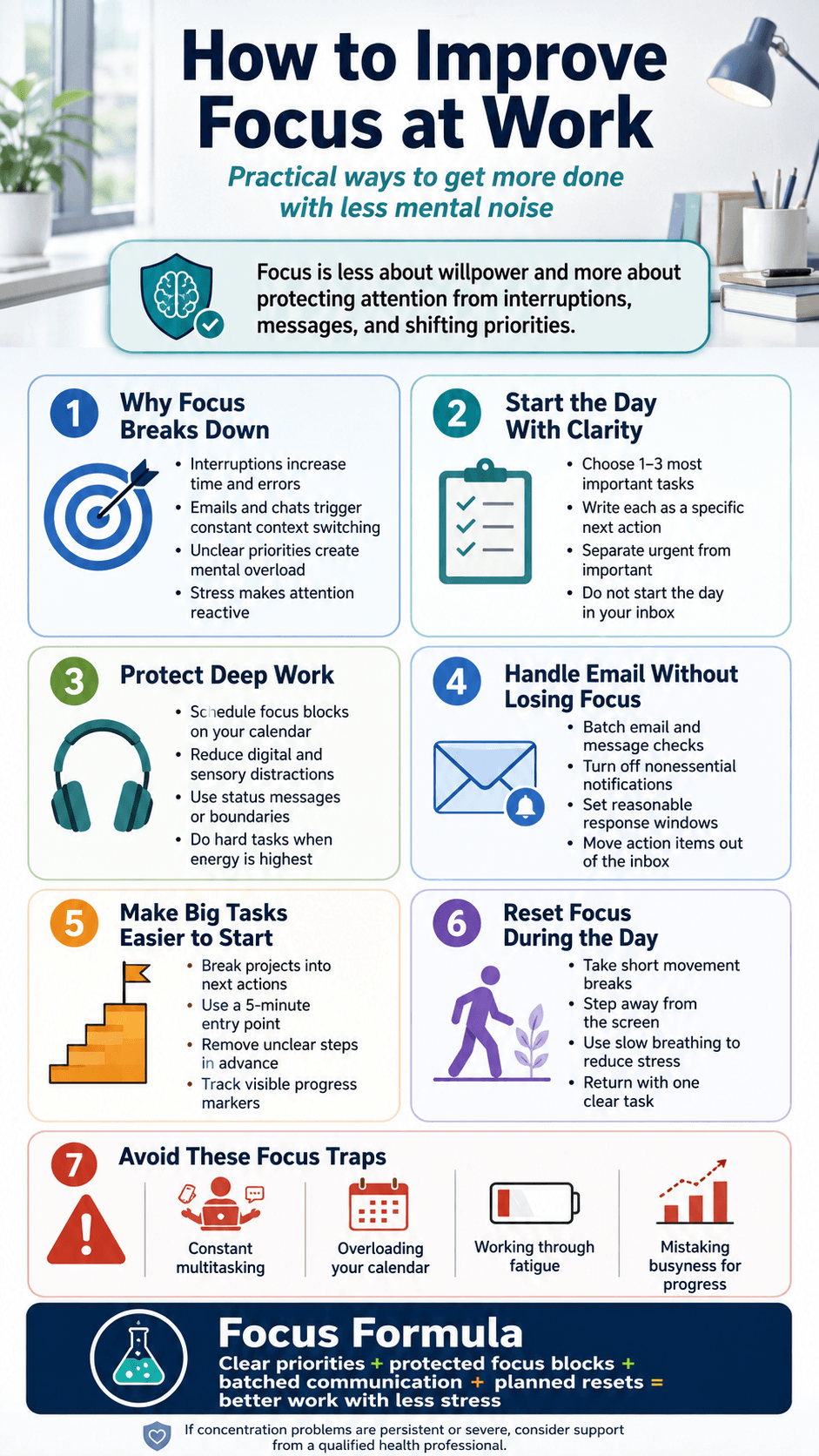
Choose the top one to three important tasks
At the start of each workday, identify one to three tasks that would make the day a success if completed. Keep the list short and concrete. Fewer priorities reduce the number of decisions you need to make and make it easier to protect time for what matters.
- Write each task as a specific next action, not a vague project label.
- Limit the list so you can realistically complete the items during your highest-energy windows.
Separate urgent from important
Use a simple mental or written distinction between urgent requests and important outcomes. Urgent items demand immediate attention but are not always aligned with your key goals. Important items move work forward on meaningful objectives. This separation helps you decide when to accept interruptions and when to protect focus.
Decide what must be finished today
Assign a deadline only when it matters. For each top task, decide whether it truly needs to be completed today or whether a later time is acceptable. This reduces the urgency pressure that pulls attention toward low-value reactions.
Avoid starting with random messages
Resist the impulse to begin the day by clearing the inbox or answering messages. Starting with reactive work trains your brain to chase external demands first. Instead, use the morning to do one important focused task, then allow limited time for messages later in a planned window.
For a related next step, see this guide to daily habits to improve focus.
For a related next step, see this guide to improving focus and concentration.
Protect Deep Work Time
Deep work is uninterrupted, focused effort on a cognitively demanding task. Creating protected blocks of time increases the likelihood of producing high-quality work in less time.
Schedule focus blocks
Block specific periods on your calendar for focused work and treat them like meetings: make them visible to others, set a purpose for each block, and defend them from nonessential requests. Scheduling protects attention by creating agreed-upon time when interruptions should be minimal.
Evidence-informed workplaces recommend defining clear blocks for concentrated work and reducing context switching by grouping related tasks together. For practical guidance on structuring these blocks and building concentration habits, see clinician-reviewed strategies for concentration and focus from Harvard Health Publishing.
Block distractions during demanding tasks
Actively reduce sensory and digital distractions while you work on demanding tasks. Options include using full-screen mode, turning off nonessential tabs, using noise-cancelling headphones, or choosing a quieter location when possible. The goal is to reduce the number of cues that can trigger attention shifts.
Use status messages or boundaries
Communicate your focus time to colleagues with status updates, calendar notes, or short messages that set expectations. Simple signals such as “Do Not Disturb: Focus Block 10:00-11:30” help others understand when you are not available for quick interruptions and reduce the social friction of saying no to an interruption request.
Work on hard tasks when energy is highest
Match task difficulty to your daily energy rhythms. Identify when you feel most alert and schedule your most demanding work in that window. Lighter tasks and administrative work fit better into lower-energy periods.
Manage Email and Messages Without Losing Focus
Digital communication is a major source of fragmentation. Instead of letting messages set your agenda, use intentional techniques that preserve attention while keeping communication timely.
Batch email checking
Group email and message checking into a few discrete times during the day rather than responding continuously. Batching reduces frequent context switches and helps you plan deeper work around communication windows. When you check messages, process each one with a clear decision: reply, defer, delegate, or delete.
Turn off unnecessary notifications
Disable notification sounds and banners for nonessential apps and channels. Notifications are designed to capture attention and can create a tendency to react. Turning them off for most of the day lowers the baseline level of disruption and gives you control over when you look at incoming information.
Use response windows
Communicate a reasonable response timeframe for messages, such as checking email twice during the workday and responding within a business day for nonurgent matters. Explicit expectations reduce pressure to reply immediately and allow you to prioritize focused work.
Avoid using inbox as a to-do list
Keeping tasks inside your inbox adds cognitive overhead because each message becomes an open loop. Move actionable items into a task manager or a calendar with a clear next step and due date. This externalization frees mental space for concentrated work.
Make Big Tasks Easier to Start
Beginning a large or vague project is often the hardest part. Structuring the first steps reduces activation energy and makes flow more likely.
Break projects into next actions
Transform vague goals into specific next actions. “Prepare Q2 report” becomes “Draft Q2 revenue section, 300 words, with chart of monthly figures.” Concrete next actions reduce decision friction and allow you to begin immediately.
Use a 5-minute entry point
Create a minimal entry step you can commit to for five minutes: open the file, write a working title, or pull the relevant data. Often, starting is the main barrier: once you invest a small amount of time, momentum builds and the session stretches longer naturally.
Remove unclear steps
Identify and remove obstacles that make the first step ambiguous. If you need access to data or a colleague’s input, secure those dependencies in advance or schedule a brief alignment before your focus block to prevent mid-task stalls.
Create visible progress markers
Break work into measurable checkpoints and mark progress visibly. Seeing forward motion—completed subtasks, updated checklists, or progress bars—reduces the psychological weight of big projects and encourages continued effort.
Reset Focus During the Workday
Attention naturally wanes over time. Intentional resets restore cognitive resources and reduce the chance of reactive decision-making later in the day.
Take short movement breaks
Regular short breaks that include movement help refresh attention and reduce physical fatigue. A brief walk, stretching, or a few standing minutes can make the next concentration period more effective. For practical clinician-reviewed guidance on breaks and concentration, see Harvard Health Publishing’s resources on focus on concentration and focus.
Step away from the screen
Eyes and mind benefit from periodic removal of screen-based stimuli. Look away from the screen, change your visual environment, or step outside for a few minutes to reduce sensory overload and reset attention.
Use breathing to reduce stress
Simple breathing techniques can reduce momentary stress and calm the mind before returning to work. A focused breathing practice for a few minutes can lower reactivity and make it easier to re-engage with a chosen task. For clinically informed techniques that support concentration and stress reduction, consider guidance from Harvard Health Publishing on concentration and focus.
Return with one clear task
When a break ends, return to work with a single, defined task. Re-establishing a clear next action prevents wandering back into low-value activities and helps your brain re-enter a focused mode quickly.
Avoid Workplace Focus Traps
Certain common habits feel productive but actually reduce effective output. Identifying and preventing these traps improves the quality of your work time.
Constant multitasking
Trying to do multiple tasks at once increases switch costs and erodes accuracy. Multitasking typically reduces efficiency and makes it harder to produce deep, high-quality work. For a clear explanation of the cognitive costs associated with switching between tasks, see research on multitasking and task-switching from the American Psychological Association.
Overloading your calendar
An overly dense schedule leaves no room for focus, recovery, or unexpected work. Protect empty blocks for deep work and realistic transition time. Treat calendar capacity as finite and schedule buffers intentionally.
Working through fatigue
Persisting through fatigue often reduces quality and increases the chance of mistakes. When possible, match task difficulty to energy levels and use short restorative breaks to prevent longer declines in productivity and well-being. Practical guidance on managing energy and concentration is available from Harvard Health Publishing on concentration and focus.
Mistaking busyness for progress
High activity does not always equal meaningful progress. Measure days by whether important outcomes moved forward, not by how many items you checked off. Regularly reviewing whether your actions are aligned with key priorities helps you avoid confusing activity with effectiveness.
Final Thoughts
Work focus improves when attention has protection: clear priorities, scheduled focus periods, fewer reactive decisions, and planned resets. You cannot eliminate all interruptions, but you can design your day so that interruptions cost less and focused work becomes more likely.
Work focus improves when attention has protection
Protecting attention is a practical habit, not a personality trait. Use small structural changes—priority clarity, guarded focus blocks, batched communication, and clear next actions—to reduce avoidable mental noise. Over time these changes compound into more consistent progress and less stress.
The best productivity system reduces unnecessary decisions
The strongest systems minimize moment-by-moment decision-making about what to do next. Externalize choices into a few trusted routines: a short morning prioritization, scheduled focus blocks, defined message windows, and a simple task manager. When decisions are pre-made, attention can stay on the work that matters.
If difficulty concentrating is persistent, severe, worsening, or significantly interferes with work, relationships, or daily life, consider seeking assessment from a qualified health professional. For information about attention concerns and guidance on when to seek evaluation, see the National Institute of Mental Health’s materials on attention issues and assessment on the NIMH website. If you are in immediate crisis or at risk of harm, contact local emergency services or a crisis line in your area.
For further reading on practical concentration strategies and clinician-reviewed recommendations, Harvard Health Publishing offers an accessible collection of techniques to support better focus and concentration during the workday on their site. For more on how interruptions affect performance, consult the peer-reviewed analysis available via PubMed Central here.

Michael Reed is the Founder and Lead Writer at Psychology Exposed. He writes about human behavior, relationships, emotional patterns, self-awareness, and practical psychology topics using research-informed, easy-to-understand content.
Read More About Michael Reed: https://psychologyexposed.com/michael-reed/