
Focus vs Concentration: What Is the Difference?
Focus is choosing where your attention goes
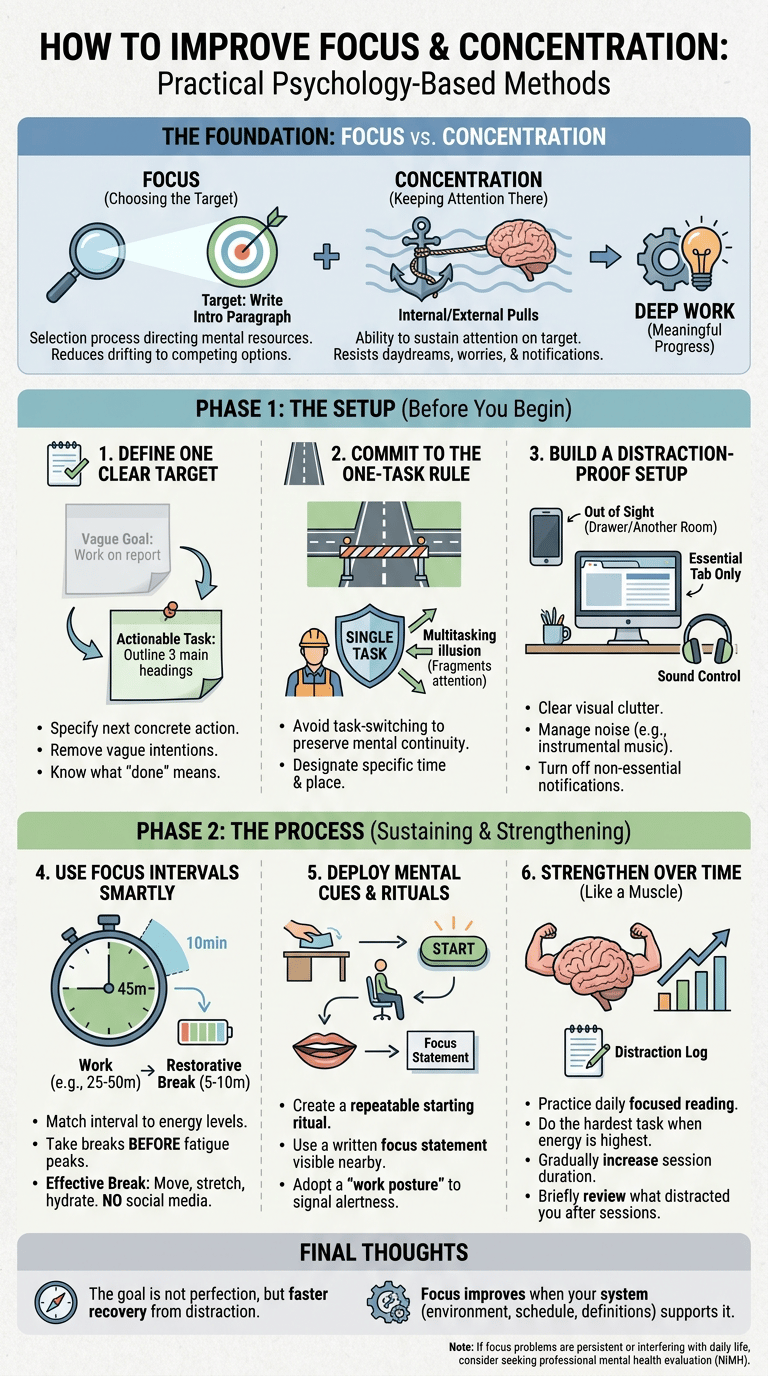
Focus refers to the decision about what receives your attention. It is the selection process that directs mental resources toward a particular target: a problem to solve, a passage to read, a project to start. A clear, chosen target reduces the chance that attention will drift to competing options. For a concise definition of psychological terms related to attention and related processes, see the APA Dictionary of Psychology.

Concentration is keeping attention there
Concentration is the ability to sustain attention on the chosen target long enough to make meaningful progress. Concentration involves resisting internal pulls such as daydreams or worries, and external pulls such as notifications and interruptions. It is a capacity that waxes and wanes during the day and across tasks.
You need both for deep work
Choosing a target without the ability to keep your attention there leads to frequent stops and little productive output. Conversely, strong capacity to stay on task offers little benefit without a clearly selected target. The practical goal for deep work is to align both: decide precisely what to work on, then protect the time and mental energy required to move it forward.
Why Focus and Concentration Break Down
Your brain seeks easier rewards
The brain is organized to conserve effort and seek quick, predictable rewards; when a task is effortful or slow to produce feedback, attention naturally drifts to activities that feel easier or more immediately rewarding. Structuring tasks to provide clearer short-term progress reduces the lure of easier rewards. For accessible coverage of research on motivation and attention, see Psychological Science.
Unclear tasks create mental resistance
Vague goals raise the activation energy needed to begin. If you do not know the next concrete step, the mind treats the task as ambiguous and postpones starting. Translating a large task into a next action reduces this resistance and increases the chance of sustained attention.
Emotional stress competes for attention
Worry, sadness, and other strong emotions capture working memory and reduce the bandwidth available for concentration. When emotional concerns are present, attention frequently shifts inward to process those feelings. If emotional states are severe, persistent, or interfering with daily functioning, consider speaking with a qualified mental health professional; for general guidance about when to seek professional help, see NIMH mental health information.
Digital interruptions reset your concentration
Notifications and frequent digital checks fragment attention. Each interruption can take time to recover from, because the mind needs to reorient to the task and rebuild the train of thought. Creating conditions that minimize these resets is a practical route to longer working stretches.
For a related next step, see this guide to strengthening focus and memory.
Start With One Clear Target
Define the next action
Before you begin, pick one concrete next action. Instead of “work on the report,” specify “write the introduction paragraph for the report” or “outline the three main headings.” The smaller and clearer the next action, the lower the friction to start and maintain attention.
Remove vague goals
Turn vague intentions into observable tasks. Replace “study chemistry” with “read and annotate pages 120 to 130 and summarize three key concepts.” The conversion from vague to specific supplies a visible standard for progress and makes concentration easier to sustain.
Make the task visible and specific
Use a single, visible cue that reminds you of the chosen target: the open document on your screen, a printed checklist, or a sticky note that names the next action. Visual cues reduce the cognitive load of remembering what to do and help reorient attention if it drifts.
Decide what “done” means before starting
Knowing the completion criteria reduces uncertainty and prevents endless tinkering. Define success for the session: is “done” a first draft, three solved problems, or a 500-word section? Clear finish lines help the brain stay oriented and provide internal rewards when reached.
Use the One-Task Rule
Why multitasking feels productive but weakens concentration
Switching between tasks creates the illusion of getting many things done, yet it fragments attention and wastes the time required to rebuild focus after each switch. When the objective is deep concentration, especially on complex tasks, limiting yourself to one primary task at a time preserves mental continuity and reduces errors.
How to protect one task from interruption
Designate a specific time and place for the task. Communicate that you are unavailable if needed, mute notifications, and close unrelated windows. Physical cues such as headphones or a closed-door policy can signal to others that you are protecting an uninterrupted block of attention.
How to return when your mind wanders
Minds wander; when it happens, use a brief recovery routine. Acknowledge the distraction without judgment, note what pulled your attention, and gently bring your focus back to the chosen next action. Repeating this nonjudgmental recovery practice reduces the time spent off task over weeks of practice.
Build a Distraction-Proof Setup
Phone placement
Out of sight often means out of mind. Place your phone in another room, in a drawer, or face down at a distance, depending on your needs. If you need the phone for the task, turn off nonessential notifications and use airplane mode when possible.
Browser tab control
Keep only the tabs you need open. Use a temporary browsing profile or dedicated browser window for focused work. Extensions or tools that hide distracting sites for set intervals can help maintain momentum, but the core principle is to reduce the number of visible options competing for attention.
Noise and environment
Match the environment to the task. For many people, low-level steady background sound or instrumental music supports concentration, while unpredictable noises harm it. If unpredictability is unavoidable, consider noise-cancelling headphones, a private workspace, or white noise to reduce distraction.
Visual clutter reduction
A tidy workspace removes visual competitors for attention. Clear unrelated papers and objects from your immediate field of view. When working on paper tasks, keep nonessential materials out of sight until they are needed.
Use Focus Intervals Correctly
Choose a realistic session length
Select an interval that matches the task and your current energy. Shorter intervals are useful when you are building concentration capacity and for tedious tasks. Longer intervals suit deeper creative work once you can reliably maintain attention for that duration.
Take breaks before mental fatigue peaks
Planned breaks prevent the steep decline in concentration that follows extended effort without rest. Brief pauses restore attentional resources and reduce errors. Rather than waiting until you are exhausted, schedule a short break when you notice diminishing returns in clarity or speed.
Use breaks that actually restore attention
Effective breaks are restorative. Stand, stretch, hydrate, walk briefly, or change posture. Avoid cognitively demanding activities that continue to tax attention. A short physical routine or a moment of mindful breathing can refresh mental resources more reliably than passive scrolling.
Avoid checking social media during breaks
Social media and certain entertainment sources are designed to capture attention and can extend breaks into prolonged distractions. Treat breaks as recovery intervals and choose restorative activities that leave cognitive resources intact for the next focus interval.
Improve Concentration With Mental Cues
Use a starting ritual
Create a small, repeatable sequence of actions you perform at the beginning of each focus session. This could be clearing your desk, opening the same document, taking three deep breaths, and reading your focus statement aloud. Rituals signal to the brain that it is time to shift into work mode.
Use a written focus statement
Write a short sentence that names the task and the expected outcome for the session. Place it where you can see it. A written focus statement reduces ambiguity and serves as a reference point when attention drifts.
Use body posture as an attention cue
Adopt a posture associated with work and concentration. Sitting forward, having both feet on the ground, and placing hands on the workspace can cue alertness. Changing posture at the end of a session also helps the brain mark the boundaries between work and rest.
Use repetition to train your brain
Consistent practice of focus routines strengthens the association between cues and mental states. Over time, the rituals and cues you use will trigger focused attention more quickly and with less conscious effort.
Watch Video
Strengthen Concentration Over Time
Practice daily focused reading
Reading dense or challenging material with intention trains sustained attention. Start with short, focused reading sessions and gradually increase duration. Summarize what you read in a sentence or two to reinforce comprehension and to practice keeping attention until a meaningful output is produced.
Do one difficult task before easy tasks
Completing a difficult or high-priority task early in the day, or when your energy is highest, reduces the chance that it will be deferred. This approach uses available willpower and cognitive resources when they are strongest, rather than letting easy tasks consume that capacity first.
Increase task duration gradually
Treat concentration like a muscle. Increase the length of focused sessions in small steps. When you successfully sustain attention for a target interval, extend the next session slightly. Over weeks, incremental increases build endurance without overwhelming motivation.
Review what distracted you
After a work session, spend a minute listing what pulled attention away. Identify patterns: certain apps, specific times of day, emotional triggers, or environmental factors. This short review turns distractions into data you can act upon to improve future sessions.
Final Thoughts
Focus and concentration improve when your system supports them
Attention is shaped by choices you can control: how you define tasks, how you structure the environment, and how you schedule work and breaks. Small changes in these areas create a system that makes focused work more likely and less effortful over time.
The goal is not perfect attention, but faster recovery from distraction
Expect interruptions and wandering thoughts. The key measure of progress is how quickly you notice a distraction and return to the chosen target. With consistent routines, clearer targets, and a supportive environment, recovery becomes faster and concentration windows become longer.
If focus problems are persistent, worsening, or significantly interfere with daily life, school, or work, consider seeking evaluation from a qualified professional. For general information about when to seek mental health support, see NIMH mental health information.

Michael Reed is the Founder and Lead Writer at Psychology Exposed. He writes about human behavior, relationships, emotional patterns, self-awareness, and practical psychology topics using research-informed, easy-to-understand content.
Read More About Michael Reed: https://psychologyexposed.com/michael-reed/