
When your mind feels crowded, a short, resonant phrase can provide a moment of relief and a gentle redirect. This article gathers shareable quotes and calming reminders for different overthinking moments, alongside psychology-aware suggestions for how to use them. Quotes are offered as tools for pause and perspective, not as a replacement for professional care. If overthinking is severe, persistent, or significantly interferes with daily life, consider reaching out to a qualified mental health professional or consult trusted resources for information about treatment and support.
Short Quotes About Thinking Too Much
Quotes for when your mind feels loud
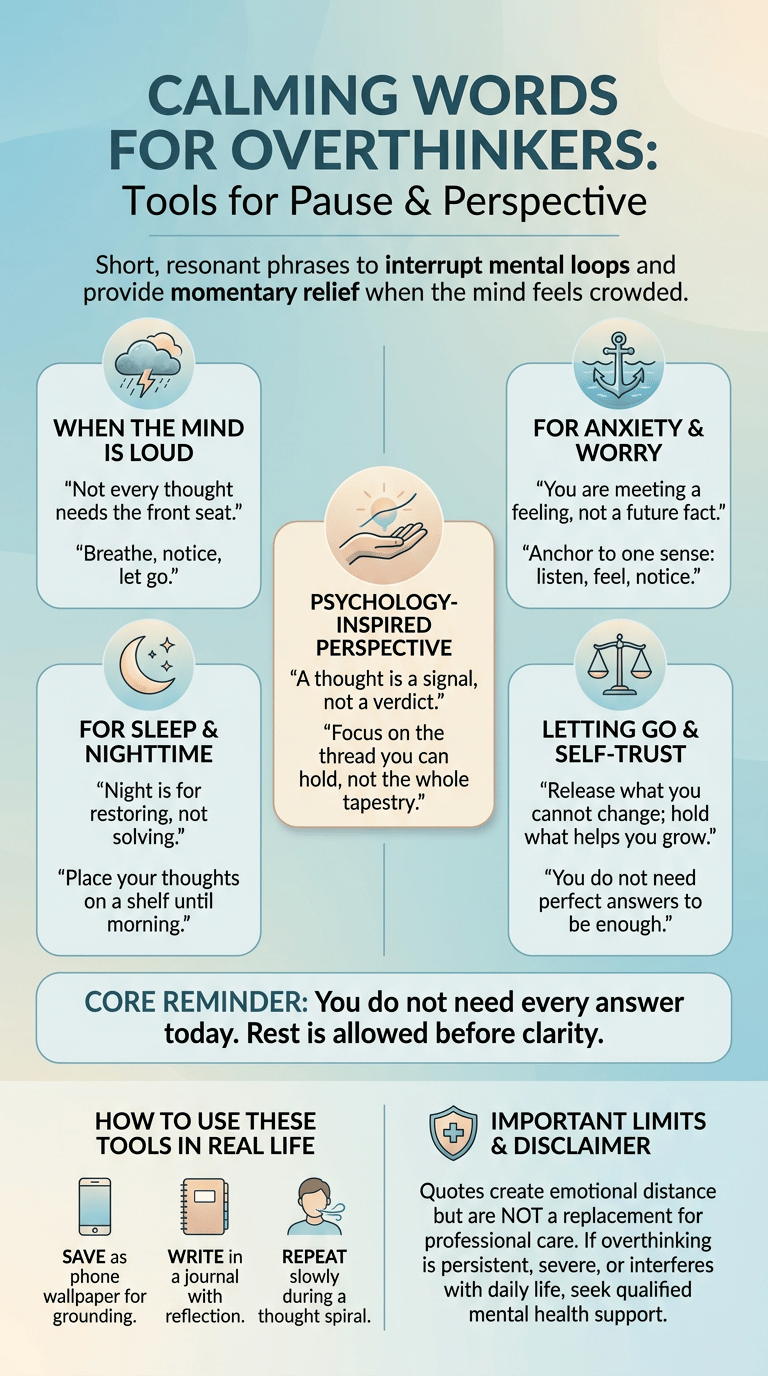
Not every thought needs the front seat.
This moment is bigger than this worry.
Breathe, notice, let go.
You are not the noise in your head.
Small pause. Small kindness. Then continue.
Quotes for when you need to let go
Release what you cannot change and hold what helps you grow.
Let it move through you like weather.
Some chapters close so new pages can open.
It is okay to put the question down for now.
Quotes for when you cannot sleep
Night is for restoring, not solving.
Count breaths, not problems.
Tomorrow can keep its plans; rest first.
Quiet the mind so the body can remember how to rest.
Quotes for when you feel anxious
You are meeting a feeling, not a future fact.
This feeling is temporary. You will move through it.
Anchor to one sense: listen, feel, notice.
Anxiety speaks loudly. You can listen with curiosity, not obedience.
Psychology-Inspired Quotes for Overthinkers
Quotes about thoughts not being facts
A thought is a signal, not a verdict.
Thoughts pass. They are not permanent statements.
You can notice a thought and choose what to believe.
Recognizing that thoughts are not always accurate representations of reality is an idea used in many evidence-based approaches to worry and anxiety; for concise definitions and context about cognitive patterns, see the American Psychological Association’s topic summaries (APA topics).
Quotes about control
Focus on the thread you can hold, not the whole tapestry.
Control the next step you can take, not the whole path.
Let go of ownership of outcomes you cannot influence.
Quotes about uncertainty
Uncertainty is part of being human. You will adapt.
Not knowing is uncomfortable. It is not dangerous by default.
You can choose curiosity over catastrophe for a moment.
Quotes about emotional peace
Calm does not mean nothing is happening. It means you can handle it.
Find a steady thing in this moment and return to it.
Peace is practice, not polishing everything away.
Quotes about self-trust
Trust the parts of you that have already navigated hard days.
You do not need perfect answers to be enough.
Small choices build faith in yourself.
Calming Reminders to Stop Overthinking
You do not need every answer today
“You do not need every answer today” is a short, permission-giving sentence that can reduce urgency and the pressure to resolve uncertainty immediately. Saying this to yourself can create space for paced decision-making and lower the intensity of mental loops.
A thought is not a prediction
Reminding yourself that a thought is not a certain prediction helps create distance from worst-case scenarios. Cognitive approaches to worry often encourage noticing thoughts and testing evidence rather than accepting them as facts. For definitions and terminology about thinking patterns, see the APA Dictionary of Psychology (APA Dictionary of Psychology).
Rest is allowed before clarity
Allowing rest before solving can break a cycle of rumination. Resting can support concentration and decision-making; for patient-focused information about sleep, anxiety, and related care options, see the MedlinePlus mental health overview (MedlinePlus mental health).
You can act without perfect certainty
This reminder supports forward motion. Many choices in life are made with incomplete information. Shifting from “I must know everything” to “I can make a good-enough choice now” reduces over-analysis and builds momentum.
You are allowed to pause before reacting
Pausing creates a gap between thought and action. That gap lets you choose a wise response rather than an automatic reaction. Techniques that build that gap are used in several therapeutic approaches and are described in professional psychology summaries (APA topics).
Quotes for Nighttime Overthinking
Quotes for racing thoughts before bed
Evening is for breathing, not bargaining.
Let the night gather what it needs to hold; you can rest.
Place your thoughts on a shelf until morning.
Quotes for sleep anxiety
Sleep is repair. It is allowed to happen while you are imperfectly ready.
Your body knows how to rest. Give it the space to do so.Worry can wait until daylight; right now, your job is to rest.
If sleep anxiety is chronic or causing daytime impairment, review reliable health information about sleep and anxiety to explore supportive options at the NIMH mental health information pages (NIMH mental health information).
Quotes for letting tomorrow wait
Tomorrow will hold its own questions; tonight is for quiet.
One night of rest helps you meet a better tomorrow
Quotes for resting without solving everything
You are allowed to rest incomplete and come back clearer.
Let sleep do some of the work for you.
Quotes for Negative Thoughts
Quotes for self-criticism
Speak to yourself like you would to a friend in pain.
Mistakes do not erase your worth.
You are learning. That is the point.
Quotes for worst-case thinking
What is likely is not always what feels loudest.
Turn down the volume on catastrophes and check the facts.
The worst thought is rarely the whole story.
Quotes for emotional reasoning
Feeling overwhelmed does not mean you are failing.
Emotions inform. They do not decide alone.
Notice the feeling, then look for evidence.
Quotes for choosing a balanced thought
Balance one worrying thought with one realistic possibility.
Add a gentle truth to the loud story.
Ask: what is helpful to believe right now?
How to Use These Quotes in Real Life
Save one as a phone wallpaper
Choose a short quote you find grounding and make it your lock-screen or wallpaper. Seeing a reminder during a spiral can be faster to access than a longer breathing exercise.
Write one in a journal
Copy a quote into your journal and add a few lines about where you feel it applies. Combining a quote with reflection helps turn an abstract phrase into a personal strategy.
Use one before bed
Say a soothing line aloud or write it on a note by your bed. Repeating a calming sentence can signal your mind that rest is permitted.
Repeat one during a thought spiral
Pick a short quote and repeat it slowly when thoughts speed up. Pair the phrase with a slow exhale to anchor your body while you shift your attention.
Turn one quote into a grounding prompt
Transform a quote into a brief exercise. For example, if your quote is “Breathe, notice, let go,” turn that into a three-step practice: breathe deeply for four counts, notice one sound in the room, and imagine letting the thought drift away like a leaf.
Why Quotes Can Help, But Have Limits
Quotes can interrupt a mental loop
Short, meaningful phrases can break automatic thinking by introducing new content into a loop. This interruption creates a chance to shift perspective or behavior. Psychological practice often uses small cognitive reminders to encourage different responses to thoughts.
Quotes can create emotional distance
When a quote reframes a worry as just a thought, it can help create distance between you and the feeling. That distance can make it easier to evaluate how much attention a thought deserves and to choose an intentional response.
Quotes are not a replacement for support
While quotes and brief reminders are useful for short-term relief and momentary redirects, they are not a substitute for professional treatment when symptoms are persistent or disabling. For trusted information about mental health services, diagnosis, and treatment options, consult established health resources such as the NIMH mental health information pages (NIMH mental health information) or the MedlinePlus mental health overview (MedlinePlus mental health).
When deeper help may be needed
If overthinking comes with severe or constant anxiety, notable changes in sleep or appetite, persistent low mood, or thoughts of self-harm, seek qualified professional support promptly. If you are in immediate danger or thinking about harming yourself, contact local emergency services or a crisis line right away.
FAQs
What is a good quote for overthinking?
A helpful quote is short, permission-granting, and easy to remember. Examples in this article include “This moment is bigger than this worry” and “A thought is a signal, not a verdict.” Choose one that feels believable and calming to you.
What should I tell myself when I think too much?
Use simple reminders such as “I can pause” or “I do not need every answer now.” Framing a sentence as permission or a gentle instruction can reduce the pressure to solve everything at once.
Can quotes help with overthinking?
Quotes can help by interrupting repetitive thoughts and offering a quick way to shift perspective. They work best as one part of a broader set of strategies, such as grounding exercises, structured reflection, or talking with a trusted person. If worry is persistent and affects daily life, professional help is recommended; see NIMH mental health information for overviews of treatment options (NIMH mental health information).
What is a calming sentence for anxiety thoughts?
Calming sentences are brief and focus on safety, permission, or perspective. Examples are “This feeling will pass” and “I can handle this one step at a time.” Try different sentences and notice which one lowers your tension most reliably.
Quotes are tools to help you pause, notice, and choose. Use them alongside healthy habits like regular sleep, movement, and connection with others. If you are unsure whether your worry needs professional attention, contact a qualified clinician or consult reputable resources for guidance.

Michael Reed is the Founder and Lead Writer at Psychology Exposed. He writes about human behavior, relationships, emotional patterns, self-awareness, and practical psychology topics using research-informed, easy-to-understand content.
Read More About Michael Reed: https://psychologyexposed.com/michael-reed/