
What Mental Clarity Means
Mental clarity is the feeling of thinking clearly
Mental clarity refers to the subjective experience of thinking with ease, noticing incoming information, making decisions without excessive effort, and feeling mentally alert. For clarity of terms, professional psychology resources define thinking and cognitive processes in ways that emphasize attention, memory, and decision processes; those definitions can help you separate the experience of clear thinking from clinical diagnoses or mood states from a psychology perspective.

Focus is easier when mental clutter is lower
People often notice that focus follows clarity. When the mind is less cluttered with competing worries, unfinished tasks, or distraction, it is easier to direct attention to a chosen task. Behavioral science summaries explain that reducing competing mental demands usually makes sustained attention simpler and more productive according to behavioral science overviews.
Brain fog can come from many causes
The phrase brain fog describes a range of experiences including slowed thinking, forgetfulness, fuzzy concentration, or a sense of mental cloudiness. Brain fog can be tied to everyday factors like poor sleep and heavy workload, to emotional stress, and sometimes to physical health or medication effects. Patient-focused health resources describe many potential contributors and emphasize looking at sleep, mood, medical conditions, and lifestyle when brain fog is persistent in patient-focused health guidance.
Why Your Mind Feels Foggy
Poor sleep
Sleep is a foundational process for cognitive functioning. When sleep is short, fragmented, or poor in quality, common effects include slower thinking, weaker concentration, and more difficulty with memory retrieval. For reliable information about sleep and mental health, professional health resources describe how sleep affects attention and mood and why prioritizing sleep is often an effective first step when clarity is reduced in mental health guidance.
Stress and emotional overload
High stress, persistent worry, or emotional upheaval can consume mental resources and make it hard to think clearly. Psychological overarousal can lead to repetitive thoughts, reduced working memory capacity, and difficulty planning. Psychology topic summaries discuss how stress and emotion influence cognition and behavior and why managing emotional load can free up attention for new tasks in psychology overviews.
Too much information
Continuous streams of new information increase cognitive load. When your brain is asked to monitor many inputs, switch between topics, or learn too much at once, clarity and focus can suffer. Behavioral science explains that information overload decreases performance and increases the sense of mental fog because attention must be divided or constantly reoriented according to psychological science summaries.
Dehydration or unstable energy
Fluctuations in energy and hydration can change how alert you feel. Mild dehydration and irregular eating patterns sometimes correspond with feelings of sluggishness or difficulty concentrating. Patient-centered health materials describe lifestyle factors that commonly influence cognition, while noting that persistent or severe cognitive symptoms merit professional evaluation for general health context.
Lack of movement
Extended physical inactivity can leave you feeling lethargic and mentally slow. Short bouts of movement often improve alertness and mood in the near term. Health summaries note that light exercise and regular movement can support general mental well-being, which in turn supports clarity and cognitive functioning in broader mental health guidance.
Start With a Mental Reset
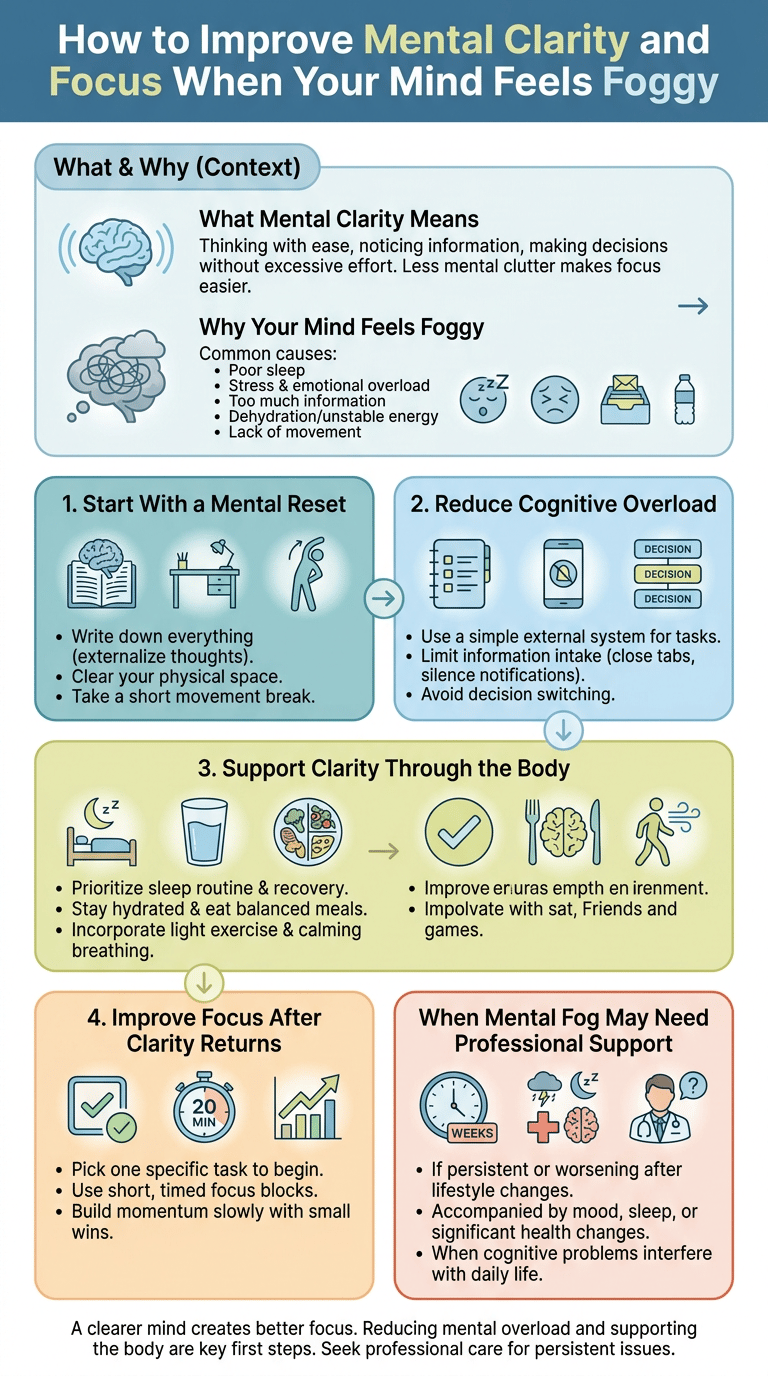
Write down everything on your mind
When your thoughts feel scattered, one effective tactic is to externalize them. Spend five to fifteen minutes writing a stream-of-consciousness list of tasks, worries, reminders, and ideas. The goal is not to organize everything perfectly but to move items out of short-term memory so the mind has room to work. This simple practice reduces the mental burden of trying to remember many things at once.
Choose one next action
From your written list, pick a single clear next action for one item. A next action is a specific, doable step such as “write two paragraphs,” “call the clinic to ask about hours,” or “set a timer for 20 minutes of reading.” Converting vague intentions into concrete actions reduces indecision and prevents the mind from cycling through options.
Clear your physical space
Physical clutter can mirror mental clutter. Take a few minutes to tidy the immediate workspace, put away unrelated items, and position only what you need for the task at hand. A cleaner environment can reduce visual distractions and help the brain focus on the chosen activity.
Take a short movement break
If you have been sitting or ruminating, brief movement can interrupt mental loops. Stand, stretch, walk for five minutes, or do a short set of gentle activity. Movement tends to increase circulation and can improve alertness enough to help you begin a task with more focus.
Reduce Cognitive Overload
Stop holding tasks in your head
Keeping many to-dos and reminders in working memory creates ongoing cognitive load. Relying on memory for multiple tasks makes it harder to think clearly. Offloading tasks into a trusted external place prevents the brain from repeatedly rehearsing what it needs to remember, which reduces background mental noise. Psychology topic resources discuss strategies for managing cognitive load in psychology overviews.
Use a simple external system
Choose a minimal, reliable external system for tracking tasks and ideas. This can be a single notebook, a basic digital list, or a simple task app. The system should be easy to capture into and easy to consult. The point is consistency: when you trust your system, you no longer need to mentally rehearse items, freeing attention for present tasks.
Limit information intake
When brain fog is present, reduce the flow of new information. Close unneeded browser tabs, silence nonessential notifications, and consider time-limiting news or social media use. Intentionally lowering the inflow of stimuli helps prevent new items from joining the mental backlog.
Avoid switching between too many decisions
Decision switching incurs a cognitive cost. Try grouping related choices together, reduce the number of options you consider where possible, and postpone minor decisions until after a focused work block. Conserving decision energy makes it easier to sustain attention on important tasks.
Support Clarity Through the Body
Sleep recovery
Prioritize a sleep routine that supports consistent timing and sufficient duration for you. Routine sleep schedules and sleep hygiene steps can improve daytime alertness and reduce cognitive sluggishness. If sleep problems persist and affect daytime function, professional resources recommend evaluation and may offer guidance on sleep-related concerns about sleep and mental health.
Hydration
Keep hydration simple and regular. Drinking fluids throughout the day and noticing how you feel after rehydrating can be a practical step to support alertness. If you have health conditions that require adjusted fluid intake, follow the guidance provided by your health care team.
Balanced meals
Aim for regular meals that combine protein, carbohydrates, and healthy fats in a way that suits your needs. Irregular eating patterns or very high-sugar meals can contribute to fluctuations in energy and concentration. Nutritional choices are part of a broader lifestyle approach to supporting cognition, but no single meal or food can be guaranteed to cure persistent cognitive problems.
Light exercise
Short, moderate physical activity supports circulation and can temporarily boost alertness and mood. A brief walk, a set of gentle stretches, or simple bodyweight movement can make it easier to return to focused tasks. Incorporating movement consistently across the day tends to support overall mental functioning.
Breathing to calm stress
Simple breathing practices can reduce acute stress and lower feelings of overwhelm. Try breathing in slowly for a count of three or four, holding briefly if comfortable, and breathing out slowly for a count of three or four. Repeating this pattern for a few minutes can create a calmer baseline for thinking, though breathing exercises are a short-term strategy rather than a substitute for clinical care when stress is severe.
Improve Focus After Clarity Returns
Pick one task
Once mental clutter has been reduced and you feel a bit clearer, select a single task to begin. Choose something aligned with your priorities and make the first step specific and small enough to start immediately.
Use a short focus block
Work in short, timed focus blocks. For example, set a timer for a manageable period and commit to working on the chosen task until the timer ends. Short blocks reduce pressure and allow you to build concentration gradually. After a break, you can reassess how you feel and decide whether to continue.
Avoid jumping straight into complex work
If your mind has been foggy, jumping immediately into highly complex or novel tasks can increase frustration. Consider beginning with an easier, meaningful step that builds momentum, then transition to more demanding work as clarity improves.
Build momentum slowly
Small consistent wins matter. Completing short focused blocks repeatedly helps rebuild confidence and attention. Track progress visibly, even in small ways, because seeing progress reduces the tendency to ruminate on what remains undone.
When Mental Fog May Need Professional Support
If brain fog is persistent or worsening
If mental fog does not improve after reasonable lifestyle changes or if it gets worse over weeks, it is appropriate to seek professional evaluation. Persistent cognitive symptoms can sometimes reflect treatable sleep problems, mood conditions, medication effects, or medical issues and deserve assessment by a qualified clinician. Trusted mental health resources outline when professional help may be needed and how to find care in authoritative mental health guidance.
If it comes with mood, sleep, or health changes
When brain fog is accompanied by new or worsening mood symptoms, significant sleep disruption, unexpected weight change, persistent pain, or other physical signs, a medical or mental health evaluation is recommended. Patient information sources explain that cognitive symptoms often occur alongside other changes and that coordinated care can help identify contributing factors in clinical patient guidance.
When to consult a qualified professional
Consult a qualified health professional when cognitive problems interfere with daily life, work, or school, or when you are unsure about the cause. Professionals can evaluate medical, psychiatric, and lifestyle contributors and recommend appropriate next steps. If thoughts of harm to yourself or others occur, or if you are in immediate danger, seek emergency help right away from authoritative mental health guidance.
Final Thoughts
Mental clarity often improves when you reduce overload
When your mind feels foggy, focusing first on reducing mental overload and restoring basic body systems often produces the largest short-term improvements. Externalizing tasks, limiting information intake, rehydrating, moving briefly, and improving sleep and routine create conditions that support clearer thinking.
A clearer mind creates better focus
Practical, sustainable changes that lower competing demands and support the body tend to make focus easier and more reliable. If cognitive problems persist despite these efforts, professional evaluation can help identify underlying causes and appropriate care. For accessible summaries of psychological topics and mental health information, professional resources offer reputable overviews and guidance about psychology topics from the American Psychological Association and broader behavioral science context from Psychological Science.

Michael Reed is the Founder and Lead Writer at Psychology Exposed. He writes about human behavior, relationships, emotional patterns, self-awareness, and practical psychology topics using research-informed, easy-to-understand content.
Read More About Michael Reed: https://psychologyexposed.com/michael-reed/