
Learning and remembering depend on two linked processes: where you place your attention and how your brain encodes and stores that information. What the brain does not focus on, it cannot encode deeply or recall reliably. This article explains how attention and memory work together and gives practical, psychology-based strategies you can use to focus better and remember more effectively when studying, learning new skills, or trying to retain information at work.

How Focus and Memory Work Together
Attention helps your brain encode information
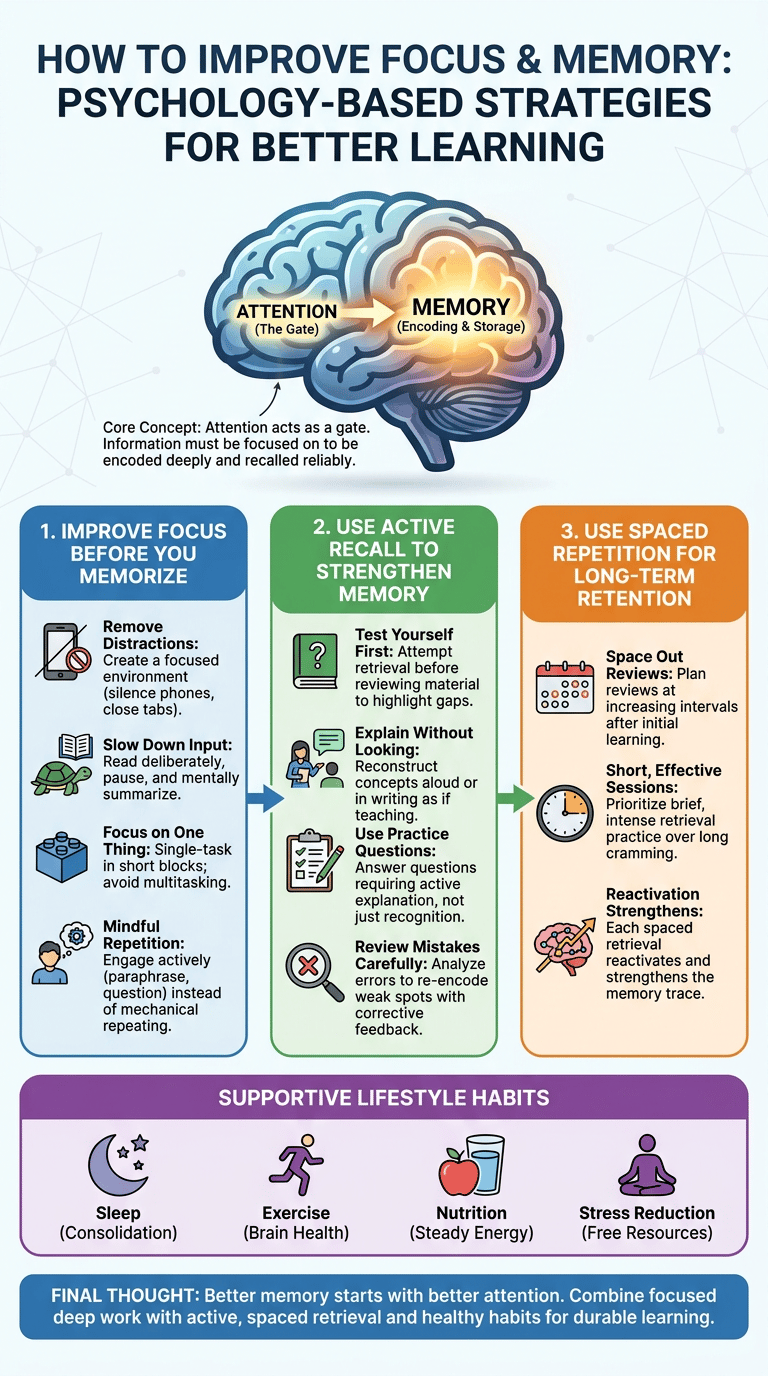
Attention acts like a gate for memory. When you focus on an item, your brain is more likely to move that information into short-term storage and then into longer-lasting memory systems. The idea that attention shapes what is encoded is a core concept in psychology and is described in broad overviews of cognitive processes and behavior. For definitions and background on these concepts, see the American Psychological Association’s discussions of cognitive topics and terminology.
Overviews of psychological topics from the American Psychological Association provide accessible descriptions of attention and memory processes that show how focused processing supports encoding.
Memory improves when information has meaning
Information that connects to existing knowledge or that you process more deeply is easier to remember. Meaningful encoding can take many forms: linking new material to prior knowledge, elaborating with examples, or organizing details into categories. Psychology resources emphasize that memory is reconstructive, and deeper processing tends to create richer memory traces that support later recall.
Distraction weakens recall
When attention is divided or shifted away from what you are trying to learn, the brain encodes less detail and creates weaker memory traces. Everyday distractions, interruptions, and background tasks reduce the depth of processing and make later retrieval more difficult. For summaries of behavioral research that explores attention and memory interactions, see accessible reports and reviews in psychology literature.
Psychological Science summaries and accessible research context explain how attentional lapses and divided attention affect learning and performance.
Why You Forget Things When You Are Distracted
Your brain never fully registered the information
Often when you think you forgot something, the memory was never formed strongly in the first place. If your attention was elsewhere when the information arrived, the brain did not allocate enough processing to encode the detail. This is why repetition without attention tends to be ineffective: simply exposing yourself to information is not the same as forming a durable memory of it.
For a related next step, see this guide to improving focus and concentration.
Multitasking overloads working memory
Working memory holds and manipulates a small amount of information for short periods. Trying to hold multiple tasks or streams of information at once strains this limited system. When working memory is overloaded, none of the items receive the focused rehearsal needed for stronger encoding, and errors or omissions increase.
Definitions and discussion of working memory from the APA Dictionary of Psychology.
Stress interferes with recall
High stress or anxiety can impair attention at the moment of learning and interfere with later retrieval. When stress is severe or persistent, it can reduce the effectiveness of attention and make remembering harder. If stress or anxiety is affecting your ability to learn or function, consider seeking guidance from a qualified mental health professional.
For general information on how mental health factors can affect thinking and daily functioning, see educational materials from the National Institute of Mental Health.
NIMH mental health information and fact sheets provide authoritative information on stress, anxiety, and related effects on cognition.
Poor sleep reduces memory consolidation
Sleep plays an important role in strengthening memories after learning. When sleep is insufficient or fragmented, memory consolidation can be impaired, which reduces how well information is retained over time. For practical, patient-friendly information about sleep, memory, and related health factors, see consumer resources that summarize clinical knowledge.
MedlinePlus mental health resources provide accessible information about sleep, stress, and lifestyle factors that support cognitive health.
Improve Focus Before Trying to Memorize
Remove distractions first
Start by creating a focused environment. Put phones on silent or keep them out of sight, close unnecessary browser tabs, and tell people nearby when you need uninterrupted time. Even low-level distractions can pull attention away and weaken encoding, so reducing them increases the chance that learning time will produce usable memories.
Slow down the input
Rapidly skimming information makes it harder to form connections. Slow the pace: read one paragraph at a time, pause after key points, and mentally summarize what you just read. Slower, deliberate intake encourages deeper processing and supports later retrieval.
Focus on one piece of information at a time
Work in short blocks focused on a single topic, concept, or task. Breaking study or practice into focused segments helps working memory fully process each item. Use a single-task approach rather than attempting to switch repeatedly between topics, which increases cognitive load.
Repeat with attention, not mechanically
Repetition matters, but mechanical repetition without engagement has limited benefit. When you repeat material, do so with mindful attention: paraphrase, ask a question about the content, or explain why it matters. These small changes turn repetition into active processing that strengthens memory.
Use Active Recall to Strengthen Memory
Test yourself before reviewing
Active recall means trying to retrieve information from memory rather than simply re-reading it. Testing yourself without looking forces retrieval and highlights gaps. After an initial learning pass, attempt to recall key points, terms, or steps before you check the material. This practice improves retention because successful retrieval reinforces memory pathways.
Explain the idea without looking
Put the material away and explain the concept aloud or in writing as if teaching someone else. This technique reveals what you understand and what is still unclear, and it requires you to reconstruct the information rather than recognize it passively.
Use practice questions
Create or use questions that reflect the kind of recall you need. Practice questions that require active responses mimic the conditions of later retrieval and help the brain form stronger memory cues. When possible, use questions that require explanation rather than yes-or-no answers.
Review mistakes carefully
Errors during retrieval identify fragile knowledge. When you make a mistake, examine why it happened, correct the error, and attempt retrieval again. Learning from mistakes strengthens memory because it focuses attention on weak spots and prompts re-encoding with corrective feedback.
Use Spaced Repetition
Why spacing beats cramming
Spacing learning sessions over time helps memory because each retrieval or review requires reactivation of the memory trace, which strengthens it. Cramming may produce short-term recall, but spaced sessions promote longer-lasting retention by distributing the cognitive work across multiple retrievals.
Psychological Science offers accessible summaries of research on learning strategies such as spacing and retrieval practice.
How to review information over time
Plan reviews at increasing intervals after the initial learning. Start with a short review soon after learning, then revisit the material at progressively longer gaps. Each review should include active recall rather than passive re-reading to maximize benefits.
How to keep sessions short and effective
Use short, focused sessions that emphasize quality over quantity. Brief, intense retrieval practice followed by short breaks is often more productive than long, unfocused study marathons. Keep sessions long enough to accomplish meaningful practice but short enough to sustain attention.
Make Information Easier to Remember
Connect new ideas to what you already know
Linking new material to familiar concepts provides retrieval pathways and a meaningful framework for encoding. When you anchor new facts to existing knowledge, you create associations that make recall more efficient and reliable.
Use examples
Concrete examples make abstract ideas tangible and easier to retrieve. Try to generate or find multiple examples that illustrate the same concept; variation helps the brain generalize and remember the underlying principle.
Create mental images
Imagery often enhances memory by creating vivid representations that are easier to recall than abstract words alone. Forming a clear mental picture, story, or scene for complex information can provide memorable hooks for later retrieval.
Organize information into categories
Chunking information into logical groups reduces cognitive load and aids working memory. Organize lists, steps, or facts into meaningful categories, and use headings, outlines, or concept maps to structure material in a way that reflects relationships and hierarchy.
Lifestyle Habits That Support Focus and Memory
Sleep
Sleep supports memory consolidation and attention. Prioritizing consistent, sufficient sleep helps the brain process new information and prepares you for focused learning. For clear, consumer-focused information about sleep and mental health, see patient-friendly resources that summarize clinical guidance.
MedlinePlus guidance on sleep and mental health offers practical information on sleep hygiene and its role in cognitive function.
Exercise
Regular physical activity supports brain health and can improve attention and mood, which in turn make focused learning more likely. Exercise helps with circulation and metabolic processes in the brain and supports the conditions needed for sustained cognitive work. For general descriptions of how lifestyle affects mental functioning, see psychology and health resources.
APA topic overviews include accessible discussions of lifestyle and behavior factors that influence cognitive performance.
Nutrition
Balanced nutrition supports overall brain function. Eating regular, well-balanced meals and staying hydrated helps maintain steady energy and attention while studying or working. Avoid portraying any single food or supplement as a cure for attention or memory issues; dietary choices support overall cognitive function as part of a healthy lifestyle.
Stress reduction
Techniques that reduce stress can improve attention and memory by freeing cognitive resources for learning. Mindful breathing, brief movement breaks, and time management strategies can reduce acute stress and make focused work more sustainable. If stress is persistent or affects daily life, seek advice from a qualified professional.
For reliable, research-informed mental health information, the National Institute of Mental Health provides educational resources.
NIMH resources on stress and mental health include fact sheets and guidance for when to seek help.
When Memory Problems Need Attention
Normal forgetfulness vs disruptive memory problems
Some degree of forgetfulness is normal, especially when attention was poor or when information is not frequently used. However, memory concerns become more serious if they are persistent, worsening, or significantly interfere with daily functioning at school, work, or home.
When to seek professional advice
If memory or focus problems are new, severe, or interfere with daily life, it is appropriate to consult a qualified healthcare or mental health professional for assessment. A professional can help determine whether underlying factors such as sleep problems, medication effects, mood or anxiety conditions, or other health issues may be contributing and can recommend appropriate next steps.
MedlinePlus mental health information offers accessible guidance on when to reach out for medical or mental health support.
If you or someone else is in immediate danger, experiencing thoughts of self-harm, or facing a crisis, contact emergency services or a crisis line right away.
Final Thoughts
Better memory starts with better attention
Attention determines what gets encoded. By reducing distractions, slowing down to process information, and focusing on one element at a time, you increase the chance that learning will produce durable memory.
Focus deeply, review actively, repeat over time
Combine focused attention with active recall, spaced repetition, meaningful organization, and healthy lifestyle habits. These practices work together: attention improves encoding, active retrieval strengthens memory traces, and spaced reviews sustain retention. When focus problems are persistent or severe, seek help from a qualified professional who can provide assessment and guidance.

Michael Reed is the Founder and Lead Writer at Psychology Exposed. He writes about human behavior, relationships, emotional patterns, self-awareness, and practical psychology topics using research-informed, easy-to-understand content.
Read More About Michael Reed: https://psychologyexposed.com/michael-reed/