
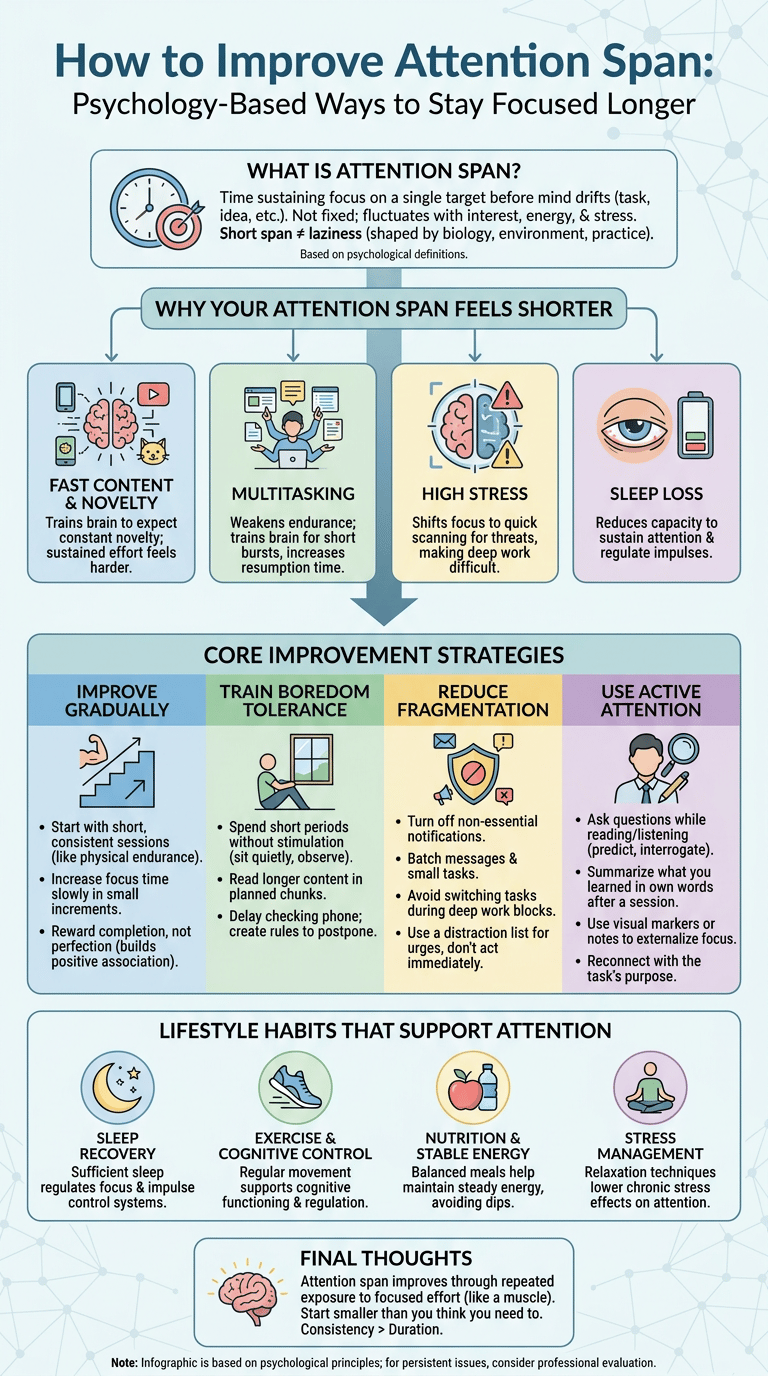
What is attention span?
Attention span means how long your mind can stay with one target
Attention span refers to the amount of time someone can sustain focus on a single task, idea, page, or stimulus before their mind drifts or they switch to something else. For a clear overview of psychological definitions related to attention and related concepts, consult the APA Dictionary of Psychology.
Attention span changes depending on interest, energy, and stress
Attention is not a fixed trait. It fluctuates with motivation, fatigue, emotional state, and the surrounding environment. Tasks that match your interests or goals are easier to sustain, while physical tiredness or high stress make sustained focus harder. For accessible context about how psychological factors shape attention and behavior, see the American Psychological Association’s general topics overview at APA Topics.
Short attention span does not always mean laziness
Many people experience shorter attention for reasons outside character or willpower. Frequent interruptions, sleep loss, anxiety, and habitually consuming fast-paced content can all reduce focused time. Describing these patterns as failure or laziness is unhelpful and inaccurate; attention capacity is shaped by biology, environment, and practice.
Why your attention span feels shorter
Fast content trains your brain to expect constant novelty
Short, rapidly changing media can encourage quick reward-checking and make sustained attention feel effortful. Over time, repeatedly consuming fast-paced content can change how often you seek new stimulation, creating a mismatch when a task requires sustained engagement. For broader discussion of how media and modern environments influence attention and behavior, see perspectives in the behavioral science community at Psychological Science.
Multitasking weakens sustained attention
Switching between tasks interrupts concentration and increases the time needed to resume a single task. Habitual multitasking trains the brain to operate in short bursts rather than extended sessions of focus, which reduces attention endurance over time. Research and summaries about attention and task switching are available through Psychological Science.
Stress makes your mind scan for threats
When stress levels are high, attention often shifts toward monitoring potential problems or threats. This adaptive response prioritizes quick scanning over deep, sustained processing, and it can make focused work feel more difficult. For reliable mental health information related to stress and functioning, review materials from the National Institute of Mental Health.
Sleep loss reduces mental control
Insufficient sleep reduces the brain’s capacity to sustain attention, regulate impulses, and maintain working memory. Difficulty concentrating is a common consequence of poor sleep. For patient-friendly information about sleep and its relationship to mental health and cognitive functioning, see MedlinePlus: Mental Health.
Boredom tolerance gets weaker when everything is instantly stimulating
Regularly relying on fast, high-stimulation activities can reduce tolerance for low-stimulation tasks. When the brain expects continuous novelty, routine or monotonous work feels aversive, making focused attention harder to maintain.
How to improve attention span gradually
Start with short focus sessions
Treat attention like physical endurance. Begin with short, manageable sessions of focused work that you can complete without frustration. Very short sessions reduce resistance and produce quick wins that build motivation.
- Choose one task and set a timer for a short period you can reliably complete.
- Avoid overcommitting time at first; the goal is consistency rather than duration.
Increase focus time slowly
Once short sessions feel comfortable, add small increments. Increasing focus time gradually helps your brain adapt without triggering avoidance. For example, if you start with shorter sessions, try adding a few minutes every few days rather than doubling time at once.
Track only one attention goal at a time
Focusing on one measurable attention goal reduces complexity and improves the chance of steady progress. Examples include reading for a set time without checking devices or completing a specific work task in a single session.
Reward completion, not perfection
Reinforce the habit of finishing focused sessions rather than expecting flawless concentration. Small rewards or a brief break after finishing a session supports learning and builds positive associations with sustained effort.
Train your brain to tolerate boredom
Spend short periods without stimulation
Practice sitting quietly for brief intervals without phone or background media. These low-stimulation breaks teach the mind to tolerate boredom and reduce the urge to seek new input immediately.
- Start with very short intervals and increase gradually.
- Use this time to notice sensations, breathe, or simply observe thoughts without acting on them.
Read longer content in small chunks
Instead of scanning multiple short articles, pick longer material and read in planned segments. Breaking longer texts into chunks trains sustained attention while keeping progress manageable.
Delay checking your phone
Create brief rules that delay automatic checking. For example, wait until a focused session is complete or postpone checking social apps for a set time after starting work. Delaying responses strengthens the habit of staying on task.
Let your mind settle before switching tasks
Allow a short pause at the end of a focused session. This pause reduces carryover of distraction and gives the mind time to reorient before engaging with a new task.
Reduce attention fragmentation
Turn off non-essential notifications
Notifications interrupt attention and encourage rapid task switching. Turn off or silence non-critical alerts during focus periods to reduce unexpected interruptions.
Batch messages and small tasks
Rather than responding immediately, schedule times to handle messages, emails, and minor tasks. Batching reduces the number of times you shift away from deep work.
Avoid switching tasks during deep work
When engaged in a deep session, commit not to switch tasks until a natural stopping point. Protecting uninterrupted blocks of time trains the brain to work longer before seeking novelty.
Use a distraction list instead of acting on every urge
Keep a nearby notepad for distracting thoughts or quick tasks that arise during focus. Jotting them down acknowledges the urge without derailing work, allowing you to return after the session.
Use active attention techniques
Ask questions while reading or listening
Turn passive activities into active ones by asking questions about the material. Predict what will come next, interrogate key points, or identify gaps in understanding to keep attention engaged.
Summarize what you just learned
After a reading or listening session, pause and summarize the main ideas in your own words. This practice strengthens comprehension and makes it easier to sustain attention in subsequent sessions.
Use visual markers or notes
Highlight, annotate, or use quick diagrams to externalize focus. Visual markers serve as anchors that help your attention remain connected to the material.
Reconnect with the purpose of the task
Remind yourself why a task matters. Reorienting to the task’s goal links attention with value and motivation, which supports endurance during challenging stretches.
Lifestyle habits that support attention span
Sleep and attention recovery
Regular, sufficient sleep supports the brain systems that regulate focus and impulse control. If sleep is poor, attention is harder to maintain. For reliable guidance about sleep and mental health, consult the NIMH resources.
Exercise and cognitive control
Physical activity supports cognitive functioning, including the ability to sustain attention. Routine movement and aerobic exercise are associated with improved attention regulation and mood. For accessible summaries of behavioral research, see Psychological Science and general psychology topics at the APA.
Nutrition and stable energy
Balanced meals and regular eating rhythms help maintain steady energy and reduce attention dips related to blood sugar changes. Avoid extreme fasting or highly irregular eating if you notice it affects concentration. For patient-focused information on mental health and related lifestyle factors, see MedlinePlus: Mental Health.
Stress management and attention stability
Practices that lower chronic stress—such as relaxation techniques, structured routines, and brief breaks—can reduce the attention-capturing effects of anxiety and worry. For accessible patient-focused information on mental health and coping, see MedlinePlus: Mental Health and resources from the NIMH.
Mistakes that keep your attention span short
Trying to fix attention with pressure
Pushing yourself to focus longer than is realistic can backfire and increase avoidance. Instead of relying on pressure, use gradual increases and consistent practice.
Consuming only short-form content
Relying heavily on short videos and rapid posts trains the brain for quick rewards and undermines tolerance for longer, less stimulating tasks. Balance short-form habits with intentional longer reading or listening sessions.
Working with your phone beside you
Having a phone within reach increases the temptation to check it. Physical separation or placing the device out of sight during focus sessions reduces fragmentation.
Expecting instant improvement
Attention endurance builds slowly. Expecting rapid change can lead to frustration and abandonment. Small, consistent gains compound into meaningful improvement over time.
Final thoughts
Attention span improves through repeated exposure to focused effort
Think of attention like a muscle: repeated, manageable practice improves endurance over time. Small, consistent sessions, reduced fragmentation, and active engagement with material all train the brain to stay with one target longer.
Start smaller than you think you need to
Begin with very short, achievable sessions and increase them gradually. Celebrate completion, protect uninterrupted time, and pair attention training with supportive sleep, movement, and stress management. If focus problems are persistent, severe, worsening, or interfere with daily life, school, or work, consider seeking evaluation from a qualified professional who can provide tailored guidance.

Michael Reed is the Founder and Lead Writer at Psychology Exposed. He writes about human behavior, relationships, emotional patterns, self-awareness, and practical psychology topics using research-informed, easy-to-understand content.
Read More About Michael Reed: https://psychologyexposed.com/michael-reed/