
What is mental focus?
Mental focus is controlled attention
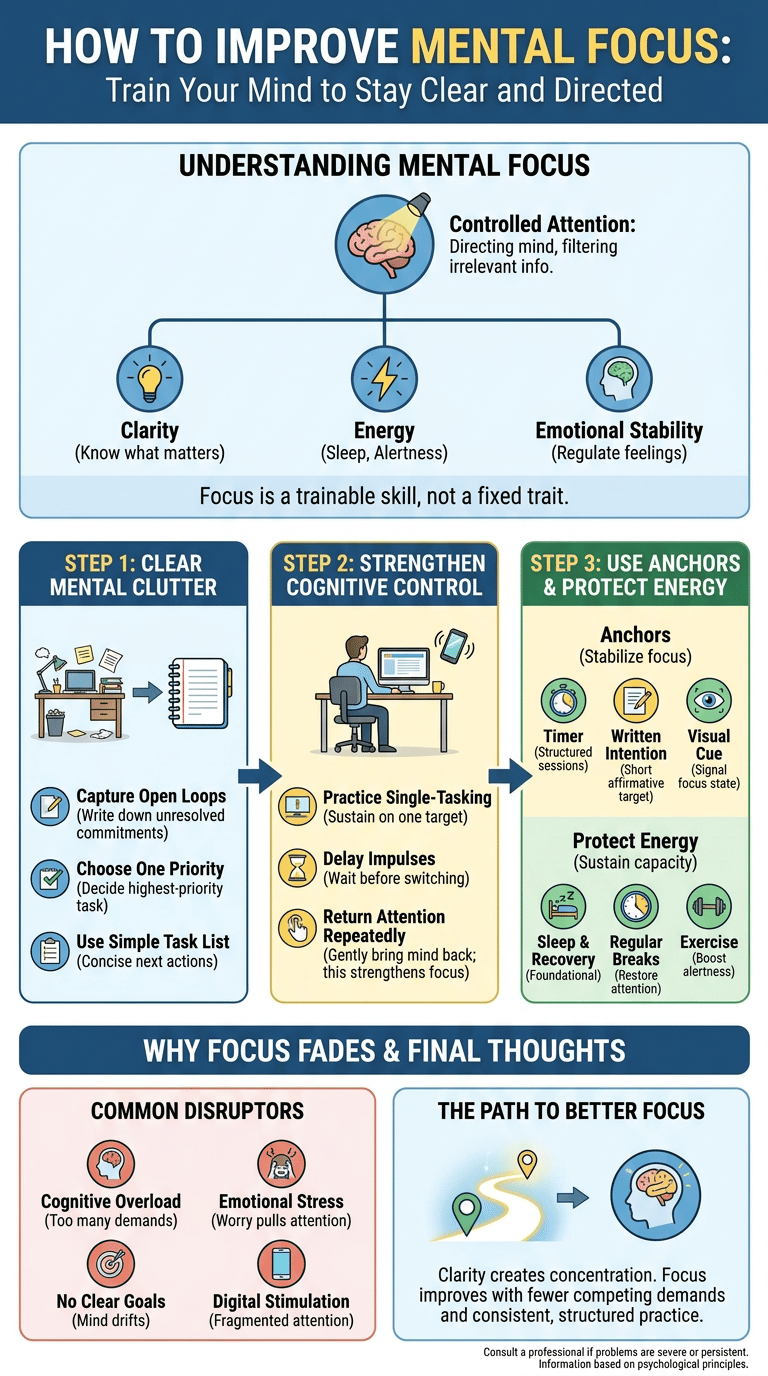
Mental focus refers to the mind’s ability to direct attention deliberately toward a selected object, task, or train of thought while filtering out irrelevant information. Psychologists describe this capacity as a form of cognitive control and selective attention that lets you allocate mental resources where they matter most. For definitions and foundational terminology on attention and related processes, see the APA Dictionary of Psychology and the American Psychological Association topics.

It depends on clarity, energy, and emotional stability
Focus does not come from a single source. It depends on three interacting domains:
- Clarity: Knowing what matters right now reduces competing mental demands.
- Energy: Sleep, recovery, and momentary alertness affect how long you can sustain attention.
- Emotional stability: Strong or shifting emotions can capture attention and reduce deliberate control.
Thinking of focus as the product of attention, energy, and emotional regulation helps you choose practical actions in each domain rather than treating focus as a fixed trait.
Focus is a trainable skill
Like many cognitive functions, focus improves with practice and structure. Small, repeatable habits strengthen the mental processes that control attention: setting clear goals, practicing sustained attention, managing impulses, and protecting recovery time. The point is progress, not perfection; consistent, structured practice yields steady improvements in how you allocate your attention.
Why mental focus fades
Cognitive overload
Your brain has limited working memory and processing capacity at any moment. When too many items compete for attention or when tasks demand heavy mental juggling, performance drops and concentration fragments. Reducing the number of active mental demands preserves the cognitive resources needed for focused work.
Emotional stress
Strong emotions pull attention away from task-relevant cues. Worry, irritation, or excitement can repeatedly redirect your mind, making it harder to sustain deliberate attention. Emotion regulation strategies help reduce these intrusions and free attention for the task at hand.
Lack of clear goals
Without a clear priority, the mind tends to drift. Ambiguity about what to do next creates “open loops” that remain in the background and keep demanding attention. Clear, simple goals reduce internal competition and guide where you direct your attention.
Too much digital stimulation
Frequent notifications, shifting windows, and endless content fragment attention and create a habit of quick task-switching. Habitual exposure to constant digital stimuli trains the brain to expect interruptions, making sustained attention more effortful. Intentional reduction of nonessential digital inputs helps you rebuild longer focus sessions.
Clear mental clutter first
Write down open loops
Open loops are unresolved commitments and reminders that occupy mental space. Capture them in a single place: a notebook, an app, or a physical list. Writing commitments down reduces their spontaneous intrusion and frees attention for the current priority.
Try a simple capture routine: whenever a stray task or idea appears, note it immediately and return to your primary focus. This practice reduces the mental background noise that erodes concentration.
Choose one priority
Decide the highest-priority task for the next block of time before you begin. State it in clear, specific language: what you’ll do and what completion looks like. A single, explicit target prevents the mind from oscillating between competing goals.
Example focus statement: “For the next 45 minutes I will draft the project outline until the introduction and two main sections are complete.”
Remove unfinished mental distractions
Identify recurring mental interruptions and create quick processes for them. That might mean setting aside 10 minutes after your focus block to process email, delegating routine items, or scheduling decisions that don’t require immediate action. The aim is to reduce the number of unfinished items that return to mind repeatedly.
Use a simple task list
Keep a concise list of next actions rather than a long, vague to-do log. Next-action lists specify the immediate physical step needed to move a task forward. They lower the activation energy to start and reduce rumination about what to do next.
Organize the list into short blocks you can address in a single focus session, and mark one item as the primary focus before you begin.
Strengthen cognitive control
Practice single-tasking
Deliberate single-tasking trains the brain to sustain attention on one target for a useful period. Choose a single, clearly defined task and commit to working on it without switching. Reduce external triggers for switching by silencing notifications and closing unrelated tabs or apps.
Start with manageable time blocks that match your current capacity, then expand them gradually as your endurance grows.
Delay impulses to switch tasks
Impulses to check messages or move to a different activity are normal. Use a short delay tactic: when the urge appears, wait for a fixed interval before acting. Often the impulse will pass, and you can stay on task. If it persists past the delay, handle it quickly and return to the primary activity.
Return attention repeatedly
Sustained attention is not continuous; it requires repeated redirection back to the task. When your mind wanders, notice the distraction without judgment, gently bring attention back, and continue. Each redirection strengthens the cognitive mechanism that governs focus.
Many small returns accumulate into longer, more resilient focus sessions over time.
Build longer focus sessions over time
Use incremental progression to extend your attention span. Practice a comfortable block of focused work for several sessions and then increase its length gradually. Gradual overload of duration trains endurance while avoiding burnout.
Combine longer sessions with clear breaks and recovery practices to protect overall mental energy.
Use mental anchors
A written intention
Write a short, affirmative intention before each focus block. A written intention clarifies the target and serves as an external cue to keep your attention aligned. Keep the statement brief and actionable, such as “Draft two paragraphs describing the problem and solution.”
A timer
A visible timer creates a boundary and helps convert open-ended effort into a structured session. Use a simple countdown for your chosen block of work, then take a planned break. Timers reduce the cognitive overhead of estimating time and build a predictable work rhythm.
A visual cue
Use a physical or visual signal that indicates you are focused and should not be interrupted. That might be a simple card on your desk, a closed door, or a specific object that reminds you to stay on task. Visual cues help other people and your own mind recognize that you are in a focused state.
A simple starting ritual
Create a short pre-work ritual that signals the start of focused time: a breath cycle, a quick stretch, arranging your workspace, or a one-line summary of the session’s goal. Rituals stabilize the transition into focus and reduce the friction of starting.
Protect mental energy
Sleep and recovery
Sustained mental focus depends on sufficient sleep and periods of recovery. Sleep supports attention, learning, and emotional regulation, and chronic sleep loss undermines the ability to concentrate. For accessible guidance on sleep and mental health, see the MedlinePlus mental health resources.
Protecting regular sleep and scheduling restorative activities are foundational steps in improving attention capacity.
Breaks and attention restoration
Short, regular breaks help restore attention. Attention restores more efficiently when you shift to low-effort, restorative activities that remove you from the focused task. Brief walks, relaxed breathing, or a short non-work activity can reduce cognitive fatigue and refresh your capacity to concentrate.
Plan breaks proactively rather than waiting until you feel exhausted; this prevents decline in performance and supports longer productive sessions.
Exercise and alertness
Regular physical activity supports overall alertness and mood, which in turn help with concentration. Even brief movement between focus blocks can increase readiness to reengage with demanding cognitive work.
Make exercise a consistent part of your routine to sustain baseline mental energy over time.
Avoid decision fatigue
Reducing the number of trivial decisions conserves willpower and attention for important work. Use routines for predictable parts of your day, batch similar decisions, and simplify recurring choices so you free mental bandwidth for complex tasks.
Common mental focus mistakes
Trying to think about too many goals at once
Holding multiple priorities in active memory divides attention. Replace multi-goal juggling with a hierarchy: one immediate priority and a short list of next actions. This reduces internal conflict and the cognitive cost of switching.
Confusing pressure with focus
Pressure or urgency can feel like heightened attention, but it often narrows perspective and increases error. True focus is deliberate and controlled; it balances clear intent with calm regulation. If pressure is dominating your mental state, pause, refocus on one clear task, and use small, structured sessions rather than forcing continuous high-pressure work.
Working without recovery
Skipping breaks and recovery reduces the duration and quality of focus over the long term. Build recovery into your schedule: short breaks during work sessions and longer recovery on a daily and weekly basis. Balanced cycles of effort and rest sustain attention and reduce burnout risk.
Over-consuming information
Endless consumption without synthesis creates mental clutter and reduces the ability to produce focused work. Limit intake to what is needed for your current goals, and allocate separate time for learning and for producing. Intentional separation prevents reading or browsing from intruding on focused creation.
Final thoughts
Mental focus improves when your mind has fewer competing demands
Concentration is less about force and more about design: clear priorities, fewer open loops, protected energy, and repeated practice of attention control. Reducing the number of things vying for your attention creates the conditions where focused work is possible and sustainable.
Clarity creates concentration
Start with clarity: define the single most important objective for each focus block, use simple anchors to begin, protect your energy with sleep and breaks, and practice the cognitive habits that return attention again and again. Over time, these deliberate structures build stronger mental discipline and a clearer, more directed mind.
If focus problems are persistent, severe, worsening, or significantly interfere with daily life, work, or school, consider consulting a qualified health professional for evaluation and support. For reliable mental health information and resources, see MedlinePlus.
For a related next step, see this guide to improving mental clarity and focus.
For a related next step, see this guide to improving focus with ADHD.

Michael Reed is the Founder and Lead Writer at Psychology Exposed. He writes about human behavior, relationships, emotional patterns, self-awareness, and practical psychology topics using research-informed, easy-to-understand content.
Read More About Michael Reed: https://psychologyexposed.com/michael-reed/