
If your thoughts are racing, looping, or crowding out everything you need to do, you want practical, immediate relief you can try right now. This article gives short, evidence-aware techniques to interrupt overthinking quickly and safely. Use them in the moment, then consider a fuller plan later if thoughts remain frequent or disruptive.

Quick answer: the fastest way to stop thinking too much
The fastest way to stop thinking too much is to interrupt the loop with a brief, intentional action that shifts attention and signals safety to your body. That could be a few slow exhales, naming the thought aloud in a nonjudgmental way, or a short physical move such as standing and walking. These actions work because they break automatic thought patterns and give your nervous system a clear cue to shift gears.
For a related next step, see this guide to how to stop thinking too fast.
Below are micro-techniques you can use immediately. Use one or combine two. The goal is not to force your mind to be blank but to give it a new focus so you can return to the present with more control.
Breathe out slowly
Exhale slowly for a count that feels longer than your inhale. A slower out-breath can activate the parasympathetic nervous system and often reduces urgency in the moment.
Name the thought
Say one sentence like, “I am having the thought that I might mess this up.” Putting the thought into words reduces its emotional charge and creates psychological distance.
Ground your senses
Use your senses to anchor to the present: notice what you see, hear, smell, and feel. Simple sensory focus pulls attention away from abstract loops and into immediate reality.
Write one sentence
Write the thought in one clear sentence on a scrap of paper or in your notes app. Seeing it written makes it less likely to loop in your head and helps you decide if it needs further action.
Take one physical action
Choose something small and doable: stand up, walk to a window, rinse your face with cool water, or gather a mug of water. Physical movement gives your brain a new task and often reduces repetitive thinking.
Why fast techniques work best when you are spiraling
Your brain needs interruption
Overthinking often becomes a cycle of repeated attention to the same thoughts. Interrupting that cycle with a brief, different activity prevents the thought loop from intensifying. Psychologists describe these loops as a form of rumination, and naming or redirecting attention can reduce their momentum according to psychological terminology.
Your body needs safety signals
When thoughts spiral, the body can register increased arousal. Simple actions like slow exhalation or a short walk send safety signals to your nervous system and help down-regulate that arousal. For general information about how stress and anxiety affect body and mind, see patient-focused guidance from a national health resource on mental health.
You need less analysis, not more
When your mind is overwhelmed, more thinking tends to fuel the loop. Fast techniques aim to reduce immediate intensity, not to solve every worry. After symptoms calm, you can return to clearer, calmer problem solving.
Fast relief is not the same as long-term healing
Quick techniques are valuable for immediate relief but do not replace ongoing self-care or therapeutic work if overthinking is frequent or causes major distress. If thoughts are persistent, impair your sleep, or interfere with daily life, consider reaching out to a qualified professional for assessment and options. Trusted mental health information from a national institute can help explain when professional support is appropriate at the National Institute of Mental Health.
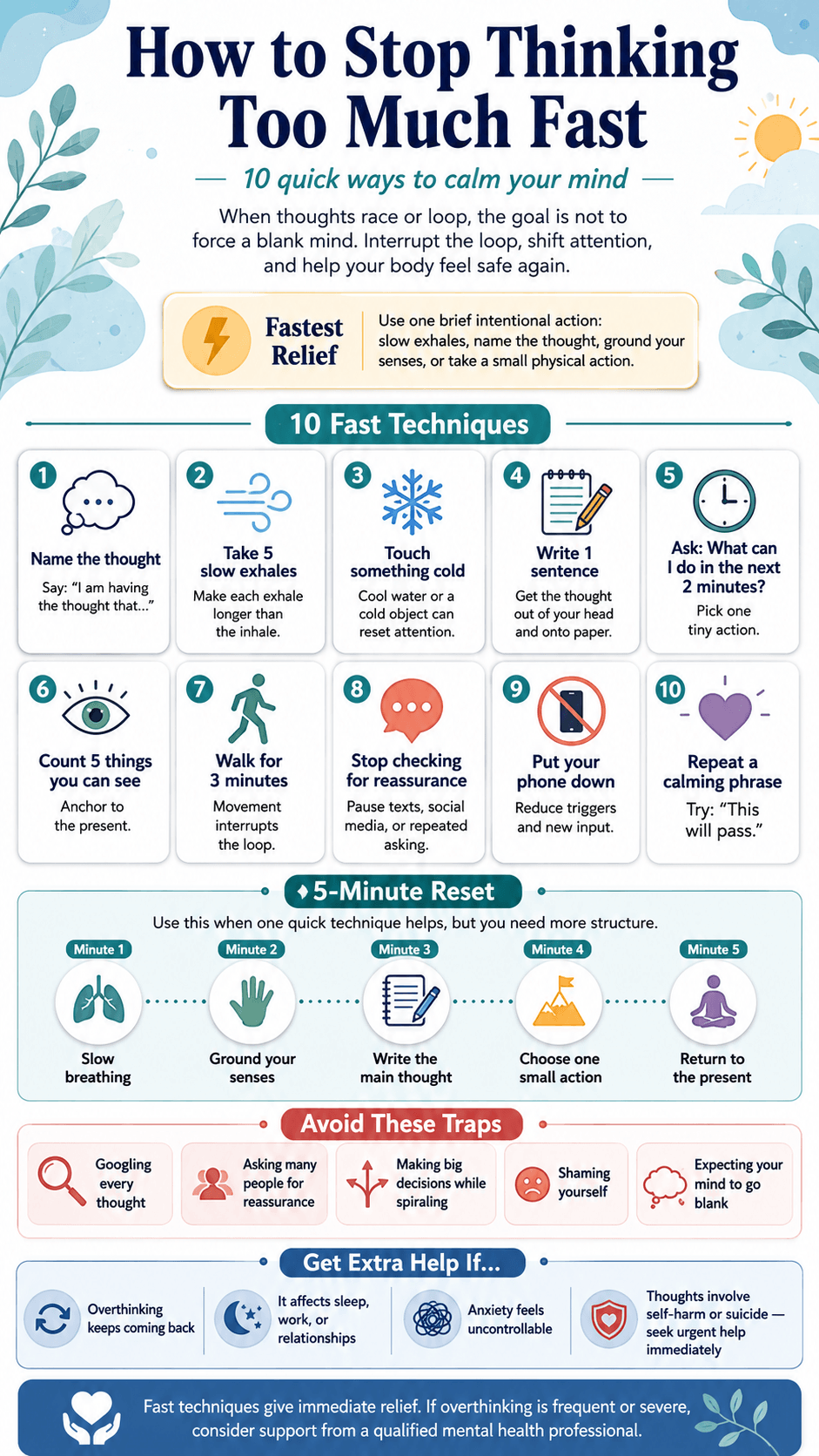
10 fast techniques to stop thinking too much
Below are ten short techniques you can use right away. Each includes a quick script or action so you can do it without thinking too much about it.
1. Use the “I am having the thought that” method
Script: Say aloud or to yourself, “I am having the thought that X.” Keep X brief, for example, “I am having the thought that I forgot something.” This framing separates you from the thought and reduces its automatic power.
2. Take five slow exhales
Action: Inhale naturally, then exhale slowly five times. Focus on lengthening each out-breath. A brief period of controlled breathing can change how urgent thoughts feel.
3. Touch something cold
Action: Splash cool water on your face or hold a cold object. Cold sensations can provide sensory feedback that shifts attention away from abstract worries and into the body.
4. Write the thought in one sentence
Action: Use one sentence only. Then fold the paper, close the notes app, or set the screen aside. Writing transfers the thought out of your head and creates space to choose what to do next.
5. Ask: What can I do in the next two minutes?
Action: Limit your focus to a tiny window. Answer with one simple action you can complete immediately. This reduces the tendency to imagine long chains of negative possibilities.
6. Count five things you can see
Action: Scan your environment and name five visible objects. This sensory check reorients attention to the present and often lowers the emotional charge of a looping thought.
7. Walk for three minutes
Action: Stand and walk slowly around your room or outside for three minutes. Movement engages different brain systems and interrupts repetitive mental patterns.
8. Stop checking for reassurance
Action: Notice urges to check messages, social media, or ask others for confirmation. Pause and choose one of the above techniques instead. Reassurance-seeking can provide short-term relief but may prolong worry.
9. Put your phone down
Action: Move your phone to another room or turn it face down for a set period. Reducing external triggers and immediate feeds of new information helps thoughts settle.
10. Repeat a calming phrase
Examples: “This will pass.” “I can handle this one step at a time.” “Not everything needs my attention now.”
Action: Say a short, compassionate phrase out loud or in your head until the urge to ruminate lessens. Repetition gives your mind a steady, safe rhythm to follow.
A five-minute reset routine
If one quick action helps but you want a compact routine with structure, try this five-minute reset. Each minute has one clear focus so you do not have to decide in the moment.
Minute 1: Slow breathing
Do three relaxed inhales with five slow exhales. Focus on the out-breath being longer than the inhale. Keep your mouth closed for breathing if that feels comfortable.
Minute 2: Ground your senses
Name out loud one thing you see, one sound you hear, and one texture you can touch. Use concrete details, for example, “I see a blue mug, I hear traffic outside, I feel the fabric of my shirt.”
Minute 3: Write the thought
Write the main thought in one sentence. If you see more than one thought, pick the one that feels loudest. Writing for thirty seconds helps move the thought out of your mind and onto paper.
Minute 4: Choose one action
Pick a small, practical step you can complete in two minutes. It can be making a cup of tea, sending a short message, standing and stretching, or setting a timer to return to the task later.
Minute 5: Return to the present
Check how your body feels. Take one final deep breath and remind yourself what is next in the moment. If thoughts recur, repeat any single step above rather than trying to analyze them further.
What to avoid when you need fast relief
When you feel overloaded, certain reactions make overthinking worse. Below are common traps and alternatives you can choose instead.
Do not Google every thought
Searching online for reassurance often produces more information and more uncertainty. If you need facts, limit searches to a single trusted source and set a short time limit.
Do not ask five people for reassurance
Repeated reassurance-seeking can temporarily reduce anxiety but typically reinforces the cycle. Try one trusted person if you need support, or use a grounding technique first.
Do not make big decisions while spiraling
Strong emotions narrow perspective and can bias decisions. When possible, pause important choices until you feel calmer and more clear-headed.
Do not shame yourself for needing help
Needing a short strategy to stop thinking too much is normal. Treat yourself with the same pragmatic kindness you would offer a friend in the same situation.
Do not expect your mind to go completely blank
The goal is manageable relief and clearer thinking, not an empty mind. Aim for space and perspective rather than perfection.
When fast techniques are not enough
Fast techniques are effective for immediate relief but they have limits. If overthinking keeps returning or interferes with your daily life, consider additional support.
When thoughts come back constantly
If thoughts quickly return after every interruption, you may benefit from a structured approach such as cognitive strategies taught in therapy. Educational resources from recognized professional organizations can help you learn more about these approaches through psychology overviews.
When overthinking affects sleep or daily life
Persistent overthinking that disrupts sleep, work, or relationships may need evaluation and a longer-term plan. Patient-focused information on mental health can help you decide whether to consult a clinician on mental health topics.
When anxiety feels uncontrollable
If anxiety feels out of control, or if you have panic attacks, frequent intrusive thoughts, or severe avoidance, consider reaching out to a healthcare professional for assessment. National mental health resources provide information on symptoms and treatment options that can guide next steps at NIMH.
When to use the full overthinking framework
Fast tactics buy you time and composure. Use them to stop the immediate spiral, then follow up with a fuller plan: identify recurring triggers, learn cognitive and behavioral techniques, and practice regular self-care. Psychological research and clinical guidelines offer frameworks for this work and for learning skills that reduce rumination over time in accessible behavioral science resources.
If thoughts involve self-harm or suicidal ideas, seek help immediately from emergency services or a crisis line in your area. If you are unsure where to start, local health authorities or national health sites provide guidance on getting urgent support.
FAQs
How do I stop overthinking immediately?
Pick one short interruption: five slow exhales, name the thought, or stand and walk for three minutes. The simplest sustainable intervention is often the best. Use one technique repeatedly until you feel less flooded.
What is the fastest way to calm my thoughts?
A combination of a slow out-breath and a sensory grounding exercise is a fast and reliable method. For example, breathe out slowly five times and then name five things in your environment you can see.
Why does my brain not stop thinking?
Thinking is your brain’s way of solving problems and protecting you. Sometimes it gets stuck on a loop because the brain perceives an unresolved threat or uncertainty. Interrupting the loop with attention-shifting actions reduces its momentum and gives you space to respond more clearly.
Can I stop overthinking in five minutes?
You can often reduce the intensity of overthinking in five minutes using focused techniques. Lasting change commonly requires repeated practice and, if needed, structured support. If you find short resets helpful, build them into your day and consider learning longer-term strategies when you are ready.
Remember: these techniques are intended for immediate relief and practical use. If overthinking is frequent, causes severe distress, impairs sleep, or interferes with daily functioning, consider consulting a qualified mental health professional for tailored support. For reliable information about symptoms and treatment options, see the National Institute of Mental Health NIMH health pages and patient-focused summaries on MedlinePlus.

Michael Reed is the Founder and Lead Writer at Psychology Exposed. He writes about human behavior, relationships, emotional patterns, self-awareness, and practical psychology topics using research-informed, easy-to-understand content.
Read More About Michael Reed: https://psychologyexposed.com/michael-reed/