
Quick Answer: How Do I Stop Thinking Too Much?
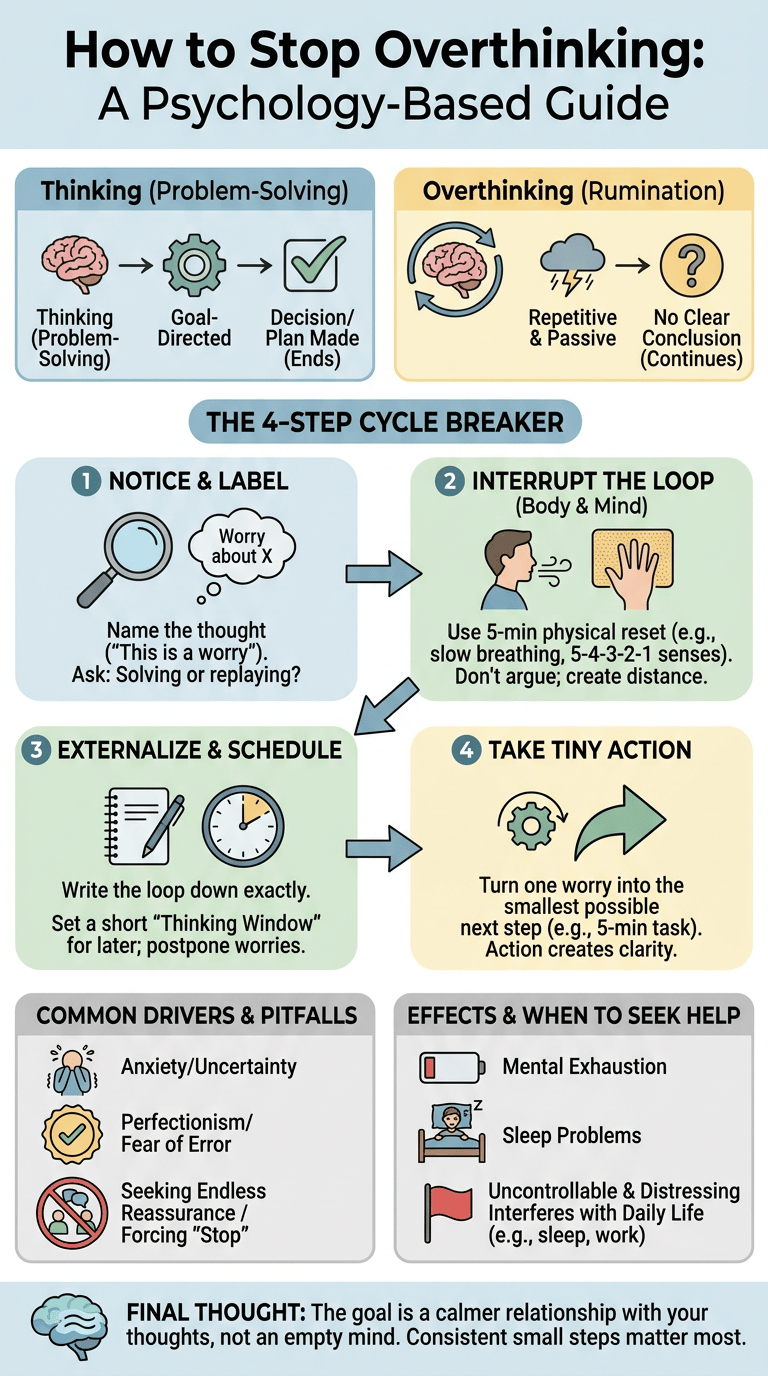
If you want a short, practical starting point: learn to notice your thought loops without fighting them, give those thoughts a short, scheduled time, use simple bodily resets, and turn at least one worry into a tiny, doable action. These steps help reduce the repetition without promising to erase thinking entirely.

Below are quick, evidence-aware tactics you can try immediately.
Name the thought instead of fighting it
When a repeated thought appears, label it with a short phrase such as “worry about the meeting” or “what if scenario.” Naming a thought makes it easier to step back from it and reduces the urge to argue with it.
Shift from solving to observing
Ask whether your mind is searching for solutions or simply replaying possibilities. Observing the process for a minute or two can stop the automatic escalation of the loop.
Use a 5-minute grounding reset
Pause and use a short physical reset: slow breathing, notice five things you see, three things you feel, and one thing you can smell. This orients attention away from the loop and into your senses.
Write down the thought loop
Capture the exact words of the loop on paper or in a notes app. Writing externalizes the cycle and often reduces the feeling that the thought is urgent or permanent.
Take one small action instead of more analysis
Turn a worry into a single, tiny next step. If the worry is about a task, decide on a five-minute action. Action creates information and reduces uncertainty, which weakens repeated thinking.
Set a thinking limit instead of thinking all day
Decide on a short, scheduled period to intentionally think about the issue, then resume your day. Structure prevents rumination from expanding to fill the whole day.
What Does It Mean to Think Too Much?
Thinking vs overthinking
Thinking is a cognitive process we use to solve problems, plan, and learn. Overthinking generally refers to repetitive, prolonged mental activity that does not lead to useful solutions and often increases distress. Psychology resources describe rumination and repetitive negative thinking as patterns that are different from productive problem-solving in both content and outcome; overthinking tends to focus on negative possibilities and past mistakes rather than clear next steps. For definitions of psychological terms, see the APA Dictionary of Psychology.
Problem-solving vs rumination
Problem-solving is goal-directed: it ends when a decision or plan is made. Rumination is repetitive and passive: it continues without reaching a clear conclusion. A practical way to distinguish them is to ask whether the thought has a realistic next action attached.
Why the brain keeps replaying unfinished problems
The mind often rehearses unresolved issues because repetition is a cognitive signal that something feels important or threatening. Replaying an unfinished scenario is the brain trying to reduce uncertainty, even when the repetition does not lead to new solutions.
Why overthinkers often mistake thinking for control
Thinking can create the illusion of control: more thought feels like more preparation. When thinking becomes the main strategy for managing uncertainty, people may prefer mental rehearsal over action because it temporarily reduces anxiety without changing circumstances.
Why Do I Think Too Much?
Anxiety and the need for certainty
Anxiety increases the desire for certainty. When outcomes are unclear, the mind may keep replaying scenarios to try to forecast and prepare. Professional resources explain how anxiety and worry are linked to prolonged rumination and difficulty tolerating uncertainty.
Information from the National Institute of Mental Health offers accessible guidance about anxiety and how persistent worry can affect daily life.
Fear of making the wrong decision
Fear of error or regret makes choices feel high-stakes. Overthinking can be an attempt to avoid blame or future regret by running through all possibilities, which paradoxically increases indecision.
Past experiences and emotional memory
Events that felt unresolved, embarrassing, or painful tend to repeat in memory and thought. Emotional memory stores meaning and threat, which can make certain topics stick in your mind longer than neutral ones.
Perfectionism and self-pressure
High standards and fear of imperfection encourage repeated mental checking. Perfectionism often turns reasonable planning into endless refinement and second-guessing.
Low emotional safety
When you do not feel secure expressing or tolerating emotions, the mind may keep thinking as an attempt to process feelings without showing vulnerability. This can prolong the mental loop instead of allowing natural emotional resolution.
Lack of closure
Unfinished conversations, unresolved tasks, and unclear endings create cognitive tension. The mind keeps returning to these unresolved items in search of completion.
Too much information and mental overload
Constant inputs, choices, and competing priorities make it harder to prioritize. Information overload can fuel mental sifting that becomes habitual and exhausting.
Signs You Are Thinking Too Much
You replay conversations repeatedly
You keep replaying what was said or what you wish you had said, looking for different outcomes or explanations.
You imagine worst-case outcomes
Your mind frequently goes to negative possibilities rather than balanced or likely ones.
You struggle to make simple decisions
You take a long time to decide on small things because you feel the need to consider every angle.
You feel mentally tired but not productive
You may spend a lot of mental energy without accomplishing tasks or moving forward on problems.
You keep asking what if
Repeated hypothetical scenarios occupy your attention and make it harder to engage with present tasks.
You confuse mental activity with progress
You believe that thinking equals doing, even when no real decisions or actions follow your thoughts.
You find it hard to relax even when nothing is happening
Calm moments trigger additional thoughts, and you feel restless rather than rested.
How Thinking Too Much Affects Your Mind and Body
Mental exhaustion
Extended repetitive thinking uses cognitive resources and leaves you feeling drained and less able to concentrate on new tasks.
Emotional irritability
Persistent rumination can increase emotional reactivity and make small frustrations feel larger.
Sleep problems
Worry and rumination are common contributors to difficulty falling or staying asleep. Patient information resources discuss how persistent thinking at night can interfere with sleep patterns and recovery.
MedlinePlus provides patient-friendly information on sleep, stress, and how mental health concerns may affect rest.
Stress tension in the body
Chronic mental activity is often accompanied by muscle tension, headaches, and physiological signs of stress.
Reduced focus
When attention is consumed by repetitive thoughts, cognitive performance on tasks that require concentration can decline.
Avoidance and procrastination
Overthinking can lead to delay because the mind keeps preparing without acting.
Relationship strain
Constant rumination about interactions or past conversations can create distance and misunderstandings in relationships.
Step 1: Separate Useful Thinking From Overthinking
Ask whether this is helping you decide or just making you spiral
Pause and assess the function of your thinking. If the process produces decisions or concrete plans within a reasonable time, it is serving a problem-solving role. If it mainly produces anxiety without resolution, label it as rumination and shift strategies.
Identify whether the thought has an action attached
If a thought leads directly to a small action you can take now, follow that action. If not, consider whether thinking about it now is the best use of your time.
Use the now, later, never method
Sort repetitive thoughts into three categories: now (action within minutes), later (schedule a time to think about it), and never (discard or let go because it is not useful). This method helps limit unnecessary cycles.
Stop treating every thought as urgent
Most thoughts are not emergency signals. Practice deciding which thoughts truly need immediate attention and which can be postponed.
Step 2: Write the Thought Loop Down
Write the exact thought
Record the precise sentence or image that keeps returning. Exact wording often reveals patterns and reduces the perceived scope of the worry.
For fast techniques you can use when the loop feels urgent, this related guide gives quick ways to calm your mind.
Write the fear behind the thought
Translate the surface thought into the underlying fear or need, such as fear of embarrassment, loss of control, or uncertainty.
If your thoughts feel rushed rather than repetitive, the guide on thinking too fast explains how to slow the pace down.
Write the action you can control
List one specific action that is within your control. Focusing on controllable steps shifts energy toward solutions.
Write what you cannot control
Make a short list of factors you cannot change. Acknowledging what is outside your control helps you stop trying to fix the unfixable through thinking alone.
Close the loop with one next step
Choose a single, practical next step. Closing the loop with a decision, even a small one, reduces the mental drive to keep replaying the issue.
Step 3: Stop Arguing With Every Thought
Why fighting thoughts often makes them louder
Trying to suppress or argue with thoughts can backfire because suppression increases their accessibility. Research and clinical guidance describe how experiential acceptance and observation are often more effective than suppression for reducing the intensity of repetitive thoughts.
For accessible background on cognitive patterns and coping approaches, see topic pages from the American Psychological Association: APA Topics.
How to notice a thought without obeying it
Practice mental distance: notice the thought, label it, note its tone, and then redirect focus to the present. Think of the thought as a passing event, not a command you must follow.
Use the phrase: This is a thought, not a command
Repeat a short phrase to remind yourself that thinking does not require action. The phrasing helps create a pause between thought and behavior.
Practice mental distance
Imagery exercises can help. Picture the thought as a leaf on a stream or a cloud passing by. Distance reduces the automatic pull to engage with the content of the thought.
Step 4: Use Your Body to Calm Your Mind
Slow breathing
Deliberate slow breathing activates the body’s calming systems. Try a simple pattern: inhale for four counts, pause for one, exhale for six counts. Even a few minutes can reduce the intensity of repetitive thought.
Progressive muscle relaxation
Systematically tensing and then relaxing muscle groups sends a clear signal to the nervous system that it is safe to unwind, which lowers the physical tension that supports mental loops.
Walking without input
Take a short walk with the intention to notice your surroundings rather than solving problems. Walking with minimal audio or screen input gives the mind a break from internal replay.
Cold water reset
A brief splash of cool water on the face or a cold shower for a short time can shift attention and reduce the immediate intensity of worry.
Grounding through the senses
Use sensory grounding: name five things you see, four you can touch, three you hear, two you smell, and one you taste. This returns attention to the present and away from looping thoughts.
Step 5: Set a Thinking Window
Why unlimited thinking creates anxiety
Allowing endless time for worry gives the mind permission to expand the problem. Structure is calming because it limits the hours available to rehearse uncertainties.
How to create a 15-minute worry window
Choose a consistent time each day for a short worry session. During that window, allow yourself to fully think about your concerns and write down action steps. When the window closes, return to other activities with a brief grounding practice.
What to do when thoughts appear outside the window
Use a short postponement script: note the worry, write a one-line reminder to address it during the next window, and use a physical or breathing reset to move on.
Why structure helps overthinkers feel safer
Because overthinking is often driven by a need for certainty and control, predictable routines and scheduled worry time create emotional safety and reduce the urge to check continuously.
Step 6: Turn Thinking Into Action
Choose the smallest next step
When a worry has a practical element, choose the tiniest possible action that moves you forward. Small actions generate feedback and reduce ambiguity.
Make a decision with limited information
Accept that perfect information is rarely available. Commit to making a reasonable decision, then treat it as a hypothesis to be adjusted rather than a final verdict.
Replace what if with what now
Shift from hypothetical scenarios to immediate options: ask “what is one thing I can do now?” rather than exploring endless what-if chains.
Use action to create clarity
Action produces data. Instead of running scenarios in your head, take a small step to gather real feedback and use that information to revise the plan.
Step 7: Reduce Triggers That Feed Overthinking
Too much social media
Constant exposure to social comparison and opinions can increase mental loops. Limit passive scrolling and create time blocks for social media use.
Too much caffeine
Caffeine can increase physiological arousal and the feeling of being unsettled. Reducing intake or timing it earlier in the day can help decrease baseline reactivity.
Lack of sleep
Poor sleep reduces cognitive resilience and increases the likelihood of repetitive thought. Sleep hygiene practices support better emotional regulation and clearer thinking.
Emotional conversations before bed
Difficult discussions close to sleep time often leave the mind rehearsing scenarios. If you must discuss emotional topics, allow time afterwards for a calming routine.
Constant checking and reassurance-seeking
Repeatedly seeking reassurance or checking facts strengthens the habit of uncertainty-driven thinking. Set limits for checking and practice tolerating small amounts of uncertainty.
Avoiding difficult conversations
Putting off necessary conversations leaves issues unresolved and available for repeated mental rehearsal. Preparing and scheduling tough conversations can close loops that feed overthinking.
What Not to Do When You Think Too Much
Do not search for reassurance all day
Reassurance provides temporary relief but often reinforces the cycle that created the worry. Limit reassurance-seeking and build tolerance for some uncertainty.
Do not force yourself to just stop thinking
Trying to suppress thoughts usually backfires. Instead, practice noticing thoughts and applying the strategies above to reduce their intensity.
Do not make major decisions while emotionally flooded
Strong emotional states narrow thinking and increase the chance of regrettable choices. Pause, use grounding techniques, and return to the decision when calmer.
Do not use distraction as your only coping method
Distraction can be useful short term, but relying solely on it prevents addressing the underlying issue. Combine distraction with problem-solving or scheduled worry windows.
Do not judge yourself for having thoughts
Thoughts are normal mental events. Self-criticism increases stress and often fuels further rumination. Practice compassionate observation instead.
When Thinking Too Much May Be Linked to Anxiety
When thoughts become uncontrollable
If thoughts feel uncontrollable, persistent, and distressing despite your efforts, this pattern may be part of a broader anxiety response. Informational resources explain how persistent worry is addressed clinically.
The National Institute of Mental Health offers information on when worry and anxiety may need professional attention.
When overthinking affects sleep, work, or relationships
If repetitive thinking interferes with daily functioning, it is reasonable to consider professional support. Clinical guidance emphasizes that significant impairment is a signal to seek help.
When reassurance never feels enough
If reassurance provides only brief relief and the worry returns quickly, the cycle may require structured behavioral strategies or support from a trained professional.
When professional support may help
Therapies such as cognitive behavioral approaches are commonly used to address patterns of repetitive thinking and rumination. If your worry is persistent, severe, or interfering with life, consider consulting a licensed mental health professional for tailored strategies.
Final Thoughts: You Do Not Need to Stop Thinking Completely
The goal is not an empty mind
Complete absence of thought is neither realistic nor necessary. The aim is to reduce harmful repetition and create a calmer, more flexible relationship with your thinking.
The goal is a calmer relationship with your thoughts
Practice noticing, labeling, scheduling, and acting. Over time, these skills reduce the intensity of loops and increase your sense of agency.
Small daily changes matter more than one perfect technique
Consistency with small habits is more effective than searching for a single cure. Build one or two practices into your day and adjust them as needed.
FAQs About How to Stop Thinking Too Much
How can I stop thinking too much?
Start with noticing and labeling your thoughts, use a short daily worry window, practice brief grounding and breathing exercises, and convert one worry into a tiny action. These steps reduce repetition and increase clarity.
How do I stop thinking too much about everything?
Prioritize. Use the now, later, never method to sort concerns. Set boundaries on information intake and create a short daily period to focus on broader worries so they do not occupy your entire day.
Why does my brain think too much?
Your brain aims to reduce uncertainty and protect you from perceived threats. When that system becomes overactive, it can produce repetitive thinking as an attempt to predict and prevent negative outcomes.
Is thinking too much a sign of anxiety?
Frequent and distressing overthinking can be a sign of anxiety, but it is not automatically a disorder. If repetitive thinking causes significant distress or impairment, consider consulting a mental health professional. The National Institute of Mental Health is a helpful starting point for understanding anxiety and related concerns.
How do I stop my brain from overthinking at night?
Reduce stimulating inputs before bed, create a brief bedtime routine that includes a five-minute worry list to capture concerns, practice grounding exercises, and limit caffeine and screen time in the evening.
Can overthinking go away?
Patterns of overthinking can become less frequent and less intense with consistent practice of the strategies in this guide, lifestyle changes that support resilience, and, when needed, professional help.
What is the fastest way to calm overthinking?
Use a quick bodily reset such as slow breathing and grounding, name the thought, write it down, and choose one tiny action or postpone it to a scheduled thinking window. These steps create immediate distance and reduce intensity.
If your thoughts are overwhelming, uncontrollable, or involve self-harm or suicidal thoughts, please seek immediate help from a qualified professional or emergency services. It is appropriate to reach out to a licensed mental health provider if repetitive thinking is persistent and significantly interferes with your life.

Michael Reed is the Founder and Lead Writer at Psychology Exposed. He writes about human behavior, relationships, emotional patterns, self-awareness, and practical psychology topics using research-informed, easy-to-understand content.
Read More About Michael Reed: https://psychologyexposed.com/michael-reed/