
Quick answer
If your mind is loud, use short, repeatable steps that calm the body first, then the attention. Start by easing physical tension, slow your breathing, anchor your senses in the present, let go of tight mental pressure, and pick one low-pressure action to shift your focus. These steps work together: calming the body signals safety to the brain, grounding brings attention out of loops of thinking, and small, achievable actions reduce the urge to analyze every detail.
Below are practical, psychology-informed techniques you can use in minutes, plus an easy 10-minute routine and guidance on common mistakes. If your racing thoughts come with severe distress, persistent interference in daily life, or thoughts of harming yourself, consider contacting a qualified professional for support.
Relax the body first
Why start with the body
Tension in the body keeps the nervous system on alert and makes mental quiet harder to reach. Quick physical checks and gentle releases tend to reduce the physiological fuel for overthinking, making mental calm more accessible.
Slow your breathing
Breathing slowly and with longer exhales is a simple lever you can reach in most settings. Intentional breath patterns can help shift the balance away from high arousal and toward calm states when practiced gently and without force.
Ground your attention
Bring your senses to what is happening now rather than following the stream of thoughts. Noticing concrete sensory details interrupts repetitive thinking and gives your brain something manageable to process.
Release mental pressure
Write down the thought loops, say them aloud to yourself, or assign them a temporary place to be handled later. Externalizing what’s stuck often lowers the urgency and reduces rehashing.
Use one calming action
Choose one small, low-pressure activity that offers mild engagement and predictable sensory feedback, such as making tea, walking slowly, or sitting quietly outside. The goal is not productivity but a gentle shift away from rumination.
Why it feels hard to relax when you think too much
Overthinking keeps the brain in problem-solving mode
When you repeatedly analyze a concern, your brain treats it like an unresolved problem that needs further work. That loop favors evaluation and prediction rather than rest. For background on how cognitive patterns influence emotion and behavior, see the American Psychological Association topic pages on emotions and coping from psychological science.
The body may still feel unsafe
Even if your thoughts are not about immediate danger, your body can be physiologically aroused in ways that make relaxation difficult. Physical signs of tension keep the nervous system primed to respond, and that state makes mental quiet harder to achieve. The National Institute of Mental Health provides information on how stress and anxiety can affect both mind and body from the National Institute of Mental Health.
Relaxation can feel unfamiliar to anxious people
If you are used to solving problems, doing, or preparing for threats, doing nothing or slowing down can feel strange or even unsafe. People who are often busy or vigilant may need to practice relaxation as a skill rather than expect it to happen automatically.
The mind resists stillness when emotions are unprocessed
Unresolved feelings often keep returning as thoughts. The mind may prefer active thinking because it feels like progress, even when it just repeats worry. Allowing feelings to be noticed without forcing them into solutions reduces their compulsion over time.
Signs you need relaxation, not more thinking
You feel mentally stuck
Thoughts go in circles without leading to clear conclusions or action. When thinking produces the same conclusions repeatedly, stepping out to relax can create space for new perspectives.
You keep repeating the same thought
Repetition is a hallmark of rumination. If a concern reappears even after considering it, shifting to calming techniques often helps the brain stop cycling.
Your body feels tense
Shoulders, jaw, hands, or stomach tightness often accompany overthinking. When the body is tense, relaxation can break the loop that fuels persistent thought.
You cannot focus on simple things
Difficulty concentrating on routine tasks suggests mental bandwidth is consumed by thinking. Short grounding or breathing exercises can restore enough focus for small, manageable activities.
You feel tired but wired
Low energy combined with high mental activity often means the nervous system needs a different signal than more thinking. Relaxation techniques offer that signal in a low-effort way.
Step 1: Use breathing to signal safety
Why breathing affects the stress response
Breathing patterns are closely linked to how alert or calm the body feels. Simple breath practices can change how the body interprets the current situation, helping reduce high arousal and making relaxation more likely. For practical guidance on breathing and other relaxation methods, see patient-friendly resources on relaxation techniques from MedlinePlus from the National Library of Medicine and general coping information from the National Institute of Mental Health for additional context.
Try slow exhale breathing
How to do it:
- Sit or stand comfortably with a relaxed posture.
- Inhale gently through the nose to a comfortable depth for about three to four seconds.
- Exhale slowly through slightly pursed lips for about five to six seconds. Let the exhale be longer than the inhale.
- Repeat for several cycles, aiming for calmness rather than precision.
Why it helps: a longer exhale tends to feel naturally calming because it encourages a shift away from high arousal. Keep the rhythm gentle and easy to maintain.
Try box breathing carefully
A gentle version looks like this:
- Inhale for three counts.
- Hold for three counts if comfortable.
- Exhale for three counts.
- Hold for three counts if comfortable.
Use shorter counts if longer holds feel forced. The goal is a steady, repeatable pattern that reduces mental churn without increasing tension.
Avoid over-controlling your breath
Trying to force the breath into an exact pattern can increase anxiety for some people. If you feel lightheaded, dizzy, or more anxious, return to natural breathing. The aim is gentle regulation, not hyperventilation or rigid control.
Keep it simple and repeatable
Pick one breathing pattern you can do anywhere and practice it briefly several times a day. Short, frequent practice helps the body learn the signal that slow, easy breathing means safe and manageable conditions.
Step 2: Ground yourself in the present
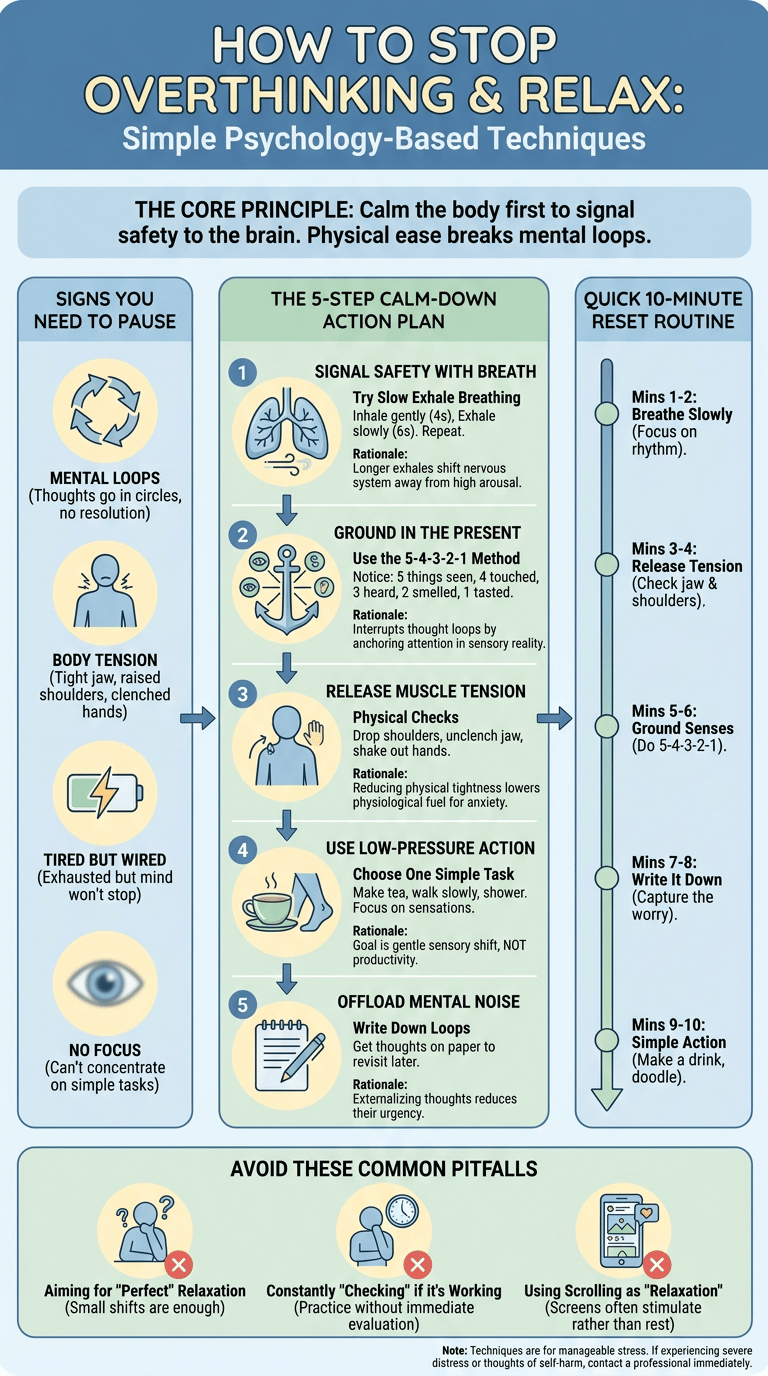
The 5-4-3-2-1 method
How it works:
- Notice five things you can see.
- Name four things you can touch.
- Identify three sounds you hear.
- Notice two smells or imagine two familiar smells.
- Identify one taste or notice the inside of your mouth.
This method anchors attention in sensory reality and interrupts thought loops without needing analysis or effort.
Touch-based grounding
Use a textured object, your clothing, or the chair under you. Naming sensations like “soft,” “cool,” or “firm” invites attention into the body and away from repeating thoughts.
Naming objects in the room
Quietly describe visible objects out loud or in your head: color, shape, function. Naming concrete details redirects cognitive processing from hypothetical scenarios to factual description.
Listening to background sounds
Put attention on ambient sounds without judging them. Notice the layers of sound rather than building stories about them. This kind of open listening has a calming, stabilizing effect.
Returning to now instead of the thought story
When a thought pulls you into a story about past or future, pause and ask, “What is actually happening right now?” Answer with sensory details. This small habit trains the mind to step out of rehearsed narratives.
Step 3: Relax muscle tension
Jaw release
Many people hold tension in the jaw. Try sitting tall, allowing the jaw to soften, and letting the tongue rest gently behind the front teeth. If it helps, open the mouth slightly and yawn softly, then close with relaxed muscles.
Shoulder drop
Raise your shoulders toward your ears on an inhale, hold briefly, and then let them fall on the exhale. Repeat a couple of times and then check the difference in tension.
Hand unclenching
Make a tight fist for a moment, then open the fingers wide and stretch them before relaxing. Hands often mirror mental clutching; releasing them can give the rest of the body permission to let go.
Progressive muscle relaxation
Progressive muscle relaxation (PMR) involves tensing then releasing muscle groups in sequence. You can start with feet and move upward or begin at the head and move downward. MedlinePlus lists progressive muscle relaxation among relaxation techniques and offers patient-friendly descriptions from the National Library of Medicine.
Gentle stretching
Slow neck rolls, shoulder stretches, and light spinal twists bring blood flow and awareness to areas that hold stress. Move only within comfortable limits; stretching should reduce discomfort, not increase it.
Step 4: Use low-pressure activities
Walking
Walk slowly and notice each step, the sensation of your feet, and your breathing. Walking with attention gives the body structured movement while redirecting mental energy away from analysis.
Cleaning one small area
Choose a tiny, contained task such as clearing a tabletop or washing one dish. The concrete result and simple motion provide satisfying closure without heavy cognitive demands.
Making tea
Preparing a warm drink combines sensory rituals—boiling, pouring, smelling—and offers predictable steps that make it easy to focus on the present moment.
Taking a shower
A warm shower can be an accessible way to add sensory calm. Pay attention to the temperature, the sound of water, and the feeling on your skin. These sensory anchors reduce the space available for repetitive thoughts.
Drawing or journaling
Use low-pressure creative acts: scribbling patterns, doodling, or freewriting for a few minutes. The goal is expression, not evaluation, so avoid judging the result.
Sitting outside without your phone
Expose yourself to nature-like sensory input: breeze, light, distant sounds. If your phone increases cognitive noise, leave it out of reach and simply notice what is around you.
Step 5: Reduce mental noise
Turn off unnecessary input
Reduce background screens, notifications, and news cycles when you need to relax. Sensory and informational overload keeps the mind busy and provides endless new material for thinking.
Stop multitasking
When you try to do many things at once, your attention fragments and rumination increases. Choose one low-pressure task and allow it your attention for a short block of time.
Write down open loops
Make a quick list of unanswered items, decisions, or reminders so they are no longer stuck in short-term memory. Seeing open loops on paper often reduces their urgency and frees mental space.
Create one quiet block
Schedule a short, protected period—ten to twenty minutes—where you intentionally do one relaxing routine from this article. Repeated practice trains the nervous system that calm is possible and permitted.
Give your brain fewer things to process
Simplify choices and reduce forthcoming decisions when you can. Lowering the number of immediate decisions decreases the cognitive load that fuels overthinking.
Relaxation mistakes overthinkers make
Trying to relax perfectly
Perfectionism about relaxation is self-defeating. Aim for incremental improvement: small, tolerable reductions in tension are meaningful and sustainable.
Checking whether the technique is working
Observing whether you are calm can become another loop. Practice without evaluation for a few cycles, then notice any changes. Nonjudgmental attention supports the process.
Expecting instant calm
Relaxation skills take repetition. Expect modest shifts at first and cumulative improvements over time. Even brief breaks can interrupt thinking loops and offer relief.
Using your phone as fake relaxation
Scrolling social media often stimulates thinking and comparison rather than rest. Choose low-stimulation activities or brief guided practices instead of passive screen time.
Thinking relaxation must mean doing nothing
Relaxation can involve gentle action, sensory focus, or structured breathing. The point is lowering stress, not achieving inertness.
A 10-minute relaxation routine for overthinkers
Minute 1–2: Breathe slowly
Sit comfortably and do slow exhale breathing for two minutes. Keep counts short and comfortable. Focus on the rhythm rather than exact timing.
Minute 3–4: Release tension
Quickly check jaw, shoulders, and hands. Do a shoulder raise-and-drop and unclench your hands. Allow each area to soften after a brief tense-and-release if that helps.
Minute 5–6: Ground your senses
Use the 5-4-3-2-1 method for a minute or two. Move through sight, touch, sound, smell, and taste or internal sensation to bring attention to the present.
Minute 7–8: Write the thought down
Take a moment to jot the recurring thought on paper, with a single line or bullet. Mark it as “To revisit later” so your mind knows it has a place to go without needing immediate work.
Minute 9–10: Choose one calming action
Finish by doing one simple action for a minute: make a cup of tea, walk to a window, or draw a quick doodle. Keep the activity low-pressure and sensory-rich.
FAQs about relaxing when you think too much
How do I relax my mind from overthinking?
Use combined body-and-attention techniques: slow breathing, gentle muscle release, grounding in the senses, and a single low-pressure activity. Writing down repetitive thoughts can also reduce their urgency. Over time, short, repeatable practices train your nervous system to shift out of high arousal more quickly.
Why can’t I relax even when I’m tired?
Feeling tired but unable to relax often means the nervous system is aroused while the body needs rest. That mismatch can come from unresolved thoughts, late-day stimulation, or habitual tension. Short calming steps that target both body and attention tend to help. If sleep problems or persistent difficulty relaxing interfere with daily life, consider discussing them with a health professional.
What is the best relaxation method for overthinkers?
There is no single best method for everyone. Many overthinkers benefit from a combined approach that addresses body tension, breathing, and attention. Finding one simple breathing pattern and one grounding routine that you can repeat in multiple settings is a practical place to start. For general information on evidence-based approaches to stress and coping, see resources from Psychological Science for behavioral science context.
Can relaxation stop anxiety thoughts?
Relaxation techniques can reduce intensity and interrupt cycles of anxious thinking, but they do not eliminate every anxious thought. For many people, combining relaxation skills with problem-solving, planning, or professional therapies when needed provides the greatest relief. If anxious thoughts are severe, persistent, or interfere with daily function, seeking guidance from a qualified mental health professional is advisable. The National Institute of Mental Health offers information on when to seek help and what kinds of treatment are available for mental health concerns.
If you experience thoughts of self-harm or suicide, or if your symptoms are severe or worsen, please contact a local emergency service or a crisis line right away. Professional help can provide immediate support and safety planning.
For a related next step, see this guide to how to stop thinking too much.

Michael Reed is the Founder and Lead Writer at Psychology Exposed. He writes about human behavior, relationships, emotional patterns, self-awareness, and practical psychology topics using research-informed, easy-to-understand content.
Read More About Michael Reed: https://psychologyexposed.com/michael-reed/