
Quick answer
If your mind feels like it is moving too quickly, focus on immediate, concrete steps that slow your body and narrow your attention. Short-term actions include slowing your breath, reducing sensory input, speaking or writing at a calmer pace, and choosing a single simple object or task to focus on. These techniques lower physiological arousal and limit rapid attention switching, making thoughts feel less chaotic and more manageable.
Below are practical actions you can use right away, each explained with why it helps and how to do it.
Slow your body first
Working from the body toward the mind is often the fastest way to shift an overactive thinking process. Simple actions like lengthening exhales, dropping your shoulders, or walking at a deliberately slow pace send feedback to your nervous system that it can relax and commonly reduce the speed of thoughts.
Speak or write thoughts at a calmer pace
When you speak or write more slowly, your inner speech and attention usually follow. Saying one sentence aloud at a measured tempo or writing short, deliberate bullet points gives your thinking less momentum and reduces the urge to chase every idea.
For fast techniques you can use in the moment, this related guide focuses on quick ways to calm your mind.
Reduce stimulation
Lowering visual and auditory input helps prevent attention from jumping. Put your phone away, turn off background noise, and sit somewhere visually simple for several minutes to create a calmer mental environment.
Ground attention in one object
Pick a single sound, object, or rhythm to anchor your attention. Even a brief focus on one neutral stimulus can halt rapid topic-switching and slow the pace of thinking.
Avoid chasing every thought
Practice letting thoughts pass without immediately following them. Note them, capture them briefly in a list, and return to your chosen anchor. This reduces the reinforcement cycle that keeps thoughts accelerating.
What it means when your thoughts feel too fast
Racing thoughts vs. busy thinking
Everyone experiences busy thinking at times. Racing thoughts feel different: they tend to move quickly from topic to topic, feel faster than you can follow, and make it hard to finish one idea. Normal busy thinking is often tolerable; racing thoughts can feel rushed, intrusive, or overwhelming.
For clear definitions of psychological terms and related topics, consult the APA Dictionary of Psychology.
Why fast thoughts feel hard to control
Thought speed is linked to attention systems and arousal. When your nervous system is more activated, attention tends to switch faster and thoughts can gain momentum, which can make it feel as if thoughts are taking over because each thought primes the next.
If your fast thoughts are part of a wider overthinking pattern, the main guide on how to stop thinking too much can help you build a broader plan.
How anxiety affects attention
Anxious states often increase physiological arousal and vigilance, which can make attention scan for threats or problems more frequently. That rapid scanning feels like thinking too fast and can pull your focus in many directions at once. For accessible information about anxiety and related symptoms, see the National Institute of Mental Health.
Why stress can speed thinking
Stress shifts the body’s priorities toward quick, automatic responses. When the system is focused on rapid solutions or avoidance, thought processes can become faster and more fragmented than steady and focused.
Common signs of thinking too fast
Your thoughts jump topics rapidly
You move from one idea to another in quick succession, often without finishing a line of thought.
You feel mentally rushed
There is a subjective sense of being pressed for time inside your head, even when external circumstances are calm.
You interrupt yourself internally
You begin a thought and mentally cut it off to start a new one repeatedly.
You struggle to finish one thought
Completing plans, sentences, or decisions feels difficult because your mind has already moved to the next item.
Your body feels wired
Fast thinking often co-occurs with bodily sensations like restlessness, tension, or a sense of being energized but unfocused.
You cannot settle into one task
Multitasking or frequent task-switching becomes the norm and makes it hard to sustain attention long enough to finish meaningful work.
Why your brain may be moving so fast
Anxiety and hyperarousal
Anxiety increases physiological arousal and vigilance, which commonly makes thought speed increase. If you experience persistent anxiety alongside racing thinking, consider consulting reputable mental health resources to better understand these connections. See the NIMH’s mental health information for guidance.
Stimulants such as caffeine
Caffeine is a stimulant that can increase alertness and subjective speed of thought. Reducing or spacing out stimulant intake may slow the pace of thinking.
Lack of sleep
Insufficient or fragmented sleep affects attention and emotional regulation, making thought patterns less stable and more prone to rapid shifting.
Digital overstimulation
Frequent switching between apps, notifications, and tabs trains attention to jump quickly. The more your environment demands rapid shifts, the more your mind adapts by increasing switching speed.
Emotional pressure
Strong emotions such as worry, anger, or excitement can accelerate thinking as the mind searches for solutions, explanations, or ways to avoid discomfort.
Many unfinished tasks
Having many open items on your mental to-do list creates background cognitive load. That mental crowding encourages quick scanning between items and makes it harder to settle on one thought.
Step 1: Slow the body to slow the mind
Physical state and mental pace are tightly connected. These concrete body-centered steps are designed to change your physiological tone so thinking can become slower and clearer.
Walk slower
When you slow your walking pace intentionally, your breathing and rhythm often slow too. Try reducing your normal walking speed and notice whether your mind follows.
Lower your shoulders
Many people carry tension in their upper body. Consciously dropping and relaxing the shoulders a few times interrupts tension patterns and sends a mild relaxation signal to the rest of the system.
Relax your jaw
Jaw tension supports a rushed state. Open the mouth slightly, soften the jaw, and let the tongue rest behind the teeth for several breaths. This small change often lowers internal pressure.
Use longer exhales
Emphasizing longer exhales can engage the body’s relaxation response and help reduce arousal. Try making exhales noticeably longer than inhales for a short period to shift your state.
Speak out loud more slowly
Read a paragraph aloud at a deliberately measured pace or describe what you are thinking in short sentences. Speaking slowly can regulate inner speech and reduce thought speed.
Step 2: Capture thoughts without following them
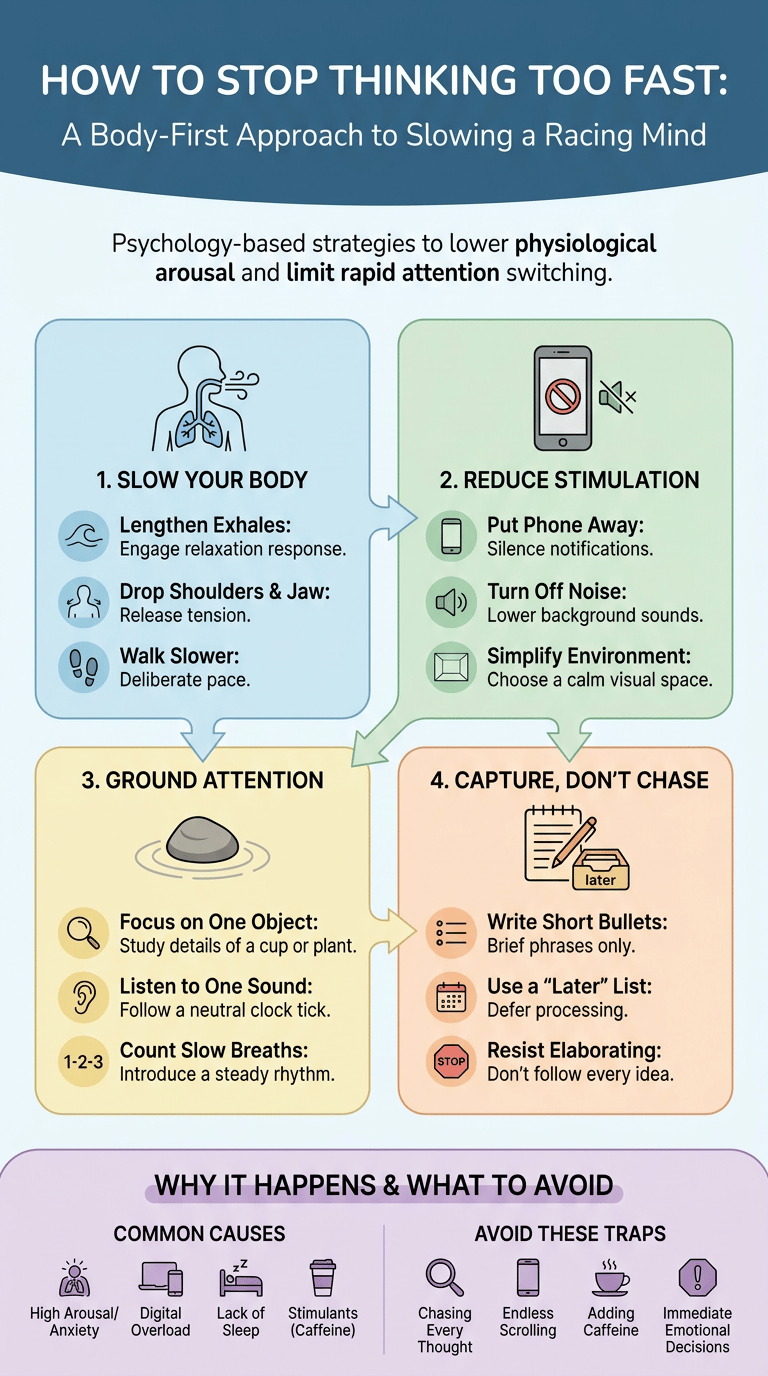
When thoughts move fast, a common habit is to chase each one. Capturing them briefly prevents the chase while preserving the thought for later.
Write short bullet points
Keep a single sheet or a small note app for quick one-line bullets. When a thought comes, write a single phrase and return to your anchor. This reduces the need to mentally hold or pursue every idea.
Do not expand every thought
Bullet points are intentionally sparse. Resist the urge to elaborate on each line immediately. The goal is to remove urgency, not to process everything in the moment.
Use a later list
Create a “later” list for items you want to revisit. Give each item a time or place to be processed so your mind does not keep pulling it forward into the present.
Let thoughts land outside your head
Place a physical notebook, a voice memo, or a dedicated app nearby. Offloading thoughts into an external container reduces internal traffic and signals to your brain that these items are stored safely.
Step 3: Reduce stimulation immediately
Fast thought speed often thrives in cluttered sensory environments. Use these immediate changes to cut down incoming stimulation.
Put the phone away
Silence notifications and place the device face down or in another room. The absence of constant alerts reduces attention shifting and prevents new topics from entering your mind.
Turn off background noise
Lower or mute music, TV, or other background sounds. A quieter environment supports slower thought pacing and makes single-object focus easier.
Stop switching tasks
Give yourself permission to stop multi-windowing. Commit to one short task and ignore new inputs until you reach a planned stopping point.
Use one screen
If possible, reduce the number of visible screens. One screen reduces the temptation to split attention and simplifies visual input.
Sit somewhere visually simple
Choose a plain area with minimal visual distraction, such as a quiet corner or a blank wall. Visual simplicity reduces the frequency of attention shifts caused by movement or clutter.
Step 4: Train single-point attention
Training attention to stay on a single point builds the mental skill needed to slow rapid thought switching. Practice short exercises and gradually increase their duration.
Focus on one sound
Pick a neutral sound like a clock tick or ambient hum and follow it for a minute or two. When attention wanders, gently return it to the sound without judgment.
Focus on one object
Choose a small object such as a cup, a plant leaf, or a stone. Study its details for a few minutes. Direct sensory focus limits the mind’s tendency to speed through ideas.
Count slow breaths
Count each breath cycle slowly and steadily. Slow counting introduces rhythm and a pacing structure that often transfers to thought speed.
Read slowly
Pick a short paragraph and read it deliberately aloud or silently at a reduced pace. Slowing reading will naturally slow inner speech and reduce thought acceleration.
Do one task without switching
Set a short, timed block to work on a single simple task. Use a timer and do not switch until the block ends. Gradual practice builds tolerance for extended single-point attention.
Step 5: Use a thought-speed reset routine
A short, predictable routine can serve as a reset when thinking becomes too fast. The structure signals to your brain that it is time to switch modes.
60 seconds of breathing
Take one minute to practice slow breathing with longer exhales. This brief pause often reduces immediate arousal and re-centers attention.
2 minutes of writing
Write two minutes of single-line bullets capturing current thoughts and a “later” plan. Keep it short and focused to prevent further elaboration.
3 minutes of walking
Take a slow three-minute walk without using your phone. Use the rhythm of steps and breath to anchor attention and reduce mental speed.
One small action
Do one simple, concrete action such as making a cup of tea, tapping a plant, or filing one paper item. Completing a small physical act provides closure that slows mental momentum.
One clear stopping point
End the routine with a verbal cue or simple phrase like “pause complete” to mark a psychological boundary. A clear stopping point helps your mind shift from rapid scanning back to steady focus.
What not to do when your thoughts race
Certain common responses can make fast thinking worse. Avoid these traps and replace them with calmer alternatives.
Do not chase every idea
Jumping after each thought reinforces the speed pattern. Instead, capture thoughts briefly and defer follow-up to a designated time.
Do not keep scrolling
Endless social media or news scrolling feeds rapid attention switching. Pause screen use and opt for low-stimulation activities until your mind slows.
Do not add more caffeine
Avoid using stimulants to “push through” a busy mind; they may increase thought speed and agitation. Choose calming routines instead.
Do not make emotional decisions immediately
Racing thoughts often amplify urgency. Delay major decisions until your mind is steadier and you can consider options clearly.
Do not judge yourself for feeling mentally fast
Self-criticism increases stress and can accelerate thinking. Use compassionate statements like “this is temporary” and apply practical strategies instead.
When fast thinking may need professional support
Fast thinking is common and often manageable with self-help strategies. However, there are situations when it is appropriate to seek evaluation and support from a qualified professional.
When thoughts feel uncontrollable
If thoughts repeatedly feel beyond your control despite self-help efforts, consider reaching out to a mental health professional for assessment and guidance.
When racing thoughts affect sleep
Persistent trouble falling or staying asleep because of racing thinking can affect daytime functioning. If sleep disruption is ongoing, a professional can help identify underlying causes and options.
When rapid thoughts come with panic
If rapid thoughts are accompanied by panic attacks, persistent high anxiety, or severe distress, contact a qualified clinician. These symptoms may benefit from professional evaluation and support. For general guidance on symptoms and when to seek care, see the NIMH’s mental health information.
When mood, energy, or behavior change suddenly
Significant shifts in mood, energy level, or behavior that occur alongside racing thoughts may need professional assessment to determine appropriate steps.
FAQs about thinking too fast
Why do I think too fast?
Thought speed can increase with higher physiological arousal, fluctuating attention, insufficient rest, stimulants like caffeine, emotional pressure, or an environment that encourages rapid switching. Each of these factors affects the nervous system and attention processes that determine thought tempo.
How do I slow down racing thoughts?
Start with body-based techniques: lengthen exhales, relax tension, and reduce stimulation. Capture thoughts briefly without expanding them, anchor attention to a single neutral object, and use short reset routines. These steps lower arousal and reduce rapid attention switching.
Is thinking too fast the same as anxiety?
Racing thoughts can be a symptom of anxiety, but they are not exclusively caused by anxiety. Fast thinking can result from multiple factors, including sleep loss, stimulants, or environmental overload. If you suspect anxiety is a primary factor, consult mental health resources for information on symptoms and supports. See the NIMH’s mental health information.
How can I calm my brain quickly?
Use a brief reset routine: one minute of slow breathing with longer exhales, two minutes of jotting short bullet points, and a short slow walk. These immediate steps often reduce arousal and create space for clearer thinking.
Closing thoughts
Thinking too fast is a common experience and often responds well to practical, body-first strategies and simple attention training. The goal is not to eliminate thoughts but to slow their pace enough so you can choose where to focus. Use short routines, externalize urgent items into a safe list, and reduce stimulation when possible. If racing thoughts become persistent, uncontrollable, or significantly disruptive to sleep or daily functioning, consider consulting a qualified mental health professional for further evaluation and support.
For reliable information on mental health symptoms and related topics, see the APA Dictionary of Psychology and the National Institute of Mental Health.

Michael Reed is the Founder and Lead Writer at Psychology Exposed. He writes about human behavior, relationships, emotional patterns, self-awareness, and practical psychology topics using research-informed, easy-to-understand content.
Read More About Michael Reed: https://psychologyexposed.com/michael-reed/