
Quick answer
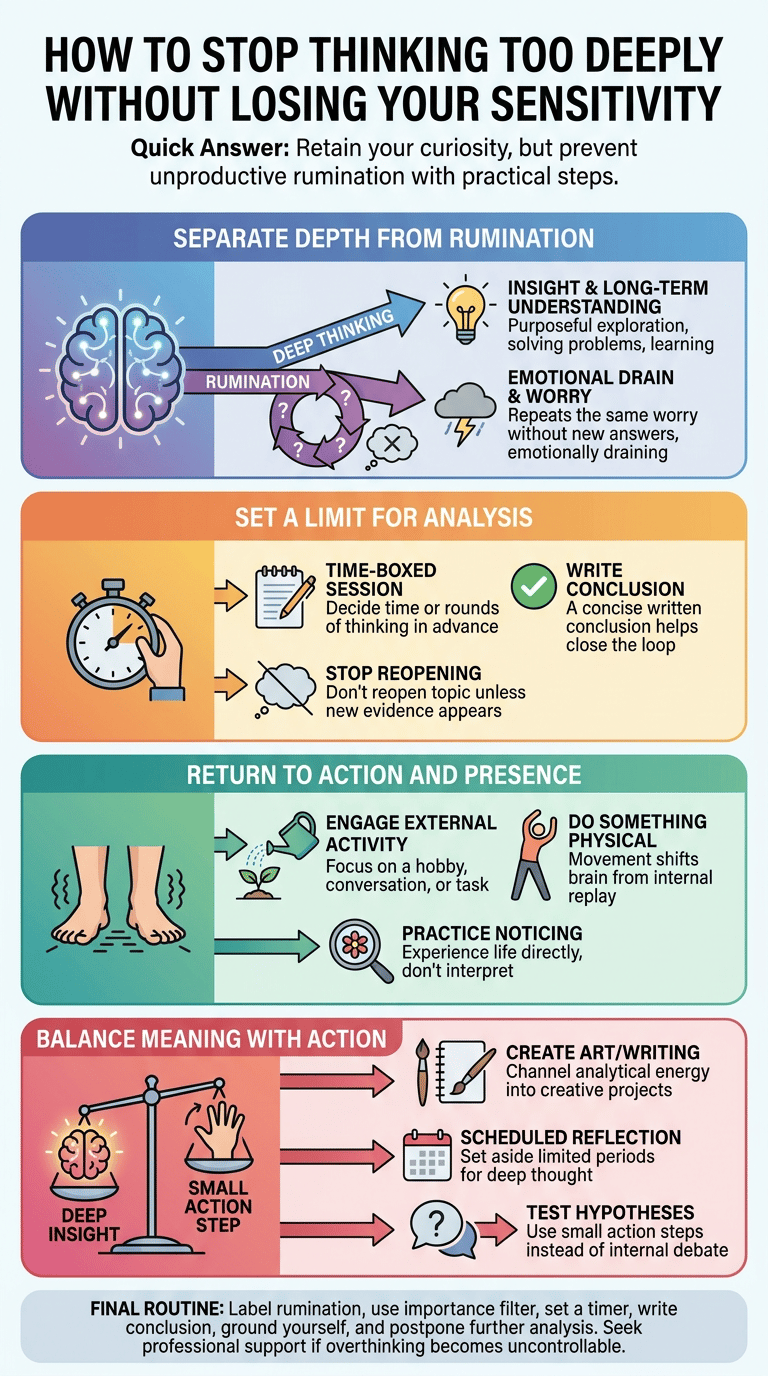
If you naturally notice detail and look for meaning, the goal is not to stop thinking deeply but to keep your sensitivity and curiosity while preventing analysis from turning into repetitive rumination that wastes energy and causes distress. Practical steps include distinguishing productive depth from rumination, setting clear limits for analysis, focusing on what a situation actually requires, resisting the urge to search for hidden meanings in every interaction, and returning to action and present-moment experience when analysis is no longer helpful.

Separate depth from rumination
Depth helps you form insights and long-term understanding. Rumination repeats the same worry without producing new answers. Notice when your thinking is moving you forward and when it is circling back over the same questions.
Set a limit for analysis
Decide in advance how much time or how many rounds of thinking you will allow for a given question. A time-boxed thinking session reduces the chance that a small uncertainty will expand into hours or days of unproductive thinking.
Focus on what the situation requires
Ask whether this moment needs detailed meaning-making or simply a practical response. Align your level of analysis with the actual demands of the situation.
Stop searching for hidden meaning in everything
Not every glance, phrasing, or event contains a secret message. Treat many everyday moments as ordinary unless there is clear evidence they are otherwise.
Return to action and presence
When analysis ceases to be useful, shift to a grounding activity, a simple decision, or sensory engagement. Doing something external reduces the mental loop and restores energy for meaningful reflection later.
Deep thinking vs overthinking
Deep thinking creates insight
Deep thinking is purposeful exploration that connects facts, context, and values to generate clearer understanding or a well-informed decision. It tends to have a direction, such as solving a problem, learning, or making sense of a meaningful experience.
Overthinking creates loops
Overthinking, including rumination and repetitive worry, often lacks progress. It repeats the same thoughts and feelings without new information or resolution, which can be emotionally draining and make decisions harder.
Deep thinking has direction
When you think deeply in a healthy way, there is a deliberate intention: to learn, evaluate options, or create. You can usually point to a next step at the end of the thinking session, even if that step is to gather more information.
Overthinking repeats the same emotional question
Overanalysis tends to replay core questions such as what this means for you or what will happen next. The content feels urgent but does not lead to new conclusions or actions.
Why sensitive people often cross the line
Reflective people notice small cues and emotional subtleties that others miss. That sensitivity is an asset, but it also makes it easier to find patterns where none exist and to spend disproportionate energy interpreting minor signals. Awareness of this tendency is the first step toward redirecting your depth where it helps most.
Why you think so deeply about everything
You notice details others miss
People who think deeply often perceive nuances in tone, posture, or context. This heightened observation leads naturally to trying to understand underlying motives or meanings.
You look for emotional meaning
If emotions guide your attention, you are likely to seek the emotional significance of events. That search can be constructive when it clarifies values and relationships, but it can become burdensome when it is a default reaction to every interaction.
You fear missing something important
Fear of overlooking a critical cue or making the wrong interpretation pushes some people into extensive analysis. That protective strategy can reduce risk in some contexts but can also cause unnecessary worry and delay.
You try to understand people deeply
A desire for accurate social understanding motivates deep thought about others. Trying to see what another person feels or intends can be compassionate, but it becomes problematic when you assume you can know their inner state without clear evidence.
You may use analysis to avoid emotional uncertainty
Sometimes deep analysis is a way to avoid direct feelings of discomfort. Turning feelings into puzzles to solve can feel safer than tolerating uncertainty, vulnerability, or emotional exposure.
Signs deep thinking has become too much
You analyze every message
If each text, email, or remark sparks extended interpretation about intent and meaning, your thinking is shifting from useful to compulsive.
You search for hidden motives
Consistently assuming hidden motives when simpler explanations fit is a sign that analysis is being driven by anxiety or mistrust rather than evidence.
You struggle to enjoy simple moments
If quiet meals, walks, or social gatherings are frequently interrupted by internal commentary and meaning-making, your capacity for presence is diminished.
You feel emotionally drained by ordinary events
When routine interactions leave you exhausted from mental work, it suggests your cognitive resources are being overused on interpretation rather than replenished by rest or pleasure.
You turn small interactions into big meanings
Magnifying minor events into sweeping conclusions about your relationships or identity indicates that depth is becoming a distortion rather than a tool.
You cannot stop asking what this means
Persistent questioning that fails to produce clearer answers is a hallmark of rumination instead of productive reflection.
Step 1: Ask whether the situation needs depth
Is this actually important?
Start by categorizing the situation. Does it affect your safety, relationships, finances, or long-term goals? If not, it may not merit deep analysis right now. This simple filter helps conserve mental energy for what truly matters.
Does this need a decision?
If no action is required, overly detailed thinking usually offers little benefit. Reserve deep analysis for moments when a choice or change depends on your understanding.
Am I looking for truth or reassurance?
Ask whether you are trying to understand objectively or seeking comfort. If the aim is reassurance, consider whether other strategies, such as asking a trusted person or accepting uncertainty, might be faster and healthier than more analysis.
What would be enough understanding?
Define a minimal useful level of insight for the situation. For example, knowing whether a conversation was hurtful may be enough without needing to reconstruct every micro-expression that occurred.
Step 2: Set an analysis limit
Give yourself one thinking session
Use a time-limited session to explore the question. Set a timer for a realistic window, gather your thoughts, and write down conclusions. This practice prevents indefinite replay.
Write your conclusion
Putting a concise conclusion in writing helps close the loop. A sentence that captures your current best understanding makes it easier to accept that you have done enough analysis for now.
Stop reopening the same question
Decide in advance that you will not reopen that topic for a set period. If you find yourself returning to it, use a brief check-in rule: allow a short follow-up only if new evidence has actually appeared.
Use a good-enough meaning rule
Adopt the mindset that “good enough” understanding is sufficient for ordinary life. Perfection is not required for many everyday decisions, and insisting on it prolongs stress and indecision.
Step 3: Stop mind-reading other people
Notice assumptions
Pay attention to the leaps your mind makes from observed behavior to implied intent. Label these as assumptions rather than facts. Recognizing the distinction reduces the power of imagined meanings.
Separate facts from interpretations
When you notice an intrusive interpretation, ask: what exactly did I see or hear? State the observable facts before adding in motives or emotional coloring. This gives perspective on how much is known and how much is inferred.
Ask directly when appropriate
If the relationship and context allow, ask concise, open questions rather than running through hypothetical reasons. Direct communication often resolves uncertainty more efficiently than guesswork.
Accept that some uncertainty is normal in relationships
Not every interaction comes with a definitive explanation. Tolerating some ambiguity is part of healthy social life and reduces the urge to fill gaps with speculation.
Step 4: Return to the present moment
Use sensory grounding
Bring attention to concrete sensations: the feel of your feet on the ground, the texture of an object, or the sounds around you. Sensory grounding interrupts abstract loops and reconnects you with experience.
Do something physical
Physical activity, even simple movements like a short walk, chores, or stretching, shifts your brain away from internal replay and toward action. Movement creates a natural break in cyclical thinking.
Engage with your environment
Focus on an external activity that requires attention, such as a hobby, conversation, or a small goal-oriented task. Engaging with the world rebalances thinking with doing.
Practice experiencing life instead of analyzing it
Try deliberately noticing rather than interpreting for short periods. For example, during a meal, concentrate on taste and texture rather than the social implications of who you are dining with. Small practice sessions strengthen your ability to be present.
Step 5: Use your depth in a healthy way
Journal with a closing sentence
Write your reflections, then close the entry with a single sentence that summarizes what you have learned and what you will do next. The closing sentence provides a clear end point to the reflection process.
Create art or writing
Channel your analytical energy into creative projects where exploration and ambiguity are productive rather than distressing. Art and writing let you explore meaning in a contained, purposeful way.
Reflect at scheduled times
Set aside regular, limited periods to reflect deeply about important topics. Scheduled reflection prevents accidental spillover of intensive thought into every idle moment.
Use depth for insight, not self-punishment
Apply your ability to analyze toward understanding patterns and solving problems, rather than rehearsing past mistakes or imagining worst-case motives. Redirecting your depth toward learning reduces its tendency to become self-critical.
Balance meaning with action
Make sure reflection informs action. If thinking does not lead to a decision, experiment, or conversation, consider scaling back the analysis and taking a small step instead.
Mistakes deep thinkers make
Believing every detail has hidden meaning
Interpreting all details as significant creates a false sense of control and leads to unnecessary workload for your thoughts. Many cues are neutral or coincidental.
Treating uncertainty as danger
Equating unknowns with threats prompts excessive scanning for meanings. Practicing tolerance for uncertainty helps free you from that habit.
Romanticizing emotional pain
Some reflective people value intense emotions as a source of authenticity. While emotions contain information, glorifying pain can keep you stuck rather than supporting growth.
Confusing intensity with truth
Strong feelings make meanings feel certain, but feeling certain is not the same as being correct. Check feelings against observable evidence and reasonable alternatives.
Staying in analysis instead of living
When thinking crowds out action, relationships, or simple enjoyment, it has become maladaptive. Rebalancing toward doing and experiencing restores equilibrium.
When deep thinking may be linked to anxiety
Deep thinking and sensitivity are not the same as anxiety, but they can overlap. When thinking becomes uncontrollable, persistent, or interferes with sleep, work, or relationships, it may function more like an anxiety pattern than healthy reflection. For accessible information about persistent worry and related symptoms, see the NIMH mental health information pages.
When it becomes uncontrollable
If you repeatedly try to stop thinking and cannot, or if thinking consumes hours each day, it may help to learn strategies designed for persistent worry.
When it causes social stress
When mind-reading and overanalysis make social interactions stressful or cause frequent misunderstandings, consider learning communication and cognitive techniques that reduce assumption-making.
When it affects sleep
Racing or repetitive thoughts that interfere with falling or staying asleep can follow from excessive analysis. Practical sleep hygiene and cognitive strategies can help. For general patient-friendly information about mental states and daily functioning, including sleep, see the American Psychological Association’s topic pages.
When it keeps you from making decisions
If overanalysis regularly prevents you from choosing a path or committing to a plan, techniques that limit deliberation and encourage small experiments can be effective. When such patterns are persistent and limiting, consulting a qualified professional can help develop personalized strategies.
Frequently asked questions
Why do I think too deeply about everything?
Often because you are attentive to detail, value meaning, and want to understand social and emotional dynamics accurately. This tendency can be reinforced by past experiences where missing a cue had negative consequences, making you more vigilant. Recognizing the adaptive roots of deep thinking helps you keep its benefits while reducing its costs.
Is deep thinking a bad thing?
No. Deep thinking is a valuable skill for problem-solving, creativity, and understanding complex emotional situations. It becomes problematic only when it is rigid, repetitive, or prevents you from acting or enjoying life.
How do I stop overanalyzing people?
Distinguish observable facts from interpretations, notice and label assumptions, and, when appropriate, ask direct, brief questions rather than running scenarios in your head. Set limits on how long you will analyze a social interaction and practice acceptance of uncertainty. If overanalysis of relationships causes significant distress, professional support can offer structured strategies to reduce mind-reading.
How do I stop searching for meaning in everything?
Use an importance filter: ask whether understanding the deeper meaning will change your decisions or well-being. If not, allow the event to remain ambiguous. Schedule dedicated times for reflection so that meaning-making happens in controlled, productive bursts. Engaging in sensory or action-oriented tasks also shifts attention away from automatic meaning searches.
Can deep thinkers stop overthinking?
Yes, with deliberate practice and strategies that preserve sensitivity while curbing rumination. Methods include time-limiting reflection, separating facts from interpretations, grounding in the present moment, redirecting depth into creative pursuits, and using small action steps to test hypotheses rather than endless internal debate. If overthinking is persistent and disabling, a clinician can help tailor approaches such as cognitive strategies or behavioral experiments.
Final practical routine to try
Try this short routine when you notice yourself starting to think too deeply about something minor:
- Label the pattern: “This feels like rumination.”
- Apply the importance filter: “Does this require a decision or action?”
- If no, set a timer for five minutes and allow yourself one focused reflection session.
- Write one concise conclusion and one small action or postponement plan.
- Use a grounding exercise or a short physical activity to move attention outward.
- Return to your day and postpone further analysis unless new evidence emerges.
Repeating this routine builds muscle memory for containing deep thinking so you can keep the strengths of sensitivity without the cost of constant overanalysis.
When to consider professional support
Many people can rebalance thinking patterns with self-help strategies and supportive habits. If thinking becomes uncontrollable, causes severe distress, interferes with work or relationships, or is accompanied by persistent low mood or sleep problems, consider seeking help from a qualified mental health professional. For reliable overviews about symptoms and treatment options, see the NIMH mental health information pages and the American Psychological Association’s topic pages.
If you or someone you know is experiencing thoughts of harming themselves, reach out to local emergency services or a crisis line immediately. Emergency and crisis resources in your area can provide immediate support and guidance.
With practice, deep thinkers can keep their sensitivity and insight while using strategies to prevent analysis from becoming an exhausting, repetitive cycle. The aim is not to become less thoughtful but to be more intentional about when and how you use your mental depth.
For a related next step, see this guide to how to stop thinking too much.
For a related next step, see this guide to how to stop overthinking so much.

Michael Reed is the Founder and Lead Writer at Psychology Exposed. He writes about human behavior, relationships, emotional patterns, self-awareness, and practical psychology topics using research-informed, easy-to-understand content.
Read More About Michael Reed: https://psychologyexposed.com/michael-reed/