
Quick answer
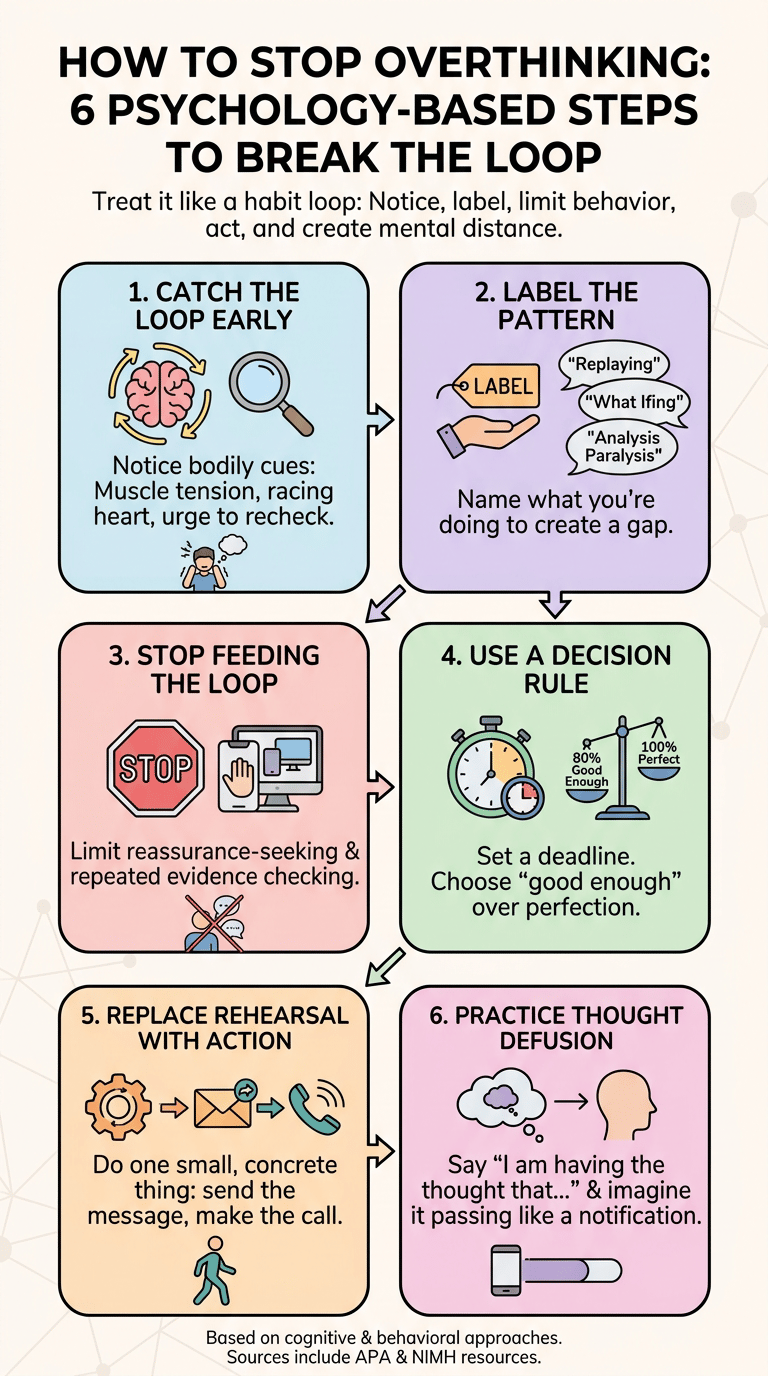
If you notice you overthink, a practical approach is to treat it like a habit loop: notice the loop early, name the pattern, limit behaviors that feed the loop, pick one small action, and practice mental distance from thoughts. These steps come from cognitive and behavioral approaches that focus on changing what you do with your thoughts rather than trying to erase them. For accessible definitions and background on related psychological terms, see the American Psychological Association topics page and the APA Dictionary of Psychology.
Catch the loop early
Overthinking tends to repeat itself. The faster you notice the moment your mind starts replaying or spiraling, the easier it is to interrupt the pattern. A simple cue can be a bodily sign such as muscle tension, a racing heart, or the repeated urge to recheck something.
Label the pattern
Put a name on what you are doing. Labels like “replaying,” “what ifing,” or “decision looping” help turn a diffuse mood into a discrete behavior you can address. Naming a pattern creates a tiny gap between you and the process and makes change easier.
Stop looking for perfect certainty
Overthinking often stems from trying to reach total certainty about an outcome that cannot be guaranteed. Practically, decide what level of information is sufficient for a next step and accept that uncertainty is a normal part of choice.
Choose one small action
Tiny actions break mental loops. Instead of trying to solve every problem at once, do one visible thing related to the worry: send the message, make a short call, or pick a time to decide. Action produces feedback that thinking alone cannot provide.
Limit reassurance-seeking
Repeatedly asking others or rechecking evidence can temporarily reduce anxiety but often strengthens the loop. Limit reassurance to a pre-set number of checks or a single clarifying question, then move to action or a distraction strategy.
What overthinking really means
Overthinking is not the same as careful thinking
Careful thinking has a goal and yields new information or a decision. Overthinking tends to be repetitive, stuck, and unproductive. It is a pattern of mental replay or anticipation that stays focused on problems without producing useful outcomes. For definitions of repetitive thinking and related terms, consult the APA Dictionary of Psychology.
Why overthinking feels productive but often is not
Ruminating or repeatedly analyzing can feel like preparation because mental rehearsal reduces immediate anxiety and gives a sense of control. However, unless the thinking leads to a decision or corrective action, it usually amplifies worry and drains cognitive resources. Cognitive and behavioral approaches emphasize shifting from thought-only strategies to concrete behaviors that test assumptions.
The difference between reflection, rumination, and worry
Reflection is purposeful and balanced, aimed at learning. Rumination is repetitive dwelling on past events or perceived mistakes. Worry tends to be future-focused, imagining threats and negative outcomes. These differences matter because each pattern responds best to different strategies: reflection benefits from structured review, rumination from behavioral activation and perspective-taking, and worry from decision rules and action planning. For patient-friendly overviews of worry and repetitive thinking, see the MedlinePlus mental health overview.
Why you overthink so much
Your brain wants certainty
Human cognition favors predictability. When outcomes are uncertain, the brain attempts to simulate possibilities to reduce unpredictability. That simulation can become a loop if it does not lead to clarifying information or action.
For readers dealing with stress and overthinking together, this related guide explains how to calm the body and narrow the problem.
You fear regret
Anticipating regret can make you weigh options repeatedly to avoid future pain. That impulse is understandable, but repeatedly running through scenarios does not eliminate regret and often increases indecision.
You try to prevent pain before it happens
Overthinking can function as a preventive strategy: if I foresee all problems, I might avoid them. In reality, thinking without testing tends to amplify perceived threats rather than prevent them.
You replay moments to feel in control
Replaying conversations or events can temporarily restore a sense of mastery, because it lets you rehearse alternative words or actions. However, this rehearsal rarely changes past outcomes and can trap attention in the past.
You learned to scan for problems
Some people become accustomed to a scanning mode that looks for threats in everyday life. That scanning can come from upbringing, past experiences, or habit. When scanning becomes default, it steers attention toward negative possibilities and fuels overthinking.
Common overthinking loops
The conversation replay loop
This loop involves stepping through past interactions, imagining different responses, and mentally scoring your performance. It often focuses on perceived social mistakes and ends without new information.
The what if loop
“What if” thinking generates worst-case scenarios in an attempt to prepare. Because worst cases are usually improbable, the loop can magnify fear and keep you stuck in hypothetical threats.
The decision loop
Also called analysis paralysis, this loop involves revisiting the same options and pros and cons without committing. Each revisit feels necessary but rarely yields more clarity.
The self-blame loop
This loop centers on criticizing your own actions and assuming personal fault for negative outcomes. It increases negative emotion and reduces problem-solving energy.
The future-prediction loop
Predicting how things will turn out can become a repeated mental habit. The loop tries to control the future by endlessly forecasting outcomes, which often increases anxiety rather than offering useful predictions.
Step 1: Identify the type of overthinking
Am I worrying about the future?
Future-focused worry often includes “what if” questions and scenario building. If your thinking is future-directed and driven by fear of negative events, treat it as worry and move to decision rules and small experiments.
Am I replaying the past?
Past replay is concerned with mistakes, social interactions, or unresolved events. When you notice repetitive past focus, techniques that shift attention to present-moment tasks and behavior are most helpful.
Am I trying to read someone’s mind?
Mind-reading or guessing others’ intentions leads to repeated checking and reinterpretation. Responding directly when feasible, or limiting assumptions when not, reduces this loop.
Am I trying to make a perfect decision?
If the core impulse is to find the single best answer, the decision loop is active. Using decision rules and deadlines helps prevent endless comparison.
Step 2: Stop feeding the loop
Stop checking the same evidence repeatedly
Repeatedly looking for confirmation takes time and reinforces the habit. Set a fixed number of checks for things like email, messages, or data you need, and treat that as your information budget.
Stop asking people for the same reassurance
External reassurance can calm you briefly but usually strengthens reliance on others. If reassurance-seeking interferes with daily life, consider limiting how often you ask and use alternate coping strategies instead. If reassurance-seeking relates to persistent anxiety, therapy approaches such as cognitive behavioral therapy are commonly recommended; the NIMH mental health information offers accessible descriptions of therapy options.
Stop researching after you already have enough information
Researching can feel productive, but information gathering has diminishing returns. Decide in advance what facts you need to decide and stop once you have them. For general mental health information and patient-friendly guidance, see the MedlinePlus mental health overview.
Stop replaying conversations without a purpose
If replaying a conversation does not produce a lesson you can use, interrupt it. Use a brief physical cue such as standing up, taking three breaths, or writing a single line about what you would do differently next time, then move on.
Step 3: Use a decision rule
Set a deadline for small decisions
Deadlines prevent endless cancellation of choices. For routine decisions, allow a short window such as 15 to 30 minutes. For larger decisions, give yourself a clear planning period and then commit to a next step.
Choose good enough instead of perfect
Perfectionism feeds overthinking. Ask whether the extra time spent searching for the ideal choice improves outcomes in a meaningful way. Often, an 80 percent solution delivered promptly is better than a perfect solution delayed indefinitely.
Ask what decision you would make if you trusted yourself
This reframes doubt into a choice that aligns with your values and past learning. Identifying the option you would choose with confidence can reveal avoidance rather than true uncertainty.
Accept that every decision has some uncertainty
Uncertainty is unavoidable. Practice deciding with that reality in mind and use small experiments and reviews to adjust later if needed.
Step 4: Replace mental rehearsal with real action
Send the message
If you find yourself rehearsing a text or email, send a short version. Real feedback ends speculation faster than imagining others’ responses.
Make the call
Phone calls or in-person steps often resolve issues that mental practice cannot. Commit to a short call with a clear agenda.
Write the plan
Put decisions into a brief written plan with a first step and a deadline. Writing converts vague worry into concrete tasks.
Take the first step
Start with a tiny action that moves you toward the outcome. Even a small step produces information that refines future choices and reduces rumination.
Let action give you feedback
Use the outcome of your action as new data. Adjust the plan based on real results rather than hypothetical scenarios.
Step 5: Practice thought defusion
Say: I am having the thought that
Prefacing a thought with a phrase like “I am having the thought that” creates distance and reduces fusion with the content. This language-based distancing is used in acceptance and commitment approaches; see the APA topics page for overviews of related therapy concepts.
Imagine the thought passing like a notification
Visualize thoughts arriving and then sliding away like alerts on a phone. This imagery helps prevent sticking to a single thought and keeps attention flexible.
Stop treating every thought as truth
Thoughts are mental events, not facts. When a thought appears, test whether it is based on current evidence or habitually negative interpretation before acting on it.
Create distance before reacting
Pausing for a brief count, a few breaths, or a short walk before responding to a provocative thought or impulsive urge reduces the chance of reactive decisions that feed overthinking later.
Mistakes that keep overthinking alive
Trying to think your way into total certainty
Relying only on thinking to create certainty is a common trap. Instead, use small tests, experiments, and actions to generate real-world feedback.
Confusing anxiety with intuition
Anxiety can feel like a warning signal, but it is not always reliable. Check whether the feeling is driven by immediate evidence or old patterns of worry.
Waiting until you feel ready
Sitting for perfect readiness often means never acting. Commit to actions you can do even when you feel only partially ready.
Avoiding discomfort
Avoidance gives temporary relief but reinforces the underlying fear. Gradual exposure through action reduces the power of avoided thoughts over time.
Reopening closed decisions
Frequently revisiting a settled choice keeps the loop alive. Set a limit on how often you will reconsider past decisions and practice moving forward after closure.
Daily habits that reduce overthinking
Morning brain dump
Spend five to ten minutes each morning writing down your main thoughts and worries. A short brain dump clears working memory and helps you set realistic priorities.
Scheduled worry time
Give yourself a brief, scheduled period each day to focus on worries. This technique prevents worries from intruding at random times and confines them to a predictable slot.
Less phone checking
Frequent checking increases opportunities to re-trigger loops. Reduce automatic checking by setting low-frequency windows for messages and news.
More physical movement
Movement interrupts rumination and supports cognitive flexibility. Short walks, stretching, or brief exercise breaks are practical tools to reset thinking.
Clearer boundaries
Establishing limits on how much time and energy you devote to other people’s problems or work tasks reduces the mental load that fuels overthinking.
Better sleep routine
Poor sleep can make repetitive negative thinking more likely. Prioritize consistent sleep schedules and habits that support restorative sleep. If sleep problems persist and interfere with daily life, consider seeking professional guidance; authoritative sources such as the NIMH mental health information can help explain treatment options.
FAQs about overthinking
Why do I overthink so much?
Frequent overthinking usually reflects a combination of wanting certainty, trying to avoid discomfort, and habitual mental patterns that developed over time. It is a common human response and does not always mean there is a mental disorder. For general mental health context and guidance, see the MedlinePlus mental health overview.
How can I stop overthinking everything?
Start by identifying the type of loop you fall into, limit behaviors that feed it, use decision rules and deadlines, and move from mental rehearsal to concrete action. Daily habits such as scheduled worry time and brief physical activity reduce the tendency to ruminate.
Is overthinking anxiety?
Overthinking is commonly associated with anxiety but it is not the same thing as an anxiety disorder. Persistent, severe worry that interferes with daily functioning can be a sign of an anxiety condition. For reliable information about anxiety and when to seek help, consult the NIMH mental health information.
How do I stop replaying conversations?
Interrupt replay with a short grounding action: stand, take three slow breaths, and write one sentence about what you learned or what you would do differently. Then redirect attention to a task that requires focus. Over time, these behavioral interrupts weaken the replay habit.
Can overthinking be reduced?
Yes. Techniques drawn from cognitive and behavioral approaches, mindfulness-informed strategies, and practical decision rules can reduce repetitive thinking. If overthinking is persistent and impairs daily life, a qualified mental health professional can help tailor an approach that fits your needs. For general descriptions of therapy approaches, see the NIMH mental health information and the APA Dictionary of Psychology.
When to seek professional help
If repetitive thinking is severe, persistent, or interferes with work, relationships, or basic daily tasks, consider contacting a mental health professional. If you experience thoughts of harming yourself or others, seek emergency help immediately.
Practical change takes repeated practice. Start with one small step today: notice one loop, name it, and do one tiny action to move forward. Over time, these small changes add up to more flexible thinking and calmer decision-making.

Michael Reed is the Founder and Lead Writer at Psychology Exposed. He writes about human behavior, relationships, emotional patterns, self-awareness, and practical psychology topics using research-informed, easy-to-understand content.
Read More About Michael Reed: https://psychologyexposed.com/michael-reed/