
Overthinking and stress often feel like a continuous loop: the mind replays worries while the body stays on edge. This guide focuses on the loop between nervous system arousal and repetitive thinking, and offers step-by-step actions that target the body first, then the thinking, and finally the practical tasks that reduce ongoing strain. The aim is practical, psychology-informed action you can use when pressure at work, home, or in life makes your mind race.
Quick answer: how to stop overthinking and stress
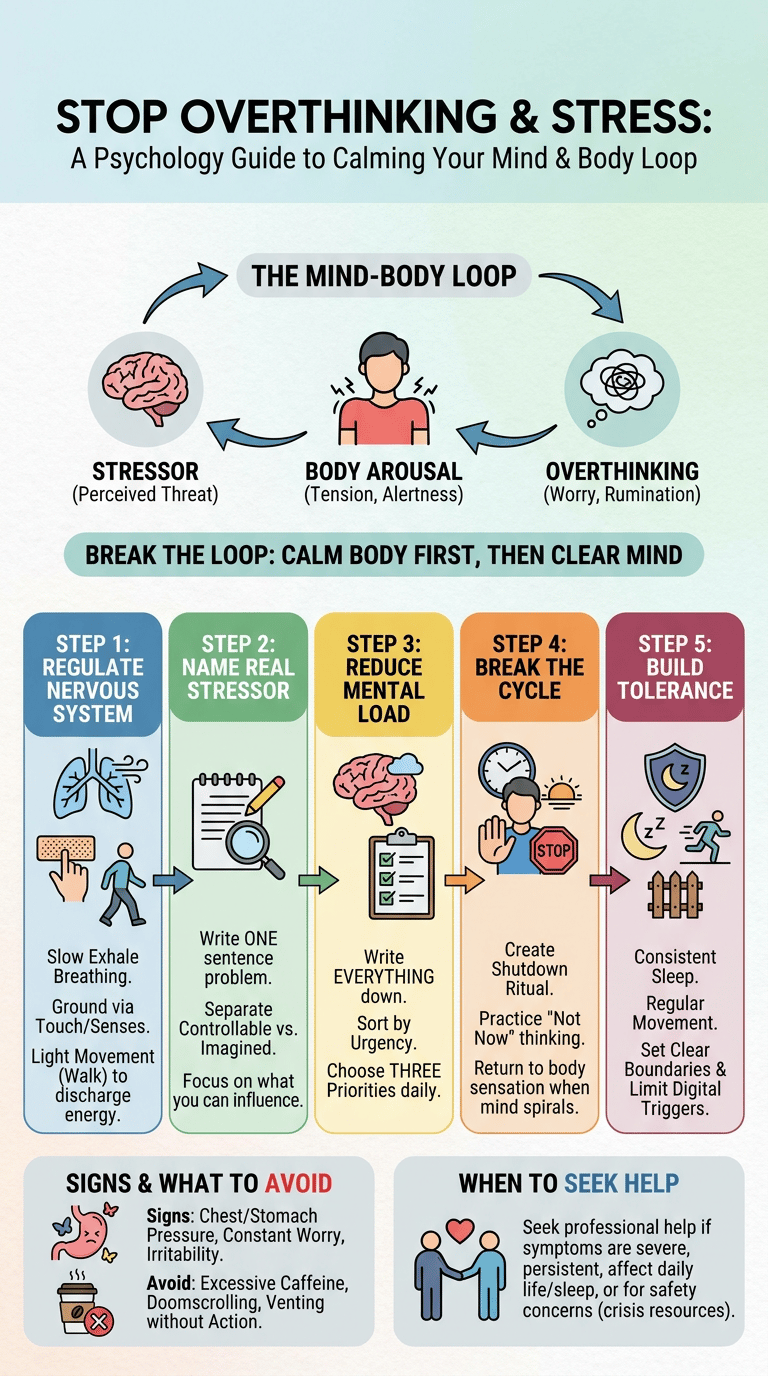
When overthinking is driven by stress, calming the body first makes thinking less urgent and clearer. Start with simple nervous system regulation – slow exhale breathing, grounding through touch or movement, and light activity to release tension. Once your body feels safer, name the specific stressor, separate what is controllable from what is imagined, capture tasks on paper, and take one small recovery action. Over time, build habits that increase stress tolerance such as consistent sleep, regular movement, limits on digital triggers, and clear boundaries.
For simple body-first techniques, use this guide to relax when stressed and overthinking.
Calm the body first
Low-effort somatic strategies can reduce arousal so thinking becomes less urgent. Simple breathing patterns and grounding bring down the body’s alarm level and make reasoning easier.
Reduce the threat response
Reducing the body’s threat response means shifting from a state of protection to one of recovery. Start with breathing and gentle movement so the nervous system moves away from high alert and into a calmer range.
Write the stressor clearly
Put the worry into clear words or a single sentence. Naming the specific problem reduces the tendency for thoughts to expand into many vague what-ifs.
Separate real problems from imagined problems
Ask whether the thought is about something happening now, or a possible future scenario. This distinction helps you focus effort on what you can influence and lets you set aside hypothetical worries for later.
Take one recovery action
Pick one small, concrete action that improves recovery: a short walk, a glass of water, a 10-minute nap, or a brief conversation to clarify expectations. A single intentional step breaks the rehearsal loop and gives the body and mind new data.
Why overthinking and stress often happen together
Stress makes the brain scan for danger
When you feel stressed, your brain biases attention toward potential threats and problems. This vigilance supports safety in danger but also increases the likelihood of repetitive scanning in everyday stress. For context about how stress and emotional responses are described in psychology resources, see the American Psychological Association’s overview of stress and coping on the APA topics pages.
Overthinking makes stress feel endless
Repetitive thinking tends to keep the brain focused on problems rather than resolutions. Rumination can prolong the subjective feeling of stress because the mind keeps rehearsing threats without clear closure. The APA Dictionary offers operational definitions for terms like rumination that help explain why repeated thinking can maintain distress in the APA Dictionary of Psychology.
Why your body can stay tense after the problem is gone
The body’s stress response does not always switch off as quickly as the event that started it. Muscular tension, elevated heart rate, and shallow breathing can persist, and those bodily cues signal danger to the brain, which then produces more worried thinking. Practical nervous system regulation helps the body register safety and signals the mind that immediate threat has passed.
The mind-body loop behind stress thinking
Think of the process as a loop: a stressor activates the body, bodily arousal increases attention to threat, attention produces more worrying thoughts, those thoughts keep the body aroused, and the cycle continues. Breaking the loop requires interventions at both the body level and the thinking level.
Signs your overthinking is stress-driven
You feel pressure in your chest or stomach
Physical sensations such as tightness, fluttering, or a knotted feeling in the chest or stomach commonly accompany stress-driven thinking. These sensations can feed worry by signaling danger even when you are safe.
You cannot relax even during free time
If downtime does not feel restful because worries intrude, your nervous system may be staying in a higher arousal state. Building short recovery rituals can help the body practice returning to rest.
You think about work or problems constantly
Persistent preoccupation with work tasks, deadlines, or relationship concerns is a hallmark of stress-driven rumination. Writing tasks down and setting boundaries can reduce the cognitive load.
You feel easily irritated
Irritability and low frustration tolerance often accompany stress-driven overthinking. These mood shifts result from sustained activation and exhaustion of coping resources.
Your mind jumps from one worry to another
Rapid switching between topics without resolution suggests open cognitive loops. Reducing open loops by capturing tasks and decisions on paper helps the brain stop scanning for missing information.
Step 1: regulate your nervous system first
When stress activates the nervous system, purely logical argument or planning is less effective. Regulation techniques reduce physiological arousal and create space for clearer thinking.
Why logic does not work well when your body is alarmed
High arousal narrows cognitive bandwidth and biases attention toward threat, which makes complex problem-solving harder. Addressing bodily arousal first often improves the ability to use reasoning and make better decisions.
Slow exhale breathing
A simple breathing technique focuses on extending the exhale to engage the parasympathetic system and encourage calm. Try breathing in for a comfortable count, then breathing out slowly for a longer count. Repeat for a few minutes until you notice a softening of tension. Relaxation strategies like paced breathing are described in accessible mental health resources such as MedlinePlus, which lists patient-friendly relaxation practices on the MedlinePlus mental health overview.
Grounding through touch and movement
Grounding brings attention back to the present and the physical environment. Examples include feeling your feet on the floor, holding a cool object, or naming five things you can see. These actions change sensory input and reduce the brain’s threat bias.
Walking to discharge stress energy
Light movement, especially walking, can reduce tension and improve mood. A short stroll outside can shift both body sensations and perspective. For patient-facing information on movement and mental health, see MedlinePlus on mental health topics.
Relaxing the jaw, shoulders, and hands
These areas commonly hold tension. Consciously softening the jaw, dropping the shoulders, and unclenching the hands reduces continuous somatic signals that maintain worry. Progressive attention to these areas also trains the body to notice and release tension earlier.
Step 2: name the real stressor
After some regulation, put the worry into words. Naming narrows the focus and reduces the mind’s tendency to produce unbounded what-ifs.
What exactly am I stressed about?
Write one sentence that states the concrete problem. Vague descriptions let the mind fill in scenarios; a clear sentence limits that expansion.
Is this a current problem or a possible future problem?
Decide whether the stressor is happening now or whether it is a hypothetical future scenario. If it is future-oriented, schedule a later time to plan so it does not hijack the present moment.
What part is under my control?
Identify actions within your control, no matter how small. Focusing on controllable elements reduces the energy spent on unchangeable factors and clarifies next steps.
What part am I carrying emotionally?
Distinguish practical tasks from emotional burdens you are holding. Some worries are reminders of values or losses rather than problems requiring immediate solutions; acknowledging this can make them easier to hold gently.
Step 3: reduce mental load
Overthinking often increases when the brain is juggling many unfinished tasks. Reducing mental load creates space for calm thinking.
Write everything down
Capture all tasks, worries, and decisions in one place. Externalizing information frees working memory and reduces the number of open loops your brain continues to check.
Sort tasks by urgency
Organize items into what needs immediate attention, what can wait, and what can be delegated or removed. Clarifying urgency prevents the brain from treating every item as an emergency.
Remove fake emergencies
Ask whether an item truly requires now attention or whether your alarmed brain is amplifying its importance. Removing manufactured urgency reduces stress-driven activity.
Choose three priorities
Limit daily goals to three meaningful priorities. This restriction reduces endless planning and creates a realistic target for accomplishment.
Give your brain fewer open loops
Close small tasks immediately when possible. A quick email, a short phone call, or scheduling a later check-in reduces the number of items the brain keeps searching for.
Step 4: break the stress-overthinking cycle
Tactics that interrupt the cycle help build rhythm between recovery and action so you do not stay trapped in repetitive thinking.
Stop problem-solving when you are exhausted
Decision-making capacity declines with fatigue and high arousal. If you are exhausted, postpone complex problem-solving until after a recovery period.
Use recovery before decision-making
Brief restorative routines – a walk, short nap, or breathing exercise – before important decisions reduce impulsive choices and improve clarity.
Create a shutdown ritual
Design a consistent end-of-day ritual that signals to your body and mind that work is over. Examples include a brief review of tomorrow’s three priorities, turning off work notifications, and a short relaxation practice.
Practice not now thinking
Train a gentle habit of deferring non-urgent worries with a phrase such as “not now, later.” Schedule a five-minute worry period later in the day rather than allowing concerns to dominate the present.
Return to the body when the mind spirals
When thoughts loop, bring attention to bodily sensations: breathing, posture, or a grounding touch. Changing sensory input helps reset the thinking pattern.
Step 5: build stress tolerance
Long-term changes reduce how often your nervous system enters high-arousal states and how quickly you recover when it does.
Sleep consistency
Regular sleep schedules improve emotional regulation and reduce reactivity. Reliable sleep routines support recovery and help the brain process daily stressors. For practical information on sleep and mental health, see the National Institute of Mental Health at NIMH.
Movement
Regular physical activity reduces baseline arousal and improves the body’s capacity to recover from stress. Short, frequent movement breaks during the day help dissipate accumulated tension. For patient-friendly guidance on activity and mental health, see MedlinePlus on mental health topics.
Boundaries
Clear limits around work time, availability, and expectations reduce chronic activation. Communicate realistic limits and protect recovery periods.
Fewer digital triggers
Notifications and constant connectivity increase cognitive load and provide more inputs for worry. Intentionally reduce digital triggers during focus and rest times.
Emotional check-ins
Regularly ask yourself how you are feeling and whether current sensations are linked to present needs or past or future concerns. Brief emotional labeling can reduce the intensity of stress-driven thoughts.
Time away from performance pressure
Make space for non-evaluative activities that provide restoration without performance demands. Downtime that is not judged as productive helps the nervous system practice safety.
What to avoid
Certain common behaviors can maintain stress and overthinking. Replace these with alternative actions that support recovery.
Drinking too much caffeine when anxious
Caffeine can increase physiological arousal and make anxious thinking more likely. If you notice heightened tension after caffeine, try reducing intake or timing consumption earlier in the day.
Doomscrolling for relief
Scrolling through negative content can feel distracting but often increases worry and arousal. Set limits on news and social media during vulnerable times.
Venting without action
Ranting can feel relieving in the moment, but if it does not lead to problem-solving or boundary-setting, it may sustain worry. Pair emotional expression with a practical next step when possible.
Ignoring body tension
Skipping simple regulation because you are busy allows bodily arousal to persist and fuel further overthinking. Short somatic checks throughout the day are time-efficient prevention.
Treating rest as laziness
Framing recovery as unproductive increases guilt and prevents effective restoration. Rest supports performance and reduces the frequency of stress-driven thinking.
When stress and overthinking need extra support
Most people manage stress and overthinking with the steps above. Seek a qualified professional if symptoms are severe, persistent, or interfere with daily life.
When stress affects sleep daily
If worry routinely prevents sleep, this can worsen concentration, mood, and recovery. Consider reaching out to a mental health practitioner for assessment and strategies.
When panic symptoms appear
If you experience intense episodes of fear, chest pain, fainting, or difficulty breathing, seek medical or mental health evaluation. These symptoms deserve prompt professional attention.
When work or relationships suffer
When stress and overthinking consistently impair job performance or close relationships, a professional can help identify patterns and support change.
When you cannot calm down even in safe situations
If you find it impossible to relax despite being in safe environments, professional guidance can help retrain the nervous system and reduce chronic arousal. For reliable information on mental health conditions and when to seek help, refer to resources from the National Institute of Mental Health at NIMH.
If you experience thoughts of harming yourself or others, or feel you are in immediate danger, seek emergency help right away. Contact local emergency services or a crisis line and reach out to a qualified professional for support.
FAQs about overthinking and stress
Can stress cause overthinking?
Yes. Stress increases vigilance and attention to potential problems, which can lead to repetitive thinking and rumination. For an overview of how stress affects behavior and emotional processes, the American Psychological Association provides accessible explanations on stress and coping.
How do I calm my mind when stressed?
Begin by calming the body: slow exhale breathing, grounding through the senses, or a short walk. Then name the specific stressor, write tasks down, and choose one small recovery action. Repeat these steps as needed to interrupt the cycle.
Why do I overthink more when tired?
Fatigue reduces cognitive control and increases emotional reactivity, making it harder to stop repetitive thoughts. Prioritizing sleep and postponing big decisions until after rest can reduce overthinking.
What is the fastest way to stop stress thoughts?
The quickest practical step is to change bodily input: take several slow exhale breaths, stand and move for a few minutes, or use a grounding touch. These actions reduce arousal and create immediate space from spiraling thoughts.
For reliable patient-facing information about managing stress and mental health, MedlinePlus provides practical guidance and links to clinical resources on mental health topics. For clear psychological definitions that explain terms like rumination and worry, consult the APA Dictionary of Psychology at the APA Dictionary. For research-informed perspectives on behavior and cognition, the Society for Psychological Science offers accessible summaries of contemporary findings at Psychological Science.
Small, regular steps that calm the body, narrow the problem, and reduce mental load are the most reliable way to reduce overthinking and stress over time. If your symptoms are prolonged or significantly interfere with daily life, consider contacting a qualified mental health professional for assessment and support.

Michael Reed is the Founder and Lead Writer at Psychology Exposed. He writes about human behavior, relationships, emotional patterns, self-awareness, and practical psychology topics using research-informed, easy-to-understand content.
Read More About Michael Reed: https://psychologyexposed.com/michael-reed/