
Feeling distracted, scattered, or unable to stick with a task is common. Improving focus is rarely about forcing more willpower. It is about understanding how attention works, why it breaks, and how to design habits, environments, body routines, and mental practices that support sustained attention. This guide walks through the psychology behind attention and gives practical, research-aware steps you can use right away and build over time.

What Does It Really Mean to Improve Focus?
Focus is not just willpower
Willpower describes short-lived efforts to override impulses, but attention operates on multiple systems in the brain and depends on energy, motivation, and context. Improving focus is less about relying on raw determination and more about shaping the conditions that make sustained attention easier. For clear definitions related to attention and self-regulation, see the APA Dictionary of Psychology for accessible terminology and concepts that clarify how attention is conceptualized in psychology.
Focus depends on attention, energy, emotion, and environment
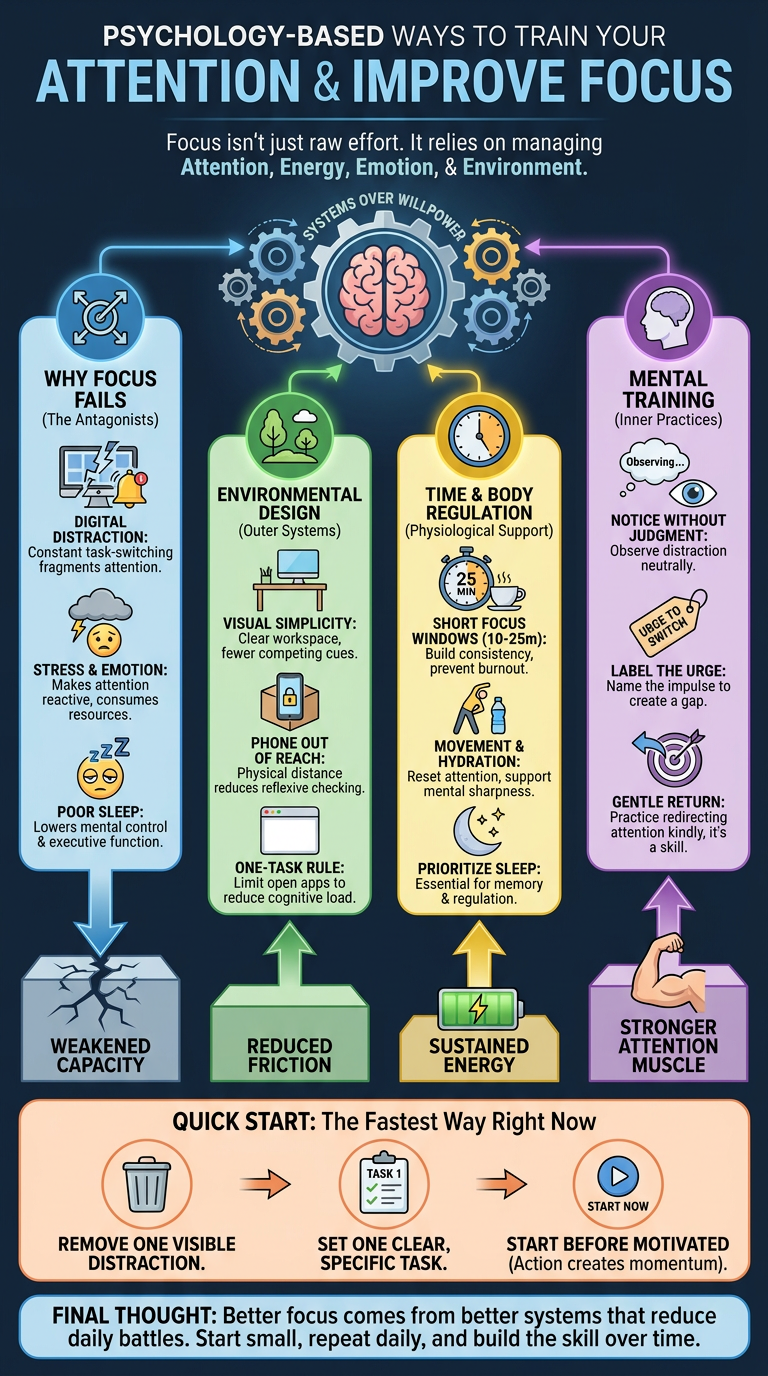
Concentration is a product of interacting systems: cognitive control that directs attention, physiological energy that supports mental effort, emotional state that biases what we notice, and environmental cues that compete for attention. Each of these elements can make focus easier or harder. Psychology resources describe attention as not a single faculty but a set of processes that select, sustain, and switch mental resources as needed; see APA topic overviews for broader context.
Why forcing yourself to focus often backfires
Trying to clamp down on distraction through repeated self-criticism or extended stints of forced concentration can increase stress and mental fatigue. When energy and motivation decline, effortful control becomes harder to sustain. Rather than punishing yourself for lapses, it is more effective to adjust the demands on attention and build systems that reduce unnecessary cognitive load.
Why Your Focus Gets Worse
Constant task-switching trains your brain to seek novelty
Each time you switch between tasks or devices, your brain adapts to frequent novelty and interruption. Over time this pattern can make shifting attention a default habit, which reduces capacity for longer stretches of deep work. Repeated reward from new stimuli reinforces novelty-seeking cognitive patterns and makes sustained attention less automatic. For research-informed perspectives, see Psychological Science.
Stress makes your attention more reactive
Stress changes how attention is allocated. When people feel stressed, attention tends to become more reactive to immediate threats or worries and less able to sustain focus on planned tasks. If stressors are ongoing, this reactive attention pattern can persist and make concentration feel fragile. For reliable information about how stress and mental health affect cognition and daily functioning, see educational material from the National Institute of Mental Health on mental health and related symptoms.
Poor sleep lowers mental control
Sleep supports memory consolidation, emotional regulation, and executive function. When sleep quality or duration is poor, the brain’s capacity for sustained attention and task switching declines. Clinical and consumer health sites summarize how sleep and cognition are linked and offer guidance on improving sleep habits to support daily mental performance. For accessible health information about sleep, cognition, and related symptoms, see MedlinePlus.
Digital distractions weaken deep attention
Notifications, tabs, and constant connectivity provide frequent attentional pulls. Each interruption fragments cognitive work and increases the time required to return to deep focus. Over time, frequent digital interruptions favor shallow attention and make it harder to enter flow states. Practical strategies that reduce the frequency and salience of these digital cues help preserve deeper attention.
Emotional overload makes concentration harder
Strong emotions, unresolved worry, or high levels of reactivity use the same cognitive resources that support deliberate attention. When emotional load is high, executive control is consumed by processing or suppressing feelings, which leaves less capacity for focused task work. Approaches that address emotional load directly or provide short emotion-regulation supports can free up attention for task-focused work.
The Fastest Way to Improve Focus Right Now
Remove one visible distraction
Pick the most obvious visual or audible distraction in your immediate surroundings and remove it. A single, clear change in the environment often yields immediate improvement in ability to sustain attention for the next few minutes.
Set one clear task
Define a single, specific task for the forthcoming work window. Vague goals increase the likelihood of task-switching and reduce the sense of progress. A clear, concrete next step reduces decision friction and helps attention lock onto one outcome.
Use a short focus window
Start with a brief, time-limited focus period such as 10 to 25 minutes. Short windows are easier to sustain and reduce the pressure to be productive for long stretches. The goal is to build consistent practice rather than to exhaust motivation in one session.
Start before you feel motivated
Motivation fluctuates, so begin the focused window even when motivation is low. Initiating action often produces momentum that increases engagement. This approach prioritizes habit and structure over waiting for ideal feelings to arrive.
How to Improve Focus Using Your Environment
Keep your workspace visually simple
A visually cluttered workspace increases competing stimuli and drains attentional resources. Minimize excess objects, papers, and screens in your immediate line of sight so that fewer items compete for visual attention. A simpler visual field reduces the frequency of involuntary shifts in attention.
Put your phone out of reach
Physically distancing your phone reduces the likelihood of reflexive checking. When the phone is out of reach or out of sight, the effort required to access it increases the chance that you will stay focused on the primary task.
Use one-tab or one-task rules
Limit open browser tabs and active applications while you work. Adopting a one-task rule for digital work reduces cognitive overhead and keeps switching costs low. Only reintroduce other tabs during planned breaks or after completing the focused window.
Make the focused action easier than the distracted action
Design tasks and systems so the path of least resistance leads to the focused action. For example, keep reference materials open and a notebook at hand so that the work flow is uninterrupted. Conversely, make distracting activities slightly more effortful by removing quick access or adding small friction points.
How to Improve Focus Using Time Blocks
Start with 10 to 25 minute sessions
Short blocks are concrete, manageable, and repeatable. They reduce the cognitive load required to begin and increase the likelihood of consistent practice. As endurance grows, gradually expand session length based on what feels sustainable.
Use breaks before your attention collapses
Regular, scheduled breaks prevent attention from collapsing into fatigue. Breaks should be long enough to restore a bit of energy but short enough to maintain momentum. Movement, hydration, or a change of scene during breaks can reset attention for the next block.
Match task difficulty with energy level
Plan harder cognitive tasks for periods when your energy and alertness tend to be higher, and reserve lower-demand tasks for times when energy dips. Matching task demands to energy reduces the need for extreme effort to stay focused and improves overall efficiency.
Avoid over-planning your day
Too many scheduled tasks can create decision fatigue and increase pressure, which reduces focus. Aim for a realistic number of meaningful goals each day and make room for unplanned needs. Simpler plans are easier to execute.
How to Improve Focus Through Body Regulation
Sleep quality and focus
Good sleep supports attention, memory consolidation, and emotional regulation. Prioritizing consistent sleep schedules, reducing evening screen exposure, and using sleep-friendly routines can bolster daytime concentration. For trusted, practical information about sleep and mental health, consult consumer health guidance available through MedlinePlus.
Hydration and mental sharpness
Some people notice that dehydration reduces mental clarity and increases distractibility. Maintaining adequate hydration across the day is a simple habit that supports overall physiological functioning and can help attention feel steadier.
Movement and attention reset
Short bouts of physical activity, such as a quick walk or standing and stretching, boost blood flow and can reset attention. Movement during breaks helps break the cycle of mental fatigue and primes the brain for renewed focus when you return to work.
Breathing to reduce mental noise
Simple breathing techniques can reduce the intensity of intrusive thoughts and physiological arousal, making it easier to settle into a task. Practices that emphasize slow, steady breathing support a calmer state of mind, which in turn supports sustained attention. See APA topic pages for related concepts in attention and emotion regulation.
How to Improve Focus Through Mental Training
Notice distraction without judging it
Learning to observe distractions as neutral events reduces the shame and tension that often amplifies attention drift. A gentle, nonjudgmental noticing of distraction makes it easier to move attention back to the task without spiraling into self-criticism.
Label the urge to switch tasks
Naming the impulse to switch tasks or check a device can weaken its pull. A simple internal label such as “checking urge” or “thought to switch” creates a brief psychological gap that supports deliberate choice instead of automatic reaction.
Practice returning attention gently
Return attention to the chosen task without harshness. Repeatedly practicing this gentle redirection is how attentional skills are strengthened. Over time, the brain learns that lapses do not mean failure; they are opportunities to practice refocusing.
Build focus like a skill, not a personality trait
Treating focus as trainable behavior creates room for incremental progress. Consistent, short practice sessions compound into stronger capacity over weeks and months. This perspective reduces pressure and supports gradual improvement through routine.
Common Mistakes That Make Focus Worse
Trying to focus for too long too soon
Starting with unrealistic expectations leads to early burnout and discouragement. Short, consistent sessions are more effective than occasional marathon efforts because they build sustainable habits without overwhelming cognitive resources.
Multitasking and calling it productivity
Multitasking often reduces the quality and speed of work compared with focused single-tasking. What feels like getting many things done at once usually fragments attention and lengthens the time needed to complete each item.
Using motivation as the starting point
Waiting for motivation before beginning a task traps progress behind fluctuating feelings. Systems, routines, and small thresholds for starting are more reliable than relying on momentary motivation.
Ignoring stress, sleep, and emotions
Focusing only on productivity hacks without addressing underlying sleep, stress, or emotional issues limits progress. Attentional capacity is tied to basic needs and emotional balance, so addressing those areas creates a stronger foundation for focused work. For information about how mental health conditions can affect attention and when to seek help, see educational materials from the National Institute of Mental Health.
When Poor Focus May Need Extra Support
If focus problems affect daily life
If difficulty focusing repeatedly interferes with work, school, relationships, or daily responsibilities, it may signal that a deeper assessment or structured support could be helpful. Persistent or worsening focus problems deserve professional attention to identify underlying factors and appropriate strategies.
If distraction comes with anxiety, depression, or ADHD symptoms
When distractibility appears alongside symptoms such as prolonged low mood, excessive worry, sleep disruption, or patterns of inattention and hyperactivity that started in childhood, it is reasonable to consult a qualified professional for evaluation. General information about mental health concerns and next steps is available from MedlinePlus.
When to speak with a qualified professional
Consider seeking professional support if focused strategies bring limited benefit, if symptoms are severe or worsening, or if attention problems are accompanied by functional decline at work or in relationships. A qualified clinician can help determine whether underlying medical, psychological, or environmental factors are contributing and recommend evidence-informed approaches.
Final Thoughts: Better Focus Comes From Better Systems
Focus improves when your brain has fewer battles to fight
Reducing unnecessary decisions, minimizing visible distractions, and attending to sleep, movement, and stress creates an environment where attention can be allocated to meaningful work rather than constant housekeeping. Systems that reduce friction and preserve cognitive energy are the most sustainable path to improved focus.
Start small and repeat the same system daily
Small, repeated practices compound. Begin with one environmental change, one time block, and one body habit that you can sustain. Repetition and consistency build attentional capacity over time, and the experience of small wins helps maintain motivation for ongoing practice.
For a related next step, see this guide to improving mental clarity and focus.
For a related next step, see this guide to improving focus with ADHD.
For a related next step, see this guide to strengthening focus and memory.
For a related next step, see this guide to improving concentration and focus while studying.
If attention problems are persistent, severe, or impacting your daily life, consider reaching out to a qualified mental health or medical professional for assessment and support. Trusted educational sources such as the National Institute of Mental Health and MedlinePlus provide reliable information to help you understand symptoms and next steps. For general psychology concepts about attention and behavior, the APA Dictionary of Psychology and APA topic pages offer accessible definitions and topic overviews. For accessible summaries of behavioral science research that contextualizes attention and distraction, see Psychological Science.
Focus is not a fixed trait. With clearer systems, supportive body routines, and gentle mental practice, most people can improve their ability to concentrate and to get more meaningful work done with less strain.

Michael Reed is the Founder and Lead Writer at Psychology Exposed. He writes about human behavior, relationships, emotional patterns, self-awareness, and practical psychology topics using research-informed, easy-to-understand content.
Read More About Michael Reed: https://psychologyexposed.com/michael-reed/