
Studying well is less about willpower and more about designing study sessions that match how attention, memory, and motivation actually work. This article gives a study-specific focus system built around preparation, active learning, memory support, deliberate breaks, and managing exam pressure. The steps below are practical, research-aware, and written for students, online learners, and exam takers who want to concentrate better while reading, reviewing, or working through practice problems.
Why Studying Feels So Hard to Focus On
Before trying to force longer sessions, it helps to understand common reasons study tasks sap attention. Recognizing these causes makes it easier to choose targeted strategies.
Studying often has delayed rewards
Learning is an investment with delayed payoff. Reading, note-taking, or solving practice problems produce benefits that often show up only later on tests, projects, or cumulative understanding. Because the reward is delayed, the brain may give preference to immediately gratifying activities. Structuring study sessions to include small, immediate markers of progress helps keep attention engaged.
Difficult material creates avoidance
Challenging or unfamiliar topics trigger avoidance responses that reduce discomfort. When material feels too hard, students naturally shift toward easier, more pleasant tasks. A useful approach is to lower the initial entry barrier so the first step feels achievable, then build momentum toward harder work.
Phones and tabs interrupt working memory
Short interruptions from notifications, social media, or extra browser tabs interfere with the limited capacity of working memory, which holds information briefly while you manipulate it. When attention shifts, it can take time to rebuild the mental context you had before the interruption. Minimizing external interruptions and reducing competing on-screen content helps protect working memory resources and reduce lost time. For definitions of cognitive terms like working memory, see the American Psychological Association dictionary for descriptions from the APA Dictionary of Psychology.
Stress makes studying feel threatening
Stress and test anxiety can change how the brain responds to study tasks, often increasing avoidance and narrowing attention to worry-related thoughts instead of the material. When stress is high, the experience of studying can feel more like a threat than a learning opportunity. If anxiety about school or exams is persistent or interferes with daily life, seek guidance from a qualified professional. For accessible information about how stress and mental health can affect daily functioning, the National Institute of Mental Health provides educational material on mental health: NIMH Mental Health Information.
Prepare Your Study Environment Before You Start
Preparation reduces the friction that makes it tempting to switch away from study. Set up the environment so starting takes minimal effort and interruptions are minimized.
Clear the desk
Remove unrelated clutter from your study surface. A tidy workspace reduces visual distractions and makes it easier to focus on the materials that matter. Keep only the books, notes, and tools you will use during the planned session.
Put your phone away
Out of sight helps keep notifications out of mind. If you need your device for study tasks, use tools such as focus mode, airplane mode, or separate study profiles to block social apps. For many students, placing the phone in another room or in a closed drawer is the most reliable way to prevent accidental checking.
Open only the materials you need
Limit the number of tabs, windows, or documents you open. Each extra source competes for your attention and increases the chance of wandering. Prepare a single, linear set of resources for the session: the chapter, lecture slides, or problem set you plan to work on.
Choose one subject or topic per session
Studying multiple subjects at once increases context switching and reduces deep focus. Decide on one subject, topic, or specific learning objective per session and stick to it. This narrow focus helps the brain build coherent memory traces and reduces cognitive load.
Set a Clear Study Goal
Vague goals lead to vague effort. Clear, measurable goals create immediate feedback and make it easier to choose appropriate study methods and block lengths.
Replace “study biology” with a specific task
Rather than telling yourself you will “study biology,” specify the task. For example: “Explain the steps of cellular respiration from memory,” or “Complete 20 practice problems on Hardy-Weinberg equilibrium.” Specific goals make it easier to notice progress and to stop when the goal is achieved.
Define the chapter, concept, or question
Identify the exact scope of the session. Name the chapter, list the concepts, or write the specific questions you will address. This reduces decision fatigue and keeps you on track during moments when attention drifts.
Decide how you will test yourself
Choose a method to check whether you learned the material: a set of flashcards, a self-quiz, practice problems, or teaching the concept out loud. Planning the retrieval test in advance helps you select the right study tactics and ensures the session ends with an active check of understanding.
Use Active Study Methods
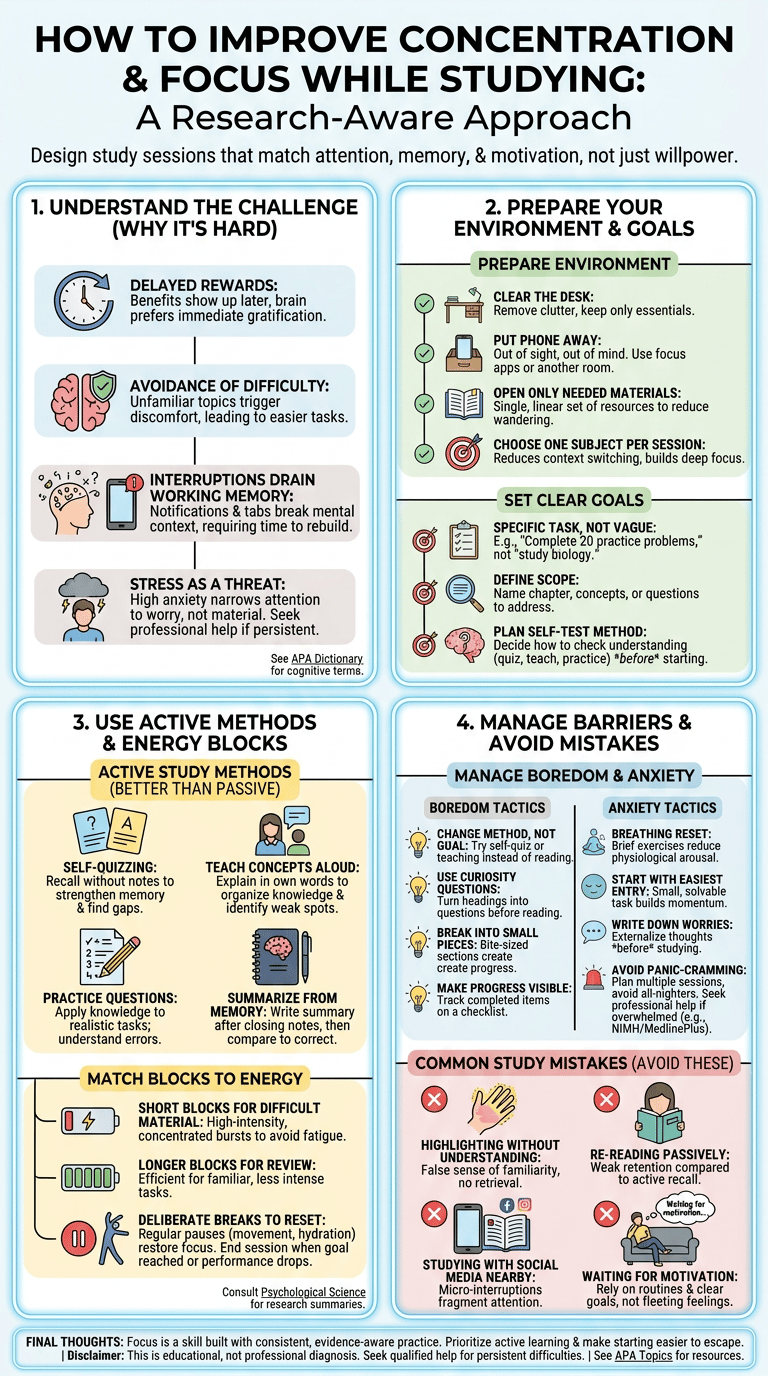
Active learning techniques engage retrieval and effortful processing, which support deeper understanding and longer retention than passive review. Research in psychology and educational science finds that active strategies produce more reliable learning outcomes. For accessible summaries of research on effective learning techniques, consult resources from behavioral science outlets such as Psychological Science.
Self-quizzing
Retrieval practice, or self-quizzing, means trying to recall information without looking at notes. This method strengthens memory and helps reveal gaps in understanding. Create short quizzes for yourself and answer them under test-like conditions to boost retention.
Teaching the concept in your own words
Explaining ideas aloud as if teaching someone else forces you to organize knowledge and identify weak spots. You can do this to an imaginary student, a study partner, or by recording yourself. Teaching translates passive familiarity into active mastery.
Practice questions
Working through practice problems applies knowledge to realistic tasks, which improves transfer to exam situations. When possible, use problems that resemble the format of your test and review answers carefully to understand errors.
Summarizing without looking
After a reading or lecture, close your notes and write a summary from memory. This method combines retrieval practice with organization. Compare your summary to the original material afterward to correct omissions and reinforce accurate details.
Use Study Blocks That Match Your Energy
Attention capacity varies across people and across the day. Align block length and intensity with your current energy level to maximize productive focus without burning out.
Short blocks for difficult material
Difficult or highly demanding topics are easier to tackle in short, concentrated bursts. Short blocks reduce cognitive fatigue and make it easier to maintain high-quality focus on complex problem solving or dense theory.
Longer blocks for review sessions
When reviewing familiar material that requires less intense cognitive effort, longer blocks can be efficient. Use these sessions to aggregate practice tests, synthesize multiple topics, or complete cumulative review tasks that benefit from sustained continuity.
Breaks that reset attention
Regular breaks prevent attention from declining with prolonged effort. Short pauses that include movement, hydration, or a brief change of scenery help restore focus for the next block. The exact interval can vary by person; the key is to use breaks deliberately and return promptly to the planned task.
When to stop a study session
End a session when you reach your goal, when your performance declines noticeably, or when mental fatigue makes effortful learning ineffective. Finishing with a quick self-test or a one-sentence summary indicates whether the session achieved its purpose and makes it easier to resume later.
Improve Focus When You Feel Bored
Boredom during study is common. Instead of waiting for motivation, change how you engage with the material to create novelty and challenge.
Change the study method, not the goal
If boredom sets in, try a different active method while keeping the same learning objective. Swap passive reading for a self-quiz, convert notes into flashcards, or attempt to teach the concept aloud. Different methods renew attention while preserving progress toward the goal.
Use questions to create curiosity
Turn headings or sections into specific questions before you read. Approaching a text with questions primes curiosity and gives your attention a target. Curiosity-driven study helps maintain engagement with materials that would otherwise feel dull.
Break the material into smaller pieces
Large chunks of content can feel overwhelming and reduce motivation. Divide material into bite-sized sections that can be completed in one short block. Each small completion generates a sense of progress that counters boredom.
Make progress visible
Track completed sections, solved problems, or answered quiz questions on a visible checklist. Seeing concrete progress reinforces motivation and reduces the drift toward distractions.
Improve Focus When You Feel Anxious
Anxiety can pull attention toward worry and away from learning. The strategies below target common anxiety patterns and provide gentle ways to restore study focus.
Use a breathing reset
Brief breathing exercises can reduce physiological arousal and help attention return to the task. Simple inhalation-exhalation cycles or a short three-minute breathing pause provides a reset before you begin or before a difficult section.
Start with the easiest entry point
Begin a session with a small, solvable task related to the material. Success on an easy item often reduces avoidance and builds momentum for more challenging work. This stepwise approach lowers the initial anxiety barrier.
Write down worries before studying
Spend a few minutes listing current worries or tasks on paper before you begin. This externalizes intrusive thoughts and can reduce the tendency for them to surface during study. After writing, choose a single focused goal for the session and return to it.
Avoid panic-studying for long hours
Long, last-minute cramming increases stress and reduces the efficiency of learning. Break exam preparation into multiple planned sessions with active review to improve retention and reduce the temptation to pull all-nighters. If anxiety becomes overwhelming or persistent, consider consulting a counselor or health professional for strategies tailored to your situation; official mental health resources such as MedlinePlus offer information on coping and when to seek support.
Common Study Focus Mistakes
Avoiding common mistakes saves time and prevents unproductive habits from taking hold. Below are frequent pitfalls and why they reduce learning efficiency.
Highlighting without understanding
Relying on highlighting alone often gives a false sense of familiarity. Highlighting marks content but does not require retrieval or processing. Use highlighting sparingly as a pre-step, then convert highlights into active study items like flashcards or practice questions.
Re-reading passively
Repeatedly re-reading text feels productive but produces weak retention compared to active methods. Replace passive re-reading with retrieval practice, summarization from memory, or teaching the ideas aloud.
Studying with social media nearby
Having social media or chat apps open creates frequent micro-interruptions and increases the chance of prolonged breaks. These interruptions fragment attention and reduce the quality of study time. Closing or blocking distracting apps during study blocks preserves concentration and memory performance.
Waiting until motivation appears
Waiting for motivation often becomes a barrier to consistent study. Motivation fluctuates naturally, so rely instead on routines, environmental preparation, and clear goals to make starting easier. Small, planned steps reduce the need to rely on feeling motivated in the moment.
Final Thoughts
Improving study focus is a skill that grows with consistent, evidence-aware practice. The system here centers on preparing the environment, setting specific goals, using active study methods, matching block length to task difficulty, and applying simple strategies for boredom and anxiety. These steps aim to make studying easier to start and harder to abandon.
Better study focus comes from active learning
Active strategies that require retrieval, explanation, or problem solving reliably support deeper learning than passive review. Integrating self-quizzing, teaching, and practice tasks into regular study produces clearer evidence of progress and makes study time more efficient. For summaries of psychological research on learning strategies and cognition, consult resources that synthesize behavioral science findings from Psychological Science.
Make studying easier to start and harder to escape
Design small start-up rituals, eliminate easy distractions, and end sessions with a clear self-test. These structural steps reduce reliance on fluctuating motivation and create a steady path toward better concentration. If focus problems are persistent, severe, or increasingly interfere with school, work, or daily life, consider reaching out to a qualified professional for an evaluation and support. The American Psychological Association provides broad overviews of psychological topics that can help you find relevant resources: APA Topics.
This article is educational and not a substitute for professional diagnosis or treatment. If you experience severe difficulty concentrating that affects your functioning, seek help from a qualified health professional.

Michael Reed is the Founder and Lead Writer at Psychology Exposed. He writes about human behavior, relationships, emotional patterns, self-awareness, and practical psychology topics using research-informed, easy-to-understand content.
Read More About Michael Reed: https://psychologyexposed.com/michael-reed/