
Quick answer: how to stop thinking so negatively
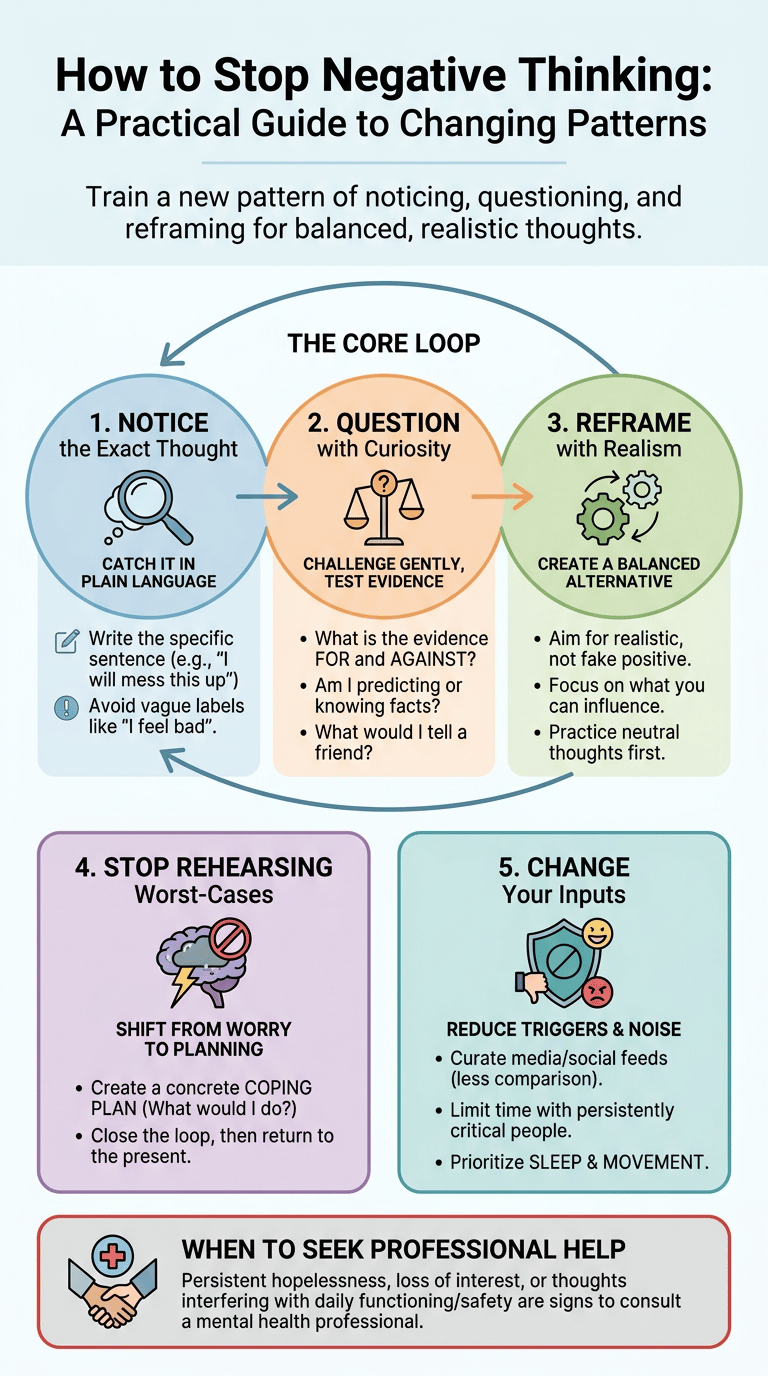
If your mind tends toward self-critical, pessimistic, or catastrophic thinking, a practical approach is to train a different pattern of noticing, questioning, and reframing thoughts so they become balanced rather than automatic. Start by noticing the exact negative sentence, question it with curiosity, test the evidence, and replace it with a realistic alternative you could accept. These steps are adapted from cognitive behavioral approaches that focus on changing thinking habits while also addressing emotional and behavioral triggers. For concise definitions of psychological terms used here, see the APA Dictionary of Psychology for background information on cognitive terms and distortions from the American Psychological Association.
Notice the pattern and begin practice
Notice the negative pattern
Begin by catching the thought in the moment. Name the exact sentence your mind is saying instead of summarizing it as a vague feeling. Noticing is the first practical step toward changing an automatic pattern.
For a related next step, see this guide to how to stop thinking too much.
Question the thought, not yourself
When you catch a negative thought, treat it like an assumption to evaluate rather than a fixed fact about who you are. Gentle, evidence-based questioning reduces self-judgment and opens space for alternatives.
Look for a balanced interpretation
Your goal is to form a balanced interpretation that fits the evidence and leaves room for uncertainty, rather than pushing for unrealistically positive thinking. Balanced statements are realistic, fair, and actionable.
Reduce emotional triggers
Identify inputs and situations that reliably activate negative thinking cycles and make practical changes where you can, such as limiting comparison-driven content, improving sleep, or pausing contact with persistently critical people.
Practice evidence-based reframing
Use short, realistic reframes based on evidence and coping actions. With time, practicing these alternatives trains the brain to default to more balanced interpretations.
What negative thinking really is
Negative thoughts vs realistic concerns
Negative thinking commonly refers to repeated, automatic thoughts that tilt toward worst-case interpretations or excessive self-criticism. That is different from a realistic concern, which is grounded in evidence and leads to practical planning. Distinguishing between the two helps you decide whether to act, plan, or reframe.
Why the brain notices threats first
Human attention evolved to prioritize potential threats because spotting danger had survival value. That means the mind is biased to notice negative possibilities more readily than neutral or positive ones. Research in psychology describes this tendency as a form of negativity bias and explains why negative information often feels more salient than positive information according to psychological science overviews.
How negative thinking becomes automatic
Repeated patterns of thinking tend to form habits. When a particular thought pattern is practiced often, it can fire automatically in new situations. Cognitive approaches emphasize breaking and replacing those habitual links with new patterns that are more helpful.
Why “just be positive” usually does not work
Forcing positivity often ignores the function of emotions and can feel unhelpful when positive statements feel untrue. A more effective route is to aim for balanced thinking that acknowledges genuine difficulties while also identifying realistic evidence and possible actions.
Common types of negative thoughts
Catastrophizing
Catastrophizing is when the mind jumps to the worst possible outcome and treats it as likely or inevitable. It ramps up anxiety and can block calm problem solving. The APA Dictionary provides useful descriptions of cognitive distortion terms that fit patterns like catastrophizing in the APA Dictionary of Psychology.
Mind reading
Mind reading assumes you know what others think about you without clear evidence. It often leads to avoidance, over-apologizing, or social withdrawal.
All-or-nothing thinking
All-or-nothing thinking sees situations in black-or-white terms, with no middle ground. When you slip once, you feel like a total failure, rather than recognizing gradations and progress.
Overgeneralizing
Overgeneralizing takes one negative event and extends it to a broad conclusion about yourself or the future. For example, one mistake becomes proof you will always fail.
Personalizing
Personalizing assigns undue personal responsibility for events outside your control. It inflates guilt and self-blame.
Discounting the positive
Discounting the positive minimizes accomplishments and positive evidence, so wins feel unimportant or undeserved.
Emotional reasoning
Emotional reasoning treats feelings as if they are reliable proof. Feeling incapable becomes evidence you are incapable. Recognizing this tendency helps separate emotion from fact.
Why you keep thinking negatively
Past criticism
Early or repeated criticism can leave a lasting inner voice that interprets ambiguous events as self-threats. That internalized voice nudges attention toward negative interpretations.
Fear of disappointment
Expecting disappointment can feel like a protective strategy, but it also sustains pessimistic predictions that become self-fulfilling by reducing effort or openness to opportunities.
Low self-trust
When you doubt your ability to cope, the mind prefers prediction over testing. Low self-trust makes pessimistic forecasts feel safer than trying and risking failure.
Chronic stress
Prolonged stress narrows attention and increases the salience of negative cues, making negative thinking more frequent and harder to shift. For general information on how stress and mental health interact, see mental health resources aimed at consumers at MedlinePlus.
Social comparison
Comparing ourselves to others, especially online, fuels beliefs that we fall short. Reducing comparison helps lower the background noise that feeds negative thinking.
Emotional exhaustion
Tiredness and emotional depletion reduce cognitive flexibility, making it harder to challenge automatic negative thoughts and practice alternative interpretations.
Step 1: catch the thought in plain language
Write the exact sentence in your mind
Put the thought into a single sentence as if you were quoting yourself. Instead of “I feel worthless,” write “I will mess this up and everyone will think I am incompetent.” Exact wording reveals assumptions you can test.
Avoid vague labels like “I feel bad”
Vague labels hide the specifics that allow change. Replace “I feel bad” with precise observations: what situation triggered it, what the thought said, and what sensation or image followed.
Identify the hidden fear
Negative thoughts often mask a core worry such as “I will be rejected” or “I cannot handle failure.” Naming this hidden fear makes it easier to address directly.
Notice repeated themes
Collect recurring thoughts in a journal. Patterns reveal core beliefs and common triggers you can target with specific strategies.
Step 2: challenge the thought gently
What evidence supports this?
List facts that support the thought. Often the evidence is limited or based on selective memory. Separating facts from interpretation helps you see whether the thought is proportionate.
What evidence does not support this?
Actively seek disconfirming data you might be overlooking. Counter-evidence balances the scale and often reveals a more nuanced reality.
Am I predicting or knowing?
Ask whether you are describing current reality or predicting a future outcome without proof. Predictions can be useful when they lead to planning, but they are not facts.
What would I tell a friend?
Imagine a friend said the same thing. Many people are kinder and more balanced with others than themselves. Use that compassionate, realistic voice for your own thoughts.
What is a more balanced version?
Create a short alternative statement that is true, fair, and less extreme. For example, turn “I will fail for sure” into “I might struggle, and I can prepare or ask for help if I need it.”
Step 3: replace negative thinking with balanced thinking
Balanced thinking is not fake positivity
Balanced thinking acknowledges difficulty while also recognizing evidence and options. It reduces distress without denying reality.
Use realistic statements
Replace absolutes with conditional or possibility phrases. Examples include “There is a chance this will go well” or “I can handle the next step even if I am unsure about the whole process.”
Focus on what you can influence
Shift energy from trying to control outcomes you cannot to actions within your control. Planning practical steps reduces helplessness and interrupts catastrophic loops.
Practice neutral thoughts before positive ones
A neutral, fact-based thought is often easier and more believable than a strongly positive claim. Start with neutral reappraisals, then broaden to constructive or hopeful statements when they feel credible.
Step 4: stop rehearsing worst-case scenarios
Why the brain rehearses danger
The mind rehearses threats to prepare for them. Rehearsal can be useful when it leads to planning, but repetitive mental simulation of catastrophe mostly raises anxiety without improving outcomes.
How to create a coping plan instead
When a worst-case scenario arises in thought, switch to drafting a clear, short coping plan: what you would do first, who you might contact, and what small steps would help. Converting worry into a plan reduces helplessness.
Ask: if this happens, what would I do?
Answer specifically. Concrete steps reduce the urge to endlessly rehearse hypothetical disasters and make you feel more prepared.
Close the loop after planning
Once you have a plan, mentally close the topic and return to the present task. You can set aside a short, scheduled time for planning if the worry persists, which reduces intrusive rehearsal throughout the day.
Step 5: change the inputs feeding your mind
Reduce comparison content
Curate your media and social feeds to reduce exposure to idealized, achievement-focused content that fuels negative comparisons. Small changes in daily inputs can shift baseline thinking over time.
Spend less time with negative people
Repeated exposure to chronically negative individuals can reinforce your own pessimistic thinking. Where possible, limit time in those dynamics and seek relationships that encourage problem solving and perspective.
Protect your morning thoughts
Mornings often set the tone for the day. Avoid immediately scrolling feeds or checking negative news. Start with a brief grounding routine that supports clarity, such as a short walk or a simple breathing exercise.
Get enough sleep
Sleep supports cognitive flexibility and emotion regulation, which makes it easier to challenge and reframe negative thoughts. For reliable consumer information about sleep and mental health, see the NIMH mental health information pages from the National Institute of Mental Health.
Move your body
Physical activity can help reduce the intensity of negative mood and support cognitive resources for reframing. For consumer-focused information on exercise and mental health, see MedlinePlus mental health resources.
What not to do with negative thoughts
Do not shame yourself for having them
Negative thoughts are common and often adaptive in small doses. Shaming yourself for thinking negatively only adds a second layer of distress and makes change harder.
Do not force positivity
Forcing unrealistic optimism can increase resistance. Instead, aim for accurate and useful thinking that allows action and reduces distress.
Do not believe every emotion as fact
A strong feeling is not always evidence of truth. Feelings are signals that invite curiosity and inquiry rather than immediate acceptance as factual statements.
Do not isolate when your thoughts get darker
Withdrawing from others can worsen negative thinking. Reach out to a trusted person or professional support if thoughts intensify or become overwhelming.
When negative thinking may signal a bigger issue
Persistent hopelessness
If negative thoughts are accompanied by a pervasive sense of hopelessness that lasts for weeks and does not respond to self-help attempts, it may indicate a larger mood concern. In those situations, discussing options with a qualified mental health professional is a reasonable next step. The NIMH offers consumer-oriented information about mood problems and treatment approaches on their mental health pages.
Loss of interest
If you notice a sustained loss of interest or pleasure in activities you once enjoyed, that change can be a signal to seek a professional evaluation, as it may reflect a treatable condition.
Strong self-criticism
Intense, chronic self-criticism that interferes with work, relationships, or daily functioning is a sign to reach out for support. Therapies that address cognitive patterns can help people learn more balanced ways of thinking.
Thoughts that interfere with daily life
When negative thinking leads to avoidance, cancelled plans, persistent sleep problems, or difficulty concentrating, it is worth consulting a clinician to explore structured approaches for change. For accessible overviews of mental health topics and treatment options, see trusted psychology resources such as the American Psychological Association topics pages on psychology topics.
When to seek professional help
If your negative thoughts are severe, persistent, or include thoughts of harming yourself, seek immediate help through local emergency services or crisis resources and contact crisis services as needed. For consumer mental health information and guidance about care options, see MedlinePlus mental health pages and the NIMH mental health information.
Frequently asked questions
Why do I always think negatively?
Always thinking negatively often reflects a mix of learned habits, protective expectations, stress, and attentional biases that favor threat. The mind’s tendency to notice negative possibilities is common and has roots in how attention evolved. Practice and structured cognitive techniques can reduce the frequency and intensity of these patterns.
How do I stop negative thoughts immediately?
While you may not erase a negative thought instantly, you can interrupt it. Techniques that help in the moment include grounding exercises, naming the thought out loud, asking a quick evidence question, doing a brief physical movement, or switching attention to a present-moment sensory detail. These tactics do not make thoughts vanish, but they reduce immediate reactivity and create space for a more balanced response.
Is negative thinking a sign of anxiety?
Negative thinking is commonly associated with anxiety and related conditions, but it is not always a sign of a disorder. Many people experience increased negative thoughts during periods of stress. If negative thinking is accompanied by persistent worry, avoidance, physical symptoms, or impairment in daily life, a professional evaluation can clarify whether anxiety or another condition is present. The National Institute of Mental Health provides consumer information about anxiety and related symptoms on their mental health pages.
Can CBT help negative thinking?
Structured cognitive behavioral techniques are designed to identify, challenge, and change unhelpful thinking patterns. CBT provides practical tools such as thought records, behavioral experiments, and graded exposure that target cognitive patterns directly. For an overview of psychological approaches and evidence-based therapies, consult reputable psychology topic summaries from the American Psychological Association.
How do I train my brain to think differently?
Training the brain involves consistent practice: repeatedly noticing the thought, questioning its evidence, creating balanced alternatives, and reinforcing new responses through behavior. Small daily habits like brief journaling, scheduled worry time, or practicing neutral reappraisals build the cognitive skills that support more balanced thinking over time.
Closing practical checklist
- Catch the exact thought and write it down.
- Ask gentle evidence questions: what supports this thought and what does not?
- Create a short, realistic reframe that feels believable.
- Make a simple action plan if there is a real risk; otherwise, schedule a brief time to revisit the concern and move on.
- Adjust daily inputs: sleep, movement, morning routine, and media consumption.
- Seek professional support if thoughts are severe, persistent, or interfere with functioning.
Negative thinking is common and changeable. By combining careful noticing, compassionate questioning, realistic reframing, and practical behavior changes, you can reduce the power of automatic pessimistic thoughts and build a more balanced, flexible inner voice. If you want to read more about cognitive terms and therapeutic approaches, the APA Dictionary and psychology topic pages offer useful background material at the APA Dictionary and on APA topics pages, while broader mental health information is available from trusted health resources such as MedlinePlus and the National Institute of Mental Health. For summaries of current psychological science on attention and negativity bias, see accessible coverage at Psychological Science.
If negative thoughts keep repeating in loops, this guide on overthinking so much explains how to interrupt the habit cycle.

Michael Reed is the Founder and Lead Writer at Psychology Exposed. He writes about human behavior, relationships, emotional patterns, self-awareness, and practical psychology topics using research-informed, easy-to-understand content.
Read More About Michael Reed: https://psychologyexposed.com/michael-reed/