
Quick answer
If your mind races at bedtime, focus on simple steps that shift your role from solver to witness. Get thoughts out of your head, follow a calm bedtime routine, stop problem-solving in bed, relax the body first, and make a brief plan for tomorrow. These steps reduce mental activation and send clearer sleep signals to the brain.

Get thoughts out of your head before bed
Write a short brain dump
Write a brief brain dump each night to move ideas from working memory to paper. Capturing tasks, worries, and ideas offloads cognitive load so your mind is less likely to rehearse them at night.
Use a calming bedtime routine
Consistent routines cue your brain that the day is ending. A sequence of low-stimulation activities, such as dimming lights, reading soothing material, and gentle stretching, helps the nervous system downshift before lying down.
Stop problem-solving in bed
Bedtime is for rest, not planning or fixing problems. Move active thinking and decision-making to an earlier part of the evening so that bed becomes associated with sleep instead of action.
For a broader framework beyond bedtime, read the main guide on how to stop thinking too much.
Relax the body first
Calming the body through breathing, progressive muscle relaxation, or a warm shower often reduces the intensity of nighttime thoughts. When the body becomes quieter, the mind frequently follows.
Create a plan for tomorrow
Before getting into bed, decide on one specific first step for your most pressing task. Knowing what you will do next reduces uncertainty that often fuels bedtime rumination.
Why your brain thinks more at night
The day gets quiet and thoughts get louder
Nighttime removes many daytime distractions. When sensory input decreases, internal thoughts become more prominent and can feel amplified.
Unfinished problems seek closure
Unresolved or ambiguous problems can keep cognitive loops active. Without scheduled time to address them, the mind may loop through possible solutions at night in an attempt to reach closure.
Anxiety can rise when distractions disappear
For many people, general anxiety becomes more noticeable when external activity declines. For information about anxiety and how it affects daily life, see the NIMH mental health information pages.
The brain may use quiet time for planning
The brain sometimes uses low-activity periods to consolidate information and rehearse possibilities. That same mechanism can look like planning or problem-solving when it occurs at an inconvenient time, such as before sleep.
Tired brains regulate emotions less well
Fatigue can reduce emotional regulation and increase negative thinking. When tired, the brain may default to worry or repetitive thinking because inhibitory control is lower. For general guidance on stress, coping, and cognitive patterns, see APA Topics: APA Topics.
Night overthinking versus insomnia
When occasional thinking is normal
Brief spikes of thought when first lying down or after waking are common and not necessarily a sign of a sleep disorder. Many people experience transient rumination during life transitions, deadlines, or stress.
When it becomes a pattern
Night overthinking becomes problematic when it regularly delays sleep, shortens sleep time, or causes repeated awakenings. Persistent difficulty falling or staying asleep that affects daytime functioning may meet clinical criteria for insomnia and should be evaluated by a qualified clinician. For more information, see the NIMH mental health information pages.
How sleep anxiety develops
Worry about sleep itself can become a self-reinforcing loop. Anticipating poor sleep increases arousal and makes sleep harder, which then confirms the worry. Breaking this cycle involves reducing performance pressure and teaching the brain that rest is possible even when sleep is imperfect.
Why worrying about sleep makes sleep harder
Focusing on the outcome of sleep creates pressure and hypervigilance. This increases physiological and cognitive activation, both of which are incompatible with the neurophysiological state needed for sleep.
Common thoughts that keep people awake
Tomorrow’s responsibilities
Thinking through next-day tasks, schedules, or to-do lists can trigger a cascade of planning thoughts that push sleep later.
Past conversations
Replaying recent interactions or rehearsing what could have been said is a frequent source of nighttime rumination.
Relationship worries
Concerns about closeness, conflict, or perceived slights often resurface at night when there is more internal attention on emotions and attachment.
Health fears
Worry about symptoms or future health can intensify in quiet moments and lead to cycles of checking and imagining worst-case scenarios.
Money stress
Financial concerns are a common and persistent source of worry that the mind can repeatedly revisit at night.
Existential thoughts
Questions about purpose, mortality, or life direction often arise when the mind has space to roam and can be especially activating at bedtime.
Random rapid thoughts
Some nights thoughts are simply fast and disorganized. Rapid thought streams can feel alarming but often reflect a state of heightened arousal rather than a meaningful problem that must be solved immediately.
Step 1: Do a pre-bed brain dump
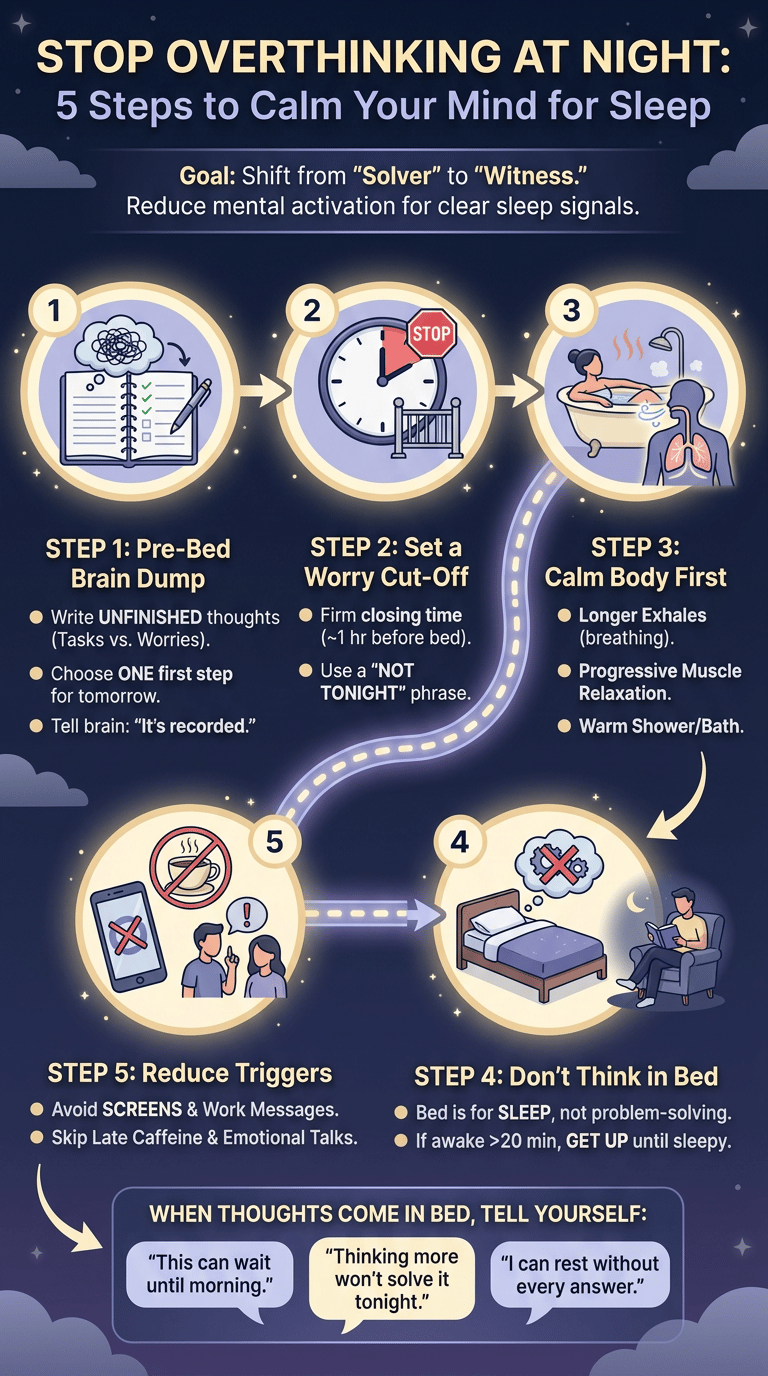
Write every unfinished thought
Set aside a short period before your wind-down to write anything unfinished on your mind. Use a simple pad or a notes app that you will not check later in bed. The goal is brevity and completeness, not polish.
Separate worries from tasks
Distinguish between items that need a next action and items that are worries without a clear solution. Tasks belong on a to-do list; worries may need a coping strategy or later problem-solving time.
Choose tomorrow’s first action
For the most important task, identify a specific, small first step you will take in the morning. This reduces uncertainty and decreases the tendency to loop through multiple possible actions at night.
Tell your brain the issue has been recorded
Before moving on, read back a short note such as, “I have written this down and will address it tomorrow at X.” That explicit mental message helps the brain accept the plan and disengage.
Step 2: Create a worry cut-off time
Why late-night problem-solving backfires
Engaging in active problem-solving late at night increases cognitive arousal and shifts your state away from relaxation. Decisions made when tired are also more error-prone, so postponing planning often improves outcomes.
Set a mental closing time
Choose a firm time to stop planning or reviewing problems, such as about an hour before bed. Use a ritual phrase or short activity that signals the end of business for the day.
Move planning earlier in the evening
Allocate an earlier planning window after dinner to handle chores, emails, or decisions. If new thoughts arise after your cut-off, jot them down and deliberately set them aside.
Use a “not tonight” phrase
Develop a gentle internal cue such as “Not tonight” or “I’ll decide in the morning” to redirect intrusive planning. Repeating a short phrase can interrupt the thought loop without harsh self-judgment.
Step 3: Calm your body before your mind
Longer exhales
Slow, extended exhalations activate the parasympathetic system and promote relaxation. Try slower breathing with exhalations that are longer than inhalations until your breathing feels smoother.
Progressive muscle relaxation
Progressive muscle relaxation systematically tenses and then relaxes muscle groups, helping you notice and release physical tension that sustains anxious thoughts.
Body scan
A guided body scan shifts attention through the body with a nonjudgmental attitude, reducing the mind’s need to stay active and improving interoceptive awareness.
Warm shower
A warm shower or bath before bed can produce a mild drop in body temperature afterward, which supports sleep onset. The comforting routine also creates a sensory boundary between day and night.
Low-stimulation environment
Dim lights, comfortable bedding, cool room temperature, and minimal noise all help the nervous system downshift. Avoid bright screens and stimulating tasks during your wind-down hour.
Step 4: Stop using your bed as a thinking place
Bed should cue sleep, not rumination
Reserve the bed primarily for sleep and intimacy. When bed becomes a place for problem-solving or replaying the day, it weakens the association the brain uses to initiate rest.
What to do if you cannot sleep
If you cannot fall asleep within about 20–30 minutes, get out of bed and do a quiet, low-stimulation activity elsewhere until you feel sleepy again. This practice prevents the bed from becoming associated with wakefulness. For general patient-focused guidance, see MedlinePlus.
Why forcing sleep increases pressure
Trying harder to sleep tends to increase cognitive and physiological arousal, making sleep more elusive. Accepting temporary wakefulness and practicing relaxation usually reduces the pressure and can lead to sleep sooner.
How to return to bed calmly
When you feel sleepy, return to bed with a short ritual such as a calming breath or a reminder that you can rest even if sleep is slow to arrive. Gentle acceptance reduces performance anxiety about sleeping.
Step 5: Reduce nighttime triggers
Phone scrolling
Social media and news increase cognitive and emotional arousal. Stop screen use at least an hour before bed or use night settings to reduce blue light and stimulating content.
Emotional conversations late at night
Important or charged conversations are better handled earlier in the day. Late-night emotional exchanges can leave both parties more aroused and make it harder to settle down for sleep.
Caffeine too late
Caffeine’s effects can last for several hours for many people. Avoiding caffeine in the afternoon and evening can reduce nighttime arousal and lower the chance of racing thoughts.
Work messages before bed
Checking work messages or emails close to bedtime shifts you into problem-solving mode. Set boundaries around work communication in the evening to protect your wind-down time.
Bright light and overstimulation
Even non-screen light can suppress sleep-promoting signals. Dim the environment and choose calm sensory input as you prepare for bed.
What to say to yourself when thoughts come at night
This can wait until morning
Reminding yourself that most problems can be addressed after rest helps reduce urgency and allows the mind to shift from active solving to temporary postponement.
Thinking more will not solve this tonight
Repeating a reality-based statement that mental effort tonight is unlikely to produce a useful solution helps decrease perseveration.
I can rest without having every answer
Normalizing rest as valuable in its own right can reduce the pressure to achieve immediate clarity or fixes during the night.
My brain is tired, not broken
Compassionate self-talk reframes runaway thinking as a sign of fatigue or stress rather than a personal failing.
When night overthinking needs support
When it happens most nights
If overthinking occurs most nights and you rarely fall asleep within a reasonable time, consider consulting a health professional who can assess sleep and mental health patterns.
When sleep loss affects daytime life
Persistent sleep difficulties that impair concentration, mood, or daily functioning may benefit from evidence-based treatments available through qualified clinicians. For general information on mental health and when to seek care, see MedlinePlus.
When anxiety feels uncontrollable
If anxiety feels overwhelming or you have panic-like symptoms, a clinician can help develop a tailored plan. Licensed mental health providers can offer assessment and treatments appropriate to your situation.
When intrusive thoughts feel distressing
Intrusive or unwanted thoughts that are disturbing or lead to compulsive behaviors should be discussed with a mental health professional to determine the best approach.
If thoughts of harming yourself or others occur, seek immediate emergency or crisis services in your area.
FAQs about thinking too much at night
How do I stop thinking so I can sleep?
Use a short, consistent pre-sleep routine that includes a brain dump, a worry cut-off time, and body relaxation. If unwanted thoughts persist, return to a brief writing exercise or a grounding technique rather than pushing yourself to solve everything in bed.
Why do I overthink before bed?
Bedtime removes daytime distractions and reduces external input. The brain may focus inward, replay problems, or attempt to plan. Fatigue and emotional arousal also reduce regulatory control, making rumination more likely.
How do I stop racing thoughts at night?
Try breathing exercises that emphasize longer exhales, progressive muscle relaxation, and a pre-sleep brain dump. If racing thoughts continue, use the strategy of getting out of bed for a short period and returning when sleepy to avoid strengthening the bed-thought association.
Is overthinking at night anxiety?
Nighttime overthinking is often linked to worry and anxiety, but occasional rumination is common. When it is frequent, severe, or causes significant sleep disruption or daytime impairment, it may reflect an anxiety-related problem that a clinician can evaluate.
What should I do if I wake up thinking too much?
Use a low-arousal strategy such as a brief body scan, slow breathing, or writing down the thought if it feels urgent. Avoid checking devices or engaging in stimulating activities. If you wake repeatedly and cannot return to sleep, consider consulting a healthcare provider for guidance.
Remember that many people experience nighttime thinking and that practical strategies can reduce its frequency and intensity. If sleep problems are persistent or significantly affecting your life, consider reaching out to a qualified health professional for assessment and support.

Michael Reed is the Founder and Lead Writer at Psychology Exposed. He writes about human behavior, relationships, emotional patterns, self-awareness, and practical psychology topics using research-informed, easy-to-understand content.
Read More About Michael Reed: https://psychologyexposed.com/michael-reed/