
Quick answer
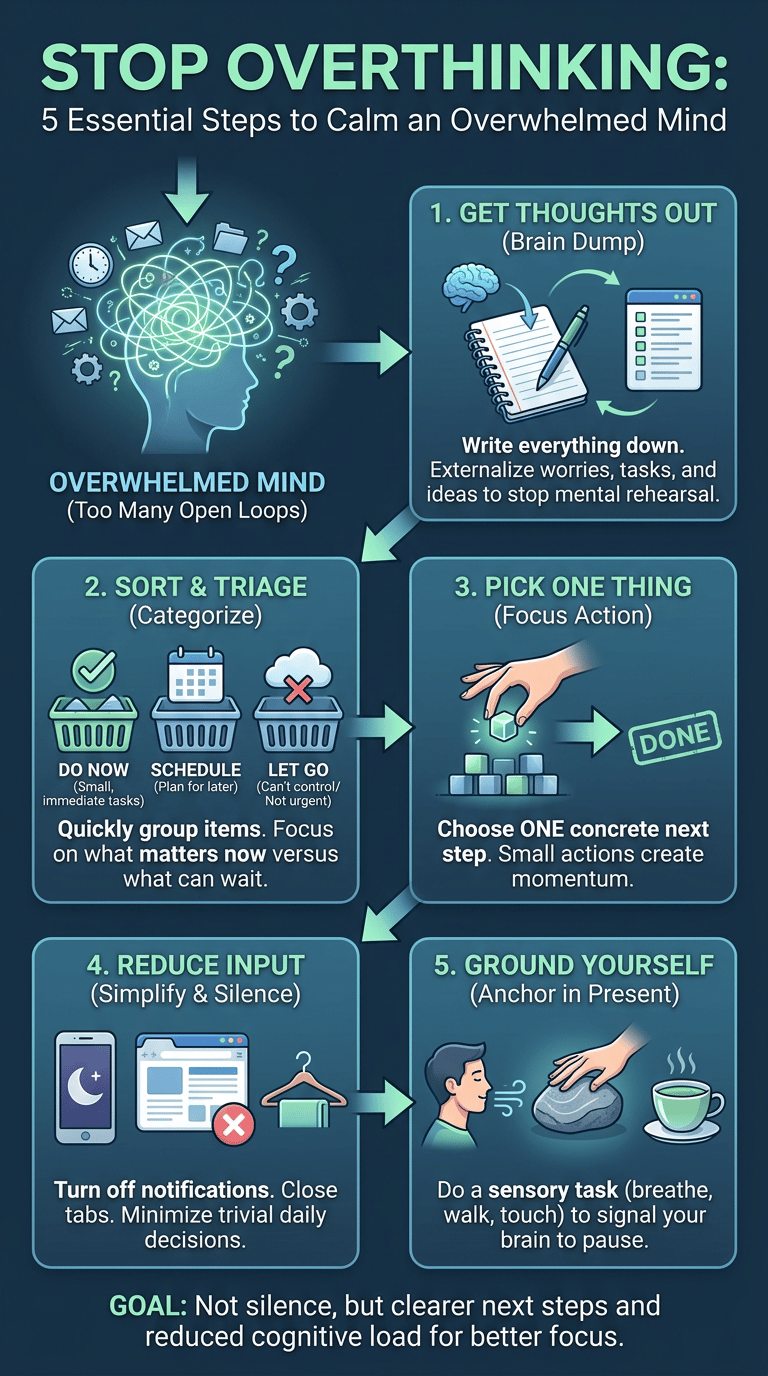
If your mind feels overloaded, the fastest way to reduce the swirl of thoughts is to reduce cognitive load and create clear next steps. Get the thoughts out of your head, sort them by what needs attention now versus later, pick one concrete next action, reduce incoming input, and do a grounding action to signal your brain that it can pause. These steps focus on closing open mental loops and freeing attention rather than trying to stop thinking completely.

Get thoughts out of your head
Write or speak the thoughts into an external place so your brain does not have to hold them all at once. Externalizing thoughts reduces the need to rehearse them mentally and creates a record you can act from later.
Sort what matters now
Quickly group items into what truly needs attention right away, what can wait, what you can delegate, and what you cannot influence. Sorting reduces the number of active items in working memory and helps you focus on fewer things at once.
Pick one problem at a time
Choose one small, concrete next step. Focused action on a single item is more effective than trying to solve multiple problems simultaneously.
Reduce input
Turn off or limit new sources of information for a set period. Emails, social media, and news are common sources of constant mental input that keep the mind occupied with new tasks and worries.
Take one grounding action
Do a simple physical task that anchors attention in the present: a short walk, a breathing exercise, making a cup of tea, or touching a textured object. Grounding actions shift attention from abstract worry to sensory experience.
Why you feel like you are thinking about everything
Your brain is carrying too many open loops
An open loop is a pending task or unresolved concern that your brain keeps checking. When many open loops accumulate, your mind repeatedly returns to them. Externalizing and organizing those loops removes the need for mental housekeeping and creates space for clearer thinking.
Emotional overwhelm makes every thought feel urgent
Strong emotions amplify the perceived importance of thoughts. When you are emotionally taxed, ordinary worries can feel suddenly urgent. That emotional coloring increases the energy your brain gives to each thought and makes it harder to let anything go.
Decision fatigue reduces clarity
Making many choices depletes mental resources and reduces the ability to prioritize. When decision resources are low, even minor options demand disproportionate attention. Reducing trivial daily decisions and creating simple rules can preserve mental clarity for what matters most.
Stress makes small issues feel bigger
Ongoing stress narrows attention toward perceived threats and negative outcomes, which can make problems feel larger and more numerous. Stress also interferes with concentration and working memory, so familiar tasks may require more mental effort than usual.
Avoidance causes thoughts to pile up
Avoiding tasks or decisions can temporarily reduce discomfort but leaves the underlying issues unresolved. That leads to repeated mental checking and an accumulation of concerns that keep resurfacing until they are addressed or scheduled for later attention.
Signs your mind is overloaded
You jump from one worry to another
If your attention moves rapidly between concerns without resolving them, that is a common sign of cognitive overload. The brain is trying to manage many pending items at once instead of following a clear priority.
You cannot decide what matters first
When priorities are unclear, your mind can default to cycling through options rather than committing to a next step. That indecision keeps multiple items active in working memory.
You feel frozen instead of productive
Overwhelm often leads to inertia. Feeling unable to start is not laziness; it is a natural response to having too many competing demands for attention.
You keep checking your phone
Compulsive checking is a way to manage uncertainty and fill attention, but it also increases input and interrupts sustained focus. That pattern can maintain the sense of thinking about everything rather than resolving specific items.
You feel mentally scattered
If your thoughts feel diffuse and it is hard to follow a single thread, you may be operating with a high load on working memory and sustained attention systems.
You struggle to finish tasks
Difficulty completing tasks is a practical sign that attention and executive control are strained by too many simultaneous demands.
Step 1: Empty your mind onto paper
Write every thought without organizing it
Start with a brain dump: set a timer and write every thought, worry, task, reminder, and idea that comes to mind. The goal is quantity, not order. Getting items out of your head reduces the mental effort of holding them and gives you material to sort.
Do not solve while writing
Avoid evaluating or fixing items during the initial dump. Problem solving belongs to a later step. For now, treat the paper as temporary storage so your brain can release the need to rehearse each item.
Include worries, tasks, feelings, and reminders
Write down emotional concerns as well as practical items. Emotions count as tasks the brain tries to manage. Naming them reduces intensity and makes them available for later organization.
Stop using memory as a storage system
Relying on memory for details keeps them active in working memory. Use lists, notes, or voice memos instead. The external record acts as a cognitive aid so you can recall items without mentally rehearsing them.
Step 2: Sort thoughts into categories
Things I can do today
Identify a small number of concrete tasks that are realistic to complete today. Keep them small and specific. Immediate tasks give your mind a short list to focus on rather than a long, vague to-do collection.
Things I need to schedule
Some items require planning but not immediate action. Put those items on a calendar or a scheduled list with a clear date and time for attention. Scheduling transfers responsibility from memory to the calendar system.
Things I cannot control
Explicitly mark items that are outside your control and do not require any action from you. Naming uncontrollable items reduces the instinct to monitor them constantly and preserves energy for things you can influence.
Things I need to talk about
Flag items that require conversation or support from others and note who you need to contact and what the purpose of the conversation is. Preparing a short agenda or a single sentence about the issue reduces the mental load of anticipating the talk.
Things I need to let go for now
Some thoughts are not urgent or useful at this time. Intentionally labeling them as deferred permits them to remain on a list without drawing active attention. You can review deferred items on a planned schedule instead of reacting to them in the moment.
Step 3: Choose the next right thing
Do not try to fix your whole life at once
Improvement happens through many small, repeated steps. Trying to overhaul everything at once increases decision load and is likely to stall progress. Focus on manageable next steps that reduce immediate burden.
Pick the most immediate problem
Choose the item that will have the biggest short-term payoff or the one that will stop creating the most mental friction. Often the best choice is the task that releases other tasks once it is done.
Choose a short task
Completing a short task quickly reduces the number of open loops and creates momentum. Small wins improve confidence and free cognitive resources for the next task.
Let small action create momentum
One completed action reduces the mind’s load and signals progress. Use that momentum to select the next simple step rather than attempting a large, overwhelming project immediately.
Step 4: Reduce cognitive load
Close unused tabs
Open browser tabs and documents act like visual reminders that compete for attention. Close or bookmark items you are not actively using so your visual environment matches your current focus.
Clean one visible area
A quick tidy of a desk, counter, or digital workspace reduces sensory clutter and makes it easier to concentrate. Physical order supports mental order.
Turn off notifications
Silencing nonessential alerts for a set block of time prevents interruptions that restart cycles of worry and decision. Create focused windows where new input is limited.
Use fewer daily decisions
Simplify routine choices like meals, clothing, or morning steps by using defaults or simple rules. Minimizing trivial decisions preserves mental energy for meaningful priorities.
Create simple routines
Routines offload executive control by automating predictable parts of the day. When certain behaviors are automatic, the brain can free resources for handling unexpected or important issues.
Step 5: Stop treating every thought as equal
Some thoughts are signals
Thoughts that point to real needs or risks deserve attention. Use a short checklist to determine whether a thought requires action, planning, or monitoring.
Some thoughts are noise
Routine worry or repeating mental commentary often provides little actionable information. Label these as noise and assign them to a deferred list or a short timeout so they stop hijacking attention.
Some thoughts are emotional leftovers
Unprocessed emotions can resurface as repetitive thoughts. Naming the emotion and deciding on a single low-effort response, such as journaling or telling a trusted person, reduces their intensity.
Some thoughts need action
If a thought points to a specific task that you can complete or plan for, convert it to a clear bullet point with a next step and a time to do it. Converting worry into action reduces rumination.
Some thoughts need rest
Some thoughts are best handled by waiting. If a concern feels persistent but not urgent, schedule a brief review rather than keeping it in active attention. Resting the mind can allow clearer perspective to emerge.
Step 6: Use boundaries to protect your mind
Information boundaries
Limit exposure to news and social feeds during periods of overload. Set specific times to check information sources and stick to them so your mind is not continually responding to new inputs.
Social boundaries
Protect your attention by limiting social demands when you are depleted. It is reasonable to decline invitations or ask for brief pauses in conversations when you need time to regroup.
Work boundaries
Use clear blocks of focused time and communicate them to colleagues when possible. Protected work periods reduce context switching and the mental cost of shifting between tasks.
Emotional boundaries
Notice when other people’s worries become your responsibility. You can be supportive while also setting limits on how much emotional labor you take on so your own thinking remains manageable.
Time boundaries
Set time limits for problem solving and planning. For example, use a short planning window and stop when time is up, moving to action or scheduled follow up. Time boundaries prevent rumination from expanding to fill limitless minutes.
When thinking about everything becomes a problem
When overwhelm causes avoidance
If the sense of overload leads to chronic procrastination or avoidance of important tasks, this pattern can worsen stress and reduce functioning. In such cases, breaking tasks into very small steps and using accountability can help.
When thoughts interfere with sleep
If intrusive thinking regularly prevents falling asleep or causes frequent awakenings, adopt evening routines that reduce stimulation and practice calming habits. Persistent sleep disruption related to worry may benefit from professional assessment and guidance; see information from the National Institute of Mental Health for general mental health resources.
When daily responsibilities feel impossible
If tasks of daily living become difficult to complete because your mind is overloaded, simplify demands, ask for help, and consider professional support to evaluate underlying contributors.
When anxiety feels constant
Persistent or high anxiety that interferes with work, relationships, or self-care may benefit from evidence-based approaches and professional discussion. For approachable overviews of mental health topics and treatment options, see the APA topics pages and the MedlinePlus mental health overview.
FAQs
Why do I think about everything all the time?
Constant thinking often reflects multiple unresolved items in working memory, heightened emotions that amplify perceived importance, and ongoing input from the environment. When many small tasks, worries, and decisions are active, the brain repeatedly scans them to keep track. Externalizing and organizing those items reduces their mental hold.
How do I stop overthinking every little thing?
Start by reducing the number of active items your mind is managing. Do a brain dump, categorize items, and choose a single small action to complete. Create simple rules for low-stakes decisions so they do not consume attention. Over time, consistent use of these steps reduces the habit of overthinking.
Why does my brain feel overloaded?
Your brain has limited capacity for holding and processing information at once. When demands exceed that capacity due to many open tasks, emotional stress, or excessive input, the experience is mental overload. Creating external lists, boundaries, and routines reduces that load and restores working memory for clearer thinking.
What should I do when my mind feels overwhelmed?
Begin with immediate, simple steps: do a brief brain dump, pick one small task to complete, and reduce input by silencing notifications. Use scheduled follow up to handle nonurgent items. If overwhelm is persistent or impairs daily life, consider discussing it with a qualified professional for tailored support.
If thoughts include self-harm or suicidal thinking, contact local emergency services or a crisis line right away. In the United States, the Suicide & Crisis Lifeline can be reached by dialing 988. If you are outside the United States, contact local emergency services or local crisis resources.
Practical templates to use now
Quick brain dump template
Set a timer and write three columns: tasks, worries, and feelings. Fill them without stopping. When time is up, underline the one or two items that feel most pressing.
Daily triage list
- One thing to do now (a short task)
- One thing to schedule this week
- One thing to let go for now
Decision rule example
Create a short rule such as: if a choice is quick, decide now; if it requires more time, schedule it. Rules reduce the time spent deliberating on trivial matters.
Closing thoughts
Thinking about everything is a signal that your cognitive resources are stretched. The practical response is not to force the mind to be silent but to reduce the number of things it must track and to create clear, small next steps. Externalizing thoughts, sorting by priority, choosing one next action, reducing input, and protecting your time and attention are repeatable habits that reduce mental clutter over time. If overwhelm persists or significantly disrupts daily life, consider reaching out to a qualified mental health professional for assessment and support. For definitions and context about emotions and cognitive processes, see the APA Dictionary of Psychology and resources from Psychological Science.
For a related next step, see this guide to how to stop thinking too much.
For a related next step, see this guide to how to stop thinking too much and relax.

Michael Reed is the Founder and Lead Writer at Psychology Exposed. He writes about human behavior, relationships, emotional patterns, self-awareness, and practical psychology topics using research-informed, easy-to-understand content.
Read More About Michael Reed: https://psychologyexposed.com/michael-reed/