
What does avoidant attachment look like?
Quick definition
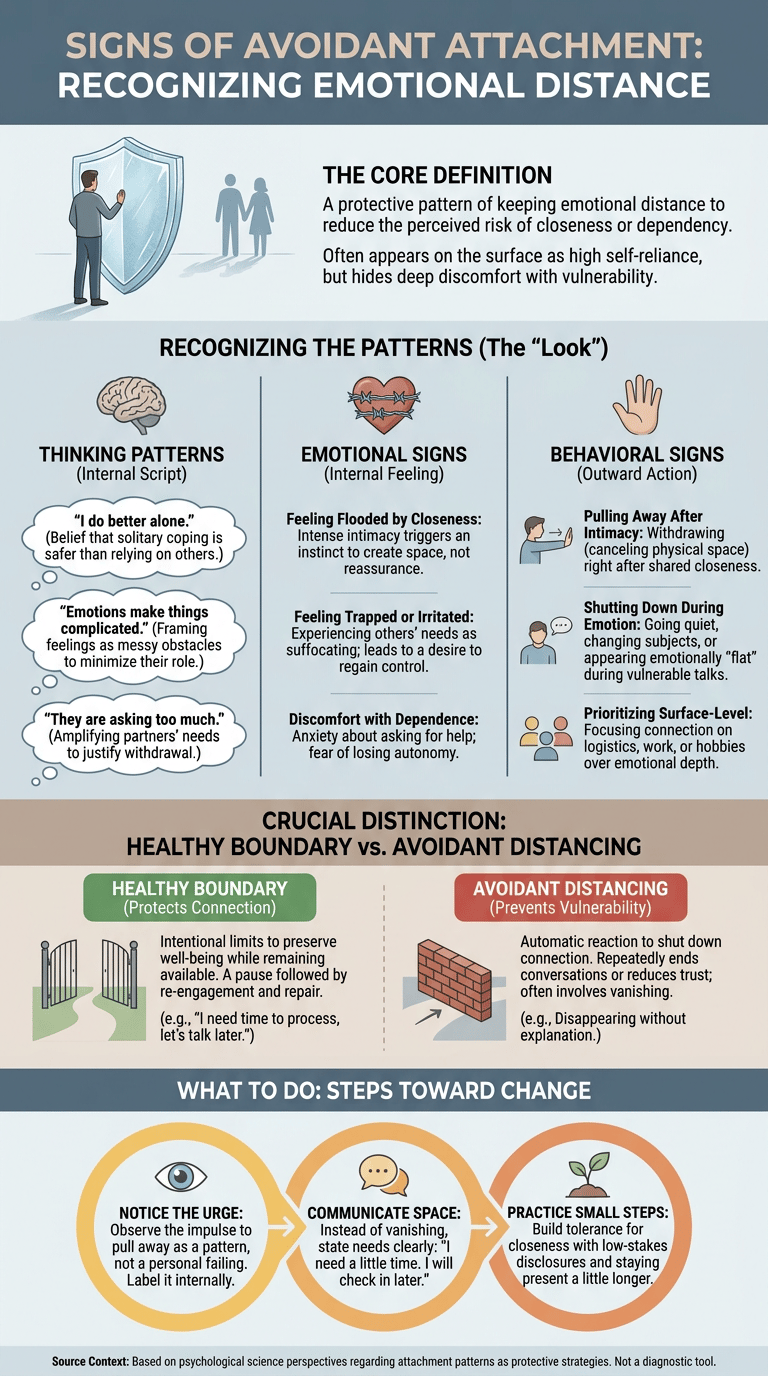
Avoidant attachment describes a pattern of relating in which a person tends to keep emotional distance from others, especially when relationships ask for closeness or dependency. In psychology, attachment refers to the long-term emotional bonds people form with caregivers and partners; definitions and core terms are summarized in the APA Dictionary of Psychology. Avoidant patterns develop for many reasons and often operate as strategies to reduce perceived risk from closeness.

Why avoidant people may seem independent
On the surface, someone with avoidant attachment can appear highly self-reliant, organized, and competent. That independence often serves a protective purpose: it reduces the need to rely on others and limits situations that might trigger emotional discomfort. This protective independence can be adaptive in some contexts, like managing tasks or preserving autonomy, but it may also make emotional connection harder to achieve.
For an accessible overview of how psychological science approaches these patterns, see resources at Psychological Science.
Why avoidance often hides discomfort with vulnerability
Avoidance is frequently less about liking solitude and more about discomfort with what closeness requires: relying on another person, admitting needs, or exposing emotional fragility. Saying “I am fine” or stepping back when a partner gets upset can reduce immediate emotional intensity, yet it also prevents opportunities for mutual support and for practicing vulnerability in safe settings. Framing avoidance as a protection strategy helps shift blame away from personal failing and toward an understandable coping pattern.
Emotional signs of avoidant attachment
Feeling overwhelmed by closeness
People with avoidant attachment often report a sense of being swept up or flooded when relationships move toward greater intimacy. That flood can feel uncomfortable rather than reassuring; the emotional intensity may trigger an instinct to create space. This reaction is about self-protection rather than rejection of the other person.
Common experiences include needing more time alone after shared emotional moments, feeling safer with practical connection instead of emotional talk, or choosing activities that keep interactions light rather than deep.
Feeling uncomfortable depending on others
Feeling anxious about asking for help, or preferring to solve problems alone, can indicate discomfort with dependence. Avoidant patterns make asking for emotional or practical support feel risky; the person might worry that dependency will lead to loss of autonomy or to being let down.
When dependence feels threatening, people tend to minimize requests, avoid revealing stress, and frame accomplishments in terms of personal effort rather than teamwork.
For a simple foundation, see this guide to what attachment styles are.
For broader context, see this guide to attachment styles in psychology.
Shutting down during emotional conversations
A frequent sign is a literal or emotional shutdown when conversations turn vulnerable: becoming quiet, changing the subject, offering short answers, or appearing emotionally flat. This shutdown reduces immediate discomfort but also breaks the thread of connection that emotional conversations build.
Because shutting down can look like disinterest, partners may misread it as rejection rather than a protective response to overwhelm.
Feeling trapped when someone needs too much
When a partner, friend, or family member expresses needs that feel intense or persistent, an avoidant person may feel trapped, suffocated, or irritated. That feeling often leads to creating distance to regain a sense of control and safety.
Repeated experiences of feeling trapped can sow guilt or confusion: the avoidant person may care about the other person but still feel compelled to pull away to preserve emotional equilibrium.
Thinking patterns of avoidant attachment
I do better alone
One common internal message is a belief that solitary coping is more reliable than relying on others. This is a practical-sounding thought that protects self-sufficiency, yet it can limit opportunities for shared problem solving, intimacy, and mutual growth.
Those with avoidant tendencies may praise independence in general terms while privately feeling lonely or disconnected at times.
They are asking too much from me
Avoidant thinking can include overestimating how demanding a partner’s needs are. Thoughts like “They want too much” often amplify discomfort and justify withdrawal. This pattern helps the mind create a clear reason to step back, which feels emotionally safer in the moment.
Emotions make things complicated
Another common thought pattern frames emotions as messy, unpredictable, or unhelpful. Labeling emotions as “complicating” serves to minimize their role and avoid situations in which feelings would need to be processed or shared.
Seeing emotions as obstacles rather than data can block learning about how to tolerate and communicate feelings in relationships.
I need distance to feel normal again
Many people with avoidant attachment report that withdrawing restores their emotional balance. Distance can be an effective short-term strategy when someone feels flooded, but if distance becomes the default reaction, it may prevent the development of new ways to stay engaged while regulating distress.
Recognizing this urge as a pattern you can observe rather than as an absolute imperative is a useful first step for change.
Behavioral signs of avoidant attachment
Pulling away after intimacy
A clear behavioral sign is withdrawing after moments of closeness. This can look like cancelling plans, reducing contact, becoming less responsive, or creating physical space soon after an emotionally intimate event.
- Pulling away may feel like self-care in the short term because it lowers arousal.
- Over time, it can interrupt trust building because the other person lacks predictable responsiveness.
Avoiding serious conversations
Avoidant behavior often includes postponing or sidestepping important discussions about feelings, needs, or relationship direction. Avoidance can happen by changing topics, staying practical, or claiming the conversation is “too much right now.”
While delaying a talk until both parties are calmer is sometimes reasonable, consistent avoidance prevents issues from being resolved and leaves underlying concerns unaddressed.
Keeping relationships surface-level
When relationships stay focused on logistics, shared activities, or light topics, it can be a sign that deeper emotional exchange is being avoided. Surface-level connection can still be pleasant, but it limits mutual vulnerability and the chance to develop greater trust.
People with avoidant attachment may favor friendships or partnerships that respect clear boundaries and minimal emotional demand.
Prioritizing work or hobbies over emotional connection
Using busy schedules, career goals, or intense hobbies to justify limited emotional availability is a common behavioral pattern. This priority can be healthy when balanced, but when it consistently replaces time spent facing emotional issues, it functions as a distancing strategy.
Choosing projects over people may reduce immediate interpersonal stress yet increase long-term loneliness or dissatisfaction with closeness.
Signs in romantic relationships
Difficulty saying what they feel
In romantic relationships, avoidant individuals often struggle to label and express emotions. Direct statements such as “I feel hurt when…” may be rare, and feelings are more likely to be expressed indirectly or not at all.
This difficulty can create miscommunication, leaving partners uncertain about what the avoidant person needs or feels.
Avoiding labels or commitment
Avoidant attachment sometimes shows up as reluctance to use relationship labels or make long-term commitments. Avoiding conversations about “what we are” or future plans can be a way to keep options open and minimize perceived pressure to become dependent.
While some people genuinely prefer open or flexible relationship styles, consistent avoidance of commitment-related conversations may reflect discomfort with closeness rather than clear preference.
Needing space after conflict
Needing physical or emotional space after a fight is normal for many people. For those with avoidant tendencies, the need for space can be pronounced and immediate, and may turn into prolonged withdrawal rather than a brief cooldown period.
Partners can misinterpret a prolonged need for space as indifference rather than a coping mechanism. Clear communication about the expected length and purpose of a break can help reduce misunderstanding.
Feeling irritated by emotional needs
Repeated feelings of irritation when a partner expresses vulnerability or seeks reassurance are common. That irritation is not necessarily about the partner personally; it often stems from the discomfort of being asked to be emotionally responsive in ways that feel demanding.
Recognizing irritation as a signal rather than a verdict on the relationship can open the door to learning new responses.
Avoidant attachment versus healthy boundaries
Healthy boundaries protect connection
Healthy boundaries are intentional limits set to preserve wellbeing while remaining emotionally available. Boundaries include saying no respectfully, asking for time to process before discussing something intense, and maintaining personal interests. Boundaries support sustainable closeness by preventing burnout.
Avoidant distancing prevents vulnerability
By contrast, avoidant distancing functions primarily to prevent vulnerability. It often operates automatically and in ways that reduce the other person’s ability to respond. The difference lies in whether the boundary aims to preserve connection or to shut it down.
Examples that reflect boundary-based protection include asking for a short pause to gather thoughts. Examples that reflect avoidance include leaving without explanation or refusing to return calls in response to emotional need.
The difference is whether closeness still feels possible
A practical way to tell healthy boundaries from avoidant distancing is to notice if closeness still feels possible after the boundary is used. If a pause or limit is followed by re-engagement, problem solving, and mutual repair, it functions as a healthy boundary. If the pattern repeatedly ends conversations, reduces trust, or makes the partner feel abandoned, it is likely avoidant distancing.
What to do if you recognize these signs
Notice the urge to disappear
The first step is noticing the familiar urge to pull away as a pattern rather than a personality flaw. Observing the sensation, labeling it, and giving it a moment of attention can reduce the automaticity of withdrawal. Simple internal notes like “I notice I want to leave” help create distance from the impulse.
Mindful observation does not require immediate disclosure to others; it is an internal skill that increases choice over reactions.
Communicate space instead of vanishing
When space is genuinely needed, try communicating it in a short, caring way rather than disappearing. Phrases such as “I need a little time to process this. I will check in later” communicate respect for the relationship while protecting your capacity. Clear, predictable communication reduces the risk that the other person interprets distance as rejection.
If persistent emotional difficulties or relationship distress are present, consider discussing these patterns with a qualified mental health professional. Trusted resources about seeking support are available from the National Institute of Mental Health and from MedlinePlus.
Practice small emotional disclosures
Building tolerance for vulnerability often works best through small, manageable steps. Start with low-stakes disclosures: mention a minor worry, share a thought, or describe a preference. Small disclosures create opportunities for positive feedback and learning that closeness can be safe.
- Choose moments when both people are relatively calm.
- Keep the disclosure brief and specific.
- Notice the response and how it changes your internal state.
Build tolerance for safe closeness
Repeated exposure to predictable, supportive responses increases comfort with closeness. Practice staying present a little longer when someone reaches out: breathe, ground attention, and if needed, use a brief timeout rather than leaving entirely. Over time, tolerating small doses of emotional intensity can expand capacity for deeper connection.
If these patterns cause severe isolation, interfere with daily life, or lead to significant distress, seeking support from a licensed therapist or other qualified professional can offer structured strategies for change. General guidance on when to seek help is available from the American Psychological Association.
Final thoughts
Recognizing signs of avoidant attachment is an important step toward understanding how you relate to others and why closeness can sometimes feel risky. Avoidant behaviors are often protective strategies shaped by past experience rather than judgments about character. With gentle observation, clear communication, small experiments in vulnerability, and, when needed, professional support, people can increase their comfort with emotional connection.
Remember: noticing a pattern is not a verdict. It is information you can use to expand choice and to create relationships that balance independence with meaningful connection.
If avoidance contributes to persistent loneliness, serious relationship conflict, or interferes with work or daily activities, consider reaching out to a qualified mental health professional for tailored support. If you or someone else is in immediate danger or at risk of harming themselves, contact local emergency services right away or use a crisis line in your area.
Reliable, accessible information about mental health and how to find help is available from the NIMH, MedlinePlus, and the American Psychological Association. For research context and behavioral science perspectives, see summaries at Psychological Science.

Michael Reed is the Founder and Lead Writer at Psychology Exposed. He writes about human behavior, relationships, emotional patterns, self-awareness, and practical psychology topics using research-informed, easy-to-understand content.
Read More About Michael Reed: https://psychologyexposed.com/michael-reed/