
When a partner seems to pull away just as things are getting close, it can be confusing, painful, and make the relationship feel unstable. Understanding avoidant attachment in relationships helps explain a common pattern: intimacy increases, the avoidant partner experiences rising overwhelm, withdrawal begins, the other partner becomes anxious, and distance grows. This article focuses on that intimacy-distance cycle in everyday romantic life and offers practical, evidence-informed ways to respond that reduce escalation and increase connection.
What Is Avoidant Attachment in Relationships?
Simple relationship-focused definition
Avoidant attachment in relationships describes a pattern where someone prefers emotional distance, values independence highly, and tends to limit closeness in romantic partnerships. This style often shows up as reluctance to share deeper feelings, keeping conversations practical rather than emotional, and stepping back when the relationship requires emotional availability. For an accessible overview of common signs and next steps, see a clinical summary of avoidant attachment behaviors and examples provided by a reputable health resource that describes avoidant attachment style.
Why independence feels safer than dependence
People with avoidant attachment often develop strategies that prioritize self-reliance and emotional self-sufficiency. These strategies can reduce perceived vulnerability and limit situations where emotional needs might go unmet. Psychological research describes this pattern as an effort to deactivate emotional systems that signal need and closeness; this deactivation can be a long-standing way to manage stress in relationships. A peer-reviewed review explains how avoidant deactivation interacts with emotion regulation and relationship outcomes, which helps explain why independence often feels safer in close relationships in a review of attachment processes and health.
Why emotional closeness can feel like pressure
For an avoidant partner, emotional closeness can activate fears about losing autonomy, being overwhelmed by needs, or being dependent on another person for emotional stability. That activation can feel like pressure rather than comfort. Over time, avoiding or dampening emotional signals can become an automatic response, which makes intimate moments feel risky instead of rewarding. Research on attachment and support in romantic dyads describes how avoidant tendencies shape both behavior and how partners interpret support efforts, contributing to cycles of withdrawal and misunderstanding in a systematic review of attachment and social support.
How Avoidant Attachment Affects Romantic Relationships
Difficulty opening up
Avoidant partners commonly keep conversations superficial at first and steer away from topics that require emotional disclosure. They may share practical details about their day while withholding feelings, worries, or hopes. This creates a mismatch when the other partner expects reciprocal emotional sharing. The withdrawal of personal information is not necessarily rejection; it is often a protective strategy to avoid perceived emotional risk.
For a practical next step, see this guide on how to heal avoidant attachment.
For broader context, see this guide to attachment styles in psychology.
Pulling away after intimacy
A classic pattern is to become more distant after a moment of increased closeness. After sharing or a vulnerable moment, avoidant partners may seem distracted, less available, or even criticize the situation as “too much.” This pullback can feel abrupt to their partner and may start the cycle of distance and pursuit that strains trust over time.
Avoiding emotional conversations
When topics become emotionally charged, avoidant partners tend to change the subject, use humor to diffuse intensity, or postpone the conversation indefinitely. Avoidance is not always conscious; for many it is an automatic attempt to reduce emotional arousal. This pattern makes resolving conflicts and building mutual understanding more difficult.
Feeling crowded by a partner’s needs
When a partner expresses frequent emotional needs or seeks reassurance, avoidant individuals can feel crowded or overwhelmed. That sensation can trigger a desire for more autonomy, and the avoidant person may respond by creating distance, setting rigid boundaries, or minimizing the other person’s requests. Over time, the partner asking for closeness may grow more anxious, increasing pressure on the avoidant person and deepening the cycle.
Common Relationship Triggers
Partner asks for deeper commitment
Requests for increased commitment, such as moving in together, defining the relationship, or making long-term plans, can feel threatening to someone who prioritizes independence. The thought of closer interdependence can activate fears of losing control or becoming emotionally dependent, so commitment conversations are common triggers for withdrawal.
Emotional conflict
Arguments that focus on feelings rather than facts are often harder for avoidant partners to tolerate. Emotional conflict heightens internal distress, and leaving the discussion or minimizing the issue can be a way to reduce emotional arousal. This strategy often prevents mutual repair, which is important for relationship health.
Feeling criticized
When avoidant partners perceive criticism, they may respond by shutting down, defending with distance, or redirecting the conversation. Because criticism can be interpreted as personal threat, it tends to reduce willingness to engage emotionally and increases the likelihood of withdrawal.
Too much closeness too quickly
Rapid escalation in intimacy or moving through relationship stages quickly can overwhelm someone with avoidant tendencies. When connection develops faster than trust and regulation skills, the avoidant person may step back to regain a sense of safety, even if they care about their partner.
Feeling responsible for someone’s emotions
Some avoidant people feel uncomfortable being the target of someone else’s emotional needs because it can create pressure to respond in specific ways. Feeling responsible for another person’s emotional state may lead to distancing behaviors intended to reduce that sense of responsibility.
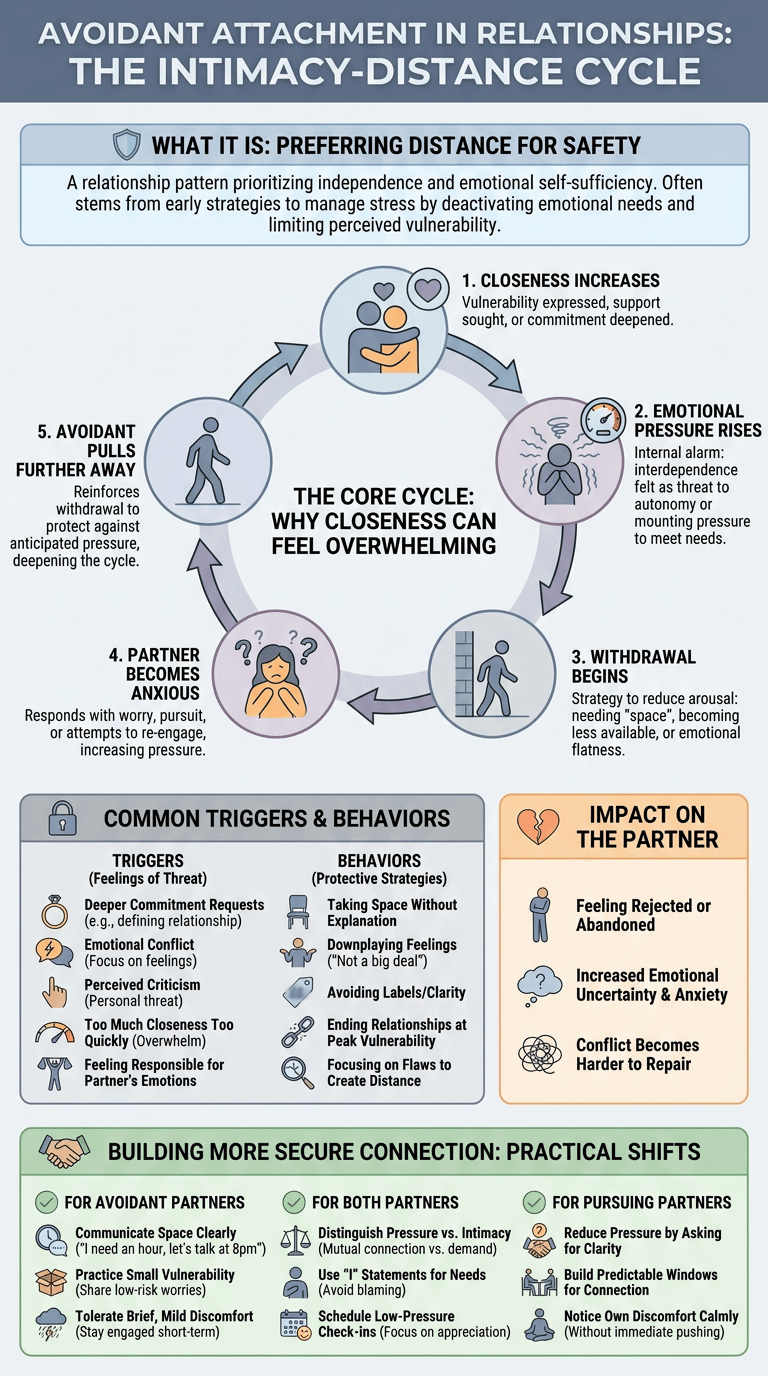
The Avoidant Attachment Cycle
Closeness increases
The cycle often begins with a period of growing closeness. One partner expresses vulnerability, asks for support, or suggests increasing commitment. The avoidant partner may initially engage, and the relationship appears to be moving forward.
Emotional pressure rises
As intimacy deepens, the avoidant partner’s internal alarm systems can detect increased interdependence. This does not mean the avoidant person does not care. Instead, growing closeness can feel like mounting pressure to meet another person’s emotional needs, which the avoidant person experiences as discomfort or threat.
Withdrawal begins
To reduce that pressure, the avoidant partner often withdraws. Withdrawal can look like needing “space,” becoming less available, being emotionally flat, or physically distancing. Withdrawal is a strategy to reduce emotional arousal and restore a sense of safety and autonomy.
Partner becomes anxious
The partner who sought closeness may respond to withdrawal with worry, pursuit, or attempts to re-engage. Those behaviors can be experienced by the avoidant partner as more pressure, which reinforces their withdrawal. This reciprocal escalation—pursuit followed by withdrawal—can become entrenched if it repeats across situations.
Avoidant partner pulls further away
Because attempts to increase closeness can precede more withdrawal, avoidant partners may continue to distance themselves to protect against future anticipated pressure. Over time, repeated cycles can erode trust and create resentment on both sides, even in relationships where both partners care deeply for one another. Research on attachment and dyadic support helps explain how these interaction patterns develop and sustain themselves over time in a systematic review of attachment and social support.
Common Behaviors in Relationships
Taking space without explanation
Needing space is normal, but avoidant partners sometimes take extended space without offering explanation. The lack of communication about timing or reasons can increase their partner’s anxiety and lead to misunderstandings. Clear agreements about what “space” means help reduce alarm in the other partner.
Downplaying feelings
Avoidant people may minimize emotions in themselves and others. Comments like “it’s not a big deal” or “I can handle it” are used to reduce emotional intensity. While this can be adaptive in the short term, persistent downplaying prevents emotional needs from being acknowledged and met.
Avoiding labels
Refusing or delaying labels for the relationship can be a way to maintain psychological distance. For some, labels imply a level of commitment and dependence they are not comfortable with yet. This avoidance can be painful for a partner who wants clarity and security.
Ending relationships when vulnerability increases
When vulnerability rises, some avoidant individuals choose to end relationships rather than navigate emotional complexity. Leaving can feel like a clean solution to avoid the risk of dependency, even when it means losing a valued partner.
Focusing on flaws to create distance
Pointing out a partner’s flaws or repeatedly criticizing minor issues can function as a way to justify emotional withdrawal. By magnifying problems, the avoidant person creates a plausible reason to step back and reduce closeness.
How It Affects the Partner
The partner may feel rejected
From the perspective of the partner seeking closeness, avoidant behaviors can feel like rejection or emotional abandonment. Repeated experiences of being turned away can undermine self-esteem and create doubts about the relationship’s future.
Emotional uncertainty increases
Not knowing when a partner will be available, or whether emotional sharing will be returned, leads to uncertainty. That uncertainty often fuels vigilance, hyper-attunement to signs of withdrawal, and anxiety about the relationship’s stability.
Conflict becomes harder to repair
Repairing conflict requires both emotional engagement and willingness to discuss hurt. When one partner habitually withdraws, opportunities for repair are missed. Over time, unresolved issues accumulate and create a backdrop of simmering resentment or distance.
If patterns of withdrawal, avoidance, or emotional unavailability cause persistent distress, interfere with daily functioning, or contribute to serious mental health concerns, consider seeking qualified professional support. A trained relationship therapist or mental health professional can help couples learn new interaction patterns and manage intense emotions safely.
How to Build More Secure Connection
Communicate space clearly
One practical step is to make “space” predictable and safe. Instead of disappearing without notice, an avoidant partner can name the need for time and offer a short window for when they will reconnect. For example, saying “I need an hour to think; can we talk at 8pm?” reduces uncertainty and prevents the partner from imagining worst-case scenarios.
Practice small vulnerability
Small, manageable acts of vulnerability help build trust without triggering overwhelming fear. Sharing a modest worry, a minor disappointment, or a brief appreciation are low-risk ways to practice emotional openness. Research and practical guides suggest that gradual exposure to vulnerability, combined with supportive responses, can help people move toward greater security suggested by research-informed guidance on cultivating attachment security.
Stay present during mild discomfort
Both partners can benefit from learning to tolerate brief, mild discomfort without escalating. For the avoidant partner, staying engaged for a short period when emotions appear can demonstrate that closeness is survivable. For the pursuing partner, noticing and naming your own discomfort calmly rather than pushing for immediate resolution can reduce perceived pressure.
Learn the difference between pressure and intimacy
Recognizing the difference between felt pressure and genuine intimacy is useful. Pressure is experienced as overwhelming demand for emotional supply; intimacy is mutual connection that usually unfolds gradually. Distinguishing between the two helps partners negotiate pacing. A clinical overview of avoidant attachment describes common behaviors and suggests ways to respond that respect both autonomy and connection in practical, reader-friendly terms.
Additional practical steps that support secure connection include:
- Agreeing on a short “pause protocol” for conflict that specifies when and how to resume the conversation.
- Using “I” statements to describe needs and discomfort without blaming.
- Scheduling regular low-pressure check-ins focused on appreciation rather than problem solving.
- Celebrating small steps toward vulnerability to reinforce positive change.
Where patterns are longstanding or particularly painful, couples therapy or individual therapy can provide a structured space to practice new ways of relating. A therapist can help identify triggers, teach emotion-regulation strategies, and build skills for safe disclosure and repair.
Final Thoughts
Avoidant attachment in relationships is not a moral failing. It is a strategy people develop, often early in life, to protect themselves from emotional pain. In romantic relationships, this strategy shows up as a pattern: the intimacy-distance cycle. Understanding that cycle reduces blame and opens the way to practical shifts.
Avoidant partners can learn to tolerate increasing closeness when their partner communicates predictably and when vulnerability is introduced gradually. Partners who pursue closeness can learn to reduce pressure by asking for clarity and building predictable windows for connection. Together, these changes create opportunities for greater security and emotional responsiveness.
If relationship patterns are causing serious distress, frequent thoughts of harming yourself, or interfering with daily life, please seek professional help immediately or contact local emergency services. For many couples, working with a trained mental health professional leads to clearer communication, more effective repair after conflicts, and a stronger sense of safety in the relationship.

Michael Reed is the Founder and Lead Writer at Psychology Exposed. He writes about human behavior, relationships, emotional patterns, self-awareness, and practical psychology topics using research-informed, easy-to-understand content.
Read More About Michael Reed: https://psychologyexposed.com/michael-reed/