
Feeling anxious in a relationship can be confusing and painful. When a partner becomes distant, slow to reply, or emotionally unclear, some people experience a rush of worry that the relationship is threatened. That pattern often reflects anxious attachment in relationships rather than a simple mismatch or poor communication. This article explains how anxious attachment shows up in romantic partnerships, why it drives a repeating cycle of fear and soothing, and practical steps both partners can use to reduce pressure and build more reliable safety over time.
What is anxious attachment in relationships?
Simple relationship-focused definition
Anxious attachment in relationships is a pattern of feeling especially worried about connection and closeness with a partner. People with an anxious attachment style tend to be vigilant for signs of rejection or distance, and they often experience intense motivation to restore closeness when they sense separation or uncertainty. For clear definitions of attachment-related terms and concepts, see the APA Dictionary of Psychology for an overview of how attachment influences behavior and emotion in close relationships in the APA Dictionary of Psychology.
Why closeness can feel urgent
For someone with anxious attachment, closeness signals safety. When closeness feels scarce, the brain interprets separation as a potential threat to emotional security. That can translate into urgent feelings and quick moves to reconnect, such as frequent check-ins, strong emotional responses when partners are unavailable, or a tendency to escalate attempts to get reassurance.
Why uncertainty feels threatening
Uncertainty about a partner’s feelings or availability often activates worry for people with anxious attachment. Unclear responses, mixed signals, or unpredictable behavior create a gap between desired safety and perceived risk. That gap tends to generate a mental “fear story” about abandonment or rejection, which triggers behaviors aimed at restoring certainty. The result can be repeated cycles of alarm and temporary relief instead of lasting calm.
How anxious attachment affects romantic relationships
Fear of being abandoned
Fear of abandonment is a central theme for many people with anxious attachment. This fear often reflects a learned sensitivity to separation that can come from earlier relationship experiences. In romantic relationships, it can show up as intense distress when a partner withdraws or when the future of the relationship feels unclear. That distress can create behaviors that try to prevent the feared outcome, even when those behaviors increase tension.
Needing frequent reassurance
Needing frequent reassurance is a common sign of anxious attachment. People may ask explicit questions about commitment, seek verbal affirmation, or look for physical closeness specifically to lower their anxiety. Reassurance can offer short-term relief, but if the underlying worry is not addressed it often returns, creating cycles where reassurance calms anxiety temporarily but does not build long-term security.
Feeling anxious during distance
Physical or emotional distance from a partner—such as being apart, a partner’s preoccupation, or reduced affection—often raises anxiety for someone with an anxious attachment style. The distress can show as rumination about the relationship, difficulty sleeping, or strong emotional reactions during reunions. These responses reflect a sensitivity to separation cues and a desire to restore predictability and closeness.
Reading small changes as danger signs
People with anxious attachment frequently interpret small changes in a partner’s mood, schedule, or tone as indicators of a larger relationship problem. A brief delay in texting, an offhand comment, or a quieter-than-usual evening can be viewed as a sign that the partner is withdrawing. That interpretation tends to generate a fear story that escalates the internal alarm and prompts behaviors designed to reduce perceived threat.
Common relationship triggers
Delayed replies
When a partner does not respond quickly to texts or calls, anxious attachment can turn the delay into a major stressor. The mind may fill the silence with worst-case possibilities about the partner’s feelings or whereabouts. The intensity of the reaction depends on prior experiences, current stress, and how reliable communication normally is in the relationship.
Changes in tone
A subtle change in a partner’s tone of voice or writing style can be interpreted as emotional distance. For someone with anxious attachment, small shifts in warmth or engagement may be read as signs that a partner is less invested, even if those shifts have other explanations such as tiredness or distraction.
Less affection than usual
Periods when a partner shows less physical or verbal affection can trigger anxious responses. That decrease may be temporary and unrelated to the relationship, but the anxious pattern tends to focus on connection as evidence of safety. Without additional information or reassurance, reduced affection is often experienced as threatening to the bond.
Conflict or emotional distance
Conflict naturally creates uncertainty. For someone with anxious attachment, disagreements can intensify fears about rejection, leading to attempts to quickly repair the relationship or avoid further distance. That urgency can make communication feel pressured and may interfere with calm problem solving.
For broader context, see this guide to attachment styles in psychology.
Partner needing space
When a partner asks for time alone or states a need for personal space, anxious attachment can interpret the request as rejection instead of a normal boundary. The immediate reaction may be to increase contact or seek proof of love, which can make the partner feel pressured and reduce their willingness to take healthy breaks in the future.
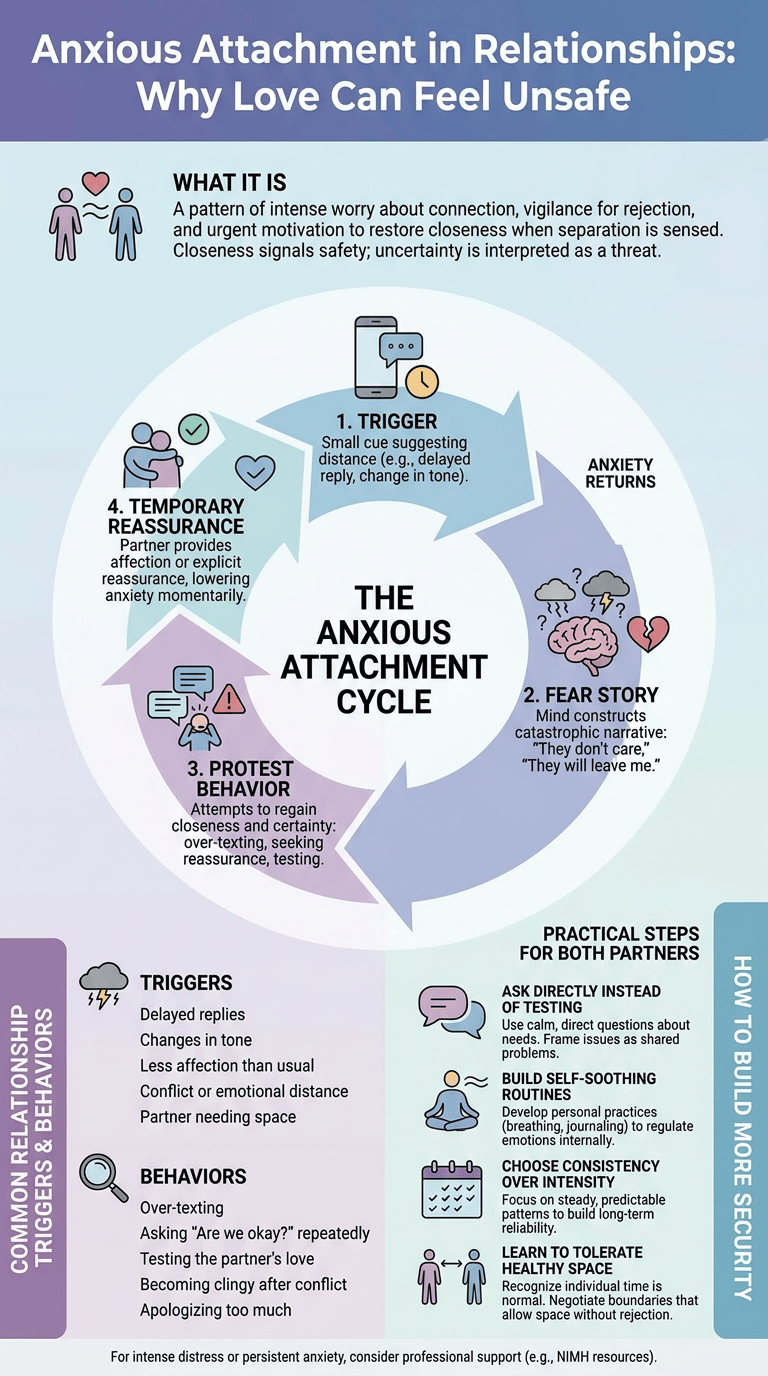
The anxious attachment cycle
Trigger
The cycle often begins with a trigger: any cue that suggests possible distance or rejection. Triggers range from a delayed text to a changed routine. For someone with anxious attachment, even a small cue can quickly become a signal that closeness is at risk.
Fear story
After a trigger, the mind constructs a fear story. This is an automatic narrative that fills the unknown with threatening explanations, such as “They do not care anymore” or “They will leave me.” The fear story is usually more catastrophic than evidence supports, but it feels convincing in the moment because it aligns with deep-seated worries about abandonment.
Protest behavior
Protest behaviors are attempts to regain closeness and certainty. Examples include frequent texting, checking a partner’s social media, confronting them about feelings, or escalating emotional expressions. These behaviors aim to test or force a response that will reduce worry.
Temporary reassurance
When a partner responds with affection or explicit reassurance, anxiety often drops quickly. Praise, promises, or physical comfort can provide immediate relief. However, because the reassurance addresses the symptom and not the underlying pattern, the calm tends to be temporary unless other changes build long-term trust and predictability.
Anxiety returns
After a period of relief, anxiety commonly returns when the next trigger appears. Because reassurance did not change the core expectation of instability, the underlying fear remains active. This creates a repeating loop of alarm, protest, reassurance, and renewed alarm that can feel exhausting for both partners.
Common behaviors in relationships
Over-texting
Over-texting is a frequent outgrowth of anxious attachment. When a partner does not respond quickly, sending multiple messages in a short span is a common attempt to reduce uncertainty. While the intent is understandable, persistent messages can feel overwhelming to the partner and may not lead to the desired calm.
Asking “Are we okay?” repeatedly
Asking “Are we okay?” again and again reflects a search for reassurance. Repetition is often driven by lingering doubt after an initial answer. This pattern can communicate deep care and concern, but it can also pressure a partner to provide frequent reassurance rather than building mutual, steady security.
Testing the partner’s love
Testing behaviors—such as creating situations that provoke a response—are attempts to confirm a partner’s feelings. These tests may involve planned withdrawals, dramatic statements, or behavior meant to elicit signs of commitment. Tests can erode trust when partners feel manipulated or confused by inconsistent signals.
Becoming clingy after conflict
After an argument, a person with anxious attachment may become particularly clingy, seeking immediate repair and closeness. This comes from the desire to reestablish safety quickly. While repair is important, excessive clinginess can prevent space for meaningful reflection and calm conflict resolution.
Apologizing too much to avoid distance
Apologizing repeatedly or accepting blame too readily can be a strategy for preventing closeness from fraying. Although empathy and taking responsibility are healthy, over-apologizing may undermine a person’s sense of self and avoid addressing the real issues that cause conflict.
How it affects the partner
The partner may feel pressured
Partners of someone with anxious attachment can feel pressured to provide constant reassurance or proof of love. That pressure can create stress and make natural behaviors like needing space or focusing on work feel risky because they might be interpreted as rejection.
Reassurance can become exhausting
Providing frequent reassurance may help in the short term, but over time it can become emotionally exhausting. A partner who feels they must continually soothe anxiety may withdraw, which can unintentionally increase the original person’s worry. This dynamic can leave both people feeling trapped in a cycle they did not intend.
Miscommunication can increase conflict
When one partner reads small cues as threats and the other experiences those reactions as overreactions, miscommunication becomes common. Each person’s attempts to protect themselves can create patterns of blame or avoidance that increase conflict rather than reduce it.
How to build more security in relationships
Ask directly instead of testing
Instead of testing a partner with indirect behaviors, practice asking direct, calm questions about needs and expectations. Clear communication helps reduce guesswork and prevents the mind from filling gaps with fearful narratives. For example, instead of creating a test scenario, say something like:
- “When you take longer to reply, I notice I feel anxious. Can we talk about how we prefer to communicate when busy?”
Direct requests frame the issue as a shared problem rather than a personal failure and invite collaborative solutions.
Build self-soothing routines
Develop reliable self-soothing practices to use when anxiety rises. Self-soothing helps reduce the urge to immediately seek external reassurance and increases emotional regulation. Examples include breathing exercises, progressive muscle relaxation, brief walks, journaling about emotions, or a short grounding routine that names visible sensory details. Practicing these techniques when calm makes them easier to use during moments of attachment anxiety.
Choose consistency over intensity
Long-term security grows from steady, predictable patterns rather than occasional intense displays. Focus on building habits that communicate reliability, such as agreed-upon check-in times, regular date nights, or consistent follow-through on commitments. Consistency helps rewrite expectations from unpredictable to dependable, which weakens the fear story that fuels anxious cycles.
Learn to tolerate healthy space
Recognize that needing space is a normal part of healthy adult relationships. Practicing tolerance for brief separations can reduce reactivity. Start with small, manageable stretches of independence and notice that the relationship remains intact. Partners can negotiate boundaries that allow reasonable time alone without implying rejection, and those agreements can be adjusted over time as trust grows.
When separation or space triggers intense distress that interferes with daily functioning, or when relationship anxiety is persistent and worsening, consider seeking qualified professional support. The National Institute of Mental Health provides information that can help people understand treatment options and when to contact a professional from the National Institute of Mental Health.
Final thoughts
Anxious attachment in relationships creates a repeating pattern where triggers lead to fear stories, protest behaviors, brief reassurance, and renewed anxiety. Understanding that pattern is the first step toward change. Both partners can help by reducing testing behaviors, increasing direct communication, and building consistent habits that signal safety. Practicing self-soothing and negotiating predictable routines can gradually shift expectations from uncertainty to greater security. If relationship anxiety is intense or persistent, reaching out to a qualified mental health professional can provide additional tools and support to improve emotional regulation and relationship functioning.

Michael Reed is the Founder and Lead Writer at Psychology Exposed. He writes about human behavior, relationships, emotional patterns, self-awareness, and practical psychology topics using research-informed, easy-to-understand content.
Read More About Michael Reed: https://psychologyexposed.com/michael-reed/